What is Google Tag Gateway?
Google Tag Gateway (GTG) is a first-party tracking method that enables you to load your Google tags through your own domain instead of retrieving them from Google's servers.
By default, Google tags, including Google Analytics 4 (GA4) and Google Ads, load from domains like googletagmanager.com and google-analytics.com. These are owned and operated by Google, which means browsers and ad blockers treat them as third-party. Google Tag Gateway changes this by routing tag delivery through a domain you control.
How Google Tag Gateway works
When GTG is configured, your browser no longer fetches gtm.js or gtag.js from Google's servers. Instead, those scripts are served from your own subdomain — for example, metrics.yourdomain.com.
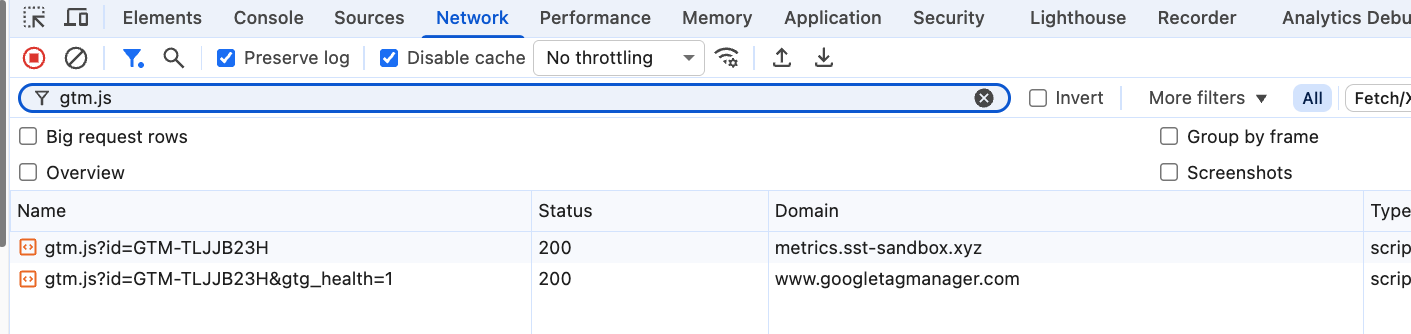
When a tag fires, requests are routed to Google through your serving path. Because the request originates from your own domain, browsers treat it as first-party traffic — making it far less likely to be intercepted by ad blockers or browser tracking protections.
Benefits of Google Tag Gateway for advertisers
Implementing GTG gives you:
- Ad blocker bypass — scripts no longer load from Google-owned domains, so they are not caught by blocklists targeting
googletagmanager.comorgoogle-analytics.com - More complete measurement — tags that would previously be blocked silently now load and fire reliably, giving GA4 and Google Ads more signal to work with
- Better attribution — with more complete event data, Google Ads can improve conversion attribution and optimize campaigns more effectively
- A step toward first-party data — GTG is a straightforward way to move Google tag delivery into a first-party context without requiring major infrastructure changes
Google Tag Gateway vs server-side tagging
GTG and server-side tagging (sGTM) are often compared, but they solve different problems and work best together.
| Google Tag Gateway | Server-side tagging | |
|---|---|---|
| What it does | Routes script delivery through your domain | Routes data collection through your server |
| Ad blocker resistance | Good — scripts load first-party | Higher — requests originate server-side |
| Cookie durability | Limited — cookies still set via JavaScript | Full — server-side HTTP cookies bypass Intelligent Tracking Prevention (ITP) |
| Platform support | Google only (GA4, Google Ads) | Any platform (Meta, TikTok, LinkedIn, etc.) |
| Data control | Limited | Full control over what is sent and where |
GTG is not a replacement for server-side tagging, it is a complement to it. When both are in place, scripts load reliably from your domain (GTG) and data is collected and forwarded server-to-server with full cookie durability (sGTM).
Who benefits most from Google Tag Gateway?
GTG is a good fit for businesses that rely on GA4 and Google Ads and want to reduce measurement loss from ad blockers and browser restrictions without overhauling their entire tracking setup.
It's particularly valuable for:
- Performance marketers running Google Ads campaigns where attribution gaps directly impact spend decisions
- Analytics teams noticing discrepancies between GA4 data and other sources
- Any business already using server-side GTM that wants to complete the first-party picture by also serving tags from their own domain
Google Tag Gateway with Usercentrics
Usercentrics makes GTG setup straightforward. Follow the GTG implementation guide.