---------------------------
Title: Social Media and Email Marketing Compliance
URL: https://usercentrics.com/us/guides/social-media-email-marketing-compliance/
---------------------------
# Social Media and Email Marketing Compliance
Learn how to protect your business, meet legal obligations, and build trust with your audience through clear privacy policies and compliance with evolving regulations. From GDPR requirements on Facebook and LinkedIn ads to crafting compliant email marketing strategies, this guide covers the essentials to keep your campaigns lawful and effective.
## Social media compliance 101: Ensuring your online presence meets privacy standards
In a world where nearly everything is available at our fingertips online, many businesses, no matter their sector, are rushing to secure their social media presence. This enables them to boost their brand presence and get their products and services seen by larger and better-targeted audiences.
However, being present on social media is not without its risks, especially as data privacy laws continue to be passed, and social media compliance is as crucial as for other websites and apps to avoid potential regulatory trouble.
Here’s what you need to know to comply with relevant laws and best practices when employing social media for your company’s digital marketing activities.
## What is social media compliance?
At its core, social media compliance means following global data privacy laws in addition to the terms of use and guidelines of various social media platforms. This involves ensuring that social media activities align with laws and regulations related to data privacy, intellectual property rights, advertising, content moderation, and disclosure requirements.
Here are the several key aspects of social media compliance to keep in mind.
### Data privacy and security
Protecting personal information shared on social media is crucial for privacy compliance. Companies must ensure that they handle user data responsibly and securely, adhering to laws such as the [General Data Protection Regulation (GDPR)](https://usercentrics.com/us/knowledge-hub/the-eu-general-data-protection-regulation/) in Europe and the [California Consumer Privacy Act (CCPA)](https://usercentrics.com/us/us/knowledge-hub/california-privacy-rights-act-cpra-enforcement-begins/) in California. These regulations require businesses to obtain consent before collecting personal data and to inform users about how their information will be used.
Companies do need to be well versed in the laws relevant to them, as there are often stipulations for what is considered publicly available information, which doesn’t have the same privacy protections. This can in some cases include social media content posted to social platforms, if no privacy settings have been activated, for example.
### Advertising and marketing rules
When it comes to advertising and marketing on social media, honesty is key. Companies must ensure that their promotional messages are truthful and not misleading.
Marketers also need to be careful about incentives offered in exchange for personal data, like a discount for signing up for a newsletter, or exclusive access in exchange for agreeing to tracking. The incentive must be proportionate to the request, as anything that looks like a bribe in exchange for personal data is frowned upon by data protection authorities, and illegal under some laws.
Additionally, companies need to clearly disclose any partnerships or sponsorships to comply with guidelines set by regulatory bodies like the US Federal Trade Commission (FTC). This transparency helps maintain trust with consumers. It’s comparable to declaring [cookies and other tracking technologies](https://usercentrics.com/us/knowledge-hub/tracking-cookies-and-the-gdpr/) in use on a website in the company’s privacy policy.
> Read about [Marketing compliance](https://usercentrics.com/guides/privacy-led-marketing/marketing-compliance/) now
### Content guidelines
Compliance also involves adhering to content guidelines that protect intellectual property rights and prevent defamation. Organizations must ensure that all posts and shared content respect copyright laws and do not harm the reputation of others. Following the rules set by social media platforms is essential to avoid penalties, account suspension, and damage to brand reputation.
### Industry-specific rules
Different industries have specific regulations that must be followed. For instance, healthcare organizations must comply with the Health Insurance Portability and Accountability Act (HIPAA) in the United States, which governs the privacy and security of health information. Similarly, financial services must adhere to rules established by the Securities and Exchange Commission (SEC) to ensure fair practices. Understanding these industry-specific requirements is vital for compliance.
These may not seem relevant to social media use on the surface. That is until one considers the proliferation and gamification of mobile apps, of which there are many for health and wellness, as well as financial management. Plus, the legal requirements vary by country, so complexity is vastly increased the more global a company’s business is.
## Benefits of social media compliance
Maintaining compliance across social media offers several important benefits for organizations, particularly in regulated industries. Here are some of the key advantages.
### 1. Legal and regulatory compliance
By adhering to social media compliance practices, organizations can do a lot of the work to ensure they also follow relevant laws. Doing so helps mitigate the risk of fines, penalties, legal disputes, and reputational damage that can arise from noncompliance.
### 2. Higher levels of data protection and privacy
Implementing social media compliance measures helps organizations protect potentially sensitive data shared on these platforms. This includes using security protocols, data encryption, access controls, [data minimization](https://usercentrics.com/us/knowledge-hub/data-minimization/), and the appropriate[ type of consent](https://usercentrics.com/us/knowledge-hub/types-of-consent/) mechanisms to safeguard customer information. These practices reduce the risk of data breaches and unauthorized access, thereby preventing reputational damage and legal and financial consequences.
### 3. Better brand reputation
Social media compliance enables companies to proactively manage their brand reputation. By monitoring social media activities, they can detect and address potential issues such as negative sentiment, customer complaints, or harmful content before they become viral content. This enables timely intervention and helps maintain a positive brand image and customer trust.
### 4. Increased customer engagement and trust
Social media compliance fosters a climate of trust and transparency with customers. By respecting privacy rights, protecting data, and adhering to advertising and marketing requirements, brands can build stronger relationships with their existing audiences and develop new ones. This increases customer loyalty, improves engagement, and attracts new customers who value compliance and responsible social media use.
Overall, social media compliance not only helps companies avoid legal and financial repercussions but also helps improve brand credibility and customer trust, which in turn enables better marketing operations to grow the customer base and revenue.
## What social media compliance laws and regulations do you need to know about?
Before companies start posting on or collecting personal data via social media platforms, there are some general social media compliance laws and regulations that they should know. Here are some key laws to know so you can ensure you’re compliant with social media regulations.
### The General Data Protection Regulation (GDPR)
The GDPR is the EU’s data protection law that governs how businesses collect, store, and use [personal data and cookies](https://usercentrics.com/us/knowledge-hub/cookies-personal-data/). It requires companies to obtain explicit consent from individuals before processing their data and mandates strict data protection measures to safeguard privacy.
The UK also now has its own version of the GDPR in the UK-GDPR, so businesses must adhere to similar requirements.
### The California Consumer Privacy Act (CCPA)
A state-level data privacy law intended to protect privacy rights for residents of California. It gives consumers the right to know what personal data is being collected about them, [data selling practices](https://usercentrics.com/us/knowledge-hub/data-is-the-new-gold-how-and-why-it-is-collected-and-sold/). It also grants them the ability to access, delete, and [opt in or opt out](https://usercentrics.com/us/knowledge-hub/opt-out-vs-opt-in/) of having their personal information sold or used for various other purposes.
### CAN-SPAM Act
This US law regulates commercial email communications, including those shared on social media platforms. It requires businesses to avoid misleading subject lines, include a physical address, and provide a clear way to opt out of future messages.
> Read about [email marketing compliance](https://usercentrics.com/guides/social-media-email-marketing-compliance/email-marketing-compliance/) now
### Children’s Online Privacy Protection Act (COPPA)
This US law protects the privacy of children under 13 years of age by requiring parental consent for the collection or use of any personal information of young users. Most of the state-level data privacy laws in the US also defer to COPPA regarding access to and handling of children’s personal data.
### Federal Trade Commission (FTC) Guidelines
The FTC enforces rules against deceptive advertising and unfair business practices. Businesses must ensure that their social media advertising is truthful, not misleading, and verifiable.
### Advertising Standards Authority (ASA) Codes
In the United Kingdom, the ASA sets advertising standards for social media content to ensure that advertising is legal, decent, honest, and truthful. These standards cover areas like misleading advertising and social responsibility.
### Health Insurance Portability and Accountability Act (HIPAA)
This US law protects sensitive patient health information from being disclosed without the patient's consent or knowledge. It applies to healthcare providers and their use of social media.
### Financial Industry Regulatory Authority (FINRA)
FINRA regulates social media use by financial firms, requiring disclosures and cautionary statements to prevent misleading claims. It also mandates the archiving of social media communications for compliance.
### Family Educational Rights and Privacy Act (FERPA)
This U.S. law protects the privacy of student education records and applies to educational institutions, including their social media practices.
## Are you aware of all the US data privacy laws?
The US lacks a comprehensive federal privacy law. Learn about state-level laws and what they mean for consumers and businesses.
## Common social media compliance risks and how to mitigate them
Social media compliance policies and standards help protect personal data, sensitive information, and other information that can reveal a great deal about individuals when aggregated. Although regulations differ by industry, there are several common social media compliance risks that all businesses active on social media should be aware of.
### Data privacy concerns
Given the number of global privacy regulations and the increasing consumer awareness of access to their personal data and demand for online privacy, it’s no surprise that companies active on social media risk running into data privacy concerns. Organizations may risk violation of privacy regulations like the GDPR and CCPA if they mishandle user data or share sensitive information without proper consent. Even if they comply with requirements, they still need to be aware of audience expectations, which may be even more stringent.
To prevent this, companies should adopt data protection best practices, including encryption and strict access controls, and ensure they comply with all applicable data privacy laws. They also need to be very careful to use data, send communications, and perform other activities within the parameters of prospects’ and customers’ expressed preferences.
### Compliance with ad regulations
Marketing departments must also follow advertising regulations when using social media to promote their business or offering. Noncompliance with advertising regulations can result in legal issues and damage to a brand's reputation. This includes failing to disclose sponsored content or using misleading advertising practices.
To avoid these pitfalls, businesses should adhere to established advertising guidelines, ensure transparency in their marketing efforts, and clearly label any sponsored content to maintain trust with their audience. Additionally, they should focus on [affiliate marketing compliance](https://usercentrics.com/guides/privacy-led-marketing/affiliate-marketing-compliance/) to ensure that all affiliate relationships and promotions meet legal and ethical standards.
### Intellectual property violations
Marketers must be careful to respect intellectual property rights when posting content online because the unauthorized use of copyrighted material or trademarks on social media can lead to legal disputes and financial penalties. It can be tempting to hop on a trend bandwagon and use popular content, but companies must be very careful about using others’ intellectual property.
Companies should take proactive steps to secure necessary permissions or licenses for any content they use and respect the intellectual property rights of others. This not only helps avoid legal issues but also fosters a culture of respect for creative work.
> Read about [marketing compliance checklist](https://usercentrics.com/guides/privacy-led-marketing/marketing-compliance-checklist/) now
### Employee conduct on social media
There can be many benefits when employees use social media on behalf of their employer. But there are also increased risks.
Employees can accidentally damage a company's reputation by posting inappropriate or confidential information on their social media accounts.
To prevent this, companies should create clear social media policies that explain what is acceptable and provide training on responsible use. There should also be a limited number of approved people who post to the companies’ social profiles. Additionally, it may be valuable and protective for other employees to make clear on their profiles when they are not posting as company representatives.
> Read about [email marketing laws](https://usercentrics.com/guides/social-media-email-marketing-compliance/email-marketing-laws/) now
## How to create a social media compliance policy in a privacy-first era?
In our privacy-focused world, crafting a social media compliance policy is essential for navigating both legal requirements and consumer expectations. It must encompass both corporate activities and expectations for staff. Follow the steps below to develop a social media compliance policy that keeps you on the right side of the law, protects and enhances your brand, and builds trust with your audience.
### Understand regulatory requirements
Given the increasing consumer expectation for online privacy, developing a social media compliance policy that prioritizes privacy is essential. To begin, it's crucial to understand the legal and regulatory requirements that apply to your company based on where you do business. The regulations you need to adhere to depend on both your company’s location and your audience’s locations, as well as your industry.
Familiarize yourself with key regulations such as the GDPR and CCPA, as well as any industry-specific laws.
> **For companies in the healthcare sector:** Consider the implications of HIPAA on your business or the FTC guidelines regarding advertising and endorsements.
### Develop a clear and detailed social media compliance policy
Given consumer preference, a privacy-first marketing strategy is essential for meeting regulatory requirements and addressing consumer concerns about data security. Such a plan focuses on respecting consumer privacy and being transparent about how data is collected, used, and stored.
When developing your social media compliance policy, set clear guidelines for managing company accounts. This should include guidelines on who has authorized access, appropriate behavior, your brand’s tone of voice, and how employees and marketers can comply with privacy regulations. Include best practices in addition to clear examples of what not to do, such as sharing confidential company information or engaging in personal disputes on official accounts.
In addition, develop a privacy policy that explains how consumer data is collected, used, and stored. This policy should be transparent and easily accessible to consumers, enhancing trust and compliance. Consider including a section on user rights, such as the right to access, correct, or delete their personal data, which can further strengthen consumer confidence in your brand.
In addition to these general guidelines, consider the specific needs of your industry.
> **For government agencies:** It’s important to include guidelines on records retention, as many social media communications may be considered public records under laws like the Freedom of Information Act (FOIA).
> **For educational institutions:** These organizations should incorporate FERPA compliance into their policies to ensure student privacy is protected in social media activities.
## Do you know why you need a privacy policy?
Privacy policies help organizations comply with privacy laws by communicating with audiences about data processing. Here’s what you need to know.
### Implement compliance measures and social media compliance monitoring tools
To achieve and maintain compliance, there are certain measures you can implement as a company.
For example, restrict access to company social media accounts to authorized and trained personnel to limit the risk of misuse. In addition, regularly monitor social media interactions to quickly identify and address any non-compliant or otherwise problematic activities.
Using monitoring tools can help track trends and assess social sentiment. Additionally, maintaining a record of all social media communications creates a valuable paper trail for compliance audits and resolving disputes.
> **In the pharmaceutical industry:** It’s essential to monitor and respond to adverse event reports that may be shared on social media platforms, as the FDA requires reporting of such events, even when discovered through social channels.
Furthermore, consider conducting regular audits of your social media practices to identify areas for improvement and ensure ongoing compliance with your policies. It may also be valuable to determine changes in engagement or where shifts in strategy may be a good idea.
### Educate and train employees
Conduct regular social media compliance training that includes data privacy laws and social media etiquette for all your employees, and include it in the onboarding process. It’s a valuable ongoing exercise even for staff who aren’t authorized to post on company accounts.
Consider providing a library of pre-approved content templates to help ensure employees have access to brand-appropriate, compliant materials, reducing the risk of non-compliant posts.
Lastly, promote open discussions about compliance issues, so employees feel safe reporting problems without fear of retaliation. Keep training materials current with regulatory changes and best practices.
Depending on your industry of operation, you may need to tailor your training accordingly.
> **For healthcare providers:** You must include training on maintaining patient confidentiality on social media, even when not directly discussing patient cases.
> **For the legal industry:** Emphasize the risks of inadvertently creating attorney-client relationships through social media interactions. Also ensure information is clear and relevant for web-based platforms, mobile apps, and other tech platforms where audiences socialize.
## Understanding social media ad compliance
Social media advertising is now a key part of modern marketing, helping businesses reach large, targeted audiences. However, as the digital world changes, so do the rules governing online ads. This makes social media ad compliance a critical issue for businesses of all sizes, as they must navigate a complex set of rules and guidelines.
Social media ad compliance involves following requirements set by platforms, regulators, and industry standards. These rules are designed to protect consumers, ensure transparency, and maintain the trustworthiness of online advertising. Important aspects include clearly disclosing sponsored content, following the specific guidelines of each platform, and complying with data privacy laws. Marketers also need to be aware of rules that apply to their specific industry, such as those for financial services or healthcare.
Compliance in social media advertising covers several key areas:
1. **Disclosure of sponsored content:** Marketers must clearly label any sponsored posts or paid partnerships, usually by using platform tools or hashtags like #ad or #sponsored. This transparency helps users tell the difference between organic and paid content.
2. **Platform-specific guidelines:** Each social media platform has its own set of guidelines that advertisers must follow, which can include rules about ad format, content restrictions, and targeting options.
3. **Data privacy compliance:** Advertisers need to comply with data privacy laws such as the GDPR and the CPRA. This includes getting proper consent for data collection, providing clear privacy policies, and giving users control over their personal information.
4. **Industry-specific regulations:** Certain industries face additional regulations. For example, financial services must comply with FINRA, while healthcare advertisers must follow rules like those in HIPAA.
Failing to comply with these regulations can lead to serious consequences, such as account suspensions, financial penalties, and damage to a brand's reputation.
Below is a printable **social media compliance checklist** which you can keep as a handy summary.
## Social media compliance checklist
[Download checklist](https://usercentrics.com/wp-content/uploads/sites/7/2024/09/uc_blog_body_770x_social_media_comp_checklist_092724-1.svg)
## Social media compliance policy examples
An example of a detailed social media compliance policy is the one created by Coca-Cola. Their policy is comprehensive and addresses various aspects of social media use by employees and representatives of the company.
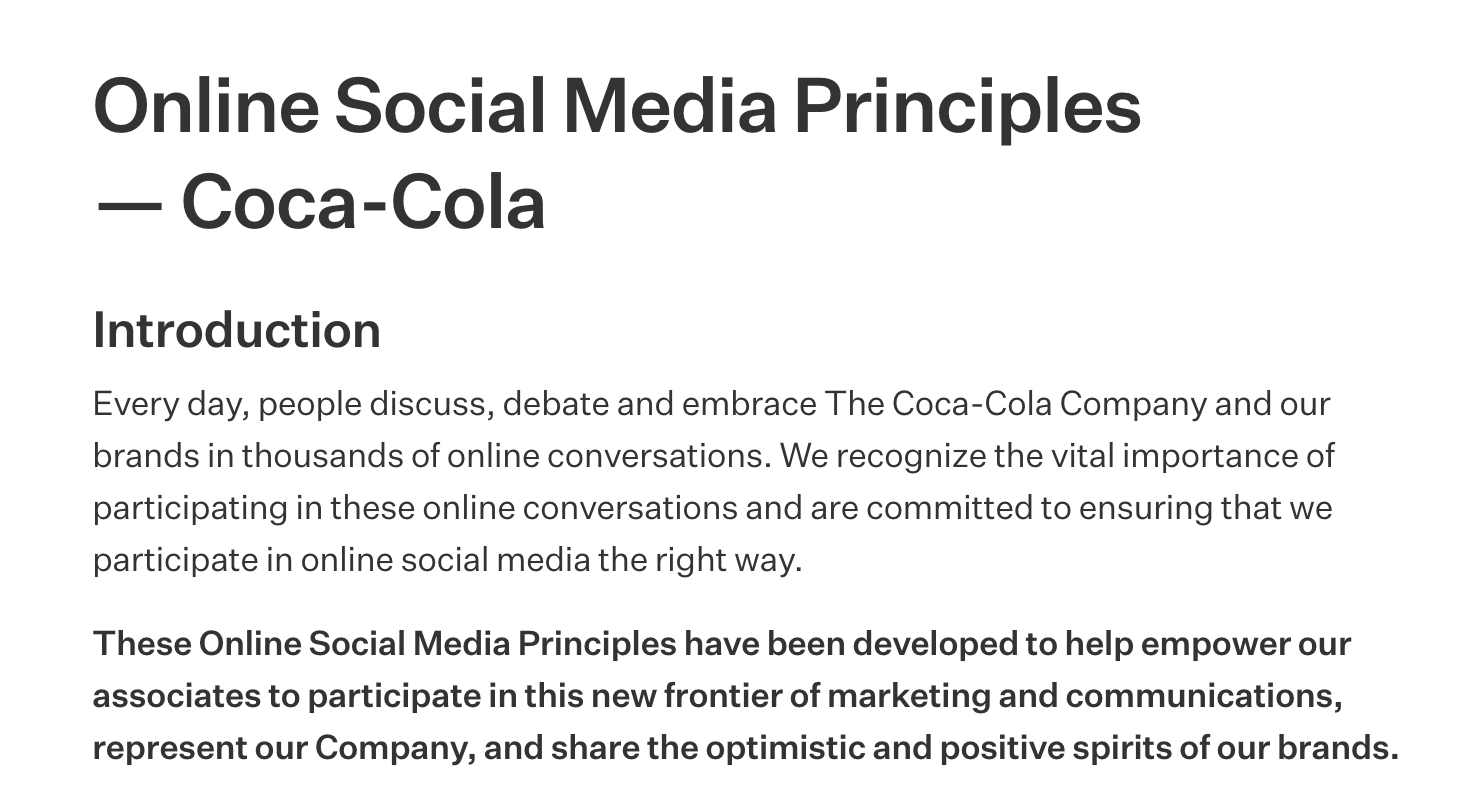
The policy is designed to guide the behavior of employees, agency associates, and company spokespeople on social media platforms. It aims to protect the company's reputation and ensure that employees represent the company positively online.
Key elements of Coca-Cola's social media compliance policy include:
- **Purpose and scope:** The policy aims to guide employees in their online interactions, emphasizing the importance of maintaining the company’s reputation.
- **Guidelines for engagement:** Employees are encouraged to participate in social media, but must exercise sound judgment and common sense. They should differentiate between speaking “on behalf of the company" and "about" the company.
- **How to respond to negative posts:** Employees are instructed to direct negative comments to authorized spokespeople rather than responding directly, which helps manage potential fallout.
- **Accountability and transparency:** The policy highlights the importance of accountability in online interactions and the need for transparency in communications.
- **Disciplinary measures:** It outlines potential disciplinary actions for violations of the policy, reinforcing the seriousness of adhering to these guidelines.
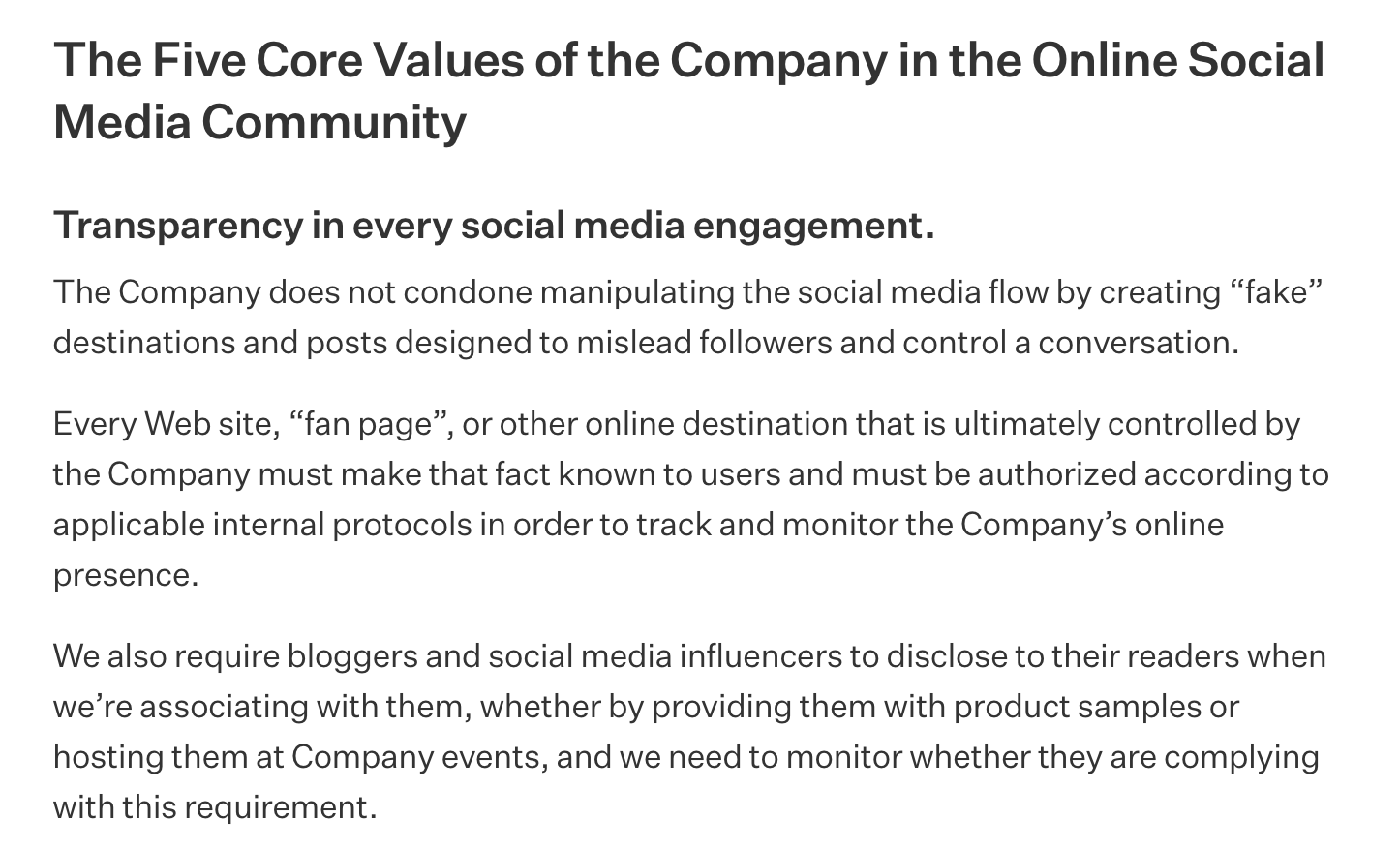
This policy is a great example of how large organizations can structure their social media compliance to protect their brand while encouraging employee engagement.
## Social media compliance software
Monitoring your company’s social media accounts can be overwhelming. That’s why social media compliance software and tools exist to help organizations ensure their social media activities adhere to industry regulations, company policies, and legal requirements.
A social media compliance solution is particularly important for businesses in regulated industries such as finance, healthcare, and pharmaceuticals, where compliance with specific laws is mandatory.
Social media compliance software offers essential features to help organizations meet regulatory standards and manage their online presence effectively. These include the following.
### Monitoring and detection
Such a tool should automatically monitor social media channels to detect potential compliance violations. They can identify misrepresentations or non-compliant content in both paid and organic posts, ensuring that all social media activities align with regulatory standards.
### Content archiving
Compliance software often includes features for capturing and archiving social media content. This is crucial for maintaining records that can be used in audits, investigations, or legal proceedings. For example, Smarsh provides capabilities to capture and archive content from platforms like LinkedIn, Twitter/X, and Facebook, helping organizations stay compliant with regulations.
### Risk management
The software helps mitigate risks by identifying and addressing security threats, such as phishing, account takeovers, and brand impersonation. It provides tools to monitor for suspicious activities and take down malicious content or fake accounts.
### Automated workflows
Many compliance solutions offer automated workflows to streamline the compliance process. This includes approval processes for content before it is published and tracking compliance status across various social media accounts.
### Regulatory compliance
The software helps ensure that social media activities comply with industry-specific regulations. This is particularly important for sectors like finance and healthcare, where noncompliance can result in significant fines and legal issues.
### Reporting and alerts
Compliance tools provide detailed reports and alerts on potential violations, allowing organizations to take immediate action. They also offer features for documenting and archiving compliance activities, which can be crucial for audits.
By leveraging social media compliance software, organizations can effectively manage their digital presence and marketing activities, protect their brand reputation, and avoid regulatory penalties.
## Stay compliant on social media
Social media offers great opportunities for businesses to grow and connect with their audience. However, it's essential to follow the rules to avoid legal issues, stay in your audience's good graces, and protect your brand.
By staying on top of data privacy laws, advertising rules, and content guidelines, as well as setting clear policies and keeping staff trained and up to date, companies can safely manage their social media presence. Following these compliance rules not only helps avoid problems but also builds trust with your audience and keeps your brand in good standing.
## The most common social media privacy issues and how to stay safe online
Social media has redefined how brands connect with consumers. The vast amount of data these platforms collect provides valuable insights that marketers use to refine their targeting, engagement, and overall strategies.
However, as more and more personal information is shared online, privacy concerns are at an all-time high. For businesses, understanding social media privacy enables you to comply with global privacy laws and avoid hefty fines while building trust with your audience.
Knowing the risks of online exposure, when consent is required to access data, and how to protect sensitive data are key to safeguarding both your business and your customers.
## What types of data do social media platforms collect?
Social media platforms collect a wide range of data. Some types, people willingly share, while others are collected automatically through interactions on the platform. These include:
- **Personal information**: This includes basic details like a user’s name, email address, phone number, date of birth, gender, and location. While some of this information is shared directly when users create accounts, other details, like a user’s IP address, can be automatically collected when they interact with the platform.
- **Behavioral data**: Platforms track how users interact with content, including what they like, comment on, share, and how long they stay on particular pages or view specific posts. By tracking these behaviors, platforms can build profiles of their users, helping marketers understand their preferences, habits, and interests.
- **Device and technical data**: Social media platforms track the type of devices users access the platform from, including the operating system, device model, and browser type. They also monitor the frequency of usage, session duration, and error logs to support the smooth operation of the platform.
- **Location data**: Many social platforms ask for access to users’ location data through GPS, IP addresses, or Wi-Fi networks. This information helps platforms offer more localized content, such as nearby events or trending topics.
- **Third-party data**: Social media platforms often integrate with external apps and services and collect additional data from those sources. For instance, when a user logs into a third-party app through their social media account, that app can access a range of data, such as their friends lists or recent activity.
While this data collection helps marketers deliver more personalized and effective campaigns, it also poses significant social media privacy risks if it is not handled responsibly.
## What do companies do with personal data?
Companies use the data gathered from social media in a variety of ways. The primary use is personalized marketing. By understanding user behaviors and preferences, marketers can create highly targeted advertisements that resonate with specific audiences. Whether it’s retargeting a user who previously viewed a certain product or suggesting products based on past behavior, social media data makes these tactics possible.
Additionally, customer insights gained through demographic and behavioral data help businesses fine-tune their offerings. Companies use this information to develop more relevant products or services and deliver content that meets their audience’s needs.
Another helpful function is audience segmentation. By grouping people into distinct segments based on shared traits or behaviors, companies can run more effective, tailored campaigns. These segments might include demographic factors such as age, location, or gender, as well as behavioral patterns like engagement level or purchase history.
Social media data also helps businesses identify trends and consumer sentiment. For example, tracking mentions of certain products or topics can help brands quickly jump on emerging trends or address potential issues before they escalate.
While these practices are effective in driving results, they can also present privacy concerns when personal data is mishandled or used without user consent.
## Why is social media privacy important?
Social media privacy is more than just a regulatory requirement — it’s essential for maintaining trust with users and protecting your business from reputational damage. The [FTC reports](https://www.ftc.gov/news-events/data-visualizations/data-spotlight/2022/01/social-media-gold-mine-scammers-2021) that one out of every four US fraud victims was targeted through social media last year, leading to losses of USD 770 million.
Social media privacy directly impacts consumer trust. Users are more likely to engage with brands that respect their privacy and are transparent about how their data is used. Without this trust, customers may stop interacting, switch to competitors, or even speak out against the brand.
In addition to protecting consumer trust, businesses also face significant financial risks if they fail to maintain privacy standards. Noncompliance with laws like the [General Data Protection Regulation (GDPR)](https://usercentrics.com/knowledge-hub/the-eu-general-data-protection-regulation/) or the California Consumer Privacy Act (CCPA), which has been expanded and amended by the [California Privacy Rights Act (CPRA)](https://usercentrics.com/us/us/knowledge-hub/california-privacy-rights-act-cpra-enforcement-begins/), can lead to hefty fines. Additionally, data breaches can incur substantial legal fees, class-action lawsuits, and other regulatory penalties.
Businesses need to understand that their reputation is on the line. A mishandled privacy breach can seriously damage a company's image, often beyond repair. Negative press and social media backlash can lead to lost customers and damaged relationships with stakeholders, like partners, advertisers, or potential investors.
## Relevant social media privacy laws
To address growing privacy concerns, including those related to social media, a number of regulations and policies have been put in place. These laws are designed to give consumers more control over their data and encourage companies to handle personal information responsibly.
Below is an overview of the most prominent and well-known global privacy laws.
- **The General Data Protection Regulation (GDPR)**: Enforced in the European Union, the GDPR requires companies to obtain clear and explicit consent before collecting personal data. It also gives users the right to access, correct, and delete their data.
- **The California Privacy Rights Act (CPRA)**: The CPRA amends the earlier California Consumer Privacy Act (CCPA), and gives California residents the right to know what personal information is being collected, to easily delete it, and to opt out of it being sold, shared, or used for targeted advertising or profiling. The law applies to businesses that collect data from California residents, including social media platforms.
- **Children’s Online Privacy Protection Act (COPPA)**: [COPPA](https://usercentrics.com/us/knowledge-hub/childrens-online-privacy-protection-act-coppa/) protects the privacy of children in the United States under the age of 13. It requires that businesses obtain verifiable parental consent before collecting personal information from children.
- **Digital Services Act (DSA)**: In the EU, the DSA requires digital platforms, including social media companies, to be more transparent about their content moderation practices and to make efforts to protect users from illegal or harmful content.
- **Brazil's General Data Protection Law (LGPD)**: The [LGPD](https://usercentrics.com/knowledge-hub/brazil-lgpd-general-data-protection-law-overview/) regulates the collection, use, processing, and storage of personal data in Brazil, including data collected through social media platforms.
Of additional interest is the potential for more specifically targeted legislation, like Australia’s [Social Media Minimum Age](https://www.reuters.com/technology/australia-passes-social-media-ban-children-under-16-2024-11-28/) bill, which passed in November 2024, and bans children under the age of 16 from accessing social platforms.
These relevant regulations are not an exhaustive list, though, and companies are encouraged to do additional research based on their location and that of their target audience, as national laws or frameworks or policies by business platforms like Google may have additional requirements.
## Common social media privacy issues
There are several significant privacy risks associated with social media, many of which stem from either intentional misuse or unintentional [exposure of sensitive data](https://usercentrics.com/knowledge-hub/sensitive-data-exposure/). These issues can have serious consequences for both consumers and businesses.
### Malware and viruses
Social media platforms can be used to spread malware and viruses. Cybercriminals pose as legitimate users or companies and send links that, once clicked, download malicious software onto the user’s device. This can lead to stolen personal data, identity theft, financial loss, or damage to a user’s device.
### Hacking and account takeovers
Hackers target social media accounts to steal sensitive data or impersonate users. Once a hacker gains access to a user’s account, they can steal sensitive data, impersonate the user, and even send harmful links or messages to the user’s contacts. This type of damage can be difficult to recover from and can severely harm both the reputations of the user and the business.
### Data mining for identity theft
Data mining involves extracting and analyzing large sets of personal information to create detailed profiles of individuals. This data can be used for identity theft, with criminals impersonating users to open credit lines or make fraudulent transactions. Because social media platforms collect extensive personal information, they can make it easier for criminals to steal identities and commit fraud.
### Data breaches
Data breaches occur when unauthorized parties gain access to user data, often due to weak security measures. These breaches can expose sensitive information such as names, addresses, passwords, and financial details. Once exposed, this data can be used for criminal activities, and the breach can cause a permanent loss of consumer trust, as well as ongoing hardship for victims.
### Location settings loopholes
Many social media platforms enable users to share their location. However, even if social media users turn off their location settings, scammers can get a device's location by other means, such as public Wi-Fi and cellphone towers. Location might not seem like a very valuable piece of data. However, when paired with other personal information, it could help to create an even more accurate fraudulent user profile. This information can also be used to track a person’s whereabouts.
### The spread of false information
False claims and misinformation can spread rapidly across social media platforms. This not only misleads users but also raises privacy concerns, especially when fake accounts or bots are used to manipulate public opinion or push fraudulent schemes.
### Third-party data sharing
Many platforms share user data with third-party advertisers, marketers, and data brokers. This can result in users’ information being sold or used for purposes they never consented to. When third-party data sharing isn’t transparent, it leads to privacy violations and a loss of consumer confidence.
## Examples of social media privacy issues
Over the years, several high-profile social media data privacy issues have highlighted the risks of social media platforms and the sensitive data they collect.
Perhaps the most infamous case is the [Cambridge Analytica scandal](https://bipartisanpolicy.org/blog/cambridge-analytica-controversy/), which revealed how millions of Facebook users' personal data was harvested without their consent. The data was then used for, among other things, political influence, including a US federal election, raising serious concerns about privacy, data misuse, and the lack of oversight on social platforms. This breach not only severely damaged Facebook's reputation but also triggered widespread calls for regulatory changes to how platforms handle personal information. This led to new laws like the Digital Services Act and [Digital Markets Act](https://usercentrics.com/digital-markets-act-dma/) in the EU.
Another ongoing privacy concern revolves around TikTok, particularly regarding its data collection practices and potential ties to the Chinese government. Critics argue that TikTok may be compelled to share user data with the Chinese government, raising questions about the security and privacy of its global user base, especially given that many users are children. These concerns have prompted several countries, including the U.S. and India, to scrutinize the app's operations more closely, with some even banning it altogether. The Canadian government [ordered TikTok’s Canadian operations to be shut down](https://www.cbc.ca/news/politics/tiktok-ban-canada-operations-what-it-means-1.7377435) in November 2024.
Controversy over the company’s practices has sparked wider discussions about the need for transparency, stronger data protection laws, and the challenges of regulating apps with international reach.
These examples serve as stark reminders of the risks social media platforms can pose to user privacy and the growing importance of handling data responsibly and transparently.
## How companies can protect their social media information
Protecting social media data is critical for any business that relies on these platforms for marketing, customer engagement, or brand building. Not only does protecting your data help achieve compliance with global privacy laws, but it also helps maintain consumer trust and safeguard your reputation. Below are key steps that companies can take to protect their social media accounts, data, and users.
### Strengthen your social media account security
Social media accounts are often targeted by cybercriminals. If your business uses social media accounts, one of the most effective ways to protect them is by using strong, unique passwords for each social media platform. Avoid reusing passwords across multiple sites to minimize the risk of unauthorized access. Additionally, enable multifactor authentication to add an extra layer of protection.
### Implement role-based access control
For larger organizations with multiple employees managing social media accounts, it's important to implement role-based access control. This means giving employees access only to the tools and data they need to perform their tasks. Limiting access reduces the risk of a security breach and protects sensitive information.
### Review third-party permissions
Many social media platforms enable users to integrate third-party apps or services. While these integrations can enhance your marketing efforts, they can also create security risks if the third-party tools have weak data protection practices. Regularly audit the apps and services connected to your social media accounts, and only give data access to trusted and secure services.
### Follow data minimization best practices
[Data minimization](https://usercentrics.com/knowledge-hub/data-minimization/) is a privacy principle that calls for only collecting the data necessary for a specific purpose. On social media, this means avoiding the over-collection of personal data and limiting how long you store it. Reduce the risks of data breaches and noncompliance with privacy laws by keeping data retention periods short, securely deleting unnecessary data, and [anonymizing data](https://usercentrics.com/knowledge-hub/data-anonymization/) when possible.
### Implement regular audits
Conduct regular security audits to protect your company’s social media information. This involves assessing your security protocols, reviewing permissions, and maintaining compliance with evolving privacy regulations. Regular audits help identify vulnerabilities and gaps in your data protection strategy, enabling you to address them proactively before any issues arise.
### Establish an incident response plan
Despite taking all the necessary precautions, breaches and other data privacy issues can still occur. Having a well-defined incident response plan in place will help your company quickly address and mitigate the impact of a data breach, should one occur. Many data privacy laws have specific requirements for organizations in the event of a breach or other violation, including notifications of affected users and authorities. So your plan should include steps to notify affected users, cooperate with regulators, and implement corrective actions to prevent future incidents (which can help mitigate penalties).
### Use a Consent Management Platform
A Consent Management Platform (CMP) is an essential tool for achieving compliance with privacy laws and managing user consent effectively. With a CMP, you can obtain explicit consent from users before collecting or processing their data, track consent status across different platforms, and handle data subject requests such as data access or deletion. This proactive solution is particularly important for businesses operating on multiple platforms or across multiple jurisdictions with varying privacy regulations.
## Verify that your online presence meets privacy standards
Being active on social media brings risks, but your online presence is important to boost brand awareness and connect with their audience. Learn all about social media privacy compliance.
## How a Consent Management Platform (CMP) can help with online privacy
Companies need to protect their users’ privacy and data on all platforms where they’re active and interact online. This includes both owned platforms, like the company website and/or app, as well as third-party social platforms. The ways companies run marketing operations online involve an ecosystem, and it’s important to center privacy in its end to end.
In addition to our recommendations for mitigating privacy risks with social accounts, companies can obtain valid consent and help protect data privacy on their websites, apps, and other connected platforms with a CMP. Protect your brand and monetization, obtain high consent rates for the data you need while building trust with users, and maintain privacy compliance to avoid penalties. Show your audiences that you respect data privacy end to end in the digital ecosystem.
## The GDPR and social media: What marketers need to know to comply
Social media strategy is a huge challenge for marketers. Which platforms? What content types? Posting velocity? What data do you need? What consent do you need from users? If you collect data on your social media followers, the key question is how to ensure your data collection and usage comply with GDPR requirements.
GDPR compliance requirements aren’t just for websites. They apply to apps, social platforms, and wherever you collect and process users’ personal data. Obtaining valid consent isn’t just a legal requirement, though. It’s a key step in building trust and engagement. And it’s simpler than you think once you understand the basics.
## The basics of the GDPR
At its core, the General Data Protection Regulation (GDPR) is a law designed to empower individuals by giving them greater control over and protection of their personal data.
It was created by the European Union to protect the privacy of anyone living in the EU. The law makes sure companies that collect personal data—like names, email addresses, and even browsing habits—are doing it in a responsible and transparent way.
Even if a business is located outside of Europe, if they're dealing with EU residents' data, they still have to follow these rules. The GDPR is all about making sure companies are clear about what data they collect, why they need it, and how they use it, as well as providing rights to individuals to control access to and use of their data.
The main goals of the GDPR are to make sure that businesses:
- are transparent about how they use personal data
- limit the amount of data they collect (only what’s necessary)
- keep data safe and secure
- respect rights and promptly act on requests to access, change, or delete user data
The regulation provides individuals with several rights, such as the right to request a copy of the data a company has about them, the right to have that data corrected, and the right to have it deleted (also known as the “right to be forgotten”).
## Want to learn more about the GDPR?
Learn the key details of the GDPR, how it affects your organization, and more. We’ve compiled a guide that covers everything you need to know.
### The GDPR and personal data
At the heart of the GDPR is the concept of personal data. The term refers to any information that can directly or indirectly identify an individual, either as individual data points or combinations of them. This includes obvious identifiers like names, addresses, and phone numbers. But it also extends to data such as IP addresses, [tracking cookies](https://usercentrics.com/knowledge-hub/tracking-cookies-and-the-gdpr/), location data, and social media activity.
Social media platforms, by their very nature, collect vast amounts of personal data. Some of it is generated by users directly — profile information, posts, comments, likes, shares, etc. — and some is generated by user activity — browsing habits, time on site, clicks, types of accounts followed, etc. The GDPR considers all of this data personal, meaning it’s subject to strict protection and oversight.
To comply with the GDPR, companies that collect personal data through social media must ensure they have a lawful basis for processing it. The two most common ways to legally process personal data are obtaining consent from the user, or relying on legitimate interest.
#### GDPR legal bases: consent
One of the clearest and most straightforward ways to legally process personal data under the GDPR is by obtaining explicit and informed consent from the user. This means the person has to actively agree to their data being collected and used for a specific purpose.
For example, if a company is running a social media campaign and collecting email addresses for a newsletter, they need to ask for clear permission and explain exactly how that data will be used. Importantly, this consent must be freely given, meaning the user isn’t forced or tricked into agreeing, and they should be able to withdraw it just as easily as they gave it.
> Read about [email marketing compliance](https://usercentrics.com/guides/social-media-email-marketing-compliance/email-marketing-compliance/) now
#### GDPR legal bases: legitimate interest
Another common way to process personal data is through what's known as "legitimate interest." This allows organizations to use personal data in ways that are necessary for their business operations, as long as it doesn’t unfairly impact the rights and privacy of the individual. For instance, a company might analyze user behavior on social media to improve their services or target ads. However, this method requires careful consideration. It may seem more convenient, but will bring additional scrutiny and requirements to prove its necessity.
A business needs to ensure that its interests don’t override the privacy rights of the individual. Typically, companies conduct a Legitimate Interest Assessment (LIA) to justify this approach and document their reasoning. It’s also important to consult with a data privacy expert, like a Data Protection Officer, and/or qualified legal counsel.
These two bases help companies stay compliant with the GDPR for their data processing operations, while enabling them to continue to use personal data — in responsible and transparent ways.
## How does the GDPR impact social media?
The GDPR has fundamentally changed how social media platforms operate, as well as how companies leverage these platforms for marketing and engagement. Social media platforms like Facebook, Instagram, Twitter, LinkedIn, and others rely heavily on collecting personal data to provide personalized services and targeted advertising. With the GDPR in force, these platforms must ensure that they are transparent about how they handle user data and that users are aware of their rights.
One of the most noticeable changes brought by the GDPR across social media is the need for [explicit consent](https://usercentrics.com/knowledge-hub/types-of-consent/). In the past, social media platforms would often bundle user consent for a variety of data processing activities into their terms and conditions. Some platforms have been fined for doing so and burying this relevant information deep on relevant web pages. Under the GDPR, consent must be freely given, specific, informed, and unambiguous, and access to relevant information about data and privacy must be easily accessible — this is becoming more readily enforced. People must have the option to opt in to data collection and processing activities, and they must be able to deny or withdraw consent at any time as easily as giving it.
For example, social media platforms have had to overhaul their privacy settings to make them easier to use and give people clear ways to access information and control their data. Users can now easily look up their data, delete their accounts, or fix any mistakes in their information, or make a request for the company holding the data to do so. These changes don’t just impact the platforms. They also affect third-party apps and advertisers that use social media data for ads or analysis.
The GDPR also limits how automated decision-making and profiling can be used. A common interpretation of “automated decision-making” that’s increasingly in use is for AI tools and using data from social platforms to train large language models (LLMs). Social media platforms often also rely on algorithms to track user behavior and show personalized content or ads. But under the GDPR, if these algorithms affect someone significantly, users must be told about it and given the option to opt-out.
## Ensure your online presence meets privacy standards
To effectively use social media for your company’s digital marketing, it’s important to comply with privacy laws and best practices. Here’s what you need to know to ensure your online presence meets these requirements.
## The GDPR impact on social media platforms
When it comes to the GDPR, social media platforms have responded in varying ways. It’s also of note that none of the major platforms was founded in the EU. Each platform has employed its own strategies for developing and evolving policies regarding access to personal data. Below are examples of how major platforms have been impacted.
### Facebook
As one of the largest social media platforms, [Facebook](https://usercentrics.com/guides/social-media-email-marketing-compliance/facebook-gdpr/) has faced considerable scrutiny under the GDPR. In response, Facebook has introduced significant changes to its privacy controls, making them more accessible and giving users more clarity about how their data is used. For example, Facebook's privacy dashboard allows users to manage their ad preferences, see what data has been collected, and delete it if they wish. Facebook has also updated its consent forms to ensure users actively opt in to data processing.
### Instagram
Also owned by Meta, the parent company of Facebook, Instagram has made similar changes. The platform updated its privacy policies and made it easier for users to control who sees their content and how their data is shared. Instagram also introduced tools that let users download a copy of their data, including photos, comments, and profile information. This measure aligns with the GDPR’s data portability requirements.
### X (formerly Twitter)
X (formerly Twitter) tries to emphasize transparency and user control in its approach to GDPR compliance. It offers features that let users manage data preferences, opt out of personalized ads, control data collection like location tracking, and request their data or delete their accounts. However, recent scrutiny has surfaced around its use of user data for AI training without clear consent, sparking concerns about GDPR compliance. In May 2024, the platform began using European users' data to train its "Grok" AI technology without obtaining explicit consent, leading to complaints filed across Europe. The developments around this case are still ongoing.
### LinkedIn
[LinkedIn](https://usercentrics.com/guides/social-media-email-marketing-compliance/linkedin-gdpr/), which caters to professional networking and is owned by Microsoft, also adapted to the GDPR by modifying its privacy settings. The platform now offers users clear choices about how their data is used, particularly concerning targeted advertising. LinkedIn provides users with the ability to export their data and manage the collection of third-party tracking data more effectively.
### Snapchat
While Snapchat’s data collection practices are relatively limited compared to platforms like Facebook, it still has to comply with GDPR regulations. The platform is also popular with younger people, which creates additional requirements for access to data and consent if it belongs to children. Snapchat updated its [privacy policy](https://usercentrics.com/knowledge-hub/what-is-a-privacy-policy-and-why-do-you-need-one/) to clarify what data it collects. It also provides tools for users to download their personal data and manage how that data is used for advertising purposes.
### TikTok
As one of the fastest-growing social media platforms globally, TikTok has also encountered regulatory pressure under the GDPR. they’ve also been fined €345 million ($379 million) by the Irish Data Protection Commission (DPC) for GDPR violations related to children's data protection.
In response, TikTok has implemented several updates to improve privacy transparency and controls, particularly focusing on its younger user base. TikTok’s privacy policy now provides clearer explanations of what data is collected and how it is used. The platform has introduced age-based settings, giving parents and guardians more control over their children’s accounts through tools like Family Pairing. Additionally, TikTok has increased restrictions on targeted advertising for users under 18, aiming to protect minors from excessive data collection. TikTok also provides European users with options to request and delete their data, as well as to review data collection and processing practices.
### Pinterest
Pinterest has made notable adjustments in response to GDPR requirements, including revising its privacy settings to help users manage data permissions more effectively. The platform offers a privacy hub where users can review collected data and adjust sharing preferences for greater control over personalization. To comply with the GDPR's consent requirements, Pinterest aims to require users to actively opt-in to personalized advertising.
However, it is currently facing allegations from the privacy advocacy group NOYB regarding potential non-compliance, including claims of tracking users without explicit consent and lacking proper legal bases for data processing.
> Read about [Marketing compliance](https://usercentrics.com/guides/privacy-led-marketing/marketing-compliance/) now
## What marketers can do to stay GDPR-compliant while using social media
Marketers who rely on social media platforms for customer engagement and advertising must navigate the GDPR carefully. Here are key strategies for staying GDPR-compliant while using social platforms and the data generated there.
### Obtain explicit consent
Consent is a core principle of the GDPR. If you’re collecting data through social media campaigns — such as through lead forms, polls, or contests — you must obtain explicit consent from users. Ensure that consent forms are clear and easy to understand, and make it simple for users to opt-out at any time.
### Be transparent about data use
Transparency is essential under the GDPR and pretty much all other data privacy laws. Always inform users about what data you are collecting, how it will be used, for what purposes, as well as what their rights are and how to exercise them. You can do this via your [cookie banner](https://usercentrics.com/knowledge-hub/cookie-banner/) and privacy policy. This information should be easily accessible in privacy policies and/or disclosures during the data collection process.
### Monitor third-party tools and data
Many marketers use third-party tools to analyze social media metrics or run ads. Ensure that any third-party tools you use are GDPR-compliant, as you are responsible for the data they process on your behalf. Ensure you get data processing agreements signed and review them regularly to ensure compliance from all service providers. Also, avoid collecting data you don’t explicitly need, or retaining it if you no longer need it.
### Respect user rights
The GDPR grants individuals several rights over their data, including the right to access, rectify, and erase their information. Marketers must ensure they have processes in place to honor these requests. If a user asks to delete their data, you must act promptly and ensure that all traces of their information are removed, even from backup systems and data held by third parties.
### Update privacy policies
Regularly review and update your privacy policies and data processing operations to ensure they remain compliant with the GDPR. Ensure that these policies are easily accessible to users, particularly when they are engaging with you through social media channels.
### Use privacy-friendly ad strategies
The GDPR has made targeted advertising more complex, but it hasn’t eliminated it. Marketers can still use privacy-friendly strategies, such as contextual advertising, which targets ads based on the content a user is viewing rather than personal data. Focus on delivering valuable content that resonates with audience segments while respecting their privacy.
> Read about [marketing compliance checklist](https://usercentrics.com/guides/privacy-led-marketing/marketing-compliance-checklist/) now
## What are the GDPR penalties for noncompliance on social media?
No matter your company size, GDPR violations on social media can result in penalties. These are determined using a two-tiered system that takes into consideration the severity of the violation and whether it’s a first or repeat offense.
Less serious breaches can result in fines of up to EUR 10 million or 2 percent of global annual revenue, whichever is higher. More severe violations can result in fines of up to EUR 20 million, or 4 percent of a company’s global annual revenue.
Exact fines are determined by factors in [Art. 83 GDPR](https://gdpr.eu/article-83-conditions-for-imposing-administrative-fines/). These factors include the nature of the violation, any preventive measures taken, and whether affected individuals were notified. Other considerations are the type of personal data involved, the company's history with data privacy, and its response to warnings. Authorities can also suspend some operations and implement resource-intensive measures like auditing a company’s operations.
GDPR non-compliance can also damage a company’s reputation. With data privacy becoming increasingly important to consumers, companies that fail to protect personal data risk losing the trust of their audience, as well as advertisers, potential investors, and others, which can have long-term consequences for their brand and revenue.
## Smoothly navigate the GDPR and social media
Staying GDPR-compliant on social media doesn’t have to be overwhelming. By prioritizing transparency, obtaining explicit consent, and respecting user rights, marketers can continue to engage their audiences while safeguarding privacy. A proactive approach to data protection will not only help avoid penalties but also build trust with your followers.
## Facebook and GDPR: What you need to know to be GDPR-compliant
### At a Glance
- Facebook GDPR compliance requires businesses to have a valid legal basis for processing personal data collected through Facebook tools, including the Meta Pixel, Custom Audiences, and Conversions API.
- The Meta Pixel places third-party cookies on visitor browsers: under GDPR, prior informed consent is required before the pixel fires for EU and UK visitors.
- Facebook GDPR compliance is affected by data transfer rules: following the Schrems II ruling, transfers of EU personal data to the U.S. require adequate safeguards such as standard contractual clauses.
- Using Custom Audiences with customer lists constitutes data sharing with Meta: businesses must disclose this in their privacy policy and verify that the underlying data was lawfully collected.
- Meta's Conversions API (CAPI) offers a server-side alternative to browser-based pixel tracking, reducing consent signal loss and supporting more compliant conversion measurement.
- A consent management platform (CMP) integrated with Meta's consent framework helps support the requirement that the Meta Pixel only fires when valid GDPR consent has been obtained.
Facebook is a top advertising platform, with [87 percent of marketers](https://instapage.com/blog/best-advertising-platforms/) saying that they currently use or have used Facebook advertising. As useful as this tool is, it’s important to note that the EU’s General Data Protection Regulation (GDPR) places strict requirements on how businesses collect, store, and use personal data, especially when using platforms like Facebook. Other laws align with the GDPR's rules, adding more responsibilities for companies.
To avoid fines and safeguard user trust, companies must ensure their use of Facebook's tools — such as ads, tracking pixels, and lead generation forms — meet GDPR requirements. This includes obtaining explicit consent and safeguarding users' rights.
## What is the GDPR?
The [General Data Protection Regulation (GDPR)](https://usercentrics.com/knowledge-hub/the-eu-general-data-protection-regulation/) is one of the world’s strictest consumer privacy and data security laws. It came into effect on May 25, 2018, and was designed to give European Union citizens more control over their personal data and better protect their privacy, especially online. The GDPR regulates how businesses collect, use, and store personal information and imposes strict requirements on organizations that process data collected from EU residents.
Under the GDPR, personal data includes any information that can be used to directly or indirectly identify an individual. This definition covers a wide range of data types, such as names, email addresses, credit card numbers, IP addresses, and even data from cookies and device IDs.
[Key principles of the GDPR](https://usercentrics.com/knowledge-hub/the-principles-of-gdpr/) include:
- [Data minimization](https://usercentrics.com/knowledge-hub/data-minimization/): Only collect the data you need, and nothing more.
- Accountability: Companies must be able to demonstrate compliance with GDPR principles.
- Transparency and consent: Companies must clearly inform users about how their data is being used (before collecting it), and obtain explicit consent to process personal information.
- Right to access and deletion: Individuals have the right to access their data and request its deletion under certain conditions.
## Want to learn more about the GDPR?
To learn more about the GDPR, key details, and how it affects your organization, we’ve compiled a guide that covers everything you need to know.
## Types of data protected under the GDPR
The GDPR protects a wide variety of types of personal data, which can be broadly categorized into two groups. The first is more commonly referred to as personal data, which includes any information that can directly or indirectly identify a person, alone or in combination with other data points, including:
- full name
- home address
- email address
- financial information like credit card numbers
- identification numbers (e.g., national insurance numbers, social security numbers)
- IP addresses and other location data
- cookies and other tracking identifiers
The second type of data is called special category data. This is what’s categorized as sensitive personal data under many other data privacy laws, and is subject to even stricter regulation under the GDPR. This data includes:
- racial or ethnic origin
- political opinions
- religious or philosophical beliefs
- health data
- biometric and genetic data
As a social media platform, Facebook processes vast amounts of both types of data. This makes it essential for companies to follow Facebook and GDPR compliance protocols.
> Read about [email marketing compliance](https://usercentrics.com/guides/social-media-email-marketing-compliance/email-marketing-compliance/) now
## How does the GDPR affect advertising?
One of the major implications of the GDPR is its effect on digital advertising, especially for platforms like Facebook, which rely heavily on user data for targeted advertising.
The GDPR requires businesses to get explicit consent from users before collecting their personal data, which is critical for advertisers who rely on tools such as [tracking cookies](https://usercentrics.com/knowledge-hub/tracking-cookies-and-the-gdpr/), tracking pixels, and behavioral data to target users.
- Users must explicitly opt-in to share their data. Pre-checked boxes, missing “Deny” buttons or implied consent are not acceptable.
- Advertisers must clearly explain how data will be used and give users the option to change preferences and/or withdraw their consent at any time.
- Users must be informed if they are being profiled, e.g. based on their behavior and preferences, and be given the option to object or opt-out.
Facebook's advertising model relies on collecting a wealth of data from its users, including their interests, browsing habits, and engagement patterns. Because Facebook is only one social platform owned by parent company Meta, users can also be tracked, and their data collected across platforms, including Instagram and WhatsApp.
Under the GDPR, Facebook has had to modify its practices to ensure advertisers using the platform can still access the insights they need while respecting the privacy of EU users.
## Facebook and GDPR
Given its enormous user base, GDPR compliance has been a major requirement for Facebook. The company has implemented several changes to comply with strict requirements set out by the regulation and data protection authorities in the EU, with a focus on user control and transparency.
To be GDPR-compliant, Facebook has made key changes, including:
- **Updates to its privacy policies**: Facebook has updated its privacy settings and provided users with more straightforward ways to control their data. Users now have more insight into what data Facebook collects, how it's used, and who it is shared with.
- **Consent mechanisms implemented**: Facebook implemented [consent management](https://usercentrics.com/knowledge-hub/consent-management/) features that enable users to opt in or out of certain types of data processing. For example, Facebook now asks users for explicit consent to process their data for purposes like targeted advertising.
- **Data access**: Users can now download a copy of their Facebook data and see exactly what personal information Facebook stores, enabling compliance with the GDPR’s data access rights.
- **Right to be forgotten**: Facebook has made it easier for users to delete their accounts and remove all associated data from Facebook’s systems.
### Facebook products affected by the GDPR
Several Facebook products and services are impacted by the GDPR, including:
- **Facebook ads**: Advertisers must now comply with the GDPR regarding user data. This compliance includes collecting explicit consent before using Facebook Ads for targeted marketing.
- **Custom audiences**: This feature enables businesses to target ads based on customer data like email addresses or phone numbers. Under the GDPR, companies need to ensure they have valid consent from individuals before uploading their data to Facebook.
- **The Facebook pixel**: This tool helps businesses track and measure ad effectiveness. Under the GDPR, companies using the Facebook pixel must now obtain clear consent from users before installing it on their websites.
- **Lead ads**: Facebook's lead generation ads, which enable businesses to collect data directly from users, must now include clear language about how the data will be used and ensure that the individuals submitting information have given explicit consent.
> Read about [Marketing compliance](https://usercentrics.com/guides/privacy-led-marketing/marketing-compliance/) now
## The GDPR and Facebook lead ads
Facebook lead ads have become a popular tool for businesses to collect valuable customer data seamlessly within the platform, but the GDPR has significantly altered how companies can use this feature.
The GDPR requires explicit consent for any data collection. Therefore, businesses using lead ads in the EU must be more transparent than ever about how they gather and use personal information. This has made lead generation campaigns more complex, as users must be fully informed and explicitly agree to share their data. Thus impacting the efficiency and ease of capturing leads.
Additionally, the GDPR’s emphasis on data minimization has limited the amount of information businesses can request through lead ads. Restricting them to only gathering essential data. The regulation provides users with greater control over their data, requiring businesses to implement systems for users to easily withdraw consent or request that their information be deleted. As a result, companies face more administrative and operational challenges as they try to find a balance between GDPR compliance and running effective Facebook lead-generation campaigns.
### Privacy policies and Facebook lead ads
If your company uses Facebook lead ads, your [privacy policy](https://usercentrics.com/knowledge-hub/what-is-a-privacy-policy-and-why-do-you-need-one/) needs to reflect that information. The policy must clearly communicate how user data collected through Facebook lead ads will be processed, and protected.
In addition, it’s important to specify the types of data collected, e.g. names and email addresses, the purpose of the collection, e.g. marketing or customer outreach, and whether any third parties will have access to the data.
Your privacy policy should also outline user rights under the GDPR, including their right to access, correct, or delete their data, and how they can withdraw consent. Make sure users know who to contact with privacy concerns or to exercise their data rights, typically via an email address or contact form.
## Learn how to create a privacy policy for Facebook lead ads
Learn everything you need to know about creating a privacy policy for Facebook ads to stay GDPR-compliant when using Facebook.
## Best practices for GDPR compliance on Facebook
Businesses must maintain GDPR compliance for Facebook ads and other marketing tools. Failing to meet these requirements can result in severe penalties, loss of access to the platform for marketing activities, and loss of trust from consumers. To avoid these outcomes, we have outlined a few best practices below that companies can follow to remain GDPR-compliant when using Facebook.
### 1. Obtain explicit consent for data collection
When using Facebook tools like Custom Audiences, lead ads, or Facebook Pixel, businesses must obtain clear, informed consent from users before collecting their personal data. Consent forms should be easy to understand, and users should be aware of exactly how their data will be used.
Using a [cookie banner](https://usercentrics.com/knowledge-hub/cookie-banner/) on your website will inform users about data collection methods, such as via Facebook Pixel, and obtain their permission before any tracking begins.
When using lead ads, make sure individuals understand what data you are collecting and why. Provide consent checkboxes (unchecked before user interaction) so users can opt in, and their agreement will be recorded.
### 2. Update your privacy policy
Under the GDPR, your business’s privacy policy must clearly state how you collect, use, and store personal data. This policy should be easily accessible, and it should detail your use of Facebook’s advertising tools, like tracking pixels or remarketing lists.
Therefore, to be GDPR-compliant when using Facebook services, make sure your privacy policy includes sections specifically related to Facebook advertising, such as how Facebook Pixel data is used for remarketing campaigns. Also, be sure to periodically review and update your privacy policy to reflect any new technologies, data collection practices, or regulatory changes.
### 3. Follow data minimization best practices
Under the GDPR, businesses are required to collect only personal data that is necessary for a specific, communicated purpose. In other words, only collect the information you need for the planned activity.
If you’re running a Facebook lead generation campaign, GDPR best practices recommend that you only ask for essential information (e.g., name, email address). Avoid requesting excessive data unless it is crucial for your business goals.
For remarketing campaigns, segment your audiences carefully to ensure you’re not processing unnecessary data about individuals.
### 4. Use data processing agreements
If your business collects personal data and works with Facebook or other third parties for data processing, a data processing agreement (DPA) must be in place. This agreement will help ensure both parties meet GDPR standards for data protection and protect both users and companies from violations.
Sign a DPA with Facebook to confirm that both your business and Facebook will comply with the GDPR’s data processing requirements. Then, ensure you have an agreement in place with any third-party vendors you work with as well, who will also adhere to GDPR standards, especially those involved in managing Facebook advertising campaigns.
### 5. Provide people with easy data access and deletion options
The GDPR grants individuals the right to access their personal data that businesses hold and request that it be deleted. Companies must make it easy for individuals to exercise this right through user-friendly interfaces or direct contact options.
To do so, implement a clear and straightforward process for users to access or delete their data. This can be done via an online form or through email support.
Regularly audit the data you collect from Facebook campaigns to ensure it aligns with your retention policies and remove any data that is no longer necessary.
### 6. Keep detailed records of consent
It is vital to keep a secure and complete record of when and how users have given consent to use their data, and any changes or revocation over time. In case of an audit, complaint, or data subject access request, you will need to demonstrate that you obtained proper consent.
One option is to implement a [consent management platform](https://usercentrics.com/knowledge-hub/consent-management-platforms/) to track and store consent records. These tools can help you comply with the GDPR requirements for Facebook ad campaigns. And if you use Facebook lead ads, make sure you document the time and method by which users gave their consent to share their data.
## Importance considerations for remarketing campaigns
Remarketing is a powerful way to re-engage users who have previously interacted with your website or social media content. However, the GDPR requires that businesses obtain explicit consent before tracking users for these purposes, which means you must:
- implement cookie consent banners to ensure users are aware of and give permission for tracking
- provide a clear explanation of how their data will be used for remarketing and offer the option to opt out at any time
Without these safeguards in place, businesses run the risk of violating the GDPR’s strict requirements for user consent for data processing.
## Consequences of GDPR noncompliance when using Facebook
GDPR fines for noncompliance can be severe, no matter the size of your company. The regulation uses a two-tiered system to determine the exact size of a penalty. This determination is based on the severity of the violation and whether it's a first or repeat offense.
Less serious breaches can lead to fines of up to EUR 10 million or 2 percent of global annual revenue, whichever is higher. More severe violations can result in fines of up to EUR 20 million, or 4 percent of revenue.
The exact fine is determined by factors outlined in [Art. 83 GDPR](https://gdpr.eu/article-83-conditions-for-imposing-administrative-fines/). This includes the nature of the violation, any preventive measures taken, whether affected individuals were notified, the type of personal data involved, the company's history with data privacy, and their response to warnings.
## Navigating Facebook and GDPR compliance
Navigating the complexities of the GDPR while using Facebook for advertising can be challenging, but it's essential for protecting your business and building trust with your audience.
By understanding the types of data Facebook handles, obtaining explicit consent, and updating your privacy policies, you can continue to use Facebook’s powerful tools without compromising on compliance. Stay proactive, follow best practices, and ensure your business meets GDPR requirements to avoid costly penalties and maintain user confidence.
## How to create a privacy policy for Facebook lead ads
Thanks to its massive audience and extensive user data generated from their activities, Facebook is one of the most powerful platforms in digital marketing and advertising. That said, if you want to use certain types of Facebook ads to collect data from users, there are certain rules and regulatory requirements you need to follow.
Most major data privacy regulations require you to outline your data collecting and handling practices in a privacy policy. Facebook itself requires that you have a privacy policy on your website if you plan to collect user data from your ads.
In this article, we’ll explore all the ins and outs of user privacy and Facebook ads. We’ll break down what your privacy policy needs to say about these ads and share key guidelines for staying compliant with the data privacy laws that apply to your business.
## What is a Facebook privacy policy?
A [privacy policy is a legal document](https://usercentrics.com/knowledge-hub/what-is-a-privacy-policy-and-why-do-you-need-one/) required by most data privacy laws. It explains how your business gathers, stores, uses, shares, and protects customers’ personal data. It also informs users about what types of personal data you collect — such as names, email addresses, or browsing behavior — how this data is processed, and their rights regarding their data and how to exercise them.
A Facebook privacy policy typically exists within your larger privacy policy document. It outlines the types of data you gather through Facebook specifically, the different ways the data is collected, and what you do with the data.
Having a privacy policy can help you remain compliant with the platform’s rules. Without one, “ad platforms can suspend your account, preventing you from running ads until you correct your data privacy compliance,” warns [Sara Marques](https://pt.linkedin.com/in/sarafmarques), PPC Specialist at Usercentrics.
What’s more, “you also risk loss of trust,” she states. “Reputational damage is hard to recover from, and results in lower advertising and general marketing performance, as well as potential loss of customers and revenue.”
## Which Facebook ads require a privacy policy?
Not all Facebook advertising requires a privacy policy. You only need to set up a privacy policy for an ad or ad set if they will collect customer information.
This is particularly important for lead ads, which are designed to gather personal data like names, email addresses, and phone numbers. These types of ads are specifically designed to remove the friction that is often involved in getting potential customers to share their information.
There are three types of Facebook lead ads:
- **Lead ads with calling**: Users can click a button on an ad to initiate a direct phone call. For example, a real estate agency might use this feature to enable potential buyers to call agents.
- **Lead ads with instant form**: Users fill out a form — usually with contact details — directly within the ad, without having to leave Facebook. These could be useful to marketing agencies offering free consultations to potential customers, for example.
- **Lead ads that click to message**: These ads open a direct chat with your business in Facebook Messenger. For instance, a local restaurant might use this function to enable users to ask questions about the menu or make reservations.
## What to include in your Facebook ads privacy policy
As the requirements for these notices are fairly consistent across data privacy laws, [writing a privacy policy](https://usercentrics.com/knowledge-hub/how-to-write-a-privacy-policy/) for your Facebook lead ads is relatively simple. What’s most important to keep in mind is that your document must be easy to find on your website or app, and you’ll need to send the link to Meta when you initially set up these ads.
Here’s an overview of the five key elements to include in your Facebook ads privacy policy.
### 1. What information you collect and how you use it
You can collect various types of personal information when running Facebook lead ads, including users’ names, email addresses, phone numbers, locations, and even preferences.
Once you have the necessary data, you can use it in a variety of ways; for example, to build your email marketing list, follow up on inquiries, or send personalized emails. This information is also especially important for [retargeting ads](https://usercentrics.com/knowledge-hub/users-consent-retargeting/), which reach users who have already engaged with your brand, to increase the likelihood of a conversion.
Whatever information you collect and however you use it, it’s important to explain it in clear terms in your privacy policy.
For example, a fitness center could run a Facebook lead ad offering a free trial membership. Users who fill out the form provide their email address and location. The gym could then email users with details about the trial and later retarget those users with ads promoting membership offers in their area.
In this case, the fitness center would need to note that it is going to gather users’ names, email addresses, and locations, and that it will harness this data to share information about promotions as well as run retargeting ads.
> Read about [marketing compliance](https://usercentrics.com/guides/privacy-led-marketing/marketing-compliance/) now
### 2. Who you share user data with
Your privacy policy must clearly explain who you share user data with. This list might include platforms like Facebook itself, analytics providers, payment processors, or service providers that help you run ads or manage customer relationships. Remember that under many data privacy laws, you are also responsible for the privacy compliance of third-party processors you employ.
You might, for instance, extract data collected via your Facebook lead ads and transfer it to an email marketing service to later send emails to the users who interacted with your ad. In this case, you would need to mention the email marketing service that you use in your privacy policy.
Educating users about who you share their data with not only helps them understand how their data is handled but also fosters trust in your brand. It supports privacy compliance with the [Digital Markets Act (DMA)](https://usercentrics.com/digital-markets-act-dma/) requirements, which require transparency about data sharing with large online gatekeeper platforms.
### 3. Whether users can access or delete the information you collect about them
Data privacy laws like the [General Data Protection Regulation (GDPR)](https://usercentrics.com/gdpr/) and the [California Consumer Protection Act (CCPA)](https://usercentrics.com/ccpa/) give users the right to access and delete the personal information you collect about them.
Most of these data privacy regulations also require businesses to provide users with requested data within a set timeframe, typically 30 to 45 days. Once a user submits a request for data correction or deletion, similar time limits apply to complete, or at least respond, to the request. It’s important to be familiar with the data privacy laws relevant to you to know the specific requirements and timeframes for data subject requests and other functions.
Your privacy policy must outline how users can access and delete the personal information you store, as well as provide a timeframe for how long these processes will take.
### 4. How customers can contact you and how you respond to legal requests
Making it easy for users to contact you to inquire about or exercise their data rights — not to mention actually completing the requested action promptly — helps you to build trust with your audience, whether they want to access, correct, or delete their information.
Your privacy policy should clearly explain how customers can contact you with questions or concerns about their personal data. This section usually includes details like an email address or phone number for a designated point of contact.
You must also address how your business responds to legal requests. Data privacy laws like the GDPR and CCPA require businesses to cooperate with lawful government inquiries, subpoenas, or other legal requests related to user data.
> Read about [email marketing compliance](https://usercentrics.com/guides/social-media-email-marketing-compliance/email-marketing-compliance/) now
### 5. How you notify customers of changes to your privacy practices and the effective date of your policy
Be sure to include the effective date at the top of your privacy policy so users are aware of the most recent date of revision. You also need to notify users whenever you make changes to your privacy policy. It’s a legal requirement to keep these documents up to date as regulations, technologies in use, and data processing activities change over time.
The document itself should state how updates will be communicated, for example, by email or in-app notification. This transparency keeps users informed and helps your business stay compliant with regulatory requirements.
[Automating your privacy policy updates](https://usercentrics.com/knowledge-hub/update-your-privacy-policy-with-usercentrics/) is a great way to keep your customers informed and maintain compliance with data privacy laws without investing too much time and effort. Usercentrics can help by syncing our [consent management platform](https://usercentrics.com/website-consent-management/) (CMP) with your privacy policy.
## Set up a privacy policy in less than 30 minutes with Usercentrics
Use our free policy generator to design automatically updated privacy policies that will help you stay compliant.
## Example Facebook Ads privacy policy
With the extensive information that you can and should include in your privacy policy, drawing one up and keeping it updated can seem overwhelming. To help you better understand what your privacy policy should look like if you run Facebook lead ads, we’ve created an example policy that you can use to get started.
In our example, XYZ Fitness is a fitness center that offers memberships and personal training services. To grow its client base, XYZ Fitness runs Facebook lead ads offering a free fitness assessment in exchange for users’ names, email addresses, and phone numbers.
## **XYZ Fitness Privacy Policy**
*Effective Date: 1 November 2024*
*1. Information We Collect*
We collect personal information that you provide to us through various means, including:
- when you sign up for a membership or services at our fitness center
- when you visit our website and complete forms, such as signing up for newsletters or booking services
- through Facebook lead gen ads
*2. How We Use Your Information*
The personal data we collect is used to:
- provide the services you have requested, such as scheduling fitness assessments or sending membership details
- communicate with you about special offers, updates, or events related to XYZ Fitness
- tailor marketing efforts, including retargeting ads on Facebook, based on your interactions with our services and ads
- improve our services by analyzing customer preferences and engagement with our website and ads
*3. Who We Share Your Data With*
We may share your personal information with third-party service providers to support our operations. We comply with [relevant data privacy law], ensuring that your information is only shared with trusted partners who comply with privacy regulation requirements.
Third parties with whom we share information include:
- [list email marketing platforms you use] to send you promotional content via email
- Facebook and [list other advertising platforms you use] to deliver targeted advertisements
- [list payment processors you use] to manage transactions securely
*4. How You Can Access or Delete Your Information*
You have the right to access, update, or request the deletion of any personal information held by XYZ Fitness. To make a request, please contact us at consumerrights@xyzfitness.com, and we will respond within 45 days.
*5. How to Contact Us and Legal Requests*
For any questions or concerns regarding your personal data, or to submit a request, please contact us at consumerrights@xyzfitness.com. You will receive a response within 30 days of confirmation of your request submission.
*6. Changes to Our Privacy Policy*
We will periodically update this privacy policy to reflect changes in our data practices or legal requirements. We will notify you of significant changes through email or by posting updates on our website. The effective date of the policy will always be displayed at the top.
*7. How We Notify You of Policy Changes*
To ensure transparency, we will notify you via email or on our website if there are changes to our privacy practices. For example, if we begin collecting new data types through Facebook ads or other means, we will update this policy and notify you accordingly.
## Why creating a comprehensive Facebook ads privacy policy is so important
Having a clear and comprehensive Facebook ads privacy policy is about much more than just checking a legal box. It’s an essential part of protecting your business and ad revenue, and building trust with your customers. It’s also an essential element in a broader [privacy-first marketing strategy](https://usercentrics.com/guides/privacy-led-marketing/privacy-first-marketing/):
- **Privacy regulations like the GDPR and CCPA set strict rules for data handling.** They also require you to inform the users whose data you collect and process how you plan to do so.
- **Creating a comprehensive privacy policy for your Facebook ads will help you stay legally compliant and avoid hefty fines and other penalties.** By maintaining compliance, you can also avoid costly business disruptions, like suspension of your Facebook advertising.
- **Clearly outlining your data usage practices in a privacy policy gives users the information they need to make informed decisions when consenting to data collection.** This transparency helps to reinforce customers’ trust in your brand.
Plus, mapping out your data handling practices can help you identify gaps and implement systems that enable you to process this information responsibly and securely and reduce the risk of data breaches.
> Regional privacy laws aren’t the only source of data privacy requirements now. Companies like Facebook have strict and evolving policies and efficient ways of detecting compliance. Companies can’t risk their advertising revenue by ignoring them.
— Sara Marques, PPC Specialist at Usercentrics
### Additional EU guidelines for compliance
When running Facebook lead ads that target customers in the EU, it’s essential to comply with both the [GDPR](https://usercentrics.com/knowledge-hub/the-eu-general-data-protection-regulation/) and the [ePrivacy Directive](https://usercentrics.com/knowledge-hub/eprivacy-everything-you-need-to-know-about-it/).
Like other data privacy laws, these regulations require businesses to obtain valid, informed consent from users before collecting their personal data. To do so, users must understand how and why their data will be used.
In addition to the requirement of consent being informed, it must also be actively given, e.g. by checking a box, and specific to each purpose, which you should outline in your privacy policy. For added protection, it’s best to use a double opt-in approach, where users must confirm their consent with two separate actions.
## Streamline data privacy compliance with Usercentrics CMP
Discover how our consent management platform helps you keep your privacy policy up to date and comply with global privacy regulations.
## Keep your privacy policy up to date and stay compliant with Usercentrics
It can feel like data privacy laws and digital platforms’ requirements are in a constant state of flux. Fortunately, staying compliant is easy when you use Usercentrics to help optimize your data privacy practices.
Our platform can help you generate a privacy policy tailored to your business and customers. It also automatically updates the document when you make changes in your CMP, like adding new data processing services, or when legislative changes require you to include new information in your policy.
By handling these details, Usercentrics helps to ensure that your privacy policy remains accurate and aligned with your consent management practices across your website, app, and other connected platforms, saving your team time and resource demands, and helping you avoid costly errors.
## Understanding LinkedIn Ads privacy policies for lead generation forms
LinkedIn Lead Gen Ads provide marketers with an efficient way to collect valuable data from potential customers. With customizable forms, businesses can gather details like names, email addresses, and job titles, all without prospects needing to leave the platform. It’s no surprise that 89% [of B2B marketers rely on LinkedIn](https://sproutsocial.com/insights/linkedin-statistics/) for lead generation, with 62% reporting successful results.
The challenge lies in balancing data collection with user privacy. Privacy-Led Marketing addresses this by focusing on responsible data collection, respecting user consent, and enabling compliance with regulations. Privacy policies are a key part of Privacy-Led Marketing, delivering on the transparency and notification requirements of global data privacy regulations, and enabling consumers to make more informed decisions about access to and use of their data..
In this article, we’ll look at LinkedIn ads privacy policies: why they matter, what they should include, and how to avoid common mistakes so you can stay privacy-compliant.
> Read about [Marketing compliance](https://usercentrics.com/guides/privacy-led-marketing/marketing-compliance/) now
## What is a privacy policy?
A [privacy policy](https://usercentrics.com/knowledge-hub/what-is-a-privacy-policy-and-why-do-you-need-one/) is a legal document that outlines how organizations collect, store, use, share, and protect users’ personal data, whether it is collected via websites, apps, or other methods. The policy also informs users of their rights regarding their data and how to exercise them.
This transparency is required for compliance with regulations like the European Union’s (EU) [General Data Protection Regulation (GDPR)](https://usercentrics.com/gdpr/), the [California Consumer Privacy Act (CCPA)](https://usercentrics.com/ccpa/)/[California Privacy Rights Act (CPRA)](https://usercentrics.com/us/us/knowledge-hub/california-privacy-rights-act-cpra-enforcement-begins/), and others. A privacy policy also helps build trust with users by communicating data practices, ideally in clear language.
## Is a privacy policy mandatory for LinkedIn Lead Gen Ads?
Yes, a privacy policy is mandatory for LinkedIn Lead Gen Ads. When users click on these ads, LinkedIn may automatically populate details like the user’s name, contact details, location, job title, and other information into a form to share with the business. LinkedIn may also display mandatory fields for additional information, such as years of experience.
Much of this information is classified as personal data under laws like the GDPR and the CPRA, which require businesses to provide a privacy policy detailing how this data is collected, used, and protected.
According to LinkedIn’s policies, businesses cannot run Lead Gen Ads on the platform without publishing a privacy policy. By ensuring your LinkedIn Ads privacy policy is in place, and kept up to date, your business is not only complying with data protection laws but also meeting these social media platform policy standards.
## Build trust with your audience
Understand the key aspects of social media compliance to safeguard your brand from potential risks and strengthen your relationship with customers.
## LinkedIn Lead Gen Ads privacy policy requirements
Businesses must meet certain privacy policy requirements in order to run effective LinkedIn Lead Gen Ads that maintain transparency and protect users’ data.
### Mandatory privacy policy URL
When setting up a Lead Gen Form, marketers will be prompted to enter a URL linking directly to their business’s privacy policy. This is a required field and must link to a web page that is solely dedicated to the policy. Businesses that don’t have a website can use tools like Google Docs to host the policy.
There is also an option to include additional privacy policy text that will be displayed on the lead generation form below the link to the privacy policy. There are no specific requirements for what should go into this optional text box. So businesses can use it to highlight key provisions from the privacy policy or provide additional context and clarity about how they will use the collected information.
### Purposes of collection
LinkedIn’s [official documentation](https://www.linkedin.com/help/linkedin/answer/a420012) does not go into detail about what should be included in a privacy policy. It only specifies: “You should also describe how you’ll use the collected leads.” The privacy policy should, therefore, describe the specific purpose(s) for which the collected data will be used.
Based on other best practices and regulatory requirements, the privacy policy should also include:
- types of data being collected
- how long the data collected will be retained
- third-party data sharing practices (who else may access the data)
- users’ rights to access or manage their data
This transparency enables prospects to understand how their information will be used and make informed decisions about whether to share their data.
### Obtaining user consent
To gain specific consent for additional data uses, businesses have the option include disclosure checkboxes on Lead Gen forms. For example, a business may ask users to consent to receiving newsletters or service updates.
For EU users, LinkedIn has removed the default consent checkbox to comply with the GDPR requirement for granular consent for each distinct purpose. Businesses can add disclosure checkboxes for up to five different purposes to enable users to explicitly opt in for each specific use of the data.
## Common mistakes to avoid with a LinkedIn Ads privacy policy
Below, we’ve outlined the common errors businesses often make when setting up a LinkedIn Lead Gen Forms privacy policy, which can hinder privacy compliance and disrupt campaigns.
### Missing or broken privacy policy link
Linking to a privacy policy is mandatory for running LinkedIn Lead Gen Ads, and having a broken link violates this requirement. The result can be that your ads are prevented from running. Businesses should check the link’s accuracy before submitting an ad for approval. If the URL on the hosting website changes, the business needs to make sure any subsequent ads contain the correct URL.
### Unclear or generic policies
Using a one size fits all privacy policy can hurt compliance efforts and erode user trust. Businesses should make sure their LinkedIn Lead Gen privacy policy is specific to their data collection and usage, and clearly explains how the data collected via LinkedIn Lead Gen Forms will be handled.
### Using complex legal language
Overcomplicated legal language can make a privacy policy hard to understand, and is prohibited under many privacy laws. Using simple, user-friendly language fosters transparency and makes it easier for users to understand their rights and how their data will be handled.
### Outdated information
A privacy policy that isn’t regularly updated may not reflect the business’s current practices or updates to regulations. Maintaining privacy policy accuracy is also required by many data privacy laws. Businesses should regularly review their data handling practices, including for advertising, as well as their privacy policy, to make sure it reflects current data collection, usage, and protection practices, as well as alignment with evolving legal requirements.
## Consequences of not having a valid privacy policy
Not having a valid LinkedIn Ads privacy policy can damage your business’s reputation and jeopardize regulatory compliance. Below, we’ve outlined the consequences that can come from failing to maintain a valid privacy policy.
### Ad rejection
LinkedIn mandates that all Lead Gen Forms must include a privacy policy URL. Failing to provide a link to the valid privacy policy can result in the advertisement being rejected, effectively pausing lead generation efforts and disrupting a campaign’s continuity, which can negatively impact business growth.
### Compliance risks
Collecting personal data without providing access to a privacy policy puts businesses at risk of violating laws like the GDPR or the CCPA/CPRA. These regulations exist to inform individuals and protect their personal data, and failure to comply can cause significant legal problems for a business, including substantial fines and disruption to operations.
> Read about [email marketing compliance](https://usercentrics.com/guides/social-media-email-marketing-compliance/email-marketing-compliance/) now
### Loss of trust
As people become more aware of data privacy issues, the absence of a clear privacy policy can cause a loss of trust. Individuals who could be leads may be hesitant to engage with ads, fearing that their personal data isn’t secure or that the company may use their data in ways they don’t want.
This lack of trust can reduce conversions and affect the brand’s ability to build trust with potential customers, ultimately harming the brand’s reputation and revenue in the long term. Transparency through a clear privacy policy helps avoid these issues by maintaining user confidence.
## How to create a LinkedIn Ads privacy policy
There are several options available for a business to create a LinkedIn Ads privacy policy, depending on its needs and available resources.
### Hire an expert
We strongly recommend working with a data privacy expert and/or qualified legal counsel to create your privacy policy. An expert can help you craft a policy that aligns with relevant data privacy laws and LinkedIn’s requirements, reducing your risk of legal complications or business disruption, and improving user trust by addressing specific privacy concerns.
### Write your own privacy policy
If a business has personnel that are knowledgeable about data privacy laws, the company’s advertising operations, and LinkedIn’s ad guidelines, they can draft the company's privacy policy. The policy should include a few key aspects, such as the type of data being collected, how it will be used, who may access it, and the measures in place to protect it. It should also explain how long the data will be retained, any third-party sharing practices, and the rights users have to access or manage their personal information.
## Draft your privacy policy in 12 steps
Learn the essential steps to create a clear and effective privacy policy that builds trust with your customers and meets legal requirements.
### Use a privacy policy generator
For businesses that need a quick, tailored solution, privacy policy generators offer an efficient way to get started creating policies as part of efforts to comply with global data protection regulations. Tools like the Usercentrics Cookiebot Privacy Policy Generator guide you through a series of questions about your data collection and usage practices to create a customized privacy policy based on your inputs. However, it’s strongly recommended to get any generated policy reviewed by a qualified expert, as well as to ensure it’s regularly updated.
## LinkedIn and GDPR: A guide to best practices for marketers
Social media can feel like its own country, with standardized ways to do things, rules to follow, and places everyone wants to access. Even so, the General Data Protection Regulation (GDPR) still applies to these platforms because of the amount of data that they provide and the opportunities that come from processing it.
For marketers using LinkedIn to reach their customers, understanding and complying with GDPR principles is essential. Not only does privacy compliance help avoid penalties, but it also builds trust with your target audience and helps build long-term engagement.
Discover how the GDPR applies to LinkedIn and what your company needs to know about Privacy-Led Marketing on the platform. We’ve also included six best practices to help you stay GDPR-compliant when using LinkedIn.
## The basics of GDPR
The General Data Protection Regulation (GDPR) was created to give individuals in the European Union more control over their privacy and how companies use and process their personal data.
For businesses, this means abiding by several key principles. These include being transparent about data usage, collecting only necessary data — also known as [data minimization](https://usercentrics.com/knowledge-hub/data-minimization/) — and ensuring that the information is accurate, secure, and only kept as long as it is needed. For marketers using LinkedIn, these principles are critical for handling data responsibly, whether you're gathering leads or running ad campaigns.
In addition to these guidelines, the GDPR requires organizations to have a valid legal basis for processing personal data. The two most relevant bases for marketers are:
- consent: individuals must agree to their data being used.
- legitimate interest: companies can process data in a way that benefits their business, provided it doesn't infringe on users' privacy rights.
Ensuring that your business has a clear and lawful reason for handling personal data and that you communicate this clearly to users, is a crucial part of staying GDPR-compliant on LinkedIn.
## Want to learn more about the GDPR?
To learn more about the GDPR, the key details, and how it affects your organization, we’ve compiled a guide that covers everything you need to know.
## How GDPR affects social media platforms
Social media platforms like LinkedIn and [Facebook](https://usercentrics.com/guides/social-media-email-marketing-compliance/facebook-gdpr/) are heavily impacted by the GDPR for companies with European operations since they gather and handle extensive personal data, including users' names, email addresses, employment details, and more. These platforms must therefore have valid legal reasons to collect and process data. They also need to provide users with clear and transparent privacy information and maintain strong security measures to protect their data.
As you navigate these requirements, it's important to recognize that LinkedIn isn’t solely responsible for your company’s GDPR compliance: your business bears responsibility for its privacy operations and legal compliance. If your business leverages LinkedIn to collect or process personal data — such as through lead generation forms or tracking user interactions for retargeting — you also bear responsibility for ensuring GDPR compliance on LinkedIn. You’re also responsible for making sure third parties contracted by you process data compliantly and store it securely as well.
This shared responsibility exists because LinkedIn operates as both a data controller and a data processor under the GDPR. As a data controller, LinkedIn decides how personal data on its platform is collected and used. But when your business uses LinkedIn for marketing, it acts as a data processor, managing data on your behalf.
## LinkedIn and GDPR
For marketers using LinkedIn, the platform provides several tools that enable businesses to reach potential customers. These tools include sponsored content, lead generation forms, and retargeting ads. As a data controller, LinkedIn has taken several steps to comply with the GDPR. These include:
- Updating its [privacy policies](https://usercentrics.com/knowledge-hub/what-is-a-privacy-policy-and-why-do-you-need-one/) and user agreements to reflect GDPR requirements.
- Implementing enhanced privacy controls for users that empower LinkedIn members to easily manage their personal data. LinkedIn offers options to download one's information, adjust visibility settings, and customize advertising preferences. These controls mean that individuals can decide how much of their data is shared and if/how it's used for targeted marketing.
- Providing tools for businesses to manage their GDPR obligations when using LinkedIn's marketing and advertising products. LinkedIn offers resources such as data processing agreements and [GDPR compliance checklists](https://usercentrics.com/resources/gdpr-checklist/) that help businesses understand their responsibilities. These resources help ensure that companies can navigate compliance requirements while using LinkedIn's powerful advertising features.
### LinkedIn lead gen forms and the GDPR
LinkedIn’s lead generation forms are one of the most popular tools for gathering personal data from users. These forms automatically populate with information from a user's LinkedIn profile, such as their name, email address, and job title. Making it easy for people to submit their information without having to click away to another web page and manually fill out a form.
However, under the GDPR, brands using lead generation forms must obtain explicit consent from users before collecting their data. Brands must also include a privacy notice on the form that outlines how the data will be used. Additionally, you need to obtain the user's consent by providing an unchecked box that they must actively check to agree.
Companies must also provide users with the option to withdraw their consent at any time and be prepared to delete personal data if requested. It’s important to regularly review and update privacy policies as operations, technologies in use, and legal requirements change to remain compliant with GDPR requirements.
> Read about [email marketing compliance](https://usercentrics.com/guides/social-media-email-marketing-compliance/email-marketing-compliance/) now
### LinkedIn remarketing ads and GDPR
Remarketing ads on LinkedIn enable businesses to target users who have previously interacted with their website or ads. This is achieved by placing a [tracking cookie](https://usercentrics.com/knowledge-hub/tracking-cookies-and-the-gdpr/) (LinkedIn Insight Tag) on a website. This cookie gathers information about how users behave, enabling LinkedIn to display relevant ads when they return to the platform.
The GDPR has strict rules on how companies can use cookies and tracking technologies, particularly concerning the collection and use of personal data. To comply, companies must obtain informed and explicit consent from users before tracking them for remarketing purposes.
This usually involves providing users with a [cookie banner](https://usercentrics.com/knowledge-hub/cookie-banner/) when they first visit a website. The banner should explain to people that tracking will occur and give them the option to accept or decline. Businesses must also respect user preferences and avoid tracking users who have opted out of cookies.
> Read about [Marketing compliance](https://usercentrics.com/guides/privacy-led-marketing/marketing-compliance/) now
## 6 best practices for GDPR compliance on LinkedIn
Achieving and maintaining GDPR compliance on LinkedIn is not just about meeting legal requirements, it’s also about fostering trust with your audience. Here are some best practices for staying GDPR-compliant when using LinkedIn.
1. **Obtain explicit consent**: Always ask for explicit consent before collecting any personal data. This is especially important when using LinkedIn’s lead generation forms or running remarketing ads. Ensure that consent is freely given, specific, and informed, and avoid using pre-checked boxes or other mechanisms.
2. **Be transparent**: Clearly communicate how personal data will be collected and used. This includes providing a clear and easily accessible privacy policy and updating it regularly to reflect any changes in data processing practices. Transparency also means informing users of their rights under the GDPR, such as their right to access, correct, or delete their data.
3. **Limit data collection**: Only collect the data that is necessary for your marketing activities. Avoid asking for unnecessary personal information, and ensure that any data collected is relevant to the purpose at hand.
4. **Secure data**: Implement appropriate security measures to protect the personal data you collect through LinkedIn. These measures may include encrypting sensitive data, limiting access to data within your organization, and regularly reviewing security protocols to identify and prevent potential risks. This also applies to third-party processors you work with.
5. **Honor user requests**: Be prepared to respond to user requests, such as those for access to or deletion of their personal data. Ensure you have a process in place to handle these requests promptly and efficiently.
6. **Regularly review compliance**: GDPR compliance is not a one-time effort. Regularly review your data collection and processing practices, technologies in use, and data you hold to ensure they align with GDPR requirements. Be sure to keep up with any changes and update your privacy policies and procedures accordingly.
## The role of privacy policies in LinkedIn marketing
When using LinkedIn for marketing purposes, a privacy policy is not only important for GDPR compliance, it’s essential for running LinkedIn ads. Specifically, LinkedIn Lead Gen Ads often automatically populate forms with personal information such as a user’s name, contact details, job title, and location, which is then shared with businesses.
Because this data is classified as personal information under the GDPR, businesses are required to provide a privacy policy that outlines how this data is collected, used, and protected. In fact, LinkedIn’s policies state that businesses cannot run Lead Gen Ads on the platform without publishing a valid privacy policy.
## Do you know how to create a privacy policy for LinkedIn ads?
Learn everything you need to know about creating a privacy policy for LinkedIn ads so you can stay GDPR-compliant when using LinkedIn for marketing purposes.
## Consequences of GDPR noncompliance on LinkedIn
No matter your company's size, the fines for a LinkedIn GDPR violation can be severe. The GDPR uses a two-tiered system to determine the exact size of a penalty, which is based on the severity of the violation and whether it's a first or repeat offense.
Less serious breaches can result in fines of up to EUR 10 million or 2 percent of global annual revenue, whichever is higher, while more severe violations can result in fines of up to EUR 20 million or 4 percent of revenue.
The exact fine is determined by factors in [Art. 83 GDPR](https://gdpr.eu/article-83-conditions-for-imposing-administrative-fines/). These factors include the nature of the violation, any preventive measures taken, and whether affected individuals were notified. Other considerations are the type of personal data involved, the company's history with data privacy, and its response to warnings. Authorities can also suspend some operations and implement resource-intensive measures like auditing a company’s operations.
GDPR non-compliance can also damage a company’s reputation. With data privacy becoming increasingly important to consumers, companies that fail to protect personal data risk losing the trust of their audience, as well as advertisers, potential investors, and others, which can have long-term consequences for their brand and revenue.
## Navigating LinkedIn and GDPR compliance
Navigating GDPR compliance on LinkedIn is crucial for any business using the platform for marketing purposes.
The GDPR has set a new standard for data protection, and businesses must take care to meet its requirements today and in the future when collecting, processing, or storing personal data. By understanding how the GDPR applies to LinkedIn and implementing best practices, marketers can protect their businesses from the risks of non-compliance while also building stronger, more trusting relationships with their audience.
With transparency, appropriate security measures, and a clear commitment to user rights, businesses can use LinkedIn in a GDPR-compliant way.
## Email marketing compliance best practices and tips
Although email is a powerful tool for engaging with your audience and driving business growth, understanding the intricate compliance requirements can be daunting.
It’s not easy to make your email marketing messages stand out in users’ busy inboxes while conforming to anti-spam laws and consumer expectations changes. This is on top of existing challenges, like the rising costs of email marketing as your list grows; meaning that every contact in your list counts.
This guide aims to demystify email marketing compliance to help you manage your compliance responsibilities while executing effective campaigns. We also cover tips and best practices to help you create compliant, respectful, and successful email campaigns.
## What is compliance in email marketing?
Email [marketing compliance](https://usercentrics.com/guides/privacy-led-marketing/marketing-compliance/) is about adhering to regulations that govern how businesses send commercial emails, in order to protect users from spam and ensure their privacy rights are respected.
Specific compliance requirements vary according to regional laws, but almost always include the need to obtain valid and unambiguous consent before sending emails, provide clear and easy unsubscribe options, and accurately identify the sender.
Compliance also extends to data protection measures and honoring user preferences. Understanding and implementing these requirements is crucial for any business engaging in email marketing.
### How legal compliance requirements impact your email marketing efforts
Compliance shapes every stage of your email marketing process, from list building to campaign execution and data management.
For example, privacy laws dictate who you're allowed to send emails to and how you must obtain and manage your contact lists (most regulations call for explicit consent before you can add someone to your mailing list). Privacy laws can also impact your email content, such as requiring a business address, a link to your privacy policy, and a clear way to unsubscribe.
These laws can also impact how you structure your email subject lines, ensuring they accurately reflect its contents and sender. They even dictate how quickly you must honor unsubscribe requests and the steps you must take to manage and protect user data.
## 8 tips for email marketing compliance and best practices
Implementing these best practices will help ensure your email marketing efforts are compliant, effective, and respectful of your audience's privacy.
### 1. Know where your email recipients are located
Understanding where email recipients are located is necessary for compliance. Different regions have their own regulations and you will need to tailor your practices to comply with relevant laws.
For example, no matter where your business is located, if you have subscribers in the EU, you'll need to comply with the [GDPR](https://www.ftc.gov/business-guidance/resources/can-spam-act-compliance-guide-business), while US recipients fall under the [CAN-SPAM Act](https://www.ftc.gov/business-guidance/resources/can-spam-act-compliance-guide-business), and California residents fall under the additional 20 state-level laws such as the [CCPA](https://usercentrics.com/ccpa/), with more likely to come.
### 2. Collect and record email consent ahead of time
Obtaining and recording explicit consent, or [consent-based marketing](https://usercentrics.com/knowledge-hub/consent-based-marketing/), is a fundamental aspect of email marketing compliance in most major regions. Make sure you have a clear opt-in process where users actively choose to join your mailing list, either through a checkbox on a sign-up form or a double opt-in process where users confirm their subscription via email.
> Obtain explicit consent before collecting any data or kicking off any campaigns. Keep comprehensive records of consent management in case they’re needed for an audit or data subject access request.
— Adelina Peltea, CMO of Usercentrics
### 3. Identify your message accurately
Accurately identifying the content of your message isn’t just good practice, it's often a legal requirement. Ensure your email subject lines and headers clearly reflect the content and purpose of your message. Avoid deceptive or misleading subject lines that could be construed as an attempt to trick recipients into opening the email.
Be transparent about the nature of your communication, whether it's promotional, transactional or informational. This honesty builds trust with your audience and complies with regulations like the CAN-SPAM Act, which explicitly prohibits deceptive subject lines and requires clear identification of advertising messages.
**“Be transparent: about the company’s identity, any relevant sponsorships or partnerships, what data you collect and how it’s used, instructions for changing or revoking consent, and preferences,”** continues Peltea.
### 4. Include your business information in your messages
Including your business information in every email is a common requirement across email marketing regulations. This typically includes your company's physical mailing address and an easily accessible contact method, such as an email address or web form.
While a physical address is often mandatory, offering digital contact options enhances the user experience and aligns with modern communication preferences. This transparency not only ensures compliance but also builds credibility with your audience.
### 5. Always offer opt-out options and honor requests quickly
Understanding [opt-in vs. opt-out consent](https://usercentrics.com/knowledge-hub/opt-out-vs-opt-in/) and providing clear and easy opt-out options is critical for both compliance and maintaining a positive brand reputation. Every marketing email should include a prominent and straightforward unsubscribe link, typically in the footer.
Peltea notes: **“Ensure unsubscribing or changing preferences is easily accessible and user-friendly to complete.”**
Honoring these requests promptly is especially important from a marketing perspective. Even if someone forgets they signed up or is doing a mass unsubscribe, a difficult opt-out process can lead to frustration and potential complaints. Respecting user choices in this way enhances customer experience and your brand reputation. Some laws specify a maximum number of days in which you must honor an unsubscribe request.
> Read about [Marketing compliance](https://usercentrics.com/guides/privacy-led-marketing/marketing-compliance/) now
### 6. Effectively manage user preferences
Effective preference management is key to both compliance and enhancing user experience. Consider using a centralized preference management tool that allows subscribers to easily update their information and communication preferences, like the [Usercentrics Preference Manager](https://usercentrics.com/preference-management/). You could include options for email frequency, content types, or specific topics of interest.
By combining preference management with consent management, you create a more accurate and personalized email experience. This [consent-based marketing](https://usercentrics.com/knowledge-hub/consent-based-marketing/) approach helps maintain compliance by honoring user consent choices and improves engagement by ensuring that subscribers receive content they're interested in. A well-designed preference manager can significantly reduce unsubscribes and improve overall campaign performance.
### 7. Monitor, audit, and regularly update your practices
Maintaining compliance is an ongoing process that requires regular monitoring and updating. Following best practices can lessen the chances of time-consuming and costly investigations.
> Regularly review and audit regulatory compliance requirements, technologies in use, data held and its handling, consent status, and other relevant aspects of email and other marketing operations.
— Adelina Peltea, CMO of Usercentrics
Conduct periodic audits of your email marketing practices to ensure they align with current regulations and best practices. These audits will include reviewing the technologies you use and your consent collection methods and checking the accuracy of your subscriber data.
Regularly clean your email lists to remove inactive subscribers and invalid email addresses. Implement a system for storing, tracking, and analyzing key metrics related to compliance, such as unsubscribe rates and complaint rates. Use these insights to continuously refine and improve your email marketing strategies.
> Read about [Email marketing regulations are laws](https://usercentrics.com/guides/social-media-email-marketing-compliance/email-marketing-laws/) now
### 8. Stay updated with changes in email marketing regulations and technologies
Email marketing regulations and technologies are constantly evolving. Stay informed about changes in laws and regulations that may affect your email marketing practices. Subscribe to industry newsletters, attend webinars, and participate in professional forums to keep up with the latest developments.
**“Stay up to date on relevant regulations, policies, and business requirements, as well as the technologies you’re using and the data you manage,”** advises Peltea.
Keep an eye on technological advancements that can help streamline compliance, such as new features in email marketing platforms or improvements in consent management tools. Staying updated allows you to proactively adapt your practices. As your policies and methods evolve, make sure you keep previous versions available for future reference or audit.
[Download our webinar on data management, marketing, and compliance.](https://usercentrics.com/events/data-management-marketing-and-compliance-the-new-supreme-discipline-for-marketers/)
## Keep your emails compliant and respect user preferences
Maintaining compliance in email marketing is not just about following rules, it's about building trust with your audience and creating more effective, respectful marketing communications. By implementing best practices, you can ensure your email marketing efforts are compliant and user-friendly. You will also build trust and contribute to your competitiveness, business revenue, and long-term growth.
Remember, consent management and user preferences go hand in hand. Tools like the Usercentrics Preference Manager are invaluable for managing user preferences across platforms, while the Usercentrics CMP offers dynamic and comprehensive consent management that helps you to meet and maintain compliance.
These tools not only mitigate legal risks, they help you create more engaging and successful email marketing campaigns. Stay informed, be proactive, and always put your audience’s choices at the forefront of your email marketing strategy.
## A guide to the GDPR and email marketing
Email marketing campaigns and email newsletters remain top tools for brands to connect with their target audiences, build trust, and drive leads. But if you do business with anyone residing in the European Union (EU) or European Economic Area (EEA), part of your email marketing strategy must include compliance with the General Data Protection Regulation (GDPR).
This regulation affects how organizations collect, store, and use personal data. It follows principles of consent, transparency and data minimization, and aims to give people more control over their personal information.
Because email marketing involves collecting and processing personal data, it’s important to ensure you collect and compile data and process it in a compliant manner. We’ll discuss how the [GDPR regulation](https://usercentrics.com/knowledge-hub/the-eu-general-data-protection-regulation/) affects marketing emails, why it's so important to remain GDPR-compliant, and how to get started.
## What the GDPR says about email marketing
The GDPR came into effect in 2018, and has important implications for marketing communication, because marketing departments process so much personal data, from customer satisfaction surveys to interactions with platforms, and events and emails.
**“When and where consent is needed, ensure that notifications are clear, consent options are user-friendly and compliant, and new consent is obtained for new purposes or at intervals where required,”** notes [Adelina Peltea](https://es.linkedin.com/in/adelinapeltea), Usercentrics CMO.
There are seven [principles of GDPR](https://usercentrics.com/knowledge-hub/the-principles-of-gdpr/) that guide and regulate personal data processing. To remain compliant with the GDPR rules in your email strategies, focus on these key areas.
> Read about [GDPR and marketing](https://usercentrics.com/guides/privacy-led-marketing/gdpr-and-marketing/) now
### Collect explicit user consent before sending messages
Email marketers can no longer send emails to whomever they wish, whenever they decide, for whatever purposes are part of their marketing strategy. [Art. 6 GDPR on the “Lawfulness of processing”](https://gdpr.eu/article-6-how-to-process-personal-data-legally/) lists consent as one of the six legal bases for you to compliantly process data. You must have specific permission before you send an email or collect any private data, and you must explain how the information is being used.
[Art. 4, par. 11 GDPR](https://gdpr.eu/article-4-definitions/) defines consent of the data subject as “any freely given, specific, informed and unambiguous indication of the data subject’s wishes by which he or she, by a statement or by a clear affirmative action, signifies agreement to the processing of personal data relating to him or her.”
Some privacy regulations follow an opt-out consent model, but the GDPR requires that your subscribers actively opt in. You can’t assume user consent or use pre-ticked boxes or pre-selected options, and you must present your consent request in clear and plain language. Ensure you check the [consent requirements](https://usercentrics.com/knowledge-hub/7-criteria-for-a-gdpr-compliant-consent/) that apply to your specific email marketing activities.
### Keep records of user consent
Because consent is such an important part of data privacy and protection, it’s essential to think about what happens after someone has given initial consent.
> Be judicious about data use, for example, with list segmentation and campaigns. Sending the right messages or offers to the right people at the right time — with their consent — does great things for your business. Ignoring customers’ and subscribers’ expressed preferences erodes trust and credibility.
— Adelina Peltea, Usercentrics CMO
What if they withdraw consent or unsubscribe? Can you send emails about new offers when someone has only given consent to complete a user survey?
You must have consent for each type of marketing activity, keep records of consent choices over time, and you must delete or amend data if a customer requests it. This means your records and evidence of user consent must be up to date and stored securely.
Records need to include the data processing and consent information provided to the user, their initial consent choices and any subsequent ones, and also note if they have withdrawn consent and you’ve ceased data collection and processing.
Your records should include:
1. the date and time of each consent action
2. which specific marketing activities the customer agreed to
3. all changes and updates to each individual’s consent
Using the right tool goes far to simplify this process and enable ongoing privacy compliance, and storing the data securely is crucial. A consent management platform (CMP) like [Usercentrics](https://usercentrics.com/website-consent-management/) can simplify this process and help you automate the collection and management of consent in a user-friendly and GDPR-compliant way.
> Read about [Marketing compliance](https://usercentrics.com/guides/privacy-led-marketing/marketing-compliance/) now
### Review your existing email database
Do you have an email database that was started before the GDPR came into effect in 2018? Or even more recent lists for which the purposes may have changed? If so, that database and those lists are also subject to GDPR compliance, because the GDPR applies retroactively.
Part of auditing and updating your email marketing operations regularly involves reviewing your existing database to check whether your current customers’ and subscribers’ consent needs to be renewed. If consent hasn’t already been obtained, you need to prioritize that. You also need to audit your email database to remove any incorrect and unnecessary information.
Data minimization, or ensuring you only collect directly relevant information and only for as long as it’s needed, helps you keep your data organized and GDPR-compliant. There are also additional requirements for consent renewal. You will need to check which of these apply to your business and take proper measures to collect consent for new kinds of marketing activities.
In many cases, EU member states have additional consent requirements, which may be more stringent than those of the GDPR. You should therefore adopt recommended best practices for consent renewal.
## What are the penalties for not complying with GDPR email marketing requirements?
Not complying with the GDPR can have major consequences for your business, from [GDPR fines](https://usercentrics.com/knowledge-hub/what-is-the-maximum-fine-related-to-gdpr-violations/) of up to EUR 20 million or four percent of annual global turnover (whichever is higher) to the long-term reputational damage that comes from breaking trust or exposing your customers’ information to a data breach.
It’s fairly common for data privacy laws to recommend higher fines for wilful violations, e.g. if you were sending marketing emails knowing consent was expired or perhaps never even obtained.
Peltea explains: **“There can be fines and other penalties under many regulations, including legal actions, being ordered to halt certain operations, delete data, or blacklisting, which can seriously curtail your marketing operations.”**
Noncompliance can have short- and long-term consequences that are best avoided. It can be daunting to include privacy compliance in your mail strategy, but don’t be discouraged. Follow these five steps to get started with GDPR-compliant email marketing.
## 5 steps to stay GDPR-compliant in your email marketing efforts
Staying GDPR-compliant with your email strategy is an ongoing process, and should be part of a larger effort to implement [Privacy-Led Marketing](https://usercentrics.com/knowledge-hub/is-privacy-led-marketing-the-solution-to-the-cookieless-future/) across all marketing communications and activities.
These five steps can help ensure your email marketing messages build trust with your audiences and minimize the risk of noncompliance.
### 1. Do an internal audit to ensure you have valid user consent
Whether or not you started compiling your mailing list before the GDPR came into effect, you still need to prove compliance if any of your customers are located within the EU.
You need to have evidence of consent. That includes maintaining a list of where your recipients are located, how you acquired them, and how and when they consented.
Start with an internal audit of your current database to ensure you have this information. If during your audit you find you don’t have valid user consent, make sure you rectify that quickly following the guidance in the next step. Note that you should conduct these audits regularly to maintain compliance.
### 2. Collect and store valid user consent
User consent is a key part of data privacy. The GDPR states that consent must be “freely given, specific, informed and unambiguous”. It’s also specific about the clarity of consent requests; they must be clearly distinguishable and presented in plain language.
Under the GDPR, people can withdraw their consent at any time and these requests need to be honored quickly. For email marketers, this means you must prove each and every person on your mailing list has clearly consented to receive that communication, and document the consent and subsequent changes.
The best way to do this is with a double opt-in method, or double agreement. Your recipient will receive an email after they register (first opt in). They then confirm registration through a link (second opt in) to that email address. This removes ambiguity and also allows you to check whether the email address they provided is correct.
### 3. Make it easy for users to opt out of your messages
The GDPR requires that users are able to easily withdraw their consent at any time. You must respect this and delete or amend their data as requested. Opt-outs are most straightforward when you embed an unsubscribe link into every email.
When a user opts out, delete the necessary data and remove them from relevant lists. This ensures you comply with the GDPR’s “right to be forgotten” ([Art. 17 GDPR](https://gdpr.eu/article-17-right-to-be-forgotten/)).
Remember to keep a record of opt-outs and update your mailing lists to reflect them. Users may also want to opt out of some marketing purposes and opt in to others. Again, make sure these changes are documented correctly.
### 4. Have a transparent marketing privacy policy
Customers need to know their data is protected, and that they can trust you to do so. Your privacy policy is one way of communicating this.
Peltea explains: **“Be transparent about the company’s identity, any relevant sponsorships or partnerships, what data you collect and how it’s used, instructions for changing or revoking consent and preferences, etc.”** Your privacy policy must be clear, use plain language, and be easily accessible.
Your marketing privacy policy isn’t the same as your privacy notice or terms and conditions on your website, as these are two different channels with different purposes. The marketing privacy policy can be a section within the broader company privacy policy, however.
Make sure your marketing privacy policy is regularly updated to stay compliant with regulations and changes in your company’s technologies and operations. This can seem overwhelming, but privacy policy generators can simplify this process and you can [automatically update](https://usercentrics.com/knowledge-hub/update-your-privacy-policy-with-usercentrics/) them with Usercentrics.
> Read about [email marketing privacy policy](https://usercentrics.com/guides/social-media-email-marketing-compliance/email-marketing-privacy-policy/) now
### 5. Frequently revise and clean your email lists
You now know more about how important it is to keep your mailing lists compliant and to keep evidence of consent and compliant data collection. This needs to be maintained and updated regularly.
Ensure you clean and revise your lists to ensure that data is correct and complete, and that you’re still using customer data for the specific purpose they consented to. For example, if someone entered their information to purchase a product, you can’t assume they consent to receive marketing emails or sales pitches about a new product; you’ll need to get new consent for those activities.
Keeping your email lists clean and correct can also help you to analyze data and improve your marketing efficiency, as you’ll have the available information to send personalized and targeted emails that are more likely to get a response.
> Monitor and analyze campaign performance. People may have consented, but are they opening your messages? Making spam reports? Optimizing email marketing takes a lot of forms and requires long-term attention and vigilance.
— Adelina Peltea, Usercentrics CMO
When you perform audits and revise your lists, this is also a good time to review your security practices. As the data controller, it’s up to you to ensure all the data you collect, store and process is kept safe and secure, including when using data processors like third-party vendors or other contractors.
Use security best practices for data transmission and storage, and implement internal access controls to protect customer data within your organization. Examples of technical measures you can use include encryption and pseudonymization, but you must also be able to prove you are using the appropriate security measures for the data you process.
> Read about [marketing compliance checklist](https://usercentrics.com/guides/privacy-led-marketing/marketing-compliance-checklist/) now
## Keep your email marketing compliant and adhere to regulations
Each of your customers probably has an inbox flooded with emails. You want to make sure yours grabs attention, builds your reputation, and generates leads — while staying GDPR-compliant. This shows you are transparent about your data handling practices, that you respect your customers’ data, and that you value their interactions with your brand.
Keeping clean, up to date email databases, ensuring clear and explicit consent, and crafting legally sound and easily accessible privacy policies are steps to help you get up to speed. Stay current with updates to the GDPR and implement needed changes quickly to remain compliant.
A consent management platform like [Usercentrics](https://usercentrics.com/) helps make it easier to stay compliant in your email marketing and beyond. It enables consent management at the point of data collection without compromising user experience. Geolocation functionality helps you customize compliance requirements to the relevant region, and thousands of legal templates are available to help you provide clear and accurate information about your data processing.
> Read about [email marketing compliance](https://usercentrics.com/guides/social-media-email-marketing-compliance/email-marketing-compliance/) now
## A comprehensive guide to email marketing privacy policies
More than four billion people use email every day.* As an owned media channel, email gives marketers an exceptional amount of control over both their messaging and reach. This makes it one of the best marketing channels your team can use to promote your brand and products.
Although email can bring your business an exceptional return on investment, it also comes with compliance challenges. With more and more focus on data privacy and consent from both regulators and customers, you need to have an effective email marketing privacy policy in place.
Below, we explore why you need a privacy policy for email marketing, what it should contain, and how you should implement it, depending on where your business or customers are located.
## Do you need a privacy policy for your email marketing?
To be compliant, you need to ensure that every step of your email marketing strategy, from how you collect email addresses and maintain your mailing lists to how you secure subscriber data, is carried out in line with all relevant data privacy laws.
This is why your email marketing privacy policy is essential. Local and international regulations require businesses to be transparent about their data collection and handling practices. Plus, to use major email service providers (like Mailchimp), you need to have an email privacy policy in place.
Your email marketing privacy policy can be a standalone document or a section within your business’s broader privacy policy. Either way, it must specifically address how subscribers’ data is handled, stored, and protected, and provide details about consent management and opt-out procedures.
## Generate your customized privacy policy
Craft a personalized privacy policy for your website in a few easy steps and ensure compliance.
## Why should your email marketing campaigns be mentioned in your privacy policy?
By including a section about email marketing campaigns in your [privacy notice](https://usercentrics.com/knowledge-hub/privacy-notice/), you keep your subscribers informed about how their data is collected, stored, and used. This transparency helps you achieve compliance and build trust with your customers.
### Customer trust and brand reputation
Customers are acutely aware of data privacy risks. [Nearly one-third of consumers](https://blog.hubspot.com/marketing/state-of-consumer-trends-report) are distrustful of handing their email addresses over to businesses because of data privacy concerns. At the same time, consumers also demand more transparency around how their information is handled.
This means that a single data privacy misstep can break customer trust and damage your business’s reputation. Data portability rights increase the risk. It's easier than ever for customers to take their business and data elsewhere — often to a competitor.
### Legal compliance and fine prevention
If you don’t cover email marketing in your privacy policy, you could damage your business’s ability to earn revenue.
Noncompliance with data privacy regulations can result in costly fines and legal action. In addition to these direct financial penalties, you may be ordered to pause or shut down certain business operations and even delete customer data. You could also lose access to your email marketing service and the excellent return on investment that this channel offers.
What’s more, all of these outcomes would likely diminish customer trust and have a negative effect on your brand reputation.
> Read about [email marketing laws](https://usercentrics.com/guides/social-media-email-marketing-compliance/email-marketing-laws/) now
## Regulations governing email marketing practices
**Relevant data privacy laws****Region****How it impacts your email marketing****Penalty for noncompliance**[GDPR](https://usercentrics.com/gdpr/) (General Data Protection Regulation)- European Union
- Applies to businesses operating in or with customers in the EU- A detailed privacy notice is a necessity
- Users must give explicit consent to receive email marketing
- Users must be able to easily access their data and withdraw consent- Up to EUR 20 million or four percent of annual global turnover, whichever is higherCalOPPA (California Online Privacy Protection Act)- California, US
- Applies to all businesses that collect information from California residents- Businesses must display a clear privacy policy that discloses how data is collected
- Users must be informed of how they can request to change or delete their data
- Data sharing practices with third parties must be disclosed- USD 2,500 per violationCAN-SPAM (Controlling the Assault of Non-Solicited Pornography and Marketing Act)- US
- Applies to all businesses that send commercial emails to US residents- Subject lines and information in emails must be truthful and clear
- Physical business address must be included
- Information about how to opt out must be included- Up to USD 51,744 per email sentCASL (Canada Anti-Spam Law)- Canada
- Applies to businesses that send commercial emails to Canadian residents- Express or implied consent must be obtained before an email is sent
- Unsubscribe mechanisms must be clear and functional
- Sender’s contact information must be included- Up to CAD 1 million per violation by individuals
- Up to CAD 10 million per violation by companiesePrivacy Directive- EU
- Applies to businesses operating in or targeting customers in the EU- Subscribers must provide explicit, unambiguous consent when opting in
- Data must be secured to maintain confidentiality
- Withdrawal of consent must be simple- Up to EUR 10 million or two percent of annual global turnover
- Alternatively, penalties can be aligned with GDPR fines[CCPA](https://usercentrics.com/ccpa/) (California Consumer Protection Act)- California, US
- Applies to all businesses collecting personal data from California residents- Email marketers must provide a clear privacy notice including information about how data is collected and used
- Users must be offered an easily accessible opt-out for the sale of their personal data
- Mechanisms for requesting data deletion must be provided- Up to USD 2,500 per unintentional violation
- Up to USD 7,500 per intentional violationPIPEDA (Personal Information Protection and Electronic Documents Act)- Canada
- Applies to businesses that collect, use, or disclose the personal information of Canadian residents in the course of commercial activities- Express consent must be given for email marketing
- Privacy policy must address email marketing and disclose data collection practices
- Businesses must provide an easily accessible opt-out mechanism- Up to CAD 100,000 per violation
## Personal data collection and the email marketing process
[Email marketing compliance](https://usercentrics.com/guides/social-media-email-marketing-compliance/email-marketing-compliance/) isn’t only about the messages you send, it’s also about what you’re doing with the customer data you collect. Here are some ways that you might use personal data in your email marketing efforts that should definitely be mentioned in your privacy policy:
- Collecting email addresses
- Segmenting customers based on demographics, preferences, or behaviors
- Tracking email engagement (e.g. opens and clicks)
- Personalizing email content
- Retargeting based on previous interactions
### Using a third party for marketing emails
Third-party email marketing tools like Mailchimp or Constant Contact are great for designing engaging emails. They’re also helpful for managing subscriber lists and ensuring that you’re compliant with the privacy laws that apply in the locations where your recipients are based.
Although third-party email marketing tools often provide standardized privacy policies, you can’t rely solely on these. This is because data controllers (the person or entity that decides how and why data is processed) are fully responsible for the handling of your subscribers’ data — even when it’s in the hands of an authorized third party.
As the data controller, you need to outline how your subscribers’ personal data will be handled in your own privacy policy. You need to include details of any data processing agreements (DPOs) that may be in place, such as how data will be stored or managed by an email marketing service provider; the roles and responsibilities of each party that can access the data; and the security measures that have been put in place to protect that data.
> Read about [marketing data privacy](https://usercentrics.com/guides/privacy-led-marketing/) now
## What needs to be in the email marketing clause of your privacy policy?
Regardless of the size, type, or location of your business, there are specific provisions that you need to include in your privacy policy.
### An unsubscribe link (opt out)
Your privacy policy must clearly state that subscribers can opt out of receiving marketing emails at any time. It’s important to outline the process for unsubscribing as well as how long it will take your marketing team to honor these requests.
The opt-out provision should also note an easy way for subscribers to contact your business directly if they have any questions about your data privacy practices or want to update their details.
### What happens to customer data after they unsubscribe
Once a user unsubscribes, they must no longer receive marketing emails. However, you may still need to keep some data on file for legal compliance or record-keeping purposes.
Your privacy policy should clarify exactly how their data will be handled after they’ve opted out, including the period for which it will be stored on your systems, as well as how they can request for their data to be deleted.
### Information about how consent is collected, stored and revoked
Users need to give explicit, informed consent before you can send them marketing emails. To obtain this consent, you need a section in your email marketing privacy policy that outlines how consent is collected and stored, as well as how it can be revoked.
This is a critical component of data privacy compliance and building customer trust. Fortunately, this is made easy with a robust [consent management](https://usercentrics.com/us/knowledge-hub/consent-management/) platform like Usercentrics.
### What personal data you collect
Your privacy policy should clearly state what types of personal data your company collects, how that data is gathered, and how it is used. This increases transparency and helps customers to better understand how their data supports your email marketing efforts. Here are examples of data that could be collected:
- **Personal data:** Email address, name, age
- **Demographic data:** Location, gender, income bracket
- **Web behavior:** Pages visited, time spent
- **Cookie data:** Preference tracking
- **Buyer activity:** Purchase history and transaction details
- **Engagement data:** Email opens, clicks
If possible, you should also provide brief examples of how this information will be used, such as using behavioral data to optimize email template formats to improve engagement.
### Whether your emails are tracked
You need to let your subscribers know that your marketing emails are being tracked. While emails themselves don’t contain cookies, tracking can occur when readers click on links and land on web pages that do have cookies that monitor their behavior.
This section of your email marketing privacy policy should clearly outline how engagement (e.g. opens, clicks, or conversions) is tracked and whether cookies or other tools are used when users interact with linked content.
## Email marketing privacy policy examples
An email marketing privacy policy is an essential document for data privacy compliance, but it can be time-consuming to create. Fortunately, there are already plenty of businesses that have created email privacy policies that you can use as a jumping-off point.
### Tesco
Rather than having a distinct email marketing privacy policy, [Tesco](https://www.tesco.com/groceries/en-GB/zone/privacy-and-cookies-policy) has incorporated the details about its email marketing-related data collection, processing, and storage into its general “Privacy and cookies policy.”
The privacy policy outlines the types of data that it might collect about users (“What does Tesco know about me?”), how and why it uses this personal data (“Why do you need to know this about me?” and “Why are you allowed to use my data in this way?”), whether it shares this information with third parties (“How does Tesco look after my data?”), and how long it will hold this information for (“Do you keep my data forever?”).
The retailer expressly tells users how they can request access to their data, how they can modify their information, as well as how they can request deletion or transfer of their data (“What rights do I have (including subject access)?”).
### Booking.com
As the most recently identified gatekeeper under the Digital Markets Act (DMA), [Booking.com](https://www.booking.com/content/privacy.en-gb.html?) has to reach a set of additional obligations for data transparency and user consent. This is in addition to those requirements set by the various data privacy laws in the countries where it operates and where its subscribers are located.
The online travel agency requires users to provide, at minimum, their name and email address to make a booking. It also notes that, due to the nature of its business, users must agree to receive communications related to their bookings.
For example, Booking.com might send emails, push notifications or communicate with users who have booked trips using a chatbot, mail, phone, or text. Plus, the privacy policy highlights that Booking.com will also process any communications that users send to the platform.
Another important factor here is the details around how Booking.com collects, stores, and uses customer data, as well as how it passes this information on to third parties (e.g. hotels) and how those third parties are entitled to use that information.
> Read about [Marketing compliance](https://usercentrics.com/guides/privacy-led-marketing/marketing-compliance/) now
## Ensure compliance with a comprehensive email marketing privacy policy
To ensure your email marketing is compliant with international data regulations, you need a comprehensive email marketing privacy policy that outlines exactly what customer data is used for, and how it is collected, managed and stored.
On top of that, your policy needs to include clear details for unsubscribing and opting out of the sale of personal data, and information about any email tracking or cookie information on included links.
Usercentrics has a privacy policy generator that will help you maintain compliance. With automatically updated web policies, as well as a robust solution for consent management, try Usercentrics to help solve your [marketing compliance](https://usercentrics.com/guides/privacy-led-marketing/marketing-compliance/) needs. [Start free.](https://usercentrics.com/us/free-trial/)
*[Number of e-mail users worldwide from 2017 to 2026](https://www.statista.com/statistics/255080/number-of-e-mail-users-worldwide/), Statista
## Email marketing laws: What to know to be compliant
Compliant email marketing doesn’t require a law degree, but you do need a functional understanding of the laws that apply to your business. It’s your responsibility to be aware of these laws, build trust with your customers, and ensure your marketing efforts don’t put your organization at risk.
We’ll begin with an overview of key global electronic communications regulations that affect email marketing. Then, we’ll cover each region’s applicable regulations and how you can put these into practice. Lastly, we’ll share some tips regarding compliant email marketing campaigns.
## An overview of global email marketing laws
Global email marketing laws evolve constantly, so it’s important to stay up-to-date. The table below outlines some of the key regulations to be aware of. Some of these explicitly address email marketing, such as the CAN-SPAM Act, while some only tangentially affect email marketing, such as HIPAA.
**Region****Regulation****Required consent****Data rights****Fines**USACAN-SPAM ActOpt outRight to access, rectify, erase, restrict processingUp to USD 51,744 per violationCanadaCASLExpress or implied consentRight to withdraw consentUp to CAD 10 million per dayEUGDPROpt inRight to be informed
Right to access, rectify, erase, restrict processing, port data, object, withdraw consent, complain
Rights in relation to automated decision makingUp to EUR 20 million or four percent of global turnover, whichever is higherUSAHIPAAOpt inRight to access and amendUp to USD 1.5 million per yearIndiaDPDPOpt inRight to access, correct, erase, withdraw consent, address grievances, nominate a substituteUp to INR 2,500,000,000BrazilLGPDOpt inRight to access, confirm, correct, anonymize, delete, port data, revoke consent, right to be informedUp to 2 percent of revenue or BRL 50 millionSingaporePDPAOpt inRight to access, correct, port data, give and revoke consentUp to SGD 1 millionUKPECROpt in (with limited exceptions)Same as GDPR Up to GBP 20 million or four percent of global annual turnover, whichever is higherSouth KoreaPIPA Opt inRight to be informed, access, rectify and delete, port dataUp to KRW 30 millionAustralia SPAM ActExpress or inferred consentRight to privacy, right to unsubscribeUp to AUD 220,000 per day1 In some cases, legitimate interest can be a legal basis for email marketing, but it is case-specific and should be analyzed closely by your organization if you want to rely on this basis.
> Read about [email marketing compliance](https://usercentrics.com/guides/social-media-email-marketing-compliance/email-marketing-compliance/) now
## The email marketing laws you need to be aware of
Let’s take a quick trip around the world to briefly discuss the main data protection regulations that apply to email marketing.
### EU and UK
#### GDPR (EU)
The European Union [General Data Protection Regulation (GDPR)](https://usercentrics.com/gdpr/) is one of the most comprehensive data laws, and it aims to give more control to individuals. Many other global regulations are based on the GDPR, which has significant implications for marketing activities, including email marketing.
- **Consent required:** The GDPR requires [consent-based marketing](https://usercentrics.com/knowledge-hub/consent-based-marketing/) and has specific requirements for obtaining consent. Consent must be obtained through an unambiguous, confirming action. It must be voluntary, informed, and freely given.
- **User rights**: The following ten data subject rights inform the GDPR:
- the right to be informed
- the right to access
- the right to rectification
- the right to erasure
- the right to restrict processing
- the right to data portability
- the right to object
- the right to withdraw consent
- the right to make complaints
- rights in relation to automated decision making and profiling
- **Penalties for noncompliance:** Up to EUR 20 million or four percent of global turnover, whichever is higher.
#### PECR (UK)
After Brexit, the UK passed a version of the GDPR called the [UK-GDPR](https://www.cookiebot.com/en/gdpr-in-the-uk-2021-uk-adequacy-decision-update/). It mostly remains the same as the EU version, but contains updates to cover areas of domestic law. The [Privacy and Electronic Communications Regulations (PECR)](https://ico.org.uk/for-organisations/direct-marketing-and-privacy-and-electronic-communications/guide-to-pecr/electronic-and-telephone-marketing/electronic-mail-marketing/) and the Data Protection Act should be used alongside the UK-GDPR. The PECR provides specific rules for electronic mail marketing communications and protecting personal data.
- **Consent required**: As with the GDPR, consent must be knowingly and freely given, clear, and specific. It involves a clear positive action, and the person must understand what they’re consenting to. An opt-in box is the best way to do this.
- **User rights:** The same as the GDPR, but with additions to rights related to automated individual decision-making.
- **Penalties for noncompliance:** Fines can reach up to GBP 20 million or four percent of global annual turnover, whichever is higher.
> Read about [marketing compliance](https://usercentrics.com/guides/privacy-led-marketing/marketing-compliance/) now
### North and South America
#### CAN-SPAM Act (USA)
The [Controlling the Assault of Non-Solicited Pornography and Marketing Act (CAN-SPAM Act) of 2003](https://www.ftc.gov/business-guidance/resources/can-spam-act-compliance-guide-business) established commercial email requirements for the USA. Its specific email rules include avoiding misleading header information or deceptive subject lines, identifying the message as an ad, and telling recipients where you’re located.
- **Consent required:** Opt out. Unsubscribe mechanisms must be able to process requests for at least 30 days after you send a message. You must honor opt-out requests within ten business days.
- **User rights:** The right to access, rectify, erase and restrict processing.
- **Penalties for noncompliance**: Each separate email in violation of the Act is subject to penalties of up to USD 51,744.
#### CASL (Canada)
[Canada’s Anti-Spam Legislation (CASL)](https://crtc.gc.ca/eng/com500/guide.htm) regulates commercial electronic messages. The Personal and Electronic Documents Act (PIPEDA) contains additional privacy regulations for emails and address harvesting.
- **Consent required:** Express consent, and in some cases, implied consent. Express consent must be given through an opt-in mechanism. Implied consent is allowed under certain conditions.
- **User rights:** Respect user requests to unsubscribe within ten business days.
- **Penalties for noncompliance:** Up to CAD 10 million per day for an organization.
#### HIPAA (USA)
The [Healthcare Insurance Portability and Accountability Act (HIPAA)](https://www.hhs.gov/hipaa/for-professionals/privacy/index.html#) regulates Protected Health Information (PHI) in the USA. The HIPAA Privacy Rule enables individuals to control whether any health information can be used for marketing purposes. The law defines “marketing” as “a communication about a product or service that encourages recipients of the communication to purchase or use the product or service.” For example, if a hospital wishes to email any past or current patients about its new cardiac unit, they must abide by these Privacy Rules ([5 CFR 164.501, 164.508(a)(3), HIPAA Privacy Rule](https://www.hhs.gov/hipaa/for-professionals/privacy/index.html#)).
- **Consent required**: Opt in consent is required.
- **User rights:** Individuals have rights to access and request corrections to health information, receive notifications about how information is used and shared, make decisions on specific information sharing and file complaints if they believe their rights are violated or their information is mishandled.
- **Penalties for noncompliance**: Various levels, up to USD 1.5 million per year or ten years of imprisonment.
#### LGPD (Brazil)
[The LGPD](https://usercentrics.com/lgpd/), Brazil’s Lei Geral de Proteção de Dados Pessoais (General Data Protection Law), has many similarities to the GDPR. It is used alongside the Email Marketing Self-Regulation Code (CAPEM), a voluntary initiative that sets out basic rules and good practices for email marketers.
- **Consent required:** Consent must be voluntary, specific and informed. A soft opt in is allowed in some cases.
- **User rights**: The same as the GDPR but with broader rights regarding automated decision-making.
- **Penalties for noncompliance**: Fines up to BRL 50 million or two percent of a company’s annual revenue in Brazil, per violation.
### Asia and Oceania
#### DPDP (India)
The Digital Personal Data Protection Act, 2023 (DPDP) was introduced to provide regulations for digital personal data processing. It follows the Information Technology Act of 2000, which aims to provide a legal framework to regulate electronic commerce and cybercrime, but which was criticized and challenged for restrictions to free speech, as well as the Information Technology (Intermediary Guidelines and Digital Media Ethics Code) Rules of 2021.
- **Consent required:** The DPDP Act requires Data Fiduciaries (similar to a ‘Controller’ in the GDPR) to obtain consent and provide notices explaining how and why personal data is processed, how people can exercise their rights, and the Data Protection Officer’s contact details. Consent must be freely given, specific, informed, unconditional, and unambiguous. It must be provided through clear affirmative action and is limited to data that is necessary for the specified purpose.
- **User rights**: Under the DPDP Act, data principals have the right to request correction of their personal data, the right to erasure, the right to withdraw consent, the right of grievance redressal, and the right to nominate someone to exercise rights on their behalf in the case of death or incapacity.
- **Penalties for noncompliance**: The DPDP Act prescribes penalties up to INR 2,500,000,000.
#### PDPA (Singapore)
Singapore’s [Personal Data Protection Act (PDPA)](https://www.cookiebot.com/en/singapore-pdpa/) predates the GDPR. The related Spam Control Act of 2007 aims to control unsolicited electronic commercial communications. Strict guidance for email marketing in Singapore dictates that email marketing campaigns must be truthful and comply with the principles of fair competition, as well as align with Singapore's family values. The Spam Control Act requires senders to include specific information in emails.
- **Consent required:** You must inform users about the intended processing and the purposes of processing. Users can withdraw consent at any time. Implicit consent, including pre-checked boxes, is an allowed form of consent.
- **User rights:** The right to give and revoke consent, the right to access, the right to correct data, and the right to data portability.
- **Penalties for noncompliance**: Up to ten percent of the organization’s annual turnover (of an organization with a turnover of more than SGD 10 million), or SGD 1 million, whichever is higher.
#### PIPA (South Korea)
South Korea’s [Personal Information Protection Act (PIPA)](https://www.cookiebot.com/en/south-korea-pipa/) is considered one of the strictest data privacy regulations in the world. PIPA includes prescriptive requirements through all stages of the data handling lifecycle.
- **Consent required**: Explicit consent is required, with a few exceptions.
- **User rights:** The right to be informed, the right to access, the right to rectification, the right to erasure, the right to object/opt out, the right to data portability, the right not to be subject to automated decision-making
- **Penalties for noncompliance**: Up to KRW 30 million. If a data breach is caused by the data controller's intentional act or negligence, they may be liable for up to five times the damages suffered.
#### Spam Act (Australia)
Australia’s Spam Act regulates commercial email and other electronic messages with specific rules for email marketing and harvesting address lists. The Spam Act forbids unsolicited commercial emails and address-harvesting software, and stipulates that commercial emails must include specific information about the sender and contain a functional unsubscribe option. The Spam Act 2003 operates alongside the Privacy Act 1998.
- **Consent required:** Consent is required before sending an email. Consent can either be express (explicit consent) or inferred.
- **User rights:** The Spam Act aims to protect people’s right to privacy by forbidding spam. People have the right to know the identity of the sender and the ability to unsubscribe.
- **Penalties for noncompliance:** Up to AUD 220,000 for repeat offenders.
## What happens if you don’t comply with email marketing regulations?
You need to ensure compliance in every location where your business operates. If you don’t, you risk criminal and financial penalties and operational restrictions. You may also face investigations and audits that use up time and resources.
You also risk longer-term damage that comes with breaking your audience’s trust. Part of that trust is about showing your audience that you respect their data privacy. Noncompliance and data breaches can jeopardize your marketing efforts and business reputation in both the short and long term.
> Read about [GDPR and marketing](https://usercentrics.com/guides/privacy-led-marketing/gdpr-and-marketing/) now
## How to keep your emails and marketing practices compliant
Navigating global laws and regulations is complex, especially because the digital world rarely stands still. Compliance is about heeding current regulations as well as keeping up with changes. Fortunately, there are tips, tools and technologies that can help.
- **Practice consent-based marketing**: It’s important to understand when and how to use [opt-in vs opt-out consent](https://usercentrics.com/knowledge-hub/opt-out-vs-opt-in/), as well as how to document consent.
- **Make it easy to unsubscribe:** Generally, every marketing email must include an unsubscribe option. Honor unsubscribe and opt out requests promptly.
- **Be transparent**: Many regulations require you to include business information and contact details in your emails and privacy policies. Be clear about your legal basis for processing data and explain why and how data is collected and stored.
- **Maintain and secure your data:** Regularly clean and audit your mailing lists to remove inaccurate information and ensure data is safe and secure, and keep evidence of security measures. These practices also help you monitor campaign performance by tracking how many emails are actually being opened, and how many people are unsubscribing or withdrawing consent.
- **Use software to manage user consent and stay compliant**: Leverage tools like Usercentrics CMP and Usercentrics Preference Manager to help you stay compliant across your global marketing efforts. [Download our webinar on complying with multiple data privacy regimes](https://usercentrics.com/webinar/cyber-risk-data-privacy-summit/).
The Usercentrics CMP delivers privacy-led marketing tools that help keep you compliant with global regulations without compromising customer experience. The personalized consent experience helps build audience trust, and uses geolocation to localize user experience and regulatory compliance. Thousands of legal templates make it easier to keep up as regulations change.
What’s more, the Usercentrics Preference Manager can tailor interactions based on individual preferences and opt-ins. With the CMP you can also embed privacy policies, keep track of user consent choices, and store user consent data securely.
## Embrace Privacy-Led Marketing
Discover how Privacy-Led Marketing can refine your marketing strategy and improve ROI. Learn how to adjust your use of Google Ads and Analytics to meet privacy requirements, elevate marketing performance, and drive overall business growth.
---
## Footer
### Products
- [Usercentrics Web CMP](https://usercentrics.com/us/website-consent-management/)
- [Usercentrics App CMP](https://usercentrics.com/us/in-app-sdk/)
- [Usercentrics CTV CMP](https://usercentrics.com/us/usercentrics-ctv-cmp/)
- [Usercentrics Privacy Policy Generator](https://usercentrics.com/us/privacy-policy-generator/)
- [Server-side Tagging Solution](https://usercentrics.com/us/server-side-tracking-solution/)
- [Usercentrics Preference Manager](https://usercentrics.com/us/preference-management/)
- [Audience Unlocker](https://usercentrics.com/us/audience-unlocker/)
- [Integrations](https://usercentrics.com/us/integrations/)
- [Web compliance scan](https://usercentrics.com/us/privacy-compliance-scanner/)
- [App compliance scan](https://usercentrics.com/us/app-data-privacy-audit/)
- [ROAS calculator](https://usercentrics.com/roas-calculator/)
### Solutions
- [Data Privacy Regulatory Compliance](https://usercentrics.com/us/data-privacy-regulatory-compliance/)
- [Marketing Performance Optimization](https://usercentrics.com/us/marketing-performance-optimization/)
- [Migration](https://usercentrics.com/us/migration/)
- [Media & Publishing](https://usercentrics.com/us/media-publishing/)
- [Retail & Ecommerce](https://usercentrics.com/us/retail-ecommerce/)
- [Banking, Finance & Insurance](https://usercentrics.com/us/banking-finance-insurance/)
- [Healthcare & Pharmaceuticals](https://usercentrics.com/us/healthcare-pharmaceuticals/)
- [Gaming](https://usercentrics.com/us/gaming/)
- [Education](https://usercentrics.com/us/education/)
- [Automotive](https://usercentrics.com/us/automotive/)
- [Travel & Hospitality](https://usercentrics.com/us/travel/)
### Regulations
- [CCPA (California)](https://usercentrics.com/us/ccpa/)
- [GDPR (EU)](https://usercentrics.com/us/gdpr/)
- [CPRA (California)](https://usercentrics.com/us/cpra)
- [CPA (Colorado)](https://usercentrics.com/us/cpa/)
- [DMA (EU)](https://usercentrics.com/us/digital-markets-act-dma/)
- [FADP (Switzerland)](https://usercentrics.com/us/fadp/)
- [PIPEDA (Canada)](https://usercentrics.com/us/pipeda/)
- [TCF v2.3 (IAB)](https://usercentrics.com/us/cmp-for-publishers/)
- [Google Consent Mode (EU)](https://usercentrics.com/us/usercentrics-cmp-and-google-consent-mode-v2/)
- [Microsoft UET Consent Mode (EU)](https://usercentrics.com/us/usercentrics-cmp-and-microsoft-consent-mode/)
- [View all regulations](https://usercentrics.com/us/regulations-and-frameworks/)
### Resources
- [Blog](https://usercentrics.com/us/knowledge-hub/)
- [Whitepapers](https://usercentrics.com/us/whitepapers/)
- [Checklists](https://usercentrics.com/us/checklists/)
- [Courses](https://courses.usercentrics.com)
- [Case studies](https://usercentrics.com/us/case-studies/)
- [Privacy-Led Marketing](https://usercentrics.com/us/privacy-led-marketing/)
- [Events](https://usercentrics.com/us/webinar/)
- [CONSENTED podcast](https://usercentrics.com/us/consented/)
- [Guides](https://usercentrics.com/us/guides/)
- [Release notes](https://releases.usercentrics.com/en)
- [Developer documentation](https://usercentrics.com/docs/)
- [RFI template](https://usercentrics.com/us/resources/usercentrics-rfi-template/)
- [Customer directory](https://usercentrics.com/us/usercentrics-customer-directory/)
### Company
- [About us](https://usercentrics.com/us/about-us/)
- [Press](https://usercentrics.com/us/press/)
- [Our offices](https://usercentrics.com/us/contact/)
- [Trust center](https://trust.usercentrics.com/)
- [Careers](https://usercentrics.com/us/career/)
- [Open positions](https://apply.workable.com/usercentrics/)
- [Diversity and inclusion](https://usercentrics.com/us/dei/)
### Support
- [General support](https://support.usercentrics.com/hc/en-us)
- [Contact sales](https://usercentrics.com/us/book-a-consultation/)
- [Technical support](https://support.usercentrics.com/hc/en-us/requests/new)
- [Billing and account](https://support.usercentrics.com/hc/en-us/categories/12253804608156-Account-and-billing)
- [Suggest a feature](https://support.usercentrics.com/hc/en-us/requests/new?ticket_form_id=10610312381340)
- [Partner login](https://partnerportal.usercentrics.com/)
- [Partner program](https://usercentrics.com/us/partner-program-overview/)
- [Affiliate program](https://usercentrics.com/us/affiliates/)