
Marketers today aren’t just competing with other brands, they’re competing with everything that captures attention.
“At the top of the funnel,” says Anjali Ramachandran, “your audience isn’t choosing between Brand A or Brand B. They’re deciding whether your brand is worth their time over Netflix or the group chat.”
As Director at Storythings, a B2B content marketing agency, Anjali believes the antidote to noise isn’t more content, but rather better storytelling. In an era driven by automation, storytelling becomes a brand’s most human, and most irreplaceable, asset. It’s a way to signal purpose, build trust, and earn sustained attention.
There’s a transformation happening in marketing today — and among marketers. As feeds are saturated with endless content and hard-to-grasp performance metrics, our most valuable skill no longer lies in optimizing campaigns. It lies in crafting narratives that help people understand why a brand exists and what it stands for.
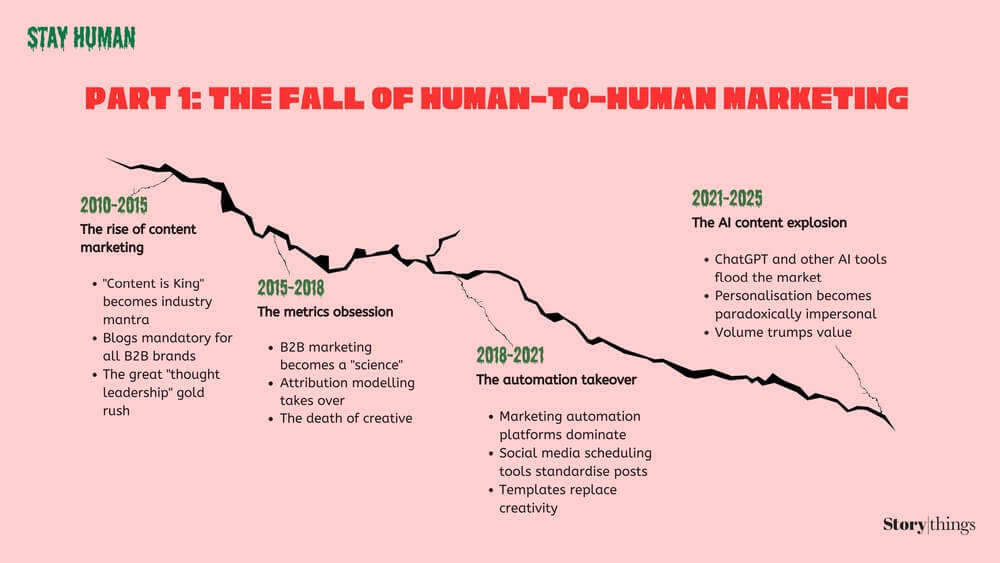
Sensing this shift, Anjali and her team began the Stay Human campaign – a witty call to action for marketers to fight what they describe as an “B2B zombie apocalypse,” where algorithm-first content and generic thought leadership make most B2B marketing feel and sound the same. Amid actionable tips to humanize content, Stay Human clearly states: B2B doesn’t mean boring to boring.
In this conversation, Anjali shares how to avoid marketing jargon and speak like a human, adopt a prototyping culture for more effective content investments, and keep your brand top-of-mind during the — believe it or not — 95 percent of time B2B buyers are not in the market.
How storytelling sets you apart
Brunni: Storythings was founded on the idea that stories are more than just “content.” What do you see as the real role of storytelling in today’s marketing landscape?
Anjali: It’s a heavily overused word, but storytelling is how you can let your audience know your “why”: Why you exist as a brand, why you are worth spending some time with, how and why you are different.
The trick, however, is in not benchmarking yourself against peers, but against everything that your audience is spending time with.
At the top of the funnel, your audience isn’t considering whether to give their attention to Brand A or Brand B, they’re considering whether you’re worth spending time on compared with binge-watching their favourite show on Netflix, listening to their favourite songs on Spotify or scrolling through group messages on WhatsApp. That’s why storytelling can set you apart.

“Storytelling is how you let the audience know why your brand exists, how it is different and why it is worth it for them to spend time with your brand.
At the top of the funnel, the audience is comparing your brand to binge-watching their favourite show or scrolling through messages in the group chat.”
Staying human in the midst of AI slop
Brunni: AI is everywhere in marketing conversations right now. But Storythings’ work insists on keeping stories human at the core. What does “staying human” look like in practice?
Anjali: The role of storytelling has never been more important, or more tricky.
With AI slop getting sloshed around the internet, it takes patience and care to make sure what you’re saying isn’t something a large language model (LLM) can regurgitate.
At Storythings, we talk to our clients about staying human by engaging in story finding, not just story telling — something Artificial Intelligence is pretty rubbish at. It takes empathy to find the right stories that can resonate with a large audience.
Staying Human also means making the effort totalk like a human, not a robot. Marketing jargon may make sense if you’re talking purely to people within your industry. But usually, if you’re building a brand, you’re talking to regular folks.
They don’t care about SEO, PPC, conversion rates, bounce rates, lead generation, and so on. So talk to them about things that matter.
We also often mention the importance of a story having a protagonist, not a subject. A subject is a more passive recipient of whatever is happening in the story; they don’t actively move the story along themselves. On the other hand, a protagonist has agency and their actions move a story along.
An audience is always more interested if they feel invested in the character’s actions — like when they see someone in a horror movie going to open a door, get a sense of foreboding, and shout, ‘No, don’t do that!’ .
Who are the main characters in your story, and what do you want them to do? Many brands center themselves instead, and lose the audience as a result.
Brunni: Many brands still treat stories as one-off campaigns. How do you encourage them to think in terms of systems, formats, and long-term relationships instead?
Anjali: This is one of our favourite questions, because it’s something we grapple with all the time!
Thankfully with the way the marketing landscape has changed over the last few years, more and more brands are realizing the importance of investing in high quality content and thought leadership that elevates a brand, and not just in SEO and paid media.
Don’t get us wrong — the latter has a role to play, but if you use up all your funds on it, you’ll reach a saturation point. Then you’ll need to put more into your top-of-funnel content in order for your audience to move down the funnel and convert. It makes more sense for you to plan to create that content on an ongoing basis so the funnel is always full.
That’s the importance of content and formats that keep people coming back for more. When people go back again and again to watch their favourite YouTube shows or listen to new episodes of a podcast, they learn something new each time.
Contrast this with a one-off campaign: You release it, put spend behind it, and then quickly forget about it. You move on to planning the next campaign, putting a lot of that effort to waste.
With multi-episode formats, you have the chance to tweak and change your content according to what you see is working.
You can bring in new elements to the story and keep your audience coming back to you, instead of surrendering them to the platforms you’re appearing on.
“Brands are realizing the importance of investing in high quality content and thought leadership that elevates a brand, and not just in SEO and paid media.
With multi-episode formats, you have the chance to tweak and change your content according to what you see is working and keep your audience coming back to you.”
Adopt a learn-by-doing approach to content
Brunni: Storythings advocates for a culture of prototyping formats and strategies before making long-lasting decisions. Say more: How can marketers implement that mindset within their teams?
Anjali: Think of prototyping like making a pilot episode of a new show. After you make a pilot, some experts and some members of your audience see it and give their opinion. Then, a show is either greenlit or pulled from the air.
We want to bring that learn-by-doing mentality into content marketing.
We teach client teams to prototype content, test it, tweak it where necessary, and build on the successful elements to increase the value of their content. In the process, you allow people to get to know different aspects of your brand based on a value proposition that keeps them coming back for more.
If you think of yourself as a football player, prototyping is like training. You wouldn’t turn up for a match without having gone for training sessions to improve your technique.
Similarly, with content, prototyping allows you to train yourself and your team in the process of making good content.
Marketers also need to think about workflow.
Some teams are big and skilled enough to manage what a tight production workflow needs, some are too small or don’t have the experience or time to dedicate to producing regular quality content.
But it’s crucial to think about workflow before you invest in content. It’s rather unfortunate to start off something that has huge potential, only to realize that you can’t keep it going because your team has run out of steam or isn’t able to keep to the publishing rhythm.
These are real issues that we see happen time and time again.
ListenFirst’s Director of Marketing Chase Varga shares her strategy while keeping privacy in the equation.
Build ongoing relationships with the audience
Brunni: What shifts in storytelling culture excite you most right now? Where should marketers be paying closer attention if they want to build trust and connection in the years ahead?
Anjali: Obviously we would say this, but invest in building a one-to-one relationship with your audience.That allows you to speak to them when you have something useful to say, instead of waiting for a specific time of year.
Christmas, Easter, summer, Thanksgiving — all great events, but also very saturated with media. It would make much more sense to engage people on a more regular rhythm through the year.
A study from the Ehrenberg-Bass Institute shows only five percent of B2B buyers are actively in the marketat any given time.The other 95 percent aren’t buying yet, but they’re still forming perceptions.
If you’re in B2B, you want to stay top of mind during that 95 percent of the time, so that when they do enter that small five percent window of consideration, they already know and trust your brand.
There’s recently been a noticeable rise in the popularity of storytellers across industries. At the same time, as we all know, AI is shortening creative lifecycles, so there is a risk of storytelling becoming commoditised.
At Storythings we use AI very carefully – we use it a lot for creative ideation but not for actual content creation, and we make sure we disclose any use to clients. It’s a fool’s errand to pretend that AI isn’t creating large-scale change in communications, but it has its limits. It takes one minute of someone trusting AI too much and using it without the required level of quality control to lose the trust and connection with your audience that you’ve built over years.
________
Anjali Ramachandran is a director at Storythings, a B Corp and content marketing agency for brands that want to Stay Human. Anjali is passionate about diversity, equality and inclusion and was a co-founder of global women in tech network Ada’s List. She has worked across India, the US and UK and is a trustee of Wasafiri, the international magazine for contemporary writing.
Storythings produces three newsletters: Storythings Newsletter (with 10 weekly creative links), Formats Unpacked (unpacking the magic in successful formats), and Attention Matters (insights on audiences and attention).