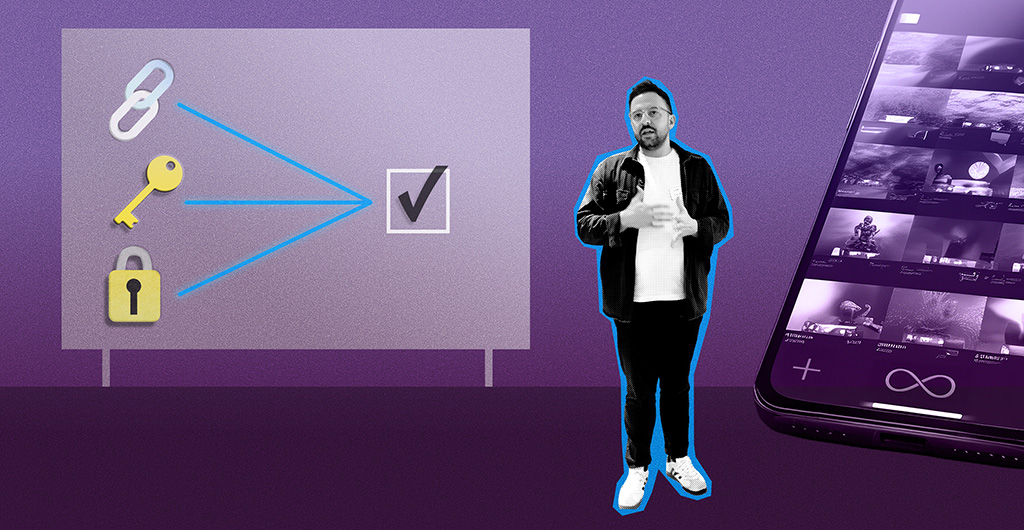

Most people don’t associate social media giants with privacy innovation — and that’s exactly why Mateus Guzzo‘s work matters. As a community & developer advocate for Privacy-Enhancing Technologies (PETs) at TikTok, Guzzo describes his role as bridging the gap between cutting-edge privacy tools and real-world strategies that shape digital platforms.
Although PETs may sound abstract, these technologies solve very real problems. They are tools that let companies learn from data without exposing individual users — think encrypted computation or anonymous metrics as ways to gain insights without compromising individual anonymity. (For more, see TikTok’s video explainer.)
Guzzo’s work draws on a nonlinear path that includes photography, speculative design, and program-building at Harvard’s Berkman Klein Center for Internet and Society. It’s taught him that we can apply a design mindset to the concept of trust.
“There’s a privacy dimension in everything, from how we structure a dataset to how we arrange a room for conversation,” he says.
At TikTok, Guzzo works across engineering and outreach, translating the complexities of privacy infrastructure into conversations the industry and general public can engage with. He advocates for open-source innovation, supports developer communities, and helps steer TikTok’s privacy efforts as both a technical and cultural shift.
More than anything, Guzzo sees PETs as a shared cultural mission. “This is not a single company mission,” he shares. “Because when one of us wins, all of us wins.”
In this conversation, we discuss how privacy can coexist with creativity and performance in digital platforms, the role of open-source collaboration in privacy innovation, and why trust is built collectively across teams, industries, and users.
From media activism to privacy advocacy
Brunni: You describe yourself as a community architect at the intersection of privacy, open tech, and governance. What drew you into this space?
Guzzo: Many things drew me to this space. I started as a photographer, and if we think about it, photography has a lot to do with privacy on a smaller scale: what we show, how subjects want to appear, how perspectives can change what we see.
As a media awareness activist, I also became fascinated with how social media interfaces “narrate” content through algorithms, and the relationship this has to privacy. I freelanced for a while as a web designer, and that spacio-narrative mentality followed me around.
Brunni: And how have those experiences shaped the way you define your role today?
Guzzo: Before starting the role at TikTok, I worked at Applied Social Media Lab at the Berkman Klein Center for Internet and Society at Harvard University. I managed program design (a.k.a. program management & events) for one of the most powerful convening hubs of the internet. There’s also a privacy dimension to the decisions that one makes regarding space, how the chairs in the room are organized, how this design affects conversations, but maybe a more architectural one.
My official title at TikTok is “Community and Developer Advocate,” which I would define as someone who walks side-by-side with the engineering team and supports them with their outreach needs: a “vibes manager,” if you will.
I work with the Privacy Innovation and Open Source teams, and it’s always very cool to learn what they are developing in the field of cutting-edge privacy and open-source technology.
I take what I learn and I try to share with the world, with both technical and non-technical audiences. I think this generally helps everyone have more informed discussions (and decisions) on what matters.
Redefining privacy through technology and culture
Brunni: PETs are often talked about in technical circles, but less so in mainstream marketing or brand conversations. How are they showing up in TikTok’s work, and why do you see them as a cultural and strategic shift, not just a technical one?
Guzzo: We might be ahead of the curve. PETs are a trending topic now in technical (and policy) circles, and I hope we will talk more about them in marketing and brand conversations very soon.
Digital advisor Kasia Chmielinski once said “there’s no such thing as a technical problem, only a people problem, a process problem, and a culture problem.” In the case of PETs, I think it’s all of those combined with technical problems, which are slowly being solved by brilliant scientists.

Nowadays, people care more and more about their privacy — as they should. Every business, from small to big, needs to think carefully about how they are treating their customer or user data. In a way, it’s a very basic feature, but also a complicated one.
It’s amazing to see how far the community has gone with technologies such as differential privacy [a framework that protects privacy by releasing only statistical information rather than individual data] and confidential computing [a cloud computing technology that keeps data protected even when it is in use]. The culture and strategic shifts that this infrastructure will enable are still to be defined, in my opinion.
TikTok’s approach to privacy innovation
Brunni: Most people don’t associate social media giants with privacy innovation. Why does it matter that a platform of TikTok’s scale is investing here, and what signal does that send to the industry?
Guzzo: I was very impressed with the investment of the company into privacy technologies when I joined. I was met with a team of the highest technical ability that is not only working on internal solutions, but is proactively raising the bar of what privacy and data protection means for an entire industry.
If we look at Project Clover [a European data security initiative], for example, the investment and the technology behind it is way ahead of the competition.
Find out how PETs can enhance consumer trust.
Improving privacy in ad measurement
Brunni: There’s more work we can all do to sense cultural shifts without overstepping data boundaries. How can PETs help marketers and platforms tune into signals responsibly, instead of falling into surveillance habits?
Guzzo: There are really powerful PETs out there that allow for both usability and data protection. When you combine different PETs in a synergistic way, which is the case of our solution for private ads measurement PrivacyGo, it gets even better.
Ad measurement in itself is a huge technical challenge. Advertisers want to know if their money is well spent.
It looks a bit like this: I see an ad on social media platform A. Then I go to search engine B, and I see the same product. Then I go to social media platform C, and I see the product again. The next day, I go straight to the product website and buy the product.
Which advertiser should be compensated, A, B, C, all of them, or none of them? It’s tricky.
With PETs, you can make this kind of measurement better without having to sacrifice individual users’ privacy, usability, or efficiency. It sounds like magic, and most good technology feels like that.At the same time, these technologies are not a silver bullet to all privacy challenges, but are an important step in the right direction.
The other technology that blew my mind at TikTok is called Confidential Computing. As an industry, we are still in the early adopters phase, so this may become a huge way of how private data analytics works in the future.
I am an avid participant of the outreach committee of Linux Foundation’s Confidential Computing Consortium, and if any of your readers are not on this train yet, hop on! A recent study sponsored by the Consortium highlights that 75% of companies surveyed are adopting confidential computing technology.
Nowadays, people care more and more about their privacy — as they should. Every business, from small to big, needs to think carefully about how they are treating their customer or user data. In a way, it’s a very basic feature, but also a complicated one.
The future of privacy
Brunni: Many brands still think of privacy as compliance overhead. What’s the missed opportunity if they don’t see privacy and cultural intelligence as core to building long-term trust?
Guzzo: Privacy is an investment. Often, it’s the differentiating aspect that shapes customer and user choices.
If you are a data collector, you need to be ahead of the curve. If you rely on analytics and insights, you also need to be ahead of the curve. That’s where cultural intelligence comes from, and PETs are the way to go to protect user privacy, and build trust.
I guess that’s why the industry needs more privacy advocates like us, who can act as an interface between the technical teams, the business, the policy, and the communities that use technology, inside and out.
Brunni: Looking ahead, what makes you optimistic about the future of PETs and platform governance?
Guzzo: It’s inspiring to see PETs gaining traction in public and policy discourse, and to see companies like TikTok investing in cutting-edge technology to ensure user privacy.
This is not a single company mission, because when one of us wins, all of us wins. There’s a long way to go, but this openness gives us more space to work with.
________
Mateus Guzzo is a community architect, researcher, and designer at the intersection of privacy, open technology, and platform governance. He is a community & developer advocate for privacy enhancing technologies (PETs) at TikTok, a member of the Confidential Computing Consortium Outreach Committee, and an advisory board member for OpenUK’s SooCon26. His work is focused on co-designing platforms for responsible technology cooperation.