

In the world of mobile gaming, success hinges on a delicate balance between monetization and player enjoyment. For years, intrusive ads and clunky consent pop-ups have threatened to tip the scales, disrupting gameplay and frustrating users.
But what if the very act of engaging players — with respect for their privacy — could unlock greater revenue?
Kristan Rivers, founder and CEO of AdInMo, believes this is the future: “In-game ads should actually enhance the player experience, not detract from it.”
This approach, which places player joy at the center of the business model, offers a powerful lesson for marketers in every industry grappling with data privacy and customer retention.
At Usercentrics’ 2025 Privacy-Led Marketing Summit, Rivers traded insights with our Senior Director of Product Marketing, Mariela Madzharova Lavric. They discussed how collecting both zero-party data (which is proactively shared by consumers) and first-party data (which is captured by businesses) helps brands to drive sustainable growth with a focus on user experience.
Ads don’t have to “optimize the joy” out of experiences
For many businesses, data collection has become an exercise in optimization that often comes at the expense of the user experience. Usercentrics research shows that 62 percent of consumers feel they’ve become the product.
Aggressive pop-ups, confusing consent banners, and irrelevant ads can make customers feel like they are being mined for data, not valued for their loyalty.
This friction can lead to drop-offs, uninstalls, and a general sense of distrust.
of consumers feel they’ve become the product
For example, imagine you’re playing a racing game when you’re interrupted by an ad that obscures half of the screen, causing you to crash. When monetization strategies disrupt the core experience of playing a game or reading an article, brands risk losing their audience’s attention.
Rivers warns against this approach and offers a way for the gaming industry to course-correct. “As an industry, we’ve swung the pendulum too far towards monetization. The consumer is a massive stakeholder in what we do, but the commercial relationship creates tension between data collection and the player experience.”
The way to bridge that tension? Personalization.
“It’s 100 percent in the player’s best interest,” Rivers says.
Research supports the need for personalization based on consented data, especially zero-party and first-party data. As Madzharova Lavric notes, over 71 percent of customers expect personalization, and 62 percent of consumers say that brands lose loyalty if they don’t provide a personalized experience.
The goal for marketers in these contexts isn’t just to capture data; it’s to create an environment where users willingly share it because they see tangible benefits.
A winning formula: consent, trust, and player choice
The AdInMo strategy is built on trust, leveraging real, human-consented data from over two billion game sessions, supported by the Usercentrics Consent Management Platform (CMP).
Before implementing the CMP, one of AdInMo’s game publisher partners saw virtually no properly consented players, but the results were transformative.
“The TCF string [encoded details about user consent] being passed went from zero to over 80 percent,” Rivers reports. Even more impressively, “The opt-in for device ID sharing went from about 20 percent to over 50 percent for this particular game.”
This wasn’t achieved through dark patterns or coercive designs. It was the result of giving players clear choices and integrating consent seamlessly into the experience.
“That’s the outcome you see when you explain to players the why behind the sharing of their data, and an understanding of what it’s being used for,” says Rivers.

In-game ads should enhance the player experience, not detract from it. Personalization is 100 percent in the player’s best interest.
The power of zero-party data in action
There’s another compelling example in the case of Nimblebit, the game developer behind mobile games like Pocket Frogs and Tiny Tower.
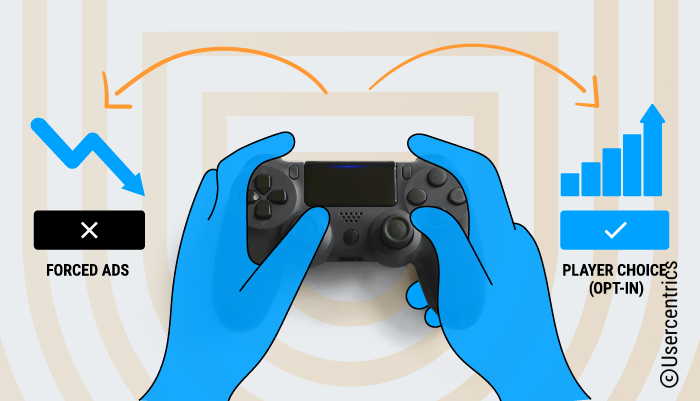
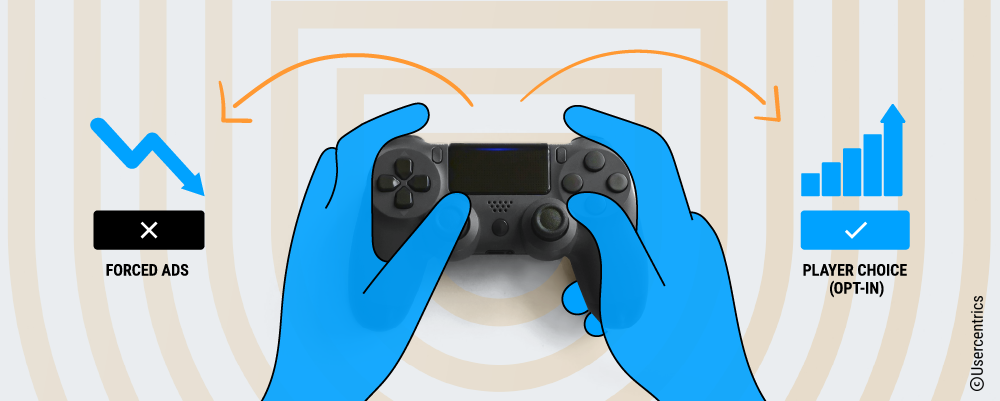
Instead of forcing ads on players, Nimblebit gave them a choice. In a building game, players could decide whether to build a “marketing floor” in their virtual tower that would display in-game ads from AdInMo.
They weren’t required to build this floor, but doing so would enable access to in-game rewards.
This opt-in model, rooted in zero-party data, empowered players to control their ad experience. As a result, Nimblebit saw an increase in D7 retention — the percentage of users who return to an app seven days after installation — and overall engagement.
Why? Because the choice was theirs. The ads became part of the game, not an interruption to it.

These moments give agency to the player, who can willingly share their experiences through contextual consent and preferences. They create the foundation for personalization that feels natural, transparent, and respectful.
AdInMo’s work has found that when engagement is driven by enjoyment rather than obligation, users are more likely to spend time and money within the app.
According to Rivers, this helps achieve game developers’ and their players’ mutual goals. “Happy players are monetizable players,” he says.
The pillars of good advertising: consent and relevance
At its core, the conversation about data in advertising is about two things: consent and relevance.
“Advertising isn’t inherently bad. But poorly targeted, irrelevant ads are a horrible experience,” Rivers shares. On the other hand, data is most useful when it delivers personalization that adds value for the user, not noise.
This idea is at the heart of Privacy-Led Marketing (PLM), a nascent category that reframes privacy as a strategic advantage rather than a compliance hurdle.
The gaming industry’s journey offers a blueprint for any business looking to thrive in the privacy-first era.
The lesson is clear: Customer experience and data privacy are not opposing forces. When integrated thoughtfully, they create a cycle of trust, engagement, and growth.
“The future isn’t about tracking people,” says Madzharova Lavric. “It’s about building relationships through transparency and respect.”
Is it too ambitious to imagine a future where data privacy actually enhances fun?
We certainly don’t think so.
Find out how Privacy-Led Marketing redefines trust with Usercentrics CMO Adelina Peltea. Get a behind-the-scenes look at how marketers are shifting towards trust.