

For years, brands have obsessed over personalization — whether for sportswear, theme parks, or food & bev. However, as this strategy matures, its limits have become visible.
Many companies look to build loyalty through a detailed profile with customer names, past purchases, and buying habits. The model is simple: collect as much information as possible and use that to deliver the “right” message at the “right” time.
Yet, data can tell us what customers do, but not always why they do it. For brands with a presence in multiple markets, this gap becomes even more pronounced. Precision alone is no longer enough. That’s why the future of personalization isn’t just data-driven; it’s also culture-driven.
Data will remain essential, but without cultural intelligence, the ability to interpret context, nuance, and shifting values, personalization risks falling flat.
The limits of data-driven personalization
The early promise of digital personalization was precision. The more information collected about a customer, the more tailored an experience could be.
But precision is not the same as resonance.
For example, a campaign might resemble past purchases, yet overlook the cultural significance of colors, holidays, or symbols that shape its reception and impact.
In the same vein, data can reveal what someone did, but not why it matters in their culture.
Even legal requirements show this. Rules differ by market, and they reflect what each culture values. For example:
- In South Korea, advertising regulations and practices emphasize Confucian values like respect for elders, social harmony, and modesty, reflecting the nation’s cultural priority of balancing tradition with modern consumerism.
- In the United Arab Emirates, all marketing materials must be government-approved to align with cultural and religious norms.
- Across Europe, the General Data Protection Regulation (GDPR) limits how personal data can be used, reflecting a strong commitment to privacy and individual rights.
- In France, the Toubon Law requires advertisements to be in French, reflecting the protection of the French language as a cultural identity.
- In Quebec, Canada, Bill 101 makes French the dominant language of signage and commerce, reinforcing the province’s francophone heritage.
When you view these as cultural signals rather than obstacles, you build trust instead of just checking boxes.
We could easily imagine a situation where an algorithm notes that a customer in Quebec engaged with English content, so it serves up more English ads. But this misses the contradiction in local values and a general preference for the French language.
In other words, the data was accurate, but it couldn’t interpret the cultural meaning. The same pattern often repeats, highlighting the limitations of data.
This doesn’t mean data-driven personalization has failed — far from it. In fact, it has enabled some of the most effective marketing strategies of the past decade. It’s just not designed to account for culture.And in a world where cultural context shapes everything from purchase decisions to brand loyalty, that gap becomes a serious problem.
Max Lucas, the founder of privacy tech agency DWC, walks us through consent banners that build trust with consumers.
Personalization needs cultural intelligence
Cultural intelligence is the ability to read social signals, language, values, community dynamics, and adapt accordingly.
In marketing, cultural intelligence recognizes that seemingly identical demographics can respond completely differently to the same message depending on their cultural context.
This matters because culture shapes not only what people buy, but also how they relate to brands.
Culture influences language, symbolism, humor, imagery, and even colors.
It defines what is aspirational in one market and ordinary in another.
It sets boundaries for what is respectful, authentic, or appropriate. To succeed, marketers must look beyond clicks and conversions and deliver personalization that fosters real connection.
Marketers should know that culture shapes not only what people buy, but how they relate to brands. Culture influences language, symbolism, humor, imagery, and even colors. It defines what is aspirational in one market and ordinary in another. It sets boundaries for what is respectful, authentic, or appropriate.
Without cultural intelligence, even the most data-rich personalization can miss the mark. A campaign designed for one audience may be irrelevant, or even offensive, to another.
And unlike a misfired product recommendation, these misalignments can create lasting reputational damage.
Euro Disney is a clear illustration of this. When Disneyland launched outside Paris, it assumed customers wanted the “authentic” American Disney experience. It kept English-only instructions, banned wine on park grounds, and priced tickets high, with standardized merchandise and food.
The formula was consistent with Disney’s global brand, but it ignored French cultural expectations. Visitors were dissatisfied, and Euro Disney was quickly declared a failure. Only after the park adapted — embracing local food, language, and customs — did it begin to succeed.
The point is not that Disney lacked data. They knew their audience size, spending power, and demand forecasts.
What they lacked was cultural intelligence: they didn’t account for how French families spend leisure time, how meals are a central part of the day, or how language is tied to national identity. The absence of these insights meant that what looked like a perfectly logical strategy on paper failed to connect in practice.
When it comes to personalization, cultural intelligence prevents brands from treating customers as interchangeable data points and instead allows them to recognize the values and meanings that shape behavior.
When a customer’s culture is acknowledged and reflected in their interactions, they feel truly seen, and this emotional connection drives real business results. In fact, emotionally connected customers are more than twice as likely to spend more, recommend a brand, and deliver a 306% higher lifetime value than those who are merely satisfied.
The interplay of data and culture
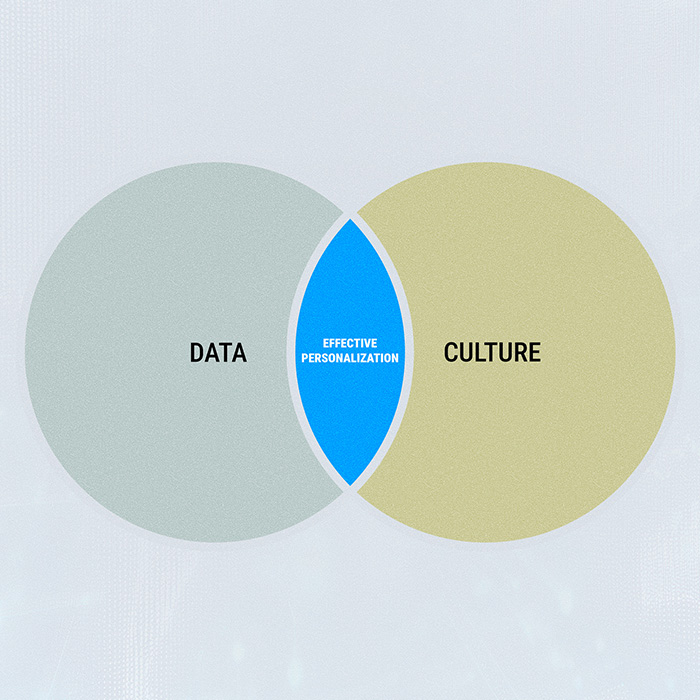
That said, data and culture aren’t competing approaches — they’re complementary. Data shows you patterns, and culture helps you interpret what those patterns actually mean.
This becomes critical as AI handles more personalization. Algorithms are great at spotting correlations, but terrible at reading context. Feed them pure data, and they might deliver technically accurate but culturally tone-deaf results.
Say you notice increased searches for “privacy tools.” That could mean fear of surveillance, curiosity about new tech, or a reaction to recent news.
Without cultural context, you’re guessing. With it, you can respond appropriately.
Research backs this up: an Ipsos meta-analysis of more than 1,200 ads found that fewer than a third performed equally well across countries — proof that culture shapes whether an idea actually connects.
Take Budweiser’s global expansion as an example. In the U.S., its messaging centered on rugged authenticity: Clydesdale horses, hard-working brewery workers, and “work hard, play hard” values.
While the data supported this approach domestically, it fell flat internationally.
In China, those same images read as low-brow and uninspiring. The cultural context was completely different. Premium meant beautiful packaging and sophisticated branding, not blue-collar authenticity. Budweiser had to shift to aluminum bottles and elevated messaging to succeed.
Same product, same data about beer consumption patterns, but totally different cultural execution.
When a customer’s culture is acknowledged and reflected in their interactions, they feel truly seen — and this emotional connection drives real business results. In fact, emotionally connected customers are more than twice as likely to spend more, recommend a brand, and deliver a 306% higher lifetime value than those who are merely satisfied.
Moving forward with cultural intelligence
Understanding cultural intelligence is one thing. Actually implementing it is another.
The good news is that you don’t need to overhaul everything at once. You can start with a few strategic shifts that compound over time.
Invest in ethnographic market research
Ethnographic research reveals the everyday habits, rituals, and social dynamics that shape consumption — insights that raw data alone can miss.
However, ethnographic research helps brands to understand not just what people do, but why it matters to them.
For instance, Nike’s global success partly comes from recognizing that athletic wear means different things across cultures; it’s a status symbol in some markets and purely functional in others.
Conduct cultural audits of current materials
Always review campaigns, packaging, and digital experiences through a cultural lens, ideally with local stakeholders or consultants. What feels playful in one market may appear flippant in another, and a color associated with luck in one culture may carry negative connotations elsewhere. For instance, a color like red evokes excitement or urgency in many Western campaigns. However, in China, red is widely viewed as a symbol of luck and prosperity.


Cultural audits reduce risk, but they also surface creative opportunities that might otherwise be missed.
Connect the dots between consumption patterns
Different cultures frame decision-making differently.
In individualistic contexts, marketing can appeal to self-expression or personal achievement.
In collectivistic cultures, messages that highlight family, community, or social status resonate more strongly.
Alongside messaging, brands can tailor pricing, product bundles, and sales channels to align with cultural logic.
Adopt culturally specific communication styles
Go beyond word-for-word translation. Localize and adapt your intent, tone, and emotional impact for the target culture.
Brands can work with local copywriters and content creators to ensure your campaign’s spirit is properly reflected across markets and cultures, rather than blindly translating and missing the mark.
Integrate compliance as cultural respect
Meeting local data and advertising regulations should be seen not only as a legal necessity, but as a cultural acknowledgment.
Language laws in France, content approvals in the UAE, or privacy protections in Europe all reflect deep-seated values. Approaching compliance as a way to show respect signals that your brand understands and honors local priorities — strengthening trust before a single product is sold.
Finding the balance between data and meaning
Personalization that is built only on data may be efficient, but it risks feeling hollow.
This is especially true for companies operating in multiple markets. Data can deliver the right offer at the right time, yet miss the moment entirely.
On the other hand, cultural intelligence transforms personalization into something more enduring. It adds context, nuance, and respect.
For enterprise brands operating in a privacy-first world, this is not optional. It’s the foundation for trust.
While data may show what customers do, culture explains why it matters. When the two are combined, personalization evolves from being a tactic to an ongoing relationship with your customers.
Jens Quentin of Eye-able explains how you can apply cultural intelligence to your consent management platform and policies.