

Imagine you land on a website you’ve never visited before. The page loads, and immediately a cookie banner appears, blocking your view of the content.
Here’s what you see: The design is cluttered. The language is dense and hard to parse. The reject button is small and tucked away in the corner, while the accept button is prominent and bright.
You want the information on this site, but something about how they’re asking for your consent feels off.
So you hesitate. You look more carefully at what they’re actually requesting. You wonder whether you can trust them with your data.
As the Usercentrics State of Digital Trust report shows, you’re not alone in having that moment of hesitation. Millions of users face this same internal conflict every day, and increasingly, they’re choosing to decline.
Consent rate matters — here’s why
The consent rate measures a simple but critical metric: the percentage of website visitors who actively agree to non-essential cookies when presented with a cookie banner.
In other words, it’s the ratio of users who click accept to the total number of users who encounter your banner.
For marketers, this number matters enormously. When visitors consent to cookies, you gain access to behavioral data that powers personalization, retargeting, and performance measurement. More consent means richer data, which translates directly into more effective marketing campaigns and better customer experiences.
But without meaningful consent, your ability to understand user behavior and deliver relevant content is severely constrained.
As an agency, we see how the landscape is shifting: Fewer people are willing to consent to cookie collection on our customer’s websites and apps than they were in the past.
This downward trend isn’t random or temporary. It reflects a genuine change in how people perceive data collection, privacy, and the brands asking for access to their digital behavior.
It’s essential to understand why users are increasingly declining cookie banners if you want to reverse this trend and build sustainable consent strategies that don’t rely on manipulation or deception.

Transparency is the foundation of trust in any consent interaction. Users need to understand, clearly and without ambiguity, what data you’re collecting, why you’re collecting it, and what you’ll do with it.
Why are people more likely to decline a cookie banner?
In your personal life, it might feel natural to decline cookies — especially when the experience feels “off.” But as a marketer, it can feel frustrating when your brand, and your data, is the one affected.
So let’s look at it from a brand perspective. Declining consent rates are rooted in two interconnected shifts in user behavior.
First, privacy awareness has fundamentally changed. People today understand far better what data collection means and what happens with their personal information once it’s shared. This heightened awareness translates into a more cautious approach to consent.
Users are no longer passively accepting cookies because a banner appeared on screen. They’re actively questioning whether they should.
The second factor is trust erosion. When brands handle data poorly, when privacy policies remain opaque, or when users feel manipulated by deceptive design patterns on cookie banners, trust deteriorates. And once trust is damaged, consent becomes much harder to obtain.
Users increasingly recognize that many companies prioritize data collection over genuine transparency about how that data will be used. This combination of stronger privacy consciousness and weaker brand trust creates a challenging environment for consent rates.
People want to protect their digital footprint, and they’re skeptical that companies will do right by their data. The result is a growing population of users who simply decline cookies rather than hope for the best.
On the surface, dark patterns seem like an easy solution to the consent problem — like making the reject button smaller or less visible than the accept button or using confusing language that makes opting out feel complicated.
These manipulative design tactics work in the short term: They artificially inflate consent rates by removing or obscuring the choice to decline. But this apparent win comes with catastrophic hidden costs.
Learn about the risks of dark patterns — and what to do instead
The trust-first approach: three core principles
There is a better way, and it’s called Privacy-Led Marketing. Instead of resorting to manipulation, the most effective path to higher consent rates lies in building genuine trust with your users.
This requires a fundamental shift in how you approach consent design. It centers on three core principles that put user experience first: transparency, value, and design consistency.
Transparency
Most dark pattern implementations violate privacy regulations, particularly GDPR.
Regulators across Europe have shown that consent obtained through manipulation is not valid consent. Companies can face fines of between six and nine figures, and, in extreme scenarios, up to 4% of global revenue or 20 million euros, whichever is higher.
But there’s another reason to avoid them: When users feel manipulated, their skepticism deepens. They remember the experience and are less willing to engage with your brand in the future.
Transparency is the foundation of trust in any consent interaction. Users need to understand, clearly and without ambiguity, what data you’re collecting, why you’re collecting it, and what you’ll do with it.
When privacy policies are written in dense legal language, when cookie purposes are obscured behind technical jargon, or when the actual scope of data collection is hidden, users feel uneasy. That unease translates into declined consents.
The opposite is equally true. When you explain your data practices in plain language that any user can understand, you give people the information they need to make an informed decision. This shifts the dynamic from manipulation to partnership.
Improving transparency starts with your cookie banner itself. Display your privacy policy prominently — and instead of generic categories like “Marketing” or “Analytics,” explain what these categories actually mean in concrete terms.
For example, instead of simply listing “Personalization,” say something like: “We use cookies to show you products similar to ones you’ve viewed before, so you see items that match your interests.” This specificity helps users understand the actual benefit they receive.
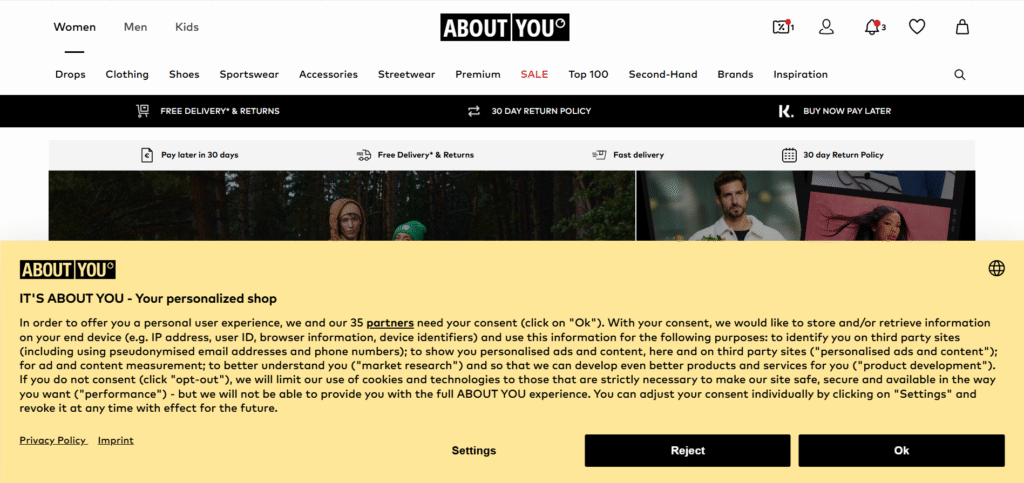
At the same time, if you’re working with 35 partners to deliver personalized experiences, as some major retailers do, say so. Explain how long cookies persist and whether data is shared with third parties.
Users appreciate honesty far more than they appreciate vague reassurances. While transparency doesn’t guarantee acceptance, it removes a major barrier to trust.
Now, she’s seeing marketers move to new playbooks with higher quality data.
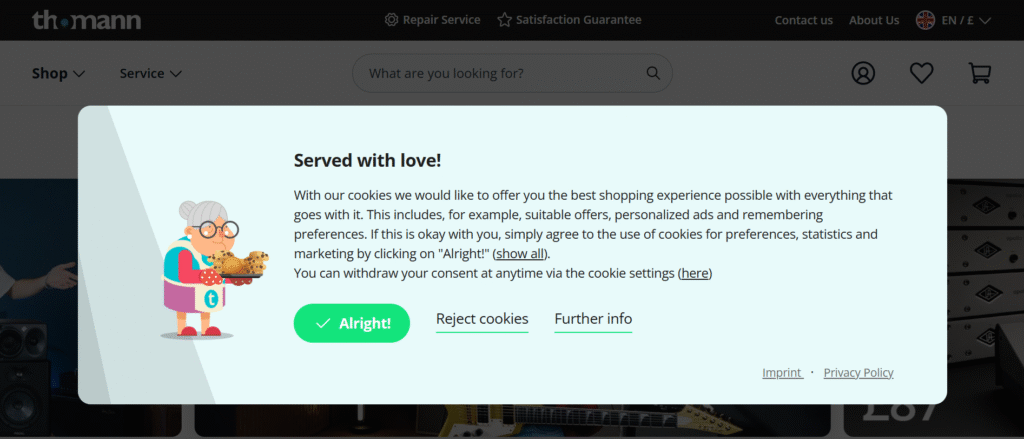
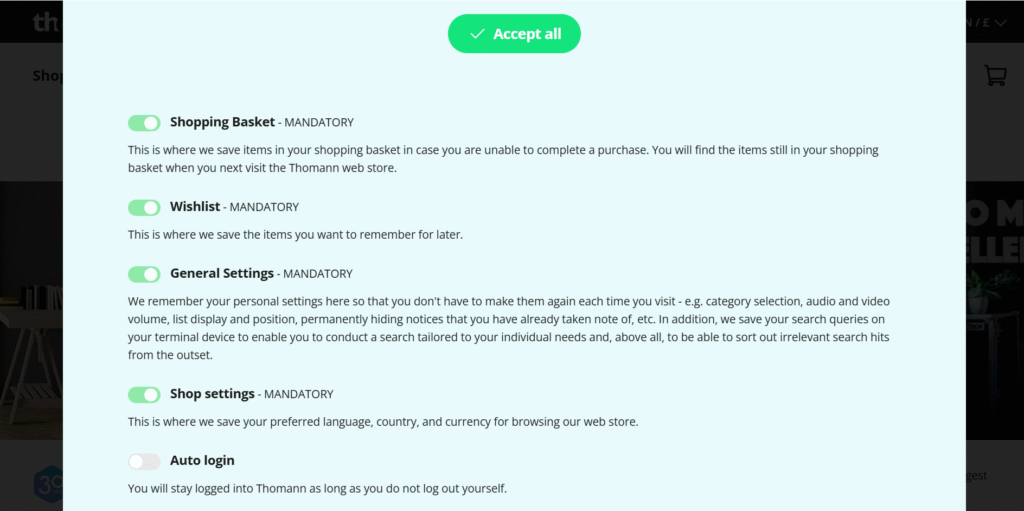
One example I particularly like is from Thomann. It’s eye-catching, explains the data purposes in simple words, and offers clear options for the decision. Plus, users can click “Further info” to find a well-structured toggle list.
Value
When you collect behavioral data, you gain insights that allow you to personalize user experience, recommend relevant products, or deliver ads users actually care about.
Your job is to make that value proposition explicit.
Instead of asking for blanket permission to collect data, explain what specifically improves when someone says yes.
Let’s say you’re requesting consent for recommendation cookies. Show users how this works: “We use cookies to remember the products you’ve viewed so we can show you similar items you might like.”
Better yet, demonstrate the value in context. If a user is browsing your product pages, you might display a message saying, “We can show you products we think you’ll love based on what you’re viewing right now. Would you like us to use cookies to do this?”
This contextual approach is effective because it connects the consent request to an immediate, understandable benefit.
Our experience shows that when companies use proper contextual consent, acceptance rates climb dramatically higher than with banner-only approaches.
You can also build value by being specific about exclusions. A line like, “We will not share your data with advertisers for targeting purposes outside our website” reassures users you respect certain boundaries.
Users are more willing to consent when they understand what they gain, which makes it a genuine agreement vs. a surrender.
Retail brand About You does this well, explaining the options for personalization and enabling the visitor to have granular control over their preferences through settings.
Similar to the Thomann example above, they highlight the value of consent in a catchy way with the headline “IT’S ABOUT YOU – Your personalized shop” — something that sounds much better than “Cookies used for personalization and remarketing purposes.”
Design consistency
The third principle is design consistency. Your cookie banner shouldn’t feel like an intrusive popup that was bolted onto your website as an afterthought.
It should integrate seamlessly with your brand’s design language, visual hierarchy, and overall user experience.
When a banner looks out of place or fundamentally different from the rest of your site, it signals that consent is something separate from your core service. Users notice this disconnect, and it undermines trust.
Design consistency means several things in practice.
First, your banner should use your brand’s colors, typography, and visual style. If your website is clean and minimalist, your cookie banner should reflect that aesthetic. If your brand uses bold, conversational language and playful design elements, your banner should match. This cohesion sends a message that you’re being transparent and authentic rather than deploying a generic compliance tool.
Second, ensure that your banner layout and interaction patterns align with how users navigate the rest of your site. If your website uses certain design patterns for important decisions or settings, your cookie banner should follow similar conventions. This familiarity reduces cognitive load and makes the consent choice feel natural rather than jarring.
Third, avoid using the banner to block your website’s main content unnecessarily. A banner that takes up half the screen or prevents users from accessing the page they came for creates frustration and resentment. Instead, position it in a way that informs users without disrupting their primary task.
If your website has a specific design language for important notifications or messages, use that same approach for your cookie banner. When your consent experience feels native to your brand rather than foreign to it, users perceive it as genuine.
As an example, many people are familiar with IKEA’s bright visuals and use of color. Their consent banner uses a font that matches the site content, and it explains users’ options at the same time as it doesn’t obscure what’s behind it.
This allows visitors to weigh the exchange and make a clear choice.
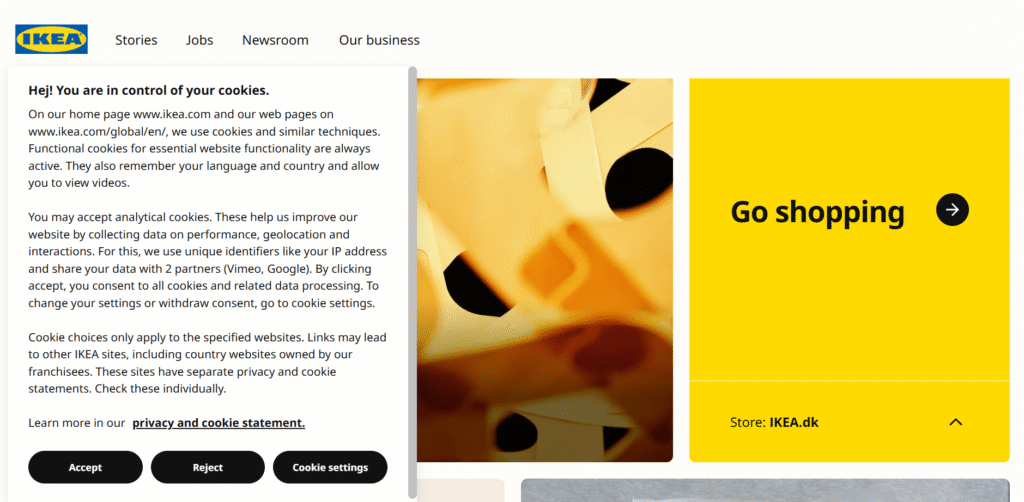
On desktop devices especially, it is possible to navigate the IKEA shop without making a decision — a powerful technique that often leads to a decreased bounce rate, something that’s important for performance marketing and advertising networks.
What would make you consent?
Think about your own online behavior for a moment. When you land on a website and see a cookie banner, what would it take for you to say YES! with confidence?
You would probably want to understand what happens with your data and what benefit you get in return for your acceptance.
You would probably want to see this explained in a way that fits the brand and feels honest rather than opportunistic.
It would feel better if the banner looks and behaves like a natural part of the user journey, not a foreign element trying to rush you into a decision.
In other words, you would be probably more willing to consent if transparency, value and design consistency were all respected.
This is the real shift that privacy-conscious, growth-minded brands now need to make. Instead of forcing the user into an unwanted interaction, marketers should ask themselves: “How can we design a consent experience that we ourselves would feel comfortable accepting?”
Answering that question helps you build a consent strategy that breaks the downward spiral of consent fatigue, respects people’s choices, and increases your brand trust value.
Most importantly, it leads to higher acceptance rates that sustain performance in the long term.
______________________________
Max Lucas is the founder of DWC, a Germany-based agency focused on the implementation and maintenance of privacy technology and software (like Usercentrics) and privacy-friendly digital measurement. Its USP is a unique interdisciplinary approach that combines resources from marketing, tech and legal. For more information, visit www.dwc-consult.com.