

In a digital landscape where relationships are often measured in clicks and impressions, the idea of community brings marketers back to something more enduring: connection that compounds. When communities are built with intention, they don’t compete with marketing or product — they strengthen them.
In communities, trust becomes tangible. People deepen their understanding not only of what a brand sells, but of what they stand for.
“Community lifts all boats,” says Zach Hawtof, co-founder of Tightknit, a community platform for the workplace communication platform Slack. “It’s a multiplier for everything. When you understand what other teams are trying to achieve, you can amplify those efforts and create better outcomes for everyone.”
That means considering the factors that make a community worth taking part in, even when it’s built around a product. “Growth matters, but not at the expense of engagement, belonging, and connection,” Hawtof says.
The idea that community isn’t just a nice-to-have, but a connective layer between consumers, teams, and brands, anchored the discussion at Usercentrics’ 2025 Privacy-Led Marketing Summit. Hawtof joined MC Silfer, Head of Community & Events at Zensai (a suite of HR tools for Microsoft 365), and David Diaz, community manager at Usercentrics to explore how tech communities can support business goals without losing their human core.
Their conversation shows just how central authenticity is to trust, and how community helps brands to build it from the ground up.

Community lifts all boats. It’s a multiplier for everything. When you understand what other teams are trying to achieve, you can amplify those efforts and create better outcomes for everyone.
The central tension of building community
Authenticity is central to trust, and community helps brands build it. Yet, despite their focus on connection and belonging, communities still operate inside organizations built for measurement.
Reconciling those two worlds is both a challenge and a superpower.
“Community thrives on trust and belonging, and you can’t KPI yourself into that,” says Silfer, referring to the traditional metrics used by marketers to track performance.
If community members suspect a company’s intentions are not grounded in trust, they may rethink their involvement. “The business side still demands ROI, dashboards, and data to prove it’s working, but nobody wants to feel like they’re part of an acquisition channel,” she says.
Let’s break that down for a moment.
For many community managers, that tension is a daily reality. Engagement can be measured, but its impact rarely follows the same time frames or logic used by sales or marketing teams.
When a community becomes too transactional, members notice — and they disengage.
Hawtof sees this tension as an invitation to build stronger internal partnerships. “A lot of leaders have never run a community before,” he explains. Education becomes part of the job: asking questions like, Is it growth at all costs, or is it value? “Value can be many things, but it’s up to the community manager to work with the rest of their team to accelerate goals,” he says.
That cross-functional alignment is essential. As Silfer notes, “Community has to be driven by leadership, the C-suite. They have to see its power and importance, and only then will they invest the time and resources it needs.”

Nobody wants to feel like they’re part of an acquisition channel.
Community as social listening
When brands listen actively, communities become a source of truth, acting as both an early-warning sign and ground for experimentation and innovation.
They’re where customers reveal unmet needs, exchange early product impressions, and even help each other solve problems faster.
For Hawtof, that’s the real value: “Your job as a community leader is to accelerate other teams’ goals,” he says.”
In practice, that means a conversation from within the community can inform a product fix, validate a new feature, or highlight pain points even before they show up in support tickets or surveys.
Usercentrics will soon launch a community to bridge online and offline connection.
“It’s not just about gathering people in a Slack space,” community manager Diaz says. “We want to create something that lives beyond the screen where partners, customers, and peers can exchange knowledge and ideas, as well as strengthen the network of trust that already surrounds our brand.”
This exchange benefits members just as much as it benefits the business. Ask a question in an active community and you receive many answers — grounded in lived experience, not generic documentation. The result is a feedback loop that feels authentic because it is peer-to-peer rather than top-down.
In that sense, community becomes a truth engine: a dynamic space that helps brands understand what their audience needs as well as their evolving relationship with the product and with each other.
How to track community success
Measuring community impact goes beyond absolute numbers, and it goes back to knowing which signals matter. While engagement, dashboards, and growth metrics certainly have their place, Hawtof warns against giving them too much weight.
“Don’t think about growth as the only goal, because it will wash out a lot of the wins around engagement, belonging and connection,” he says.
Instead, strong communities track success across three dimensions:
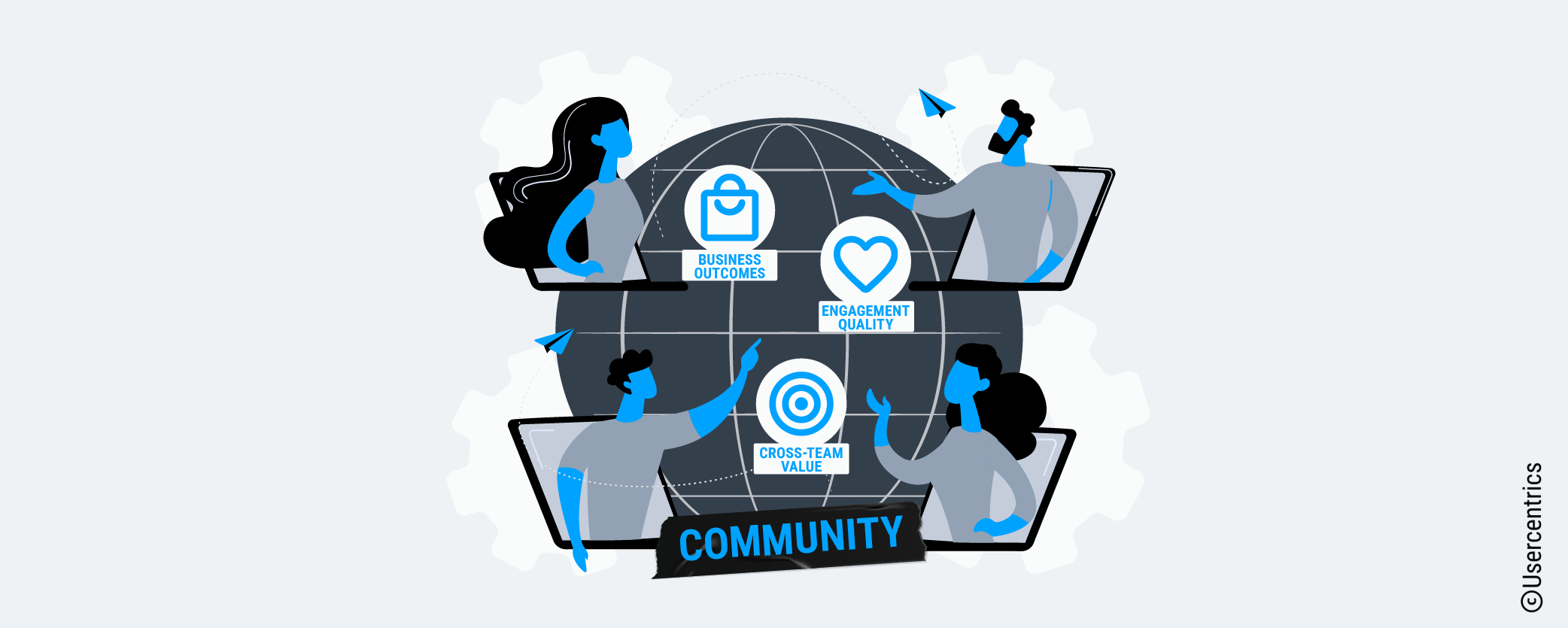
Business outcomes
There are ways to connect community to business outcomes through indicators like net revenue retention, churn, upsell and cross-sell.
Comparing the performance of accounts that participate in the community versus those that do not often reveals clearer patterns: Do members stay longer? Renew more often? Expand more confidently?
Engagement quality
Community engagement means moving beyond vanity metrics like log-ins or post counts.
What matters is whether the right people — ideal customers, partners, advocates — are participating. If they are not, identify the barriers and address them.
You can connect the platform you use for customer relationship management to community activity to identify clear outcomes, like which members refer others, test new features, or expand their product use over time.
Cross-team value
Strong communities involve working directly with other teams. Ask: Can the community help to accelerate goals that we share with other departments?
Community managers can also connect the community to cross-team objectives:
- Does the community provide real user feedback to inform product?
- Does the community amplify marketing through advocates and positive word-or-mouth?
- Does the community help customer success to increase satisfaction and reduce support tickets?
Communities and trust: a two-way street
Trust is often described as the result of a strong community. But it’s also one of its biggest conditions for community to exist in the first place.
Every interaction — whether it’s a product conversation, a shared challenge or a learning moment — either reinforces or weakens that trust loop.
“At Usercentrics, we’re building our community as a space where partners and customers can meet each other, not just us,” says Diaz. “When people connect over shared goals rather than product features, that’s when real trust starts to grow.”
As Hawtof puts it, “You’re working with humans, the most complicated of creatures. So you’re trying to evaluate something that can’t be truly quantified like someone’s feelings towards a company, or how they like a product. It is similar to trying to evaluate brand.”
That’s precisely why communities matter: they make the intangible, visible. A strong community doesn’t just reflect user sentiment, it also helps shape it. It’s in that space that companies learn what resonates, what didn’t land well, and what their audience really needs.
Silfer sees this as a continuous exchange. “Real impact happens when you co-create this with your customers and partners,” she says.
“Don’t just create something because you think it’s the right thing to do. Ask them, and make sure you’re delivering something that’s meaningful.”
In the era of data privacy, trust is your strongest growth driver. Learn more about the foundations of Privacy-Led Marketing.