

Digital consent has reached an inflection point.
According to Usercentrics research, cookie acceptance rates are declining for the third consecutive year across Europe and the U.S., with nearly half of consumers accepting cookies less often than they used to. 42 percent of consumers now actively read consent banners.
As a result, savvy marketers must design privacy interfaces that respect how human minds actually process decisions, not how legal departments assume they do.
That means treating consent banners as part of the first brand impression on your website, not the last legal hurdle.
We’re all running on autopilot
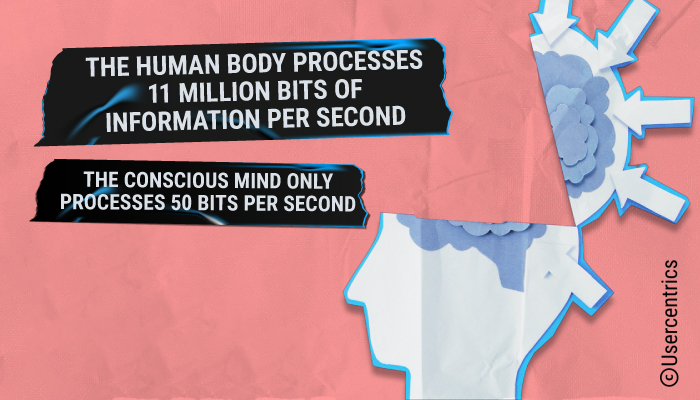
According to Encyclopedia Britannica, the human body processes 11 million bits of information per second through the senses, while the conscious mind only processes 50 bits per second.
That means most decisions operate on autopilot. Unconscious cognition includes perception, learning, memory, and decision-making at levels we are not aware of in the moment.

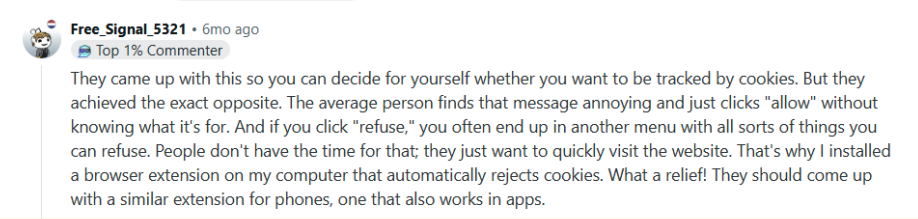
This cognitive reality is what makes dark patterns so effective, and so damaging to long-term trust. Brands may use cookie banner manipulation to trigger unconscious habits, causing users to choose accept without conscious thought.
While these techniques may lead to positive brand engagement in the short term, they harm brand reputation in the long term.
There’s also a predictable long-term psychological response. When people feel their freedom restricted by manipulative interfaces, they experience reactance, a negative psychological response to feeling restricted or undermined by external forces. Reactance can lead to resistance to persuasion or even noncompliance with requested actions or behaviors.
Build a better brand: Design for believability
As marketers, we are in the business of helping people make good decisions about what data they share. That’s not a problem; it’s an opportunity.
Branded consent experiences outperform generic ones because they support better comprehension rather than exploiting mental shortcuts.
Design your cookie banner for believability and strong branding by making every decision obvious, simple, and fair.
Here are some tactics that help build trust and deliver better user experience with consent banners.
Marketing tactics from positive psychology
- Fluency heuristics
- Framing effects
- Primacy effects
- Rhyme-as-reason
- Symmetric friction
- Positive framing
Fluency heuristics
The simple, plain language of fluency heuristics triggers trust because the brain treats easy-to-process information as more credible. Generic legal copy reads as evasive whereas a clear brand voice reads as honest.
Fluency heuristic: In psychology, a fluency heuristic is a type of cognitive bias. The more skillfully or elegantly an idea is communicated, the more likely it is to be considered seriously, whether or not it is logical.
Framing effects
Choices shift based on presentation, not substance. Instead of manipulating this bias, cognitive consent uses it to clarify options.
For example, when setting up your consent management tool, consider putting the “Reject” button on the left (to signal the past) and “Accept” on the right (to signal the future) — not only does this tap into cognitive cues, it matches reading patterns.
Primacy effects
The first statement that someone reads will make an unconscious impression, and users assign them the highest value. Design top-of-banner messages to be concise and true, and to clearly declare intent.
Rhyme-as-reason
People judge rhyming statements as more accurate, but this should be used to clarify rather than deceive. For instance, “Read and decide, we’re on your side” beats generic privacy platitudes.
Symmetric friction
In effective choice architecture, accepting and rejecting require equal cognitive effort. When one path is hidden or complicated, users notice and trust erodes.
The cognitive consent approach aligns with measurable consumer behavior changes.
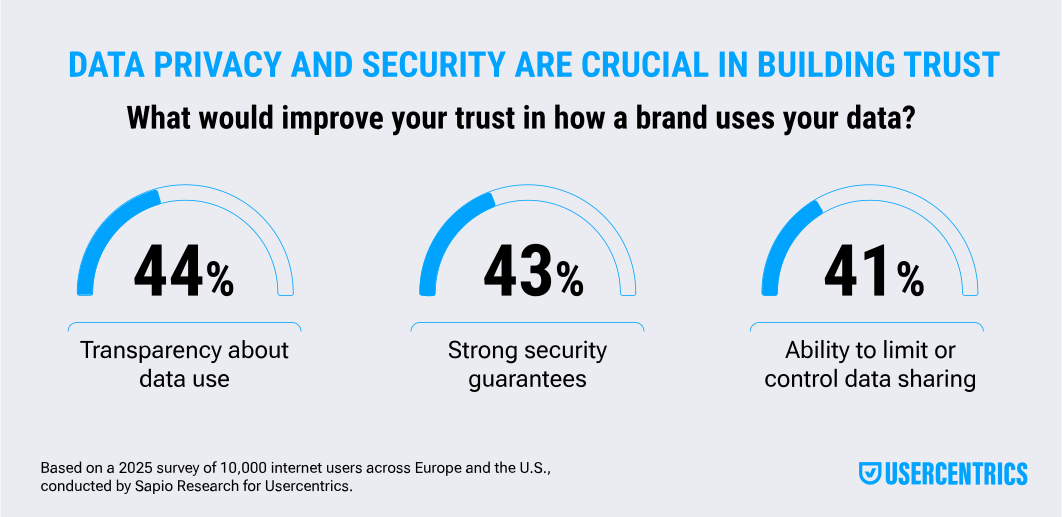
Trust has become conditional: 44 percent of consumers want transparency about data use, 43 percent expect security guarantees, and 41 percent demand real control.
Think about the impact you want to have and the tasks your users are trying to accomplish and design accordingly.
Use positive framing for acceptance
Cookies keep your user experience smooth. If you’re aiming for acceptance, present your consent options with positive framing.
When consent is treated as a product feature — with granular preferences, clear policy language, and easy withdrawal — people share more data and churn less. This generates cleaner first-party datasets that improve measurement and personalization without relying on brittle third-party signals.
A branded consent experience feels better
I came across a skincare brand that used bright and clear visuals that drew me in immediately, but the design choices in their cookie banner were a drastic contrast.
Beside the eye-catching branding, the cookie banner seemed generic. While functional, it was entirely uninspired, like it existed just to check off legal requirements.

“We care about your privacy. We and our partners use cookies and other technologies to improve your experience, measure performance, and tailor marketing.
Details in our Privacy Policy.
Manage Preferences: Accept, Decline”
This showed me a disconnect between privacy and overall branding. For this skincare brand, privacy might be simply a compliance afterthought, not a core brand value. Some might even wonder if it’s even the same company asking for consent.
You can quickly transform a user’s experience with A) brand-consistent language that spells out clear benefits tied to their privacy choice and B) visual design that matches the product experience.
Here’s how I would rewrite it to fit the brand:
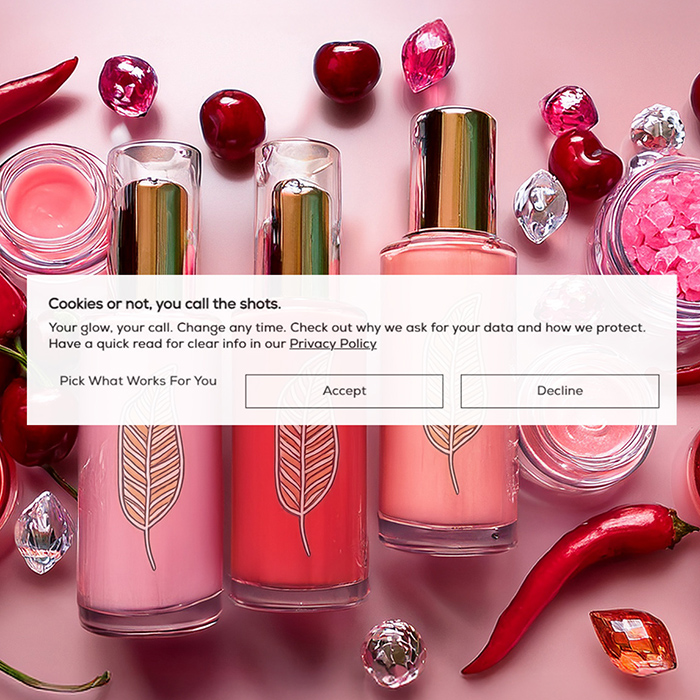
Your glow, your call. Change any time. Check out why we ask for your data and how we protect it. Have a quick read for clear info in our Privacy Policy.
Pick What Works For You: Accept, Decline”
Specifically, I’d add rhymes, some humor, and brand references — overall, creating a consent request that feels more relatable, human, and still completely on-brand.
Why does it work better?
It comes down to fluency heuristics. If something is easy to read and understand, the brain treats it as more credible.
Legal or technical jargon is harder for the average user to understand, and therefore feels less credible. Simple, plain language convinces the mind to trust the idea because it is easier to process.
Brands that optimize solely for acceptance rates push teams toward dark patterns that spike short-term conversion but destroy long-term permission.
Cognitive science, culture, and consent
Brands are woven into the social fabric of the communities they operate within. If they don’t behave according to accepted norms, they risk being deemed untrustworthy by customers.
Once again, cognitive science provides valuable insights: Humans have a familiarity bias. People default to what feels known because the brain equates familiarity with safety.
You can guide decisions by showing real understanding of the person’s context. Localizing your cookie banner adapts your message to resonate with customers, wherever they are in the world. When language, order, and visuals feel locally fluent, reactance drops and voluntary permission rises.
Customizing banners for relevant regulatory information and localizing consent banners to preferred languages is just the first step for privacy compliance and optimal user experience.
People trust what feels known. Use region-specific lexicon, idioms, and norms in consent copy the same way you do on localized landing pages to trigger recognition, not suspicion.
Anjali Ramachandran from Storythings has some new strategies to share.
Understand local behaviors and preferences
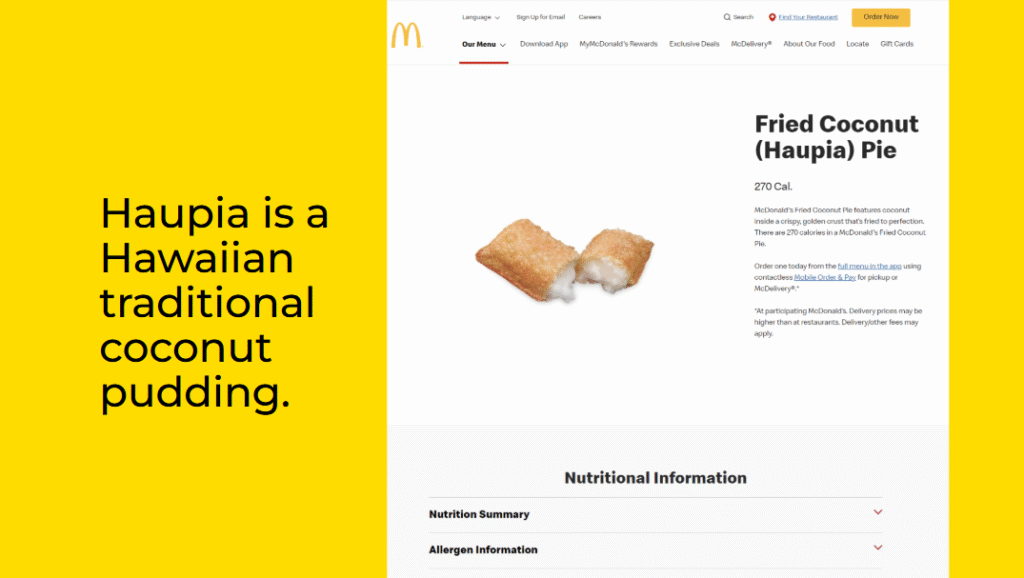
I call this the “Haupia Pie” principle. But if you haven’t been to Hawaii, chances are you have no idea what haupia is.
McDonald’s is a global brand that knows that American apple pie is nice, but it doesn’t exactly scream Aloha.
To be truly local, you need to cater to market expectations. So in Hawaii, they offer haupia pie instead, a fried pie with a traditional Hawaiian coconut pudding filling.
Identify region-specific privacy concerns and norms, then name them in your banner. For example,
- “We don’t sell data,”
- “No cross‑site ads,”
- “Data stays in the EU.”
Replace generic boilerplate with familiar local terms the audience actually uses.
Executive psychology: We all have cognitive biases
Stakeholders have biases that block privacy-first thinking. Executives that are rewarded for short-term profit will reject longer-term trust investments even when research proves future value.
To set your company up for long-term success, you need to be tactical:
- Structure decisions to minimize executive decision fatigue.
- Lead with the most important point to take advantage of the primacy effect.
- Time requests strategically: people tend to take more risks early and late in the week, and fewer on Thursdays.
- Do not fall for the measurement trap. Optimizing solely for acceptance rates pushes teams toward dark patterns that spike short-term conversion but destroy long-term permission. Goodhart’s Law warns that when metrics become targets, they cease being good measures.
The compounding effect of consent
Brands designing for believability gain structural advantages as trust becomes a marketing currency. Transparent brands earn more permission, which produces better data, which enables more relevant experiences, which reinforces trust through demonstrated value delivery on declared terms.
Consent-based datasets outperform scraped or coerced signals on lifetime value and model accuracy. Most importantly, cognitive consent creates cultural and procedural moats that competitors cannot quickly replicate.
The measurement shift moves from vanity metrics, like raw accept rates, to value metrics: trust-weighted consent retention, active preference management, and demonstrated user agency.
Cookie acceptance rates are declining across Europe and the US. Savvy marketers need to rethink privacy interfaces.
___________________
Myriam Jessier brings data to life, transforming numbers into captivating stories that spark action. With a knack for making the complex delightfully clear, they empower teams to see — and seize — the opportunities hidden in every dataset.
Get to know more about their work with Neurospicy Agency and certified Google Analytics Agency PRAGM.