

Note: Usercentrics is not affiliated with, does not have a partnership with ToS;DR, and makes no representations or sponsorship of the opinions and materials published by ToS;DR.
Try to think back to the last time you read — in full — the terms of service on a new platform you were joining or service you were about to start using before you clicked “I have read and agree to terms of use.”
If you can’t, or quietly said to yourself “never,” you’re not alone.
There’s a long list of reasons people skip ahead. Terms are usually written in complex language riddled with legalese, or could be seen as too vague to be relevant. They can be pages long, and you just want to get to what’s behind the accept button. (Terms change frequently, so why bother?)
Or, it could be just plain fatigue: The average Internet user comes across almost 1,500 privacy policies a year. With each about 2,500 words, they would take roughly 76 days to read.
For marketers, unreadable terms are more than a legal issue. They chip away at the very trust that makes digital relationships possible. When people don’t understand how their data is handled, it comes with risks from hidden fees to lost rights.
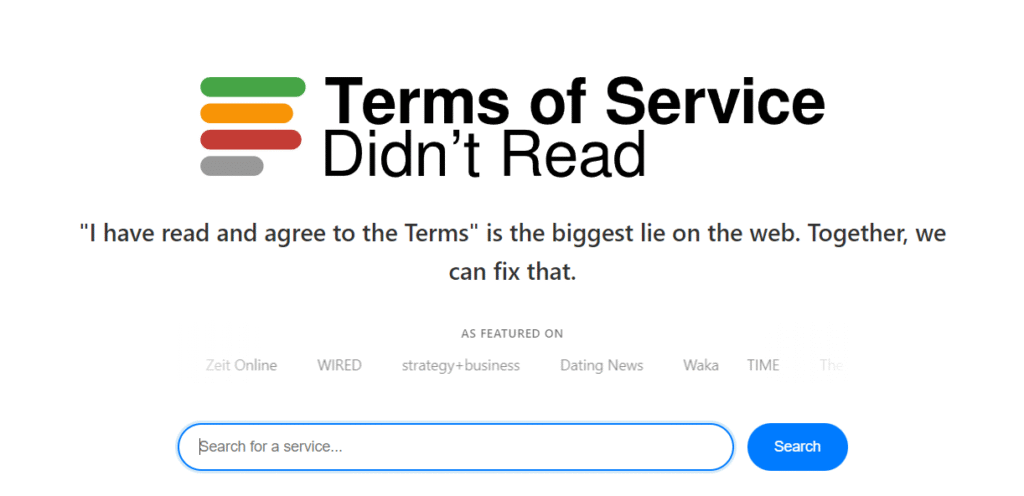
“‘I have read and agree to the Terms’ is the biggest lie on the web,” reads the welcome line on Terms of Service; Didn’t Read (ToS;DR). And that’s probably not an exaggeration.
But all is not lost — “Together, we can fix that,” the site text continues.
Instead of simply calling out poor behavior online, the community-sourced platform is offering a potential solution: where data literacy is both an act of personal empowerment and a collective practice of making the internet a safer space.
The risks in Terms of Service
The internet is full of data-hungry tools and platforms, which results in people creating an ever-expanding digital footprint.
But for the average internet user, true knowledge of where all that personal data is stored, and for what purpose, is often out of reach — and it can put them at a disadvantage.
Evan Radkoff, lead AI developer at ToS;DR, shared with Usercentrics:
“One of the core digital privacy issues of our time is that the average internet user’s digital footprint extends far beyond what they are aware of. This gap, always expanding, puts consumers at a disadvantage as they have no idea where, how, and for what purpose their personal information is stored.”
On the one hand, people are engaging with their privacy options now more than ever. Usercentrics’ 2025 State of Digital Trust report found that 42 percent of consumers read cookie banners “always” or “often,” while 46 percent click “accept all” cookies less often than three years ago.
However, reading the fine print can feel like a bigger time commitment. A 2017 Deloitte survey found that 91 percent of consumers consent to the terms of service without reading them, and this rises to 97 percent among 18–34-year-olds.
As a result, clicking “I agree” can be a reflex, not an informed decision — including for marketers outside of your day job!
Agreeing to terms without reading, for example, may prevent you from filing class-action lawsuits. (In practice, this means that if a platform mishandles your data, you’ve already signed away your right to collective legal recourse with a single click.)
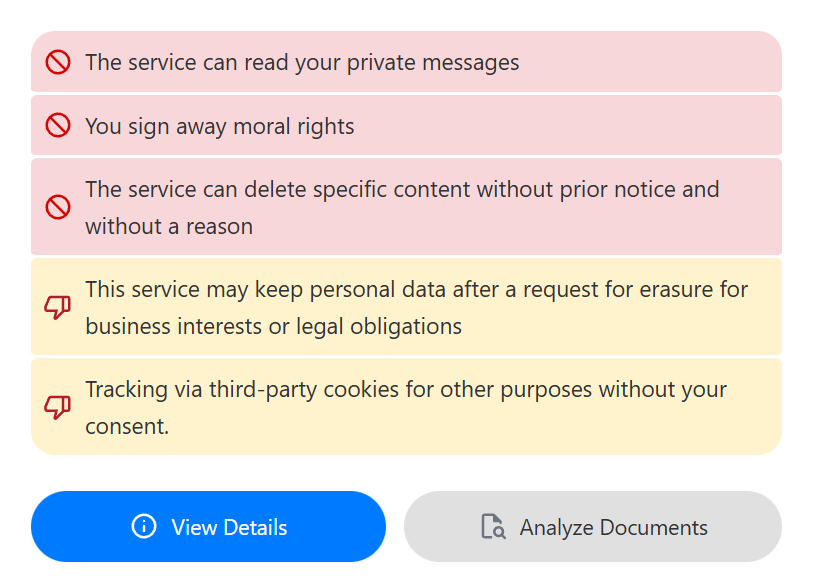
It can also give platforms the freedom to read your private messages or simply delete your content without prior notice or reason.
This isn’t without risk for platforms. For example, the U.S. Federal Trade Commission has imposed large fines on social media platforms after identifying a lack of consumer transparency.
That’s because clauses that look like technicalities can, in practice, tilt the balance of power heavily toward platforms. This is exactly the kind of imbalance ToS;DR is trying to make visible.
When you use plain language, your customers are more likely to trust you.
Finding a community-based solution
Scroll through ToS;DR and the information feels refreshingly straightforward.
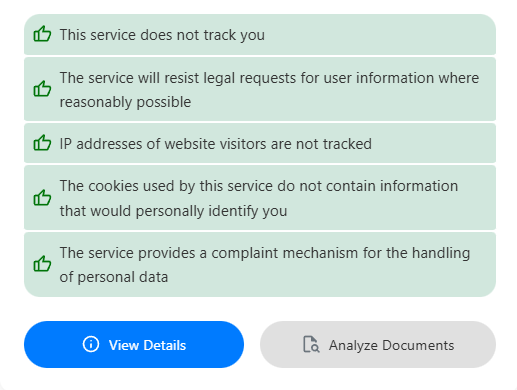
You’ll find the name of a platform, an overall grade from A (best) to E (worst), and a color-coded list of items explaining the terms of service in everyday language, each paired with a simple thumbs up or down.
The transparency that ToS;DR provides for users can double as feedback for marketers, and how their brands are perceived in the wider digital trust ecosystem.
The simplicity of the tool is by design. Founders Hugo Roy, Jan-Christoph Borchardt, and Michiel de Jong have credited the plain language of Creative Commons and Europe’s energy efficiency labels as inspiration when they first created the platform back in 2012.
But accessibility shouldn’t be mistaken for superficiality. Each grade points to something concrete in the fine print: like whether a platform can delete your content, track you across the web, or lock you out of collective legal action.
As Evan Radkoff explains:
“Our hope is that ToS;DR tips this imbalance in the other direction — informing people of their data privacy rights, and empowering them to make smarter choices about which services to use.”
The point is not just to call out bad practices, but to rebalance the relationship between platforms and their users. By translating legalese into plain language, ToS;DR seeks to turn passive agreement into informed choice.
The role of privacy literacy
The thread connecting all of this is privacy literacy. Many people don’t realize how deeply terms of service shape their online experience, or how often they quietly change in the background. For brands, this poses a risk to consumer trust.
Recent EU laws are pushing companies toward more transparency, but in fragmented ways:
- The General Data Protection Regulation (GDPR) requires privacy policies to be clear and accessible.
- The Digital Services Act (DSA) requires platforms to explain how they moderate content and apply their terms.
- The EU Data Act requires companies to explain upfront what data they collect and how it can be accessed or erased.
Still, none of these rules guarantee that users are clearly notified every time the terms of service changes, which puts much of the literacy burden on individuals.
Not to mention, regulation and literacy aren’t the same thing. Laws can require companies to write clearer policies, but they can’t force users to read them nor understand what they mean in practice.
When businesses rely on opaque or constantly changing conditions, they not only confuse users but also risk undermining the trust that drives adoption and loyalty in the first place.
That’s the gap ToS;DR aims to fill. While regulators focus on compliance, ToS;DR focuses on comprehension. Instead of competing with legal frameworks, it works to translate them into the simple language people actually understand.
Here’s a peek behind the scenes of how ToS;DR works.
Volunteers read through a service’s terms and privacy policies, highlight specific clauses, and tag them as positive or negative for users. These contributions are then discussed in the community, and once there’s consensus, they’re added to the public database. Each service is then given an overall grade from A (best) to E (worst).
Users can see these ratings instantly while they browse, via ToS;DR’s site or a web extension — and so can marketers. It’s both a window into how our policies are perceived and an opportunity to use that feedback to strengthen transparency and trust.
ToS;DR also invites users to get more involved with the agreements that impact them. The platform is open-source, and anyone can contribute to the database by assessing terms, flagging issues, or simply adding the browser extension to stay informed.
In this way, privacy literacy becomes a practice of paying it forward to make the internet safer for everyone. Brands, take notice!

Building digital trust through community
At first glance, the fact that ToS;DR’s judgments come from volunteers rather than lawyers or regulators might seem like a limitation.
But what some might see as a shortcoming, is arguably the platform’s greatest strength — including for brands that want to make a good impression on their users.
People, not algorithms, sift through the clauses, which means ToS;DR reflects the concerns and priorities of actual users. Each clause is debated and revised in the open until a consensus emerges. That process makes the ratings less about authority and more about transparency.
Brands can choose to see this as actionable user feedback on their policies.
Research on collaborative platforms like Wikipedia shows why this kind of process matters: when decisions are made transparently and debated openly, people are more likely to trust the process, even if they don’t fully agree with every outcome. ToS;DR follows the same model, grounding its legitimacy in openness.
As Evan Radkoff puts it:
“People trust our privacy grades, and I believe that is largely because we are an open community. All of our grades are based on publicly available analyses, which we invite anyone to scrutinize and improve.”
In a world where 62 percent of people feel they have become the product, trust is sorely needed. People sense that their attention and personal information have become commodities in an ecosystem designed to profit from their behavior.
Tools like ToS;DR can help bridge that gap, offering grassroots oversight where institutional trust has eroded.
While users may not agree with every evaluation, they can see exactly how it was reached, and even join the discussion themselves. Instead of one-way communication from platform to user, ToS;DR flips the script: it’s a community that’s defining, in plain language, what counts as fair and unfair treatment of data.
Moving from bystander to participant
Regulations will continue to evolve, but laws alone don’t bridge the gap between legal text and everyday understanding. That’s where communities become valuable.
Data privacy is not just a personal issue. It shapes the collective online spaces we all rely on: from social media platforms to messaging apps, online marketplaces and beyond.
When people understand what they’re agreeing to, they don’t just protect themselves; they raise the bar for how their data can be handled by platforms.
“I agree” may still be the most common phrase on the internet, but it doesn’t have to be the biggest lie. The shift from passive clicking to informed choice is already happening: people read cookie banners more often, volunteers are dissecting terms of service, and platforms are being held accountable in ways that seemed impossible a decade ago.
What can you do? Check a platform’s rating before you sign up. Better yet, join the conversation — because the internet we get is the one we’re building together.
Communities are a great way to build brand loyalty and get early user feedback.