
Everyone’s had that moment: you mention “electric bikes” over dinner, and the next morning . . . ads for e-bikes pop up across your social media pages. Suddenly you wonder: Is my phone listening?
Stories like these aren’t rare.
Although most of the time they’re the result of precise ad-tech targeting, they speak to a broader perception of marketing as invasive, even crossing the line into surveillance territory.
For years, digital data was treated as a resource: something to collect, hoard, and extract value from. But that model is breaking.
Consumers have grown more cautious, privacy regulations have tightened, and AI has made the stakes feel higher. And marketers are facing the resulting friction. On the one hand, there’s pressure to show return on investment and concrete, measurable results. On the other, there is a public that’s increasingly reluctant to share their data.
We’re moving from the mindset that “more data equals better marketing” to an online context where meaning matters more than metrics. The question isn’t whether data still matters, but whether it can be used in a way that actually makes people care, trust, and engage with brands.
This article explores the changing role of data in marketing. From consent-first strategies to emotionally intelligent campaigns, we’ll look at how brands can earn trust amidst growing consumer skepticism.
Key Findings
- Transparency now ranks as the #1 driver of brand trust
- Data storytelling is emerging as a must-have marketing skill
- Vibe marketing is redefining performance through emotional resonance
- Privacy-Led Marketing turns data into relationship capital
The new consumer mindset
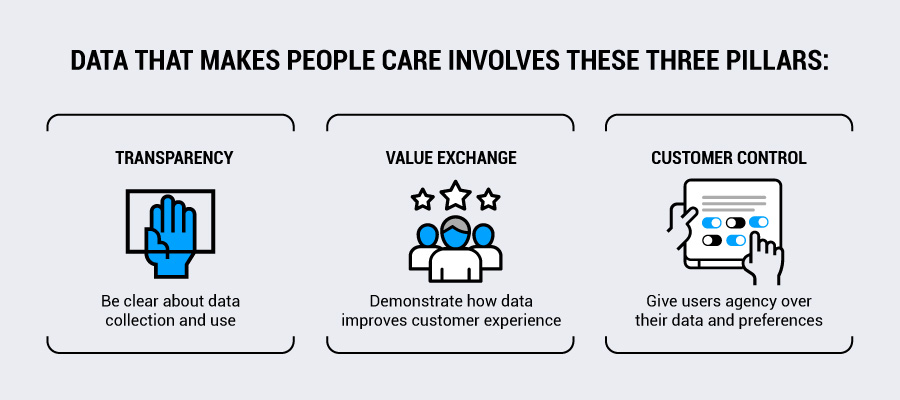
In 2025, the days of clicking “accept all” on every cookie banner are over. Today’s consumers recognize the value of their data. They understand what it means to give consent, and expect transparency over how their information is used.
According to the latest State of Digital Trust report, 46 percent of people accept cookies less often than they did three years ago, and 42 percent now read consent banners “always” or “often” before deciding. That’s a clear sign that digital literacy and active decision-making are replacing passivity.
This change points to a greater cultural shift. Consumers are more aware of targeted ads, tracking technologies, and the mechanics behind personalization. Transparency has become the number one driver for trusting a brand, with 44 percent of consumers ranking it as their top factor for building trust.
The AI boom has added an extra layer of complexity to online interactions, drawing consumers’ attention to data flows and corporate motivators like never before.
Users aren’t rejecting innovation, but demanding increased control, clarity, and accountability at every touchpoint. And that’s where the opportunity exists for marketers.
For marketers and Chief Marketing Officers (CMOs), adopting new technology and meeting regulatory standards are only one part of the story. There’s significant competitive advantage to be gained from seeing consumers as informed participants in a two-way relationship that’s built on transparency and respect for their digital autonomy.
Data use isn’t dead, it just needs better stories
Shifting away from data hoarding won’t leave marketers empty-handed. On the contrary, even in today’s privacy-conscious landscape, data is still a powerful lever when it’s combined with purpose.
What’s changed is how that data needs to be used.
In a digital context where every like, hovering of the mouse, and abandoned cart is quantified, impact comes from collecting truly valuable information and transforming that raw data into stories that matter.
Luckily, marketers aren’t working with less, they’re just working differently. With the right tools, it’s possible to turn consented, high-quality data into sharper insights and deeper resonance with customers.
Making data make sense (and meaning)
Enter data storytelling. The concept is exactly what it sounds like: combining data, narrative, and often visual elements to break down information into stories that are both easier to understand and remember.
This approach swaps out cold, impersonal stats for human context: framing insights in ways that tap into lived experiences and emotions. The reason it works is simple: stories activate empathy and memory in ways numbers can’t.
Take Strava, for instance. The fitness app transforms raw performance stats — think distance ran, elevation climbed, and time spent training — into visual summaries and milestone badges. These visuals encourage users to share progress, celebrate achievements, and connect through group challenges. Strava has successfully turned personal data into a shared narrative of motivation and belonging.
Canva’s Beyond the Numbers survey points in the same direction: 85 percent of business leaders say storytelling makes data more engaging, and 80 percent say it helps drive decision-making. When data is framed as a story, it resonates.
This is exactly why data storytelling is gaining traction as a future-proof skill.
Myriam Jessier, a consultant who specializes in transforming numbers into stories, argues that in a world of automated insights and AI-generated charts, the human ability to craft a compelling story remains irreplaceable.
“Not only does AI want your job, it wants to ingest the data. It wants to make the judgment calls for you. So, what’s your value as a marketer? Telling a good story,” they explain.
Getting to yes: Expert insights on transforming cold numbers into compelling narratives that drive action and get budgets approved.
Vibe over surveillance
Vibe marketing has emerged as one of 2025’s new strategies. It prioritizes emotional resonance and cultural alignment over hyper-targeting, and shifts the focus from cold data points to what the experience of engaging with a brand actually feels.
This new approach to marketing relies on qualitative signals like mood, sentiment, and collective cultural cues to shape how campaigns sound, look, and land with customers.
It’s not anti-data. Instead, vibe marketing uses technology to listen more intuitively, and to measure what can’t always be neatly quantified.
This shift comes in response to the growing understanding that traditional metrics can fall short. As Jamie Bulman, Senior Solutions Consultant at Brandwatch, explains:
“The trend that I’ve observed over the last few years has been that those metrics tend to be viewed by organisations more as an indicator than an absolute.”
In other words, numbers still matter, but they no longer paint the full picture. As marketing evolves, there’s a growing shift toward blending soft signals with data.
What if the real insight lies not just in what worked, but in why it resonated — a question that data alone can’t always answer?
Gaining those insights requires embracing nuance. Tracking shareability over reach, language over volume, and sentiment over sentiment scores. And it means accepting that measuring emotional impact is not an exact science.
“If you approach marketing campaigns in that way, you’re ultimately going to get closer to reality than if you just look at top-level metrics and try to impose some kind of order from the outside,” explains Jamie.
Vibe marketing leans into that imperfection. It uses AI to help make sense of cultural patterns, amplify human creativity, and identify emotional themes across content and conversations about a brand. The result is marketing that feels more human, and more in tune with the world it’s speaking to.
In practice, it works by combining soft signals and hard data using:
- Advanced social listening: Moving beyond keywords to more deeply understand the online context that shapes the conversation around a brand.
- Sentiment analysis and contextual cues: AI-driven tools that monitor not just what’s said, but how it’s said, and analysing what resonates, what feels off, and why.
- Behavioral signals: Tracking micro-moments like subtle shifts in mood, trend, or community response to adjust campaigns in real time.
Vibe marketing uses AI not just to track performance, but to stay culturally fluent by picking up on shifts in sentiment, language, and community dynamics in real time. It shortens the feedback loop between brands and audiences, helping campaigns feel more responsive and emotionally in tune.
But vibes alone won’t carry a strategy.
The brands that stand out are the ones combining qualitative signals with quantitative insights. They’re not abandoning metrics, but using them to understand both resonance and reach.
AI is reshaping marketing, moving away from rigid metrics and toward emotion and cultural resonance.
Privacy-Led Marketing as strategic advantage
Your customer doesn’t care about your data strategy. They care about how you make them feel.
Privacy-Led Marketing bridges the gap between strategy and experience by turning data practices into active trust-building opportunities. It’s an approach to brand building that is rooted in informed consent and respect for users’ preferences. This means using better, consented data to create marketing that feels good to engage with.
Right now, consumers are overwhelmed by choice and increasingly skeptical of how their information is used. Privacy-Led Marketing offers marketers a clear edge: it makes people care not just about the message or product, but about the brand behind it.
In practice, it looks like this:
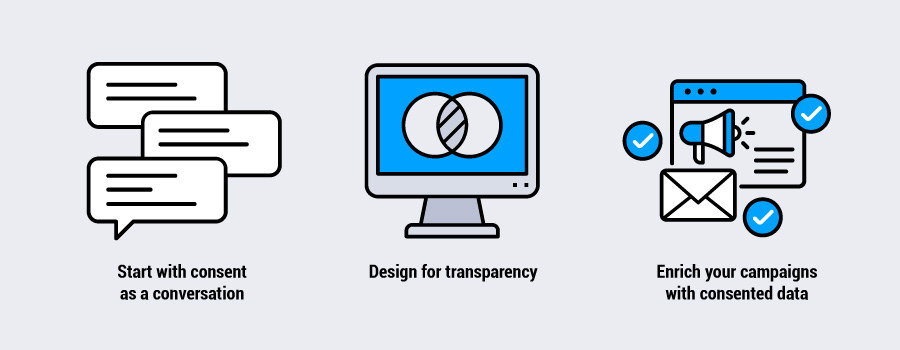
- Start with consent as a conversation. Make it clear, contextual, and continuous. When people understand what they’re opting into and why, they’re more likely to engage and trust what follows.
- Design for transparency. Use every touchpoint, from cookie banners to preference centers, to show users you respect their agency. This builds a baseline of credibility before the first ad even lands.
- Enrich your campaigns with consented data. Instead of relying on third-party profiles or shadow tracking, incorporate first-party data and contextual consent. The data you do get will be more accurate, more timely, and more aligned with user intent.
Privacy-Led Marketing is a strategic shift in how brands communicate and connect, as it turns data into a tool for relationship-building rather than just optimization. By empowering users to have a say on how their data is used, they’re more likely to feel seen and respected, and stick around for the long run.
Toward a new data culture in marketing
The need for data in marketing isn’t going anywhere. But the old playbook — collect more, target harder, optimize endlessly — is outdated. And the new narrative is already being written.
It is one that’s focused on collecting better data and using it more effectively. It prioritizes data use that tells a story, earns trust, and includes users as active participants. That reflects not just how people behave online, but what they care about.
Marketers today play a pivotal role in shaping this new culture. They have an opportunity to act as storytellers building a new reality that uses data to build trust, not just revenue.
It turns out, data can make people care. But only when it’s used to build relationships rather than exploit them, when it empowers instead of manipulates, and when it serves customer needs over just corporate interests.