

If you’ve been treating consent banners as a privacy compliance speed bump, it’s time to reframe it as performance infrastructure.
With Google’s Consent Mode v2, and parallel, consent‑aware controls across platforms like Microsoft Ads’ UET, a better consent journey yields policy‑compliant signals that unlock modeled conversions, steadier bidding, healthier remarketing eligibility, and stronger audience strategies.
The result is a compounding loop in which trust drives revenue. Improved consent UX raises consent rates; higher consent rates improve signal coverage and quality; better signals fuel platforms’ modeling and learning; modeling stabilizes bidding and lowers CPA; and efficiency gains free up resources to further improve UX and measurement.
Key takeaways
- Consent as performance infrastructure: Consent banners are not mere compliance hurdles, but can and should be essential performance infrastructure that drives growth.
- Consent Mode v2 and platform integration: Google’s Consent Mode v2 and similar controls like Microsoft Ads’ UET enable policy-compliant signals for improved conversion modeling and audience strategies.
- Trust-driven revenue loop: There’s a compounding loop wherein improved consent UX leads to higher consent rates, better signal quality, stabilized bidding, and increased ROAS.
- Optimizing consent UX: Designing transparent consent banners and preference centers with clear language and choices builds user trust.
- Usercentrics for implementation: Usercentrics solutions streamline mapping of consent purposes to platform signals, helping ensure accurate configuration and propagation.
- Measurable instrumentation: Instrumenting the consent flow to measure business outcomes, tracking metrics like consent rates, modeled conversions, and CPA/ROAS stability are critical.
- Avoiding pitfalls: Common implementation errors include mis-mapped purposes or inconsistent gating, but there are solutions to ensure effective consent management.
- Continuous optimization: An ongoing operating cadence of reviews, disciplined change control, and experimentation are important to maintain the “consent-to-conversion flywheel.”
Why consent UX is now performance‑critical
Signal loss is structural. Regulations, browsers, and platform policies limit what can be collected and used by default, and the platforms’ answer has been to reward consent‑aware implementations with robust modeling and activation features — so long as they receive the right consent state.
The practical cost of “no” or an unknown consent status isn’t limited to missing cookies. It shows up in the core economics of your media with reduced eligibility for remarketing and audience expansion, fewer observable conversions to train bidding algorithms — leading to volatility in CPA/ROAS — and noisy attribution that slows budget decisions and learning cycles.
Consent Mode v2 and the platform shift
Consent Mode v2 (CMv2) formalizes how Google interprets user choices by mapping your purposes to states that govern storage, modeling, and personalization. In practice you translate your CMP’s purposes to four CMv2 states:
- analytics_storage
- ad_storage
- ad_user_data
- ad_personalization
Together these determine whether Google can read or write storage, whether consent‑aware pings can be used to model conversions in the absence of storage, and whether data may be used for ads personalization where lawful.
Microsoft Ads is moving in a similar direction with UET’s consent‑aware behavior and conversion modeling. Treat UET as you treat gtag or GTM: downstream of a single source of truth for consent, with events gated according to lawful bases.
Other ecosystems increasingly honor consent on server‑side endpoints via gateways or tag servers. Your job is consistent gating and propagation: capture consent once, attach it to every event, and suppress events that lack a lawful basis.
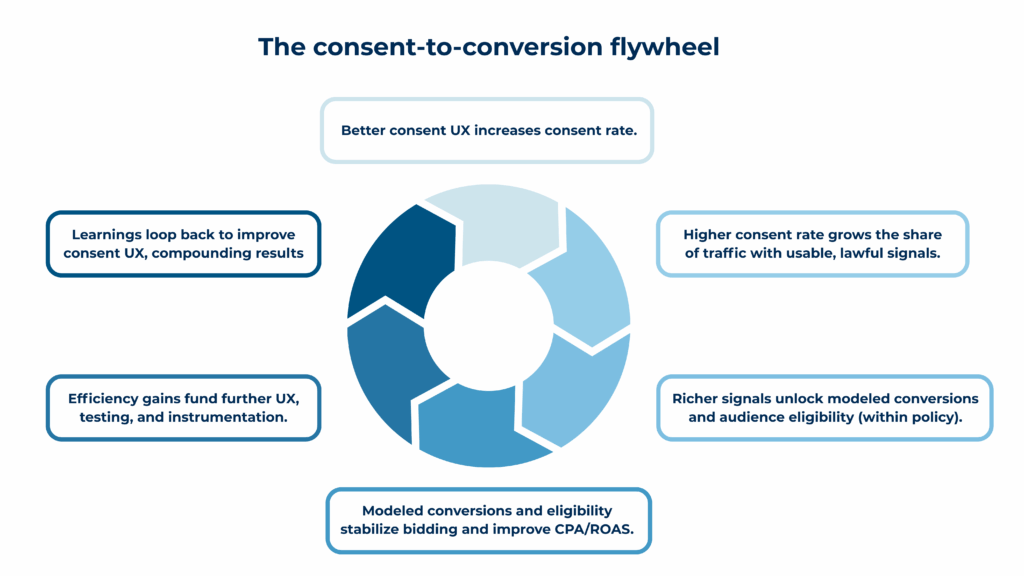
The consent-to-conversion flywheel, which shows a six-segmented circle with progressively darker blues in each segment. From the top and moving right and down, the segment descriptions are: “Better consent UX increases consent rate”, “Higher consent rate grows the share of traffic with usable, lawful signals”, “Richer signals unlock modeled conversions and audience eligibility (within policy), Modeled conversions and eligibility stabilize bidding and improve CPA/ROAS”, “Efficiency gains fund further UX, testing, and instrumentation”, and “Learnings loop back to improve consent UX, compounding results”.
Design banners for outcomes and for trust
Treat the banner and preference center as a micro‑experience whose job is to help a user make an informed, confident choice. Plain language matters: explain what you collect and why, without legalese, euphemisms, or scare tactics. Offer clear, equivalent choices and avoid dark patterns.
Group purposes meaningfully — analytics, advertising, and personalization are intuitive to most users — and make the preference center obvious so people can adjust choices later.
Consider contextual consent for features that require specific purposes. Asking at the moment of need helps users connect purpose to value. Localize for language, legal frameworks like the TCF v2.2 or GPP, and cultural expectations. Ensure the visual hierarchy is accessible with clear contrast, focus order, and readable type.
Map consent to platform signals with Usercentrics
Usercentrics CMP handles the heavy lifting of purpose‑to‑platform mapping. Your focus is getting the configuration, propagation, and QA right so platforms receive the signals they expect.
- Configure frameworks and purposes in Usercentrics CMP. Align purpose taxonomy, e.g. analytics, advertising, personalization, to business use cases, and enable the relevant regional frameworks, like the TCF v2.2, GPP, etc.
- Enable and verify Consent Mode v2. Turn on CMv2 in your implementation, then confirm that analytics_storage, ad_storage, ad_user_data, and ad_personalization reflect user choices across regions and devices.
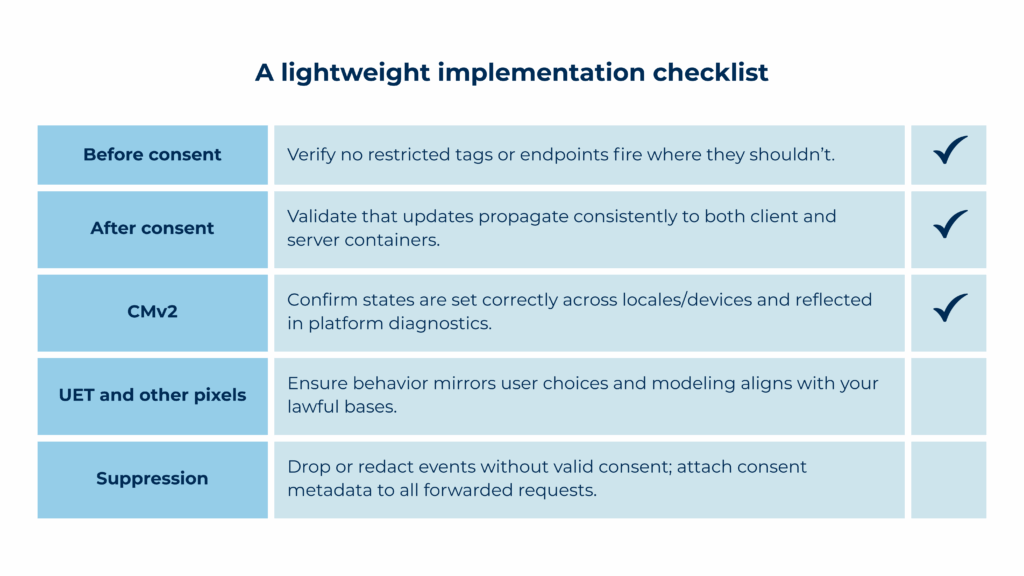
- Orchestrate tag behavior via your TMS. Use the Usercentrics data layer events to gate Google tags, Microsoft UET, and other pixels. Where required, no restricted endpoints should fire prior to receiving consent.
- Propagate consent server‑side. Forward the consent state from Usercentrics CMP to your server‑side gateway so GA4/Google Ads, UET, and other APIs receive consent metadata and noncompliant events are suppressed.
- Test end to end. Use platform diagnostics and preview tools to validate CMv2 state, verify UET behavior, and segment analytics by consent cohort to ensure downstream performance reflects consent choices.
Instrument the flow so the loop is measurable
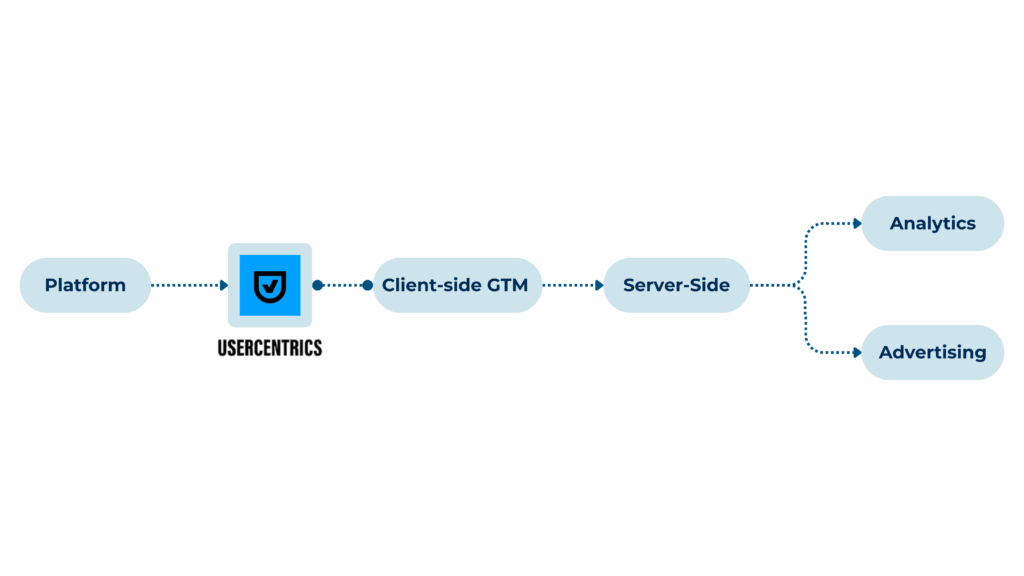
Build once and propagate everywhere. When the CMP signals a consent decision or update, push a structured event into your data layer. Tag management enforces purpose checks for every tag, client, and server.
A server‑side gateway re‑checks consent before forwarding events to analytics and ad endpoints like GA4, Google Ads, Microsoft UET, and others, attaching consent metadata or dropping noncompliant requests.
Analytics should store consent context on events so you can segment cohorts and compare downstream performance between consented and limited‑consent traffic. This instrumentation is what turns an elegant UX into measurable business outcomes.
A lightweight implementation checklist
Experiment responsibly and look beyond consent rate
Optimize like a marketer and a steward. Design experiments with clear hypotheses and ethical constraints, focusing on copy clarity, action labels, purpose descriptions, contextual prompts, and localization.
Evaluate outcomes based on a composite of trust and performance, not consent rate alone. Primary KPIs include:
- Consent rate by market/device
- Share of traffic with usable signals
- Modeled conversions
- CPA/ROAS stability by consent cohort
Secondary KPIs include:
- time‑to‑decision
- opt‑outs via preference center
- remarketing list coverage
- API error or rejection rates due to missing consent flags
Give experiments fixed evaluation windows — often two to four weeks — to allow modeling and platform learning to settle.
Connect trust to revenue in your dashboards
Leaders need to see cause and effect. Put consent metrics alongside performance metrics in one view. Track consent rate, decision latency, and purpose coverage over time, plus the share of events with usable consent, API rejection rates, and your server‑ vs client‑side mix.
Tie those to modeled conversions, CPA or ROAS stability, and the size and growth of eligible audiences. Include an operational layer, with banner variant history, purpose text changes, tag additions/removals, audits, and time‑to‑remediation, so it’s clear which changes drove which outcomes.
How to implement proof of trust to revenue with Usercentrics
- Start by configuring the relevant legal frameworks and granular purposes in Usercentrics CMP.
- Signal consent decisions to the data layer with purpose breakdown, framework, and policy version.
- In your tag manager, ensure those purposes gate Google Consent Mode v2 behavior and Microsoft UET, and extend the same checks to all pixels.
- Add a server‑side enforcement layer that validates consent on every incoming event, attaches consent metadata to outbound requests, and suppresses events that lack a lawful basis.
- Validate your setup in platform diagnostics and preview tools, confirm that UET and other endpoints reflect user choices, and segment analytics by consent cohort so you can measure the change.
- Establish a recurring cadence to review trust and performance dashboards, refresh banner hypotheses, and update purpose descriptions or localization based on user behavior and regulatory changes.
Pitfalls to avoid and how to fix them
Mis‑mapped purposes and signals can leave you with healthy consent rates but weak modeled conversions or limited audience eligibility. Audit purpose‑to‑tag mapping and verify CMv2 states and UET gating in every locale.
Inconsistent client/server gating can let suppressed events through server‑side. Make your gateway the enforcement point and reject requests without valid consent metadata.
Locale regressions after changes often stem from missing pre‑flight checks. Add per‑locale tests and a regression suite to your deployment pipeline. And if consent rises without performance lift, revisit the clarity and specificity of purpose descriptions and use contextual prompts that align purpose with user intent.
What “good” looks like
Transparent, accessible UX earns consent without pressure or tricks. A single source of truth for consent is propagated consistently to every tag and API. Consent Mode v2 states and UET behavior align exactly with your purposes and lawful bases.
Modeled conversions appear where expected, bidding is more stable across consent cohorts, and decision quality improves because your analytics includes consent context. Most importantly, you run an operating cadence — with regular reviews, disciplined change control, and ongoing experimentation — that keeps the flywheel spinning.
Growth that respects privacy isn’t a compromise; it’s a strategy. When your consent experience is clear and your CMv2 and UET integration is robust, you reduce risk and unlock a richer, more reliable signal layer. That strengthens modeling, steadies bidding, and compounds the value of every experiment you run. That’s the consent‑to‑conversion flywheel at work.
Remember, though, that regulations and platform policies evolve. Partner with your legal and compliance teams to ensure your implementation reflects current requirements in each market.
Learn how to compliantly obtain and manage consent in Server-side GTM.