
Every business collects personal data, but managing it responsibly is another story. With evolving laws like the GDPR and the CCPA, and with users demanding greater transparency, organizations need more than policies on paper.
They need a privacy program that turns compliance principles into everyday practice, building trust, confidence, and control for both the business and users. A strong program aligns people, processes, and technology to handle data responsibly, reduce risk, and build user trust.
This guide walks you through how to design a data privacy compliance program that fits your business, from governance and consent management to training, monitoring, and automation.
Key takeaways
- A data privacy compliance program is a structured system for managing how your organization collects, processes, stores, and protects personal data.
- Global privacy regulations like the GDPR and CCPA require organizations to implement formal privacy frameworks.
- Data privacy programs go beyond compliance to build user trust and reduce legal and operational risk.
- Building a data privacy program involves mapping data flows, implementing technical controls, training your team, and monitoring compliance continually.
- Success metrics for privacy program management track consent rates, incident response times, user rights requests, and audit readiness.
What is a data privacy compliance program?
A data privacy compliance program is the framework your organization uses to handle personal information responsibly. It covers everything from collection to deletion, with policies, processes, and technical controls that align with the requirements of privacy regulations.
A data privacy program defines:
- Roles and responsibilities: who is accountable for each part of the process
- Data flows: how personal information moves through your systems
- Data subject rights management: what happens when someone requests access, correction, or deletion of their data
- Incident response: how you act quickly and transparently when something goes wrong
It also includes documentation, technical implementation, training, and ongoing monitoring.
Without such a program, you’re managing privacy reactively and responding to individual requests or incidents as they happen. For companies to be able to grow, you need to manage privacy proactively, with systems that prevent issues before they escalate.
What’s the difference between a data privacy program and a data protection program?
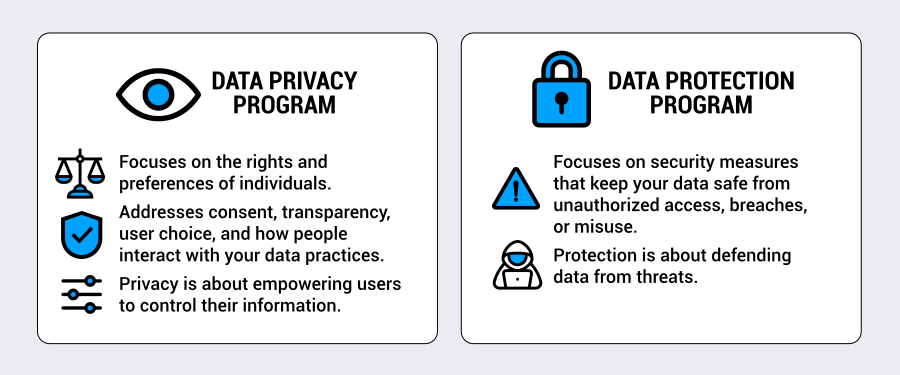
While the terms are sometimes used interchangeably, there’s a subtle distinction worth noting:
- A data privacy program focuses on the rights and preferences of individuals. It addresses consent, transparency, user choice, and how people interact with your data practices. Privacy is about empowering users to control their information.
- A data protection program focuses on security measures that keep your data safe from unauthorized access, breaches, or misuse. Protection is about defending data from threats.
In practice, these terms will overlap because you can’t have effective privacy without strong protections in place. Therefore, most companies treat these concepts as components of a single integrated system rather than separate initiatives.
Learn the key differences between data privacy and data security.
Why does your business need a data privacy program?
A privacy program is more than just a set of guidelines; it’s a foundational pillar for your business, and expanding regulations are a driving force for implementing a data privacy compliance program. This is because they are becoming stricter and enforcement is escalating.
For instance, the EU’s General Data Protection Regulation (GDPR) can fine organizations up to €20 million or 4% of global annual revenue for severe or repeated violations, and the California Privacy Rights Act (CPRA) imposes penalties of up to USD 7,988 per intentional violation or for violations involving minors.
These numbers can lead to attention-grabbing headlines when fines are levied, but they tell only part of the story.
Privacy also builds trust. When people understand how you handle their data, and see that you respect their choices, they’re more likely to engage with your brand on an ongoing basis.
Research consistently shows that consumers factor privacy into their purchasing decisions, and that transparency directly influences loyalty. In other words, protecting data isn’t just good compliance practice; it’s good business.
A strong data privacy program also reduces risk. Data breaches cost an average of USD 4.45 million per incident. Beyond financial loss, breaches also erode customer confidence and damage reputations. A structured data protection plan helps your organization identify vulnerabilities, respond quickly when incidents occur, and demonstrate due diligence to regulators.
Finally, a data privacy program creates operational efficiency. Without clear processes, every user rights request turns into a manual investigation. Every vendor contract becomes a one-off negotiation. And every new product feature triggers weeks of back and forth over privacy compliance questions.
A well-run privacy program standardizes these workflows, saving time and reducing friction across teams.
The alternative, managing privacy reactively, means constantly scrambling to interpret regulations, respond to issues, and hope nothing critical slips through the cracks. That approach wastes resources you could be dedicating to innovation and growth. It also doesn’t scale and certainly doesn’t prepare your business for audits or regulatory inquiries.
Data privacy program requirements under various global privacy regulations
Most privacy regulations share common frameworks, but each brings specific obligations that shape how you build your data protection plan. Understanding what’s required helps you create a program that works across multiple jurisdictions without duplicating effort.
The GDPR sets the baseline for privacy frameworks
The European privacy regulation established principles that many subsequent laws have adopted in whole or in part since its introduction. These include needing a legitimate reason to process personal data, requiring consent for data processing, and ensuring that users can exercise their rights and have control over their information.
Companies must be able to demonstrate that their data operations are compliant with relevant regulatory requirements when requested by authorities.
The GDPR requires organizations to maintain records of their processing activities, conduct data protection impact assessments (DPIA) for high-risk operations, and report breaches within 72 hours. In addition, organizations that process data at scale or handle sensitive categories typically need to appoint a data protection officer (DPO).
These aren’t just checkbox exercises; they’re operational requirements that demand maintained infrastructure.
California’s approach emphasizes consumer control
The California Consumer Privacy Act (CCPA) and its successor, the CPRA, focus on giving people control over their data via comprehensive rights.
This means you must tell consumers exactly what data you collect and why, enable them to opt out of having their data sold or shared, or used for targeted advertising or profiling. Honor deletion requests without making them jump through hoops. California also prohibits discrimination against people who exercise their rights.
If you operate in the U.S. market, California’s rules were the first among modern and comprehensive U.S. state-level privacy laws, and other states that are following suit have similar requirements. It’s a solid framework for initiating your U.S. data privacy strategy.
Discover which US states have data privacy laws and what it means for your business.
International jurisdictions add specific layers
Canada’s Personal Information Protection and Electronic Documents Act (PIPEDA) requires meaningful consent from users and limits data use to stated purposes. Australia’s Privacy Act mandates transparency through 13 Australian Privacy Principles (APPs) and gives individuals rights of access to their information. Japan’s Act on the Protection of Personal Information (APPI) requires security measures appropriate to the processing risks involved.
Each country and its regulations bring their own definitions, thresholds, and procedural requirements.
Therefore, rather than building separate programs for each jurisdiction, an effective privacy program identifies where requirements overlap and which best practices provide the broadest protection.
You establish a baseline that satisfies the strictest common elements, such as legitimate processing basis, user rights mechanisms, consent management, security controls, and documentation. Then layer in region-specific requirements where necessary. This approach scales more efficiently than treating each regulation as an isolated project.
How to build a data privacy compliance program?
A data protection program isn’t a one-time project. Instead, it’s a living system that evolves with your business operations and the regulatory landscape. Here’s how to build it from the ground up.
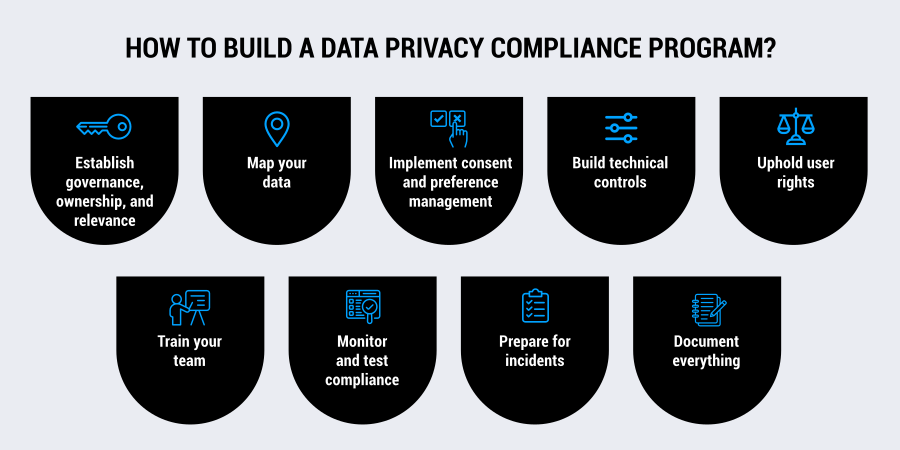
1. Establish governance, ownership, and relevance
Privacy can’t live in a silo. It requires coordination across legal, IT, marketing, product, and operations departments.
Start by appointing a privacy lead, a Data Protection Officer, Chief Privacy Officer, or similar role. This person will oversee the program, coordinate stakeholders, and serve as the point of contact for regulators and users.
Next, define clear roles and responsibilities. Who reviews vendor contracts? Who handles user rights requests? Who tracks consent metrics? Clarity strengthens accountability and facilitates smoother operations.
Lastly, clearly define which privacy laws, frameworks, and platform policies apply to your business based on where your customers are, which tech partners you use, and the types of data you collect and purposes for which you process it. This dictates the scope and strictness of your controls.
2. Map your data
You can’t protect what you don’t understand. Data mapping reveals what personal data you collect, where it comes from, how it flows, who accesses it, and where it’s stored.
Start with collection points, like website forms, mobile apps, customer support, and third-party integrations. For each, document what data is collected and why. For instance, Marketing may need email addresses for campaigns, and Product teams may need usage data to improve features.
Then trace how this data moves through your systems. Ask questions like:
- Does your CRM sync with your email platform?
- Does analytics data flow to advertising networks?
Visual mapping helps uncover gaps and unnecessary access or transfers.
Finally, record where data resides, how long it’s retained, and when and how it’s disposed of after the retention period. Specify storage regions, backups, and archives. Different data types have different retention requirements. Document these decisions to stay legally compliant and audit-ready.
3. Implement consent and preference management
Regulations require clear, informed, and revocable consent. Users must understand what they’re agreeing to and have genuine control.
Therefore, in your website notice, use plain language to explain what data you collect and why. Provide granular options: for instance, enable users to consent to analytics use but reject advertising use.
Make consent withdrawal as easy as opting in. A single-click opt-out should mirror a single-click opt-in, and revocations must propagate across all systems promptly.
A consent management platform (CMP) can automate this: displaying cookie banners to provide required notifications, storing preferences, blocking non-essential tracking until consent is given, and syncing consent decisions across your tech stack.
4. Build technical controls
Privacy can’t just be policy; it needs to be enforced through technology.
- Access controls: Restrict data access based on role and necessity.
- Encryption: Protect data in transit, in use, and in storage.
- Data minimization: Collect only what’s needed for stated purposes and automate deletion after retention periods expire.
- Anonymization: Mask or aggregate identifiers whenever possible.
Strong technical controls reduce uncertainty and both data privacy compliance and security risks.
5. Uphold user rights
Individuals have legal rights over their data and access to it. Build clear workflows to process rights requests efficiently.
Create intake channels — e.g., email, web form, or chatbot — and route requests by type — e.g., access, correction, or deletion. Define service-level targets, ideally faster than regulation-required maximums, and track performance to identify bottlenecks.
Log every request, identity verification, and outcome. This audit trail provides proof of compliance and can reveal trends that warrant further attention.
6. Train your team
Privacy isn’t just the responsibility of your privacy lead — it’s everyone’s responsibility, every day. Regular training helps your teams understand their roles in the program and be able to spot potential issues faster, so they can be dealt with promptly.
Consider tailoring training to each function, for example:
- Engineers: Privacy by design, secure coding, encryption
- Marketing: Consent management, opt-in/opt-out rules, processing purpose boundaries
- Customer support: Identity verification, appropriate data disclosure, escalation procedures
Make training practical, test understanding, and update it regularly as your program and regulatory requirements evolve.
7. Monitor and test compliance
Ongoing oversight keeps your program effective. Conduct regular audits to review processing activities, vendor compliance, and technical safeguards.
In addition, conduct quarterly internal audits to verify consent records, retention adherence, and request handling accuracy. Annual vendor assessments can confirm that third parties uphold your privacy standards. (Under many data privacy laws, your company is responsible for ensuring privacy-compliant data processing by contracted third parties.)
Lastly, perform data privacy impact assessments for new products, features, or data uses to identify and mitigate risks before launch. Regular testing demonstrates proactive compliance.
8. Prepare for incidents
Even with safeguards, incidents can occur. That’s why it’s important to have an incident response plan in place that defines how to detect, contain, investigate, and report breaches.
Also, consider preparing communication templates in advance. When you’re managing an active incident isn’t the time to draft breach notification letters from scratch. Having templates ready means you can move faster while helping to ensure that you include all the required information.
9. Document everything
Documentation proves your program’s existence and maturity. Maintain up-to-date:
- Privacy policies that explain collection, use, and rights
- Processing records that detail purposes, legal bases, categories, and retention
- Consent logs, which capture when and how users gave or withdrew consent, and for what
- Training and audit reports, and incident logs
Consider keeping all of these documents centralized, version-controlled, and easily accessible. This way, when an auditor or regulator asks for evidence, you’ll be ready.
KPIs to measure the success of your data privacy program
A well-designed data privacy compliance program should demonstrate its value through measurable outcomes. Tracking the right metrics helps you understand whether your privacy program management approach is working and where it needs adjustment.
Consider the following indicators to help you communicate progress to leadership and justify continued investment.
Download checklistConsent rates
Monitor what percentage of users provide consent for different processing activities. Low consent rates might indicate unclear language, too many options, or user distrust. High consent rates suggest your messaging resonates and users see value in the exchange.
A comprehensive CMP provides detailed analytics information about user interactions and consent rates, enabling you to iterate and optimize this metric quickly.
Discover tips to boost your cookie consent opt-in rate.
User rights request volume and response time
Track how many access, deletion, correction, or portability requests you receive and how quickly you respond. Increasing request volume might signal growing privacy awareness among your users or trust concerns among customers that need addressing. Slow response times indicate process bottlenecks that need fixing.
Incident frequency and severity
Measure how many privacy incidents occur, what types, how severe they are, and how long it takes to resolve them. A well-functioning program should see incident rates decline over time as controls mature.
Training completion rates
Track what percentage of employees complete privacy training and how they score on assessments. Low completion rates or poor assessment performance suggest your training needs improvement or better enforcement.
Vendor compliance scores
If you work with third-party processors, ensure data privacy requirements are clearly defined in contractual agreements. Assess their privacy practices regularly. Create a scorecard that tracks whether vendors meet your data protection standards. Low scores might require remediation plans or vendor changes.
Audit findings
Count the number and severity of issues identified during internal or external audits. Fewer findings over time indicate your program is strengthening.
Time to launch new features
Measure how long privacy review adds to your product development cycle. A streamlined program should reduce review time while maintaining thoroughness. Long delays suggest your processes need optimizing.
Build a data protection plan that works for your business
Privacy compliance doesn’t have to slow you down. The right program integrates with how your business operates and brings operational and competitive advantages, rather than creating friction at every turn.
Start with the fundamentals and build from there. Focus on processes that scale rather than manual workarounds that break as you grow. Remember that privacy isn’t a single project or destination, but an ongoing practice that evolves alongside your business.
If you need infrastructure that simplifies consent management, data mapping, and compliance automation without overhauling your tech stack, Usercentrics can help. Our solutions are designed for businesses that need privacy tools that work across regulations and integrate seamlessly with your tech stack so that you can respect user choice.
Our Consent Management Platforms manage the technical side of privacy compliance across the GDPR, LGPD, U.S. state-level laws, and other frameworks like the TCF v2.2.
It automatically enables blocking of non-essential tracking until consent is given, where required, and records user preferences for audits. Signaling of consent choices means they’re consistently applied across all systems. When a user withdraws consent, that decision propagates instantly to every connected platform.
This isn’t just about meeting legal requirements; it’s about building trust. By showing that you respect user choices and handle data responsibly, you create a stronger foundation for lasting customer relationships and higher engagement.

Join our growing community of data privacy enthusiasts now. Subscribe to the Usercentrics newsletter and get the latest updates right in your inbox.
