
Google Fonts remains one of the most popular open-source font libraries worldwide, featuring hundreds of free typefaces. Its accessibility and speed make it a top choice for developers and marketers alike.
What many businesses don’t realize, however, is that Google Fonts can introduce data privacy concerns. When loaded via Google’s CDN, the service collects users’ IP addresses and transfers them to the U.S. Since that information counts as personal data under the General Data Protection Regulation (GDPR), you must have a legal basis for processing it.
Do you rely on Google Fonts for your website? This article shows you what this requirement means for your organization and how to comply with GDPR requirements when using it.
At a glance
- Google Fonts isn’t GDPR-compliant by default because loading fonts via Google’s CDN shares visitors’ IP addresses with Google servers, which may involve data transfers outside the EU.
- The 2022 Munich ruling showed real liability: a website operator was found to have unlawfully transferred an IP address without a valid legal basis, triggering penalties.
- If you embed Google Fonts via CDN, you’re the data controller and need a lawful basis under the GDPR (in practice: informed consent) before any IP address transfers happen.
- The two practical compliance paths are self-hosting or consent-gating: Host fonts locally to avoid third-party transfers altogether, or use a CMP to block Google Fonts until the user opts in (with fallback fonts to protect UX).
- GDPR-friendly font options exist, but don’t remove your obligations: EU-hosted libraries reduce cross-border transfer risk, yet you still need transparent disclosure and ongoing checks.
The legal and financial risks of using Google Fonts
Fonts may seem like a minor design feature, but they still fall under GDPR regulatory requirements when they involve the collection and transfer of user data.
The core issue with Google Fonts is that when someone visits your website, their browser connects to Google’s Content Delivery Network (CDN) to retrieve the files needed to display the page. During the process, their browser shares the visitor’s IP address with Google servers, which may be located outside the EU, including in the U.S.
Since an IP address can identify an individual, the GDPR treats it as personal data. Art. 6 GDPR states that you must have a lawful basis, such as informed consent or contractual necessity, before your business can collect and process this information. And sharing it without a lawful basis is considered an unauthorized transfer.
As the website operator, you carry sole responsibility for data processing. Through the simple act of integrating Google Fonts into your website, you’ve become the data controller. This leaves you open to GDPR penalties and civil lawsuits like the 2022 Munich ruling.
Legal background: the 2022 Munich court ruling
Why should a civil lawsuit like the 2022 Munich ruling matter to international businesses? The case clarified that even small web design features can trigger legal liability.
A private individual filed a claim against a website operator for unlawfully transferring their IP address. In response, the Munich Regional Court agreed that there was no legal basis for the data transfer because there was no contractual necessity, given the option to self-host, and ruled that transfers without consent breached the GDPR.
The plaintiff was awarded EUR 100 plus interest in damages, and the court stated that any future violations would incur larger fines. The penalty was small, but the case set a new precedent and led to thousands of individual and business filings. Now aware of the data misuse, many wanted to exercise their right to be forgotten under Art.17 GDPR.
Important: This ruling served as a wake-up call for organizations that a single Google Fonts complaint from a private individual could lead to fines, regulatory scrutiny, and negative press.
Is Google Fonts GDPR-compliant?
Google Fonts isn’t GDPR-compliant by default. It depends on how you implement the tool on your website and how you manage the transfer of each user’s IP address to Google’s servers.
The GDPR doesn’t directly prohibit tools like Google Fonts. Instead, the law aims to give individuals more transparency and control over how businesses process their personal data. It does so by providing rules for how you collect, store, and use such information.
In this case, the GDPR requires you to have a legal basis before enabling your website to transfer IP addresses through your font library. Your website must have a mechanism to obtain each visitor’s informed consent before any data transfers occur.
Where does Google Fonts collect personal data as stated in GDPR regulations?
Google Fonts doesn’t set cookies or collect information through forms like your website does. However, it receives each user’s IP address when their browser requests a font file to load the page.
The Google Fonts Privacy FAQ states that personal data may be logged for analytics purposes to help understand and improve the platform’s performance.
In this setup, both your business and Google act as independent data controllers. You must ensure that any data transfers initiated by your website meet GDPR consent requirements. Google is only responsible for how the IP addresses it receives are stored and processed on its servers.
How to implement Google Fonts in accordance with data protection regulations
Per GDPR guidelines, contractual necessity is generally not considered to be a legal justification for enabling data transfers through Google Fonts. If you want to continue using the font library, this leaves you with two options: find another legal basis for transfers, or use the platform in a way that doesn’t involve sharing personal information.
Option 1: Host Google Fonts locally on the server
You can integrate Google Fonts locally so the files are uploaded from your own server. This way, you avoid transferring IP addresses to Google’s servers and sharing users’ personal data.
But hosting the fonts yourself comes with disadvantages: you must set up and maintain the Google Fonts files yourself because you won’t receive automatic updates or the latest versions of typefaces. Additionally, you may experience longer loading times, meaning visitors will see a fallback font while they wait, which can impact the user experience.
Option 2: Integrate Google Fonts with the help of a CMP
You may also use consent as the legal basis for data transfers and implement a Consent Management Platform (CMP) such as Usercentrics CMP. This involves a one-time setup, after which the software automatically requests consent via a banner and manages the font loading process based on whether consent has been obtained.
Two steps are required to ensure that Google Fonts is only activated after the user has given consent:
- Set “Google Fonts” as a data processing service in your Usercentrics Admin Interface.
- Customize the script to be included.
Step 1: Set “Google Fonts” as a data processing service
Navigate to the menu item “Service Settings” in your Usercentrics Admin Interface and add a new service from our service database.
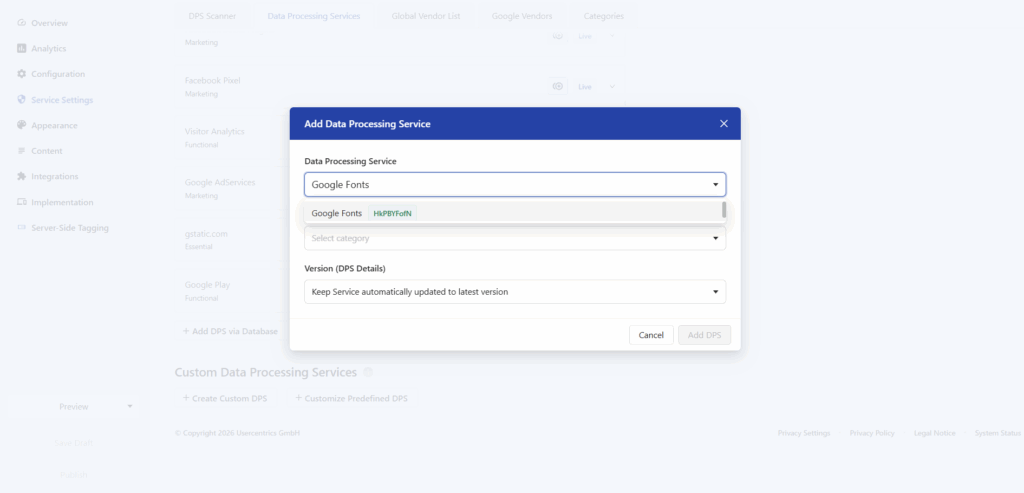
Search for Google Fonts and select the appropriate category. We recommend the Functional category.
Save the changes.
Step 2: Customize Google Fonts script
Review for accuracy and clarity. Correct any outdated phrasing or information. (This note applies to the example script below.)
In most cases, Google Fonts is embedded directly into the website to ensure that it loads as quickly as possible. In this situation, you will have to adapt the script. Please look at the following for an example of the Roboto font:
<script type=”text/plain” data-usercentrics=”Google Fonts”>
var head = document.getElementsByTagName(‘head’)[0];
var link = document.createElement(‘link’);
link.rel = ‘stylesheet’;
link.type = ‘text/css’;
link.href = ‘https://fonts.googleapis.com/css?family=Roboto’;
head.appendChild(link);
</script>
Simply insert the link to the corresponding font in line 6. The Usercentrics CMP will now check the consent status and will only load Google Fonts if consent has been given.
However, if you have implemented Google Fonts using Google Tag Manager, please read our Google Tag Manager Implementation Guide and do not run the corresponding tag until you have obtained consent.
Note that if a visitor doesn’t give their consent, the Google embed code won’t run, and Google-hosted fonts won’t load. Visitors will see a distorted version of your webpages unless you upload backup options. To ensure a smooth web experience, configure a fallback font for every webpage that works across all operating systems.
Additionally, visitors will see a Flash Of Unstyled Text (FOUT) before they give their consent. This disappears once they provide or decline consent or close the banner.
How to implement other fonts in compliance with GDPR data protection regulations
Some companies have launched privacy-led font libraries, which may provide a more suitable alternative to Google Fonts for your website.
Bunny Fonts
Bunny Fonts is an open-source font library with thousands of free fonts. It’s hosted entirely on EU servers and anonymizes all logs at the source, meaning there’s no need to transfer personal data internationally. This makes the platform more privacy-friendly by default and reduces the burden on your company.
But Bunny Fonts doesn’t eliminate all your responsibility. Because your website still collects IP addresses, even if it anonymizes the data, you must disclose this in your privacy notice.
CoolLabs
CoolLabs is another open-source, EU-hosted alternative to Google Fonts. It gives you the option to use CDNs or load free fonts to your own web server to avoid international data transfers.
However, as a smaller, emerging solution, CoolLabs relies on its community to manage its features. It has fewer font families than some options and can’t offer strong guarantees about uptime and consistent updates.
Fontsource
Fontsource is a self-hosted alternative that offers many of the same fonts as Google in NPM packages. Instead of manually uploading the files and updating your CSS paths, you can use the platform to automate the process.
Because self-hosting through Fontsource involves no third-party data transfers, it eliminates the need for consent. The trade-off is that the uploaded fonts increase the size of your website, often impacting load times.
Checklist for a privacy-led approach to website fonts
Whatever font library you use, GDPR implementation requires you to take some proactive steps towards achieving data privacy compliance. Here’s a checklist you can use to help ensure that you’ve met all the regulatory requirements.
Audit data processes
Conduct an audit to see whether you collect, store, and use personal data from people located in the EU.
Identify your font library
Do you use Google Fonts or another solution like Adobe or Fontsource? Check whether it’s hosted outside of the EU, meaning it involves cross-border data transfers.
Understand your current setup
Learn whether you’re using CDNs or self-hosting. If you’re using CDNs, check whether you have a consent mechanism in place for data transfers to the U.S.
Integrate fallback options
Add fallback fonts to your website in case a user declines consent.
Test your website
Conduct a trial run to see whether all fonts load properly and fallback options work so the page appears as it should.
Monitor providers
Revisit font libraries periodically to see whether hosting regions or logging practices have changed.
Automate consent management
Consider investing in GDPR compliance software like Usercentrics CMP to automatically collect consent via banners and log each user’s decision.
Build a privacy-led website to achieve privacy compliance and foster trust with visitors
Font delivery is a small detail on your website that can have major implications for your company, impacting the user experience and exposing you to potential regulatory risks. Controlling how and where data flows helps keep your business compliant with data privacy laws like the GDPR.
The Usercentrics CMP can give you this control by blocking Google Fonts until you’ve obtained consent from users. The software also has geolocation capabilities, detecting each visitor’s current region and adapting the consent banner to their local requirements and helping you maintain privacy compliance with jurisdiction-specific requirements.

Join our growing community of data privacy enthusiasts now. Subscribe to the Usercentrics newsletter and get the latest updates right in your inbox.