

How to protect your website traffic in the AI search era
Just about everyone with a website is worried about AI search and how it’s impacting the way people find your brand. That’s because a clear pattern has emerged: rising impressions with a steady decline in clicks.
60 percentof U.S. searches now result in no click because AI satisfies intent directly in the interface, as Bain & Company research has shown.

For many businesses, this has real consequences. When traffic drops, so does the demand websites rely on to support revenue. For website-led products in particular, this shift can feel like an existential threat.
If that sounds familiar, don’t panic. The rise of AI search doesn’t mean the halt of all traffic to your website.
In this guide, I’ll break down what has changed in search and why clicks are falling. I’ll then share what we observed while navigating this shift alongside Usercentrics. From there, I’ll outline the strategies required to protect website traffic in the AI search era.
At a glance
- AI search is driving a “visibility up, clicks down” pattern. More intent is satisfied directly in interfaces like AI Overviews and chat-based tools, which pushes discovery and evaluation off-site before a buyer ever reaches your domain.
- Website traffic is still protectable, but the strategy has shifted. You need a holistic organic system that maintains traditional SEO performance while also adapting to how AI systems describe, trust, and recommend your brand.
- Measurement needs context. Account for baseline and seasonality, and measure leading vs lagging metrics supplemented by self-reported attribution, to capture true “no-click” influence.
- Brand positioning is now a visibility requirement. If you can’t clearly articulate who you’re for and what you solve (and repeat it consistently across channels), Google, AI systems, and buyers struggle to categorize you.
- Owned tactics are your conversion engine. SME-led content, tight topic clusters, scannable “answer-first” structure, schema and crawl accessibility, and verified EEAT attribution all increase rankings, citations, traffic, and conversions.
- Earned tactics shape the narrative upstream. Consistent positioning across the web, strong review profiles, contextually relevant backlinks, and listicle placements keep your brand visible in the answers that influence decisions long before the click.
- Usercentrics’ Q3 results show the strategy can work. A priority cluster grew impressions 73% QoQ and clicks 101% QoQ, with broader gains in non-brand clicks (+15.6%), AI-search traffic (+27%), MQLs (+48%) and SQLs (+27%).
What has changed in search? Here’s why clicks are dropping
For a long time, the buyer journey was relatively linear. Someone searching for a product or service would do a Google search, click a result on page one, evaluate the product on site, and convert.
This could be a sign-up, a demo, a free trial, or a purchase. In other words, discovery, evaluation, and conversion mostly happened in one place.
That’s no longer how search works, for two reasons:
- Discovery has become fragmented, and people are forming opinions about your brand before ever visiting your website.
Half of consumers now use AI-powered search engines, with a majority citing it as their top digital source for buying decisions. People no longer turn to Google and browse websites. Rather, they ask a question and expect an answer: from ChatGPT, a copilot inside HubSpot, or an in-app assistant.
- AI-powered SERP features like AI overviews provide synthesized answers directly in the search experience.
Instead of sending the click to the page with the best explanation, Google pulls bite-sized insights onto the SERP and the user gets what they need without having to click on one of the results.
Say, for example you’re looking for the best CRM for a small SaaS business. You’ll receive a shortlist of relevant brands.
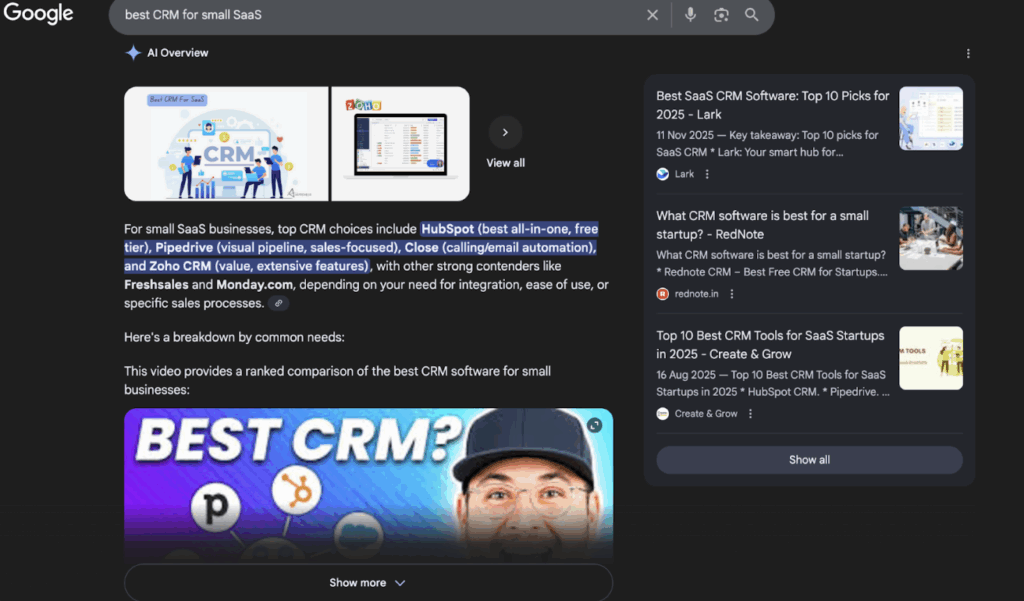
That means the consideration stage often happens off site: within ChatGPT, via AI overviews, on review platforms like G2, in Reddit threads, through Slack communities, and on video platforms like YouTube. That’s what we seek to influence via Generative Engine Optimization (GEO).
GEO focuses on shaping how AI systems understand and determine credibility of your brand and product, so you show up in the answers that influence decisions long before a click ever happens.
If your brand isn’t mentioned, you’re at the risk of being invisible to a potential customer. If you are cited or referenced, buyers will still make their way to your website, but they’ll do so later in their journey, when they’re closer to a decision.
This is also why measurement can’t rely on click-based analytics alone. In a zero-click world, AI search and off-site evaluation can influence buyers without producing a traceable session. If you want a real view of demand creation, you need to combine software attribution (what tools can track) with self-reported attribution (what actually influenced the buyer).
You can protect website traffic even though CTR is slipping for other brands
Search is changing, and many brands see CTR dropping.
But is there a way to protect website traffic in a search environment that increasingly leans on AI-generated answers? Absolutely.
With the right tactics, you can protect (or even improve) traffic levels in this AI-search era. That’s not just a theory.
In 2025, we made it happen for Usercentrics’ Q3 organic search performance, when a priority cluster saw a strong rise in traffic:
- Impressions grew roughly 73% QoQ and clicks increased 101% QoQ.
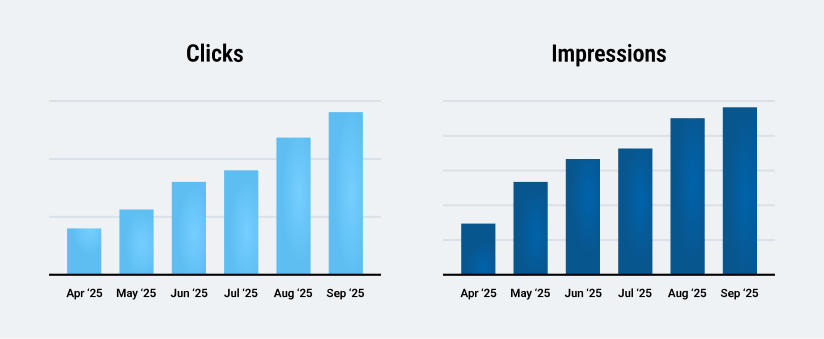
That didn’t happen by accident; it came from doubling down on a range of tactics, which I’ll cover later in this article.
And when we stepped back from individual clusters and looked at overall performance, the system held up where it mattered most. In Q3:
- Non-brand clicks increased 15.6% QoQ
- AI-search traffic grew 27%
- Pipeline moved with it, with MQLs +48% QoQ and SQLs +27% QoQ
- Overall organic website traffic increased by 134% from Q1–Q3 (50% more than the annual traffic goal)
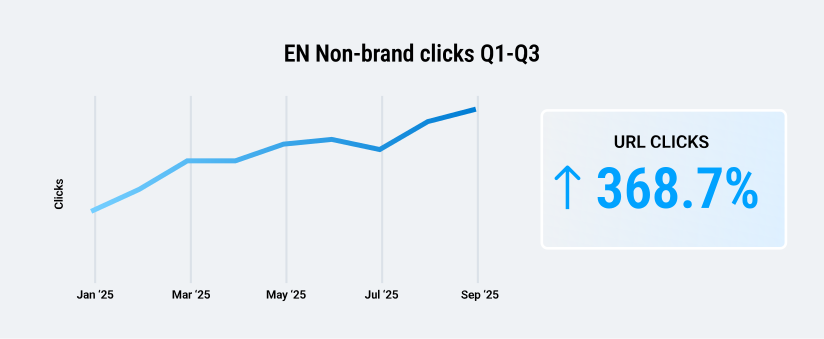
The key takeaway here? Continue investing in your website with traditional SEO while incorporating GEO tactics.
So yes, you can protect website traffic in the AI search era. But you do it by building a holistic, organic growth system that earns visibility earlier in the journey and attracts and converts more effectively later.
Below, I’ll break down the tactics we used to protect Usercentrics’ traffic over the past year.
In practice, organic performance is rarely a straight line.
Here’s a peek into how we pressure-test performance so we don’t over-credit SEO and GEO for a spike, or misread a dip as failure. We’ll go into our full framework for measurement and attribution in the fifth installment of this guide.
- Expect seasonality and normalization: Some months dip regardless of how strong your strategy is. Within strong quarters, surges can be driven by temporary visibility for trending keywords, followed by normalization that has nothing to do with your execution.
- Account for algorithm volatility: Core and spam updates can cause temporary drops. When that happens, diagnose whether the dip is (a) seasonal, (b) algorithmic, or (c) self-inflicted (technical changes, internal linking changes or content edits).
- Sanity-check external influences: Product launches, paid spend changes, PR campaigns and brand pushes can all move organic discovery. It doesn’t invalidate your SEO and GEO work, but you shouldn’t claim causality without checking the full picture.
- Separate leading and lagging indicators: Leading metrics (visibility, citations, impressions, rankings, share of voice, non-brand clicks) show momentum in discovery. Lagging metrics (MQLs, SQLs, pipeline, revenue) prove whether that momentum turns into business outcomes. We also use cohort views (tracking performance over time) over snapshot views (one period), for a more reliable overview, especially in volatile quarters.
- Patch the “zero-click blind spot”: Because AI search can influence decisions without a click, analytics won’t tell the full story. Add a simple self-reported attribution field: “How did you hear about us?” to your signup or demo flows to capture high-intent discovery that GA4 won’t reliably attribute.
Note: This is just the beginning. We’ll cover the technical fundamentals in a later installment, including advanced attribution modelling, schema generation and testing, and query fan-out tracking, so you can validate what’s actually working.
A two-pronged approach to organic growth in the AI search era
Organic growth works as a two-pronged system.
- On one side, you have on-page, “owned” tactics. These are the pages you control, where you capture demand, build trust, and drive conversions.
- On the other side, you have off-page, “earned” tactics. These are the sources that help AI systems form opinions and narratives around your brand and influence buyers before they ever click through to your site.
Think of it this way: owned content builds trust and converts demand, while earned content shapes perception and credibility upstream.
Both sides of the system have to work together. This is the only model I have seen to consistently protect traffic, influence AI answers, and keep pipeline moving.
I’ll explore these two tactics in-depth shortly, but first a note on brand positioning, which is central to your visibility in the AI search era.
“Many companies struggle to articulate clear positioning or differentiation,” explains Kristina Pantelic, Skale’s Organic Growth Lead. “It’s often difficult to get a simple, one-sentence answer to what they do, who they serve, and how they’re different.”
When that clarity is missing, the effects multiply. Google, AI systems, and buyers all struggle to categorize your product or understand the specific problem it solves. Instead of being recognized as the right answer to a defined need, your brand becomes vague, interchangeable, or invisible altogether.
For a long time, SEO performance didn’t hinge on addressing this. You could rank by targeting keywords and creating relevant content that matched buyer intent, even if your positioning was inconsistent.
AI changes that dynamic, and discovery now depends on how consistent your messaging is. And if your website says one thing about your brand and a third-party site says something different, AI systems aren’t able to effectively synthesize this information and translate it into a coherent summary that customers can understand.
That said, your positioning needs to be clear and consistent across both owned and earned content. This makes it easier for:
- AI systems to recognize relevance and describe your brand accurately in summaries, overviews, answers, and recommendations
- Buyers to understand what your product does, who it’s for, and if it’s the right solution to the problem they’re looking to solve
Here’s a peek into how we audit how your brand appears across AI. We’ll go deeper on execution (including prompt libraries and scoring) in a later installment of this, but this alone can remove a lot of “invisible brand” risk.
1) Pick the “verification sources” AI relies on most: Review sites (G2, Capterra), business listings (Crunchbase), social profiles (LinkedIn) and credible industry coverage.
2) Check five elements for exact consistency: Brand name, product name, category, description and positioning.
3) Run LLM citation checks: Prompt ChatGPT, Gemini and Perplexity with your category queries and competitor comparisons to see how you’re described today, and where competitors dominate.
4) Close gaps with controlled edits: Update listings, refine repeated descriptions, fix category drift and align third-party profiles so AI sees one coherent version of who you are.
Before we go further: Technical SEO is still crucial in the AI search era, and you need to have strong foundations in place for your on-page and off-page tactics to work. If you’re looking for some tips, this technical SEO guide covers the basics.
On-page “owned” tactics
On-page “owned” tactics cover content that you directly control. It includes your website (product pages, landing pages, guides, and resources), your social media, and any other platforms you manage (like YouTube).
Here, you’re able to explain what you do, prove your credibility, and give buyers a clear next step when they’re ready to act.
High-quality content
The explosion of low-effort, AI-generated content has made it easy to publish something that looks acceptable but offers very little real value, so high-quality content with a clear point of view is non-negotiable.
That’s why you should prioritize:
- SME interviews that capture first-hand experience
- Data-driven research and whitepapers that demonstrate authority
- Brand-specific insights that competitors can’t replicate
These inputs send strong Experience, Expertise, Authoritativeness, Trustworthiness (EEAT) signals, both to the Google algorithm and potential customers evaluating your brand.
This improves conversion rates and strengthens brand equity while greatly increasing the chances your content both ranks well on Google and shows up in LLMs.
Topically relevant content clusters
One of the biggest mistakes I see content marketing teams make is treating content like a series of one-off efforts. A blog post here, a guide there, and the hope that a few strong pages will carry the rest of the site.
Topic clustering has been a proven SEO strategy for over half a decade. And when done well, clusters improve AI visibility while continuing to drive clicks in traditional search.
If your site looks like a reliable knowledge base on a theme, you get surfaced and cited more consistently, not just for one search term, but across the broader set of questions buyers ask as they evaluate options.
Remember the cluster I mentioned above? Where impressions grew by roughly 73% QoQ, while clicks more than doubled (+101% QoQ)? That performance wasn’t accidental.
It came down to this clustering strategy:
- Expanding coverage inside priority clusters
- Closing intent gaps, even where topics looked similar on the surface but served different needs
- Tightening internal linking back to newly published and recently refreshed content, so the site functioned as a connected system
- Auditing regularly to catch overlap, mismatch, and missed pathways before they became a problem
And we didn’t leave content to fend for itself. We backed each cluster with consistent link building, so strong pages had the external validation they needed to compete in a crowded category.
No part of your organic search strategy should be treated as a “one and done.” Your content clusters need regular health checks and refresh work.
A simple cadence looks like: monthly cluster health checks (intent overlap, internal linking gaps, decaying pages, new SERP features), and quarterly refresh cycles (update top performers, merge cannibalizing pages, and expand coverage where competitors are winning citations).
The goal is to keep the cluster tight, current, and clearly structured so both Google and AI systems can confidently extract answers.
Good content structure
If Google and AI systems can’t easily extract meaning from your content, they won’t rank it or cite it, no matter how good it is.
This also applies to readers, who want skimmable, scannable content they can quickly draw insights from.
The goal has always been the same: make information easy for humans (and algorithms) to understand. But with AI and zero-click search, content is surfaced in snippets. Your structuring increases your chances of making the cut.
| Tactic | What it looks like | Why it works |
| Modular content architecture | Break a page into clear, self-contained blocks that each answer a single question or decision point. For example, structuring H2s and H3s as 150–300 word blocks, each focused on one idea. | Every section should make sense on its own, because that’s how it’s most likely to be encountered, whether by a reader scanning the page or an AI system pulling a specific passage. |
| Answer-first formatting standard | Start every meaningful section with a direct answer. This can just be one or two sentences that clearly respond to a likely user prompt. | This helps human readers scan quickly and it gives AI systems a clean extraction point. If the answer is buried halfway down a paragraph, it’s less likely to be used. |
| Structural elements for scannability | Elements that make it easier to skim and extract insights from articles quickly. This can look like TL;DR blocks, bulleted key takeaways, and HTML comparison tables. | Both buyers and AI systems favor content that’s easy to scan. These elements create value-dense units of information that are easy to summarize, quote, and reuse. |

Machine-readable technical foundations
Structure isn’t just visual. Schema markup provides guidance around what your content is and how it should be interpreted. Article, FAQPage, and Author schema all help provide that context.
On the technical side, you need to be intentional about access. Ensure modern AI agents like GPTBot, Google-Extended, and PerplexityBot are explicitly allowed to crawl your site, in addition to Google’s crawlers.
This enables LLMs to access your content so they’re able to cite and reference it in their answers.
Schema isn’t about adding markup everywhere — it’s about prioritizing what helps search engines (and AI crawlers) interpret your content correctly. For most SaaS brands, the highest-impact starting points are:
- Review/rating schema on product or service landing pages, where it can support rich results and trust signals
- FAQ schema on pages that already include visible Q&As, which can improve rich snippet eligibility and “answer extraction”
- Person schema on author pages to strengthen attribution and EEAT signals by connecting content to credible experts
Just as important: Validate that your schema is actually being read. Treat this as part of a broader technical AI readiness check. Confirm the structured data is machine-readable, confirm pages are indexable, and make sure modern crawlers aren’t blocked from accessing the content and markup.
In a later installment, we’ll share a full technical breakdown of schema generation and testing workflows.
Verified EEAT attribution
I mentioned this above, but it deserves its own section. Generic brand attribution doesn’t cut it. High-performing, owned content needs real subject matter experts behind it.
That means clear author bylines, detailed bios, credentials, and links to credible author profiles.
This is one way you’re able to signal trust to readers, Google, and AI systems that decide which sources to rely on.
Off-page “earned” tactics
Owned platforms are where conversion happens. But they can only do their job if demand reaches them. That relies on your second prong: earned tactics. This is about how your brand appears beyond your website.
Google and AI systems don’t just look at what you say about yourself. They cross-reference third-party sources, reviews, and high-authority editorial content to decide which brands are credible, relevant, and worth recommending.
Entity hygiene and brand consistency
AI search recognizes entities, not URLs. So while how you talk about yourself on your own site is important, you also need to be sure your brand is strong and recognizable everywhere else.
Your brand name, category association, and positioning need to be consistent across the web, from editorial coverage to comparison pages to review platforms and more. Inconsistencies create uncertainty for LLMs, and uncertainty reduces visibility in AI search.
Simplified: when AI cross-references sources and sees conflicting descriptions (category drift, mismatched product naming, inconsistent “who it’s for”), it often responds by hedging, or excluding you entirely.
This goes back to the importance of consistent branding and strong positioning. In addition to clarity on your own site, you need to ensure your messaging is the same everywhere else, regardless of whether you’re being talked about in a YouTube video or referenced in a third-party article.
Review sites and trust platforms
Review ecosystems play a much bigger role than most teams realize. They act as trust validators, not just for buyers, but for the models themselves. Treating these platforms as a core part of your organic growth strategy is not optional.
Set up Google My Business, respond to user reviews, and frequently audit and update accounts on review sites like G2 and Trustpilot.
A network of backlinks
In SEO and GEO, authority isn’t built solely through a handful of high-authority links. It’s built through repeated, contextually relevant mentions across relevant domains.
Being cited often, in the right places, and for the right reasons matters more than chasing links with a high Domain Rating (DR).
The first step is to create high-quality content that readers find valuable enough to link to. The next is to conduct strategic link building and outreach to support that content.
All that Usercentrics content that performed so well? It was supported by high volumes of tactical link-building across a range of relevant sites. For tips on how to conduct successful link building outreach, read our playbook.
There’s no one-size-fits all strategy you can apply. It depends on your industry, your brand, your competitors, the competitiveness of the market, and the scale of your other organic growth efforts.
However, in most markets, you’re looking at roughly 6–25 high-quality placements per month. This takes a lot of work (including analysis, discovery and outreach), and your efforts need to be maintained on a monthly basis.
SERP patterns shift. Your competitors will keep on publishing. That’s why link-building is an always-on system. We’ll go over tactics in a later installment of this guide, but for now you can read our playbooks on link building outreach, backlink analysis and “how many backlinks do you need to rank?”
AI citation outreach
If a buyer asks “What’s the best consent management platform for a SaaS site?”, the sources that shape the answer are often listicles, review sites, community threads, and comparison pages.
That’s why link building work has now broadened to include targeted outreach to the third-party sources that AI systems already favor.
These resources help explain why a tool exists, who it’s for, and how it compares to alternatives. They’re designed to help people find the right tool that suits their needs.
Getting mentioned here can quickly win you visibility in relevant AI answers and results, because your content sits inside the exact pages AI engines already reuse when they answer buyer questions. From an AI perspective, they act like a shortcut to category consensus.
To build a sustainable organic growth plan, your strategy should include a mix of traditional link building and these AI visibility placements.
Traditional link building strengthens rankings and builds topical authority so your performance improves over time, but winning a spot in a highly cited listicle gets you into AI sooner.
We tested this recently with a client, and were able to increase AI brand mentions from just seven to 93. This helped them to reach a top three position in AI-generated answers — ahead of two industry giants — and push their domain citations up to 146.
Just like link building, this requires consistent, ongoing effort and defence, but with different strategic targeting.
From an AI visibility standpoint, the most valuable wins aren’t necessarily single, high-DR trophies. They’re repeated, contextually relevant mentions inside credible spaces that models trust to verify information.
We’ll go deeper on how to identify the sources you should be going after (the exact domains and formats AI engines already favor for your highest-intent prompts) in chapters two and four of this guide, including citation tracking, query fan-out mapping, and how to prioritize the sources most likely to influence AI answers.
Why organic growth still works in the AI search era
It’s easy to look at falling CTR and assume that it’s no longer possible to protect organic traffic. Yes, search has changed. Discovery is more fragmented, early evaluation happens off-site, and AI overviews answer questions directly on SERPs.
Your website is still essential; it just shows up later in the journey, when a buyer is closer to a decision.
You can protect your traffic even as search evolves.
We saw it first hand with Usercentrics. Even while CTR slipped for parts of the site, the overall system held where it mattered. Non-brand clicks grew, AI-search traffic increased, and pipeline moved with it.
We can attribute that outcome to a strategic, organic growth system:
- Clear positioning made it easier for AI systems and buyers to understand what the product is for.
- Focused content clusters built authority across entire topics, not just individual keywords.
- LLM-friendly structuring ensured content could be extracted and reused in AI answers.
- Consistent off-site signals, from reviews to earned placements like listicles and comparison mentions, shaped perception and built authority long before a click ever happened.
That’s the real takeaway.
You don’t protect traffic by focusing on boosting CTR at all costs. You do so by building an organic growth system that earns visibility earlier and converts more effectively later.
Search will continue to evolve, but when your strategy is designed for how decisions are made today, organic can still be one of your most reliable growth channels.