
Every interaction your users have with your website or app generates data. Email addresses, browsing patterns, payment details, health records — the list goes on. This information powers your business decisions, but it also comes with responsibilities.
However, user data protection isn’t about locking information away. It’s about building systems that respect the people behind the data while keeping your business privacy compliant and trustworthy.
When you get it right, you build relationships based on transparency. When you get it wrong, you risk regulatory fines, reputational damage, and lost customer trust.
Key takeaways
- User data protection means keeping personal information safe from unauthorized access, loss, or misuse.
- Protecting data builds trust with customers and enables organizations to meet legal and ethical responsibilities.
- Different types of data, like personal identifiers, financial records, health information, and sensitive characteristics, need specific, enhanced protections.
- Data protection best practices include limiting data collection, obtaining explicit consent, encrypting data, controlling access, and monitoring vendors.
- Tools such as CMPs, DLP software, IAM systems, encryption solutions, SIEM platforms, and data classification tools help enforce protection measures.
What is user data protection?
User data protection is the practice of safeguarding any information that identifies or relates to an individual. It includes technical security measures, compliance with legal requirements, and organizational policies that govern how you collect, store, use, and eventually delete that information.
Data protection for businesses means ensuring that customer information remains confidential, accurate, and accessible only to authorized parties. You’re protecting against unauthorized access, accidental loss, and misuse, whether that comes from external threats like hackers or internal risks like employee negligence.
How is data protection different from data privacy?
Data protection and data privacy are often used interchangeably. They appear to be two sides of the same coin, but are in fact two distinct concepts that work hand in hand.
- Data protection focuses on how companies secure their customer data. For instance, encryption protocols, firewalls, backup systems, and access controls that keep data safe from breaches, loss, or unauthorized access.
- Data privacy focuses on the what and why of user data. It looks at what data you may collect, how you may use it, and the rights that individuals have over their information.
Privacy determines whether you should collect someone’s location data in the first place. Protection ensures that once you have it, nobody can steal it.
Learn the key differences between data security and data privacy.
Why companies need to protect user data
Trust is the foundation of every customer relationship. When people share their information with you, they’re placing confidence in your ability to protect it. Break that trust once, and it’s hard to win back. Studies consistently show that consumers prefer doing business with companies that take data protection seriously.
But trust isn’t the only reason data protection strategies matter. The regulatory landscape has transformed. Several privacy laws have become influential global standards that continue to evolve, alongside new regulations being passed.
Many organizations now fall under multiple frameworks, like the EU’s General Data Protection Regulation (GDPR), California Consumer Privacy Act (CCPA), and Brazil’s General Data Protection Law (LGPD). GDPR fines can reach EUR 20 million or four percent of global annual revenue, whichever is higher, making noncompliance costly.
The financial and reputational fallout from data breaches is also severe. IBM reports the average cost of a breach at USD 4.4 million, which includes costs for everything from legal fees and regulatory penalties to lost business.
However, many companies never fully recover their reputation because customers leave, partners become hesitant, and investor confidence erodes.
Beyond compliance and cost, there’s an ethical responsibility. Personal data can expose deeply personal customer information. Mishandling it can cause harm, from identity theft to discrimination or even physical danger. Therefore, protecting user data isn’t just a legal duty, it’s also a moral one.
What types of customer data should you protect?
Not all customer data carries the same risk, but generally, all personal information deserves careful handling.
- Personal identifiers: This includes information like names, email addresses, phone numbers, physical addresses, IP addresses, and device identifiers. These can directly identify someone or be easily linked to them.
- Financial information: This includes information like credit card numbers, bank account details, transaction histories, and payment information. Even if you use a third-party processor, you’re responsible for protecting related data.
- Health data: This includes information like medical records, prescriptions, insurance details, genetic data, or fitness tracker information. Some of this data falls under regulations like HIPAA in the U.S., depending on how it’s collected or shared.
- Behavioral and preference data: This includes browsing history, purchase patterns, search queries, location data, and app usage. In aggregate, these details can reveal personal insights about a person’s habits and interests.
- Sensitive personal characteristics: This includes data such as racial or ethnic origin, political opinions, religious beliefs, sexual orientation, or biometric identifiers like fingerprints and facial recognition data. Most regulations require extra protection for this information.
The key question isn’t just what data you have, it’s whether you actually need it. Many businesses collect far more information than they need, or even use, thus creating unnecessary risk exposure.
How to protect user data (best practices to improve data protection)
Effective data protection strategies rely on a combination of security measures and consistent implementation. Below are six strategies to best manage data protection.
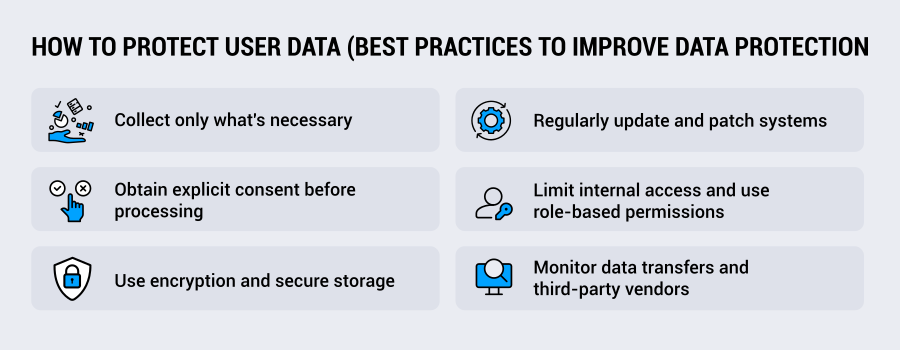
Collect only what’s necessary
The best way to protect data is to not collect it and have it in your possession in the first place.
Limiting data collection to the targeted essentials reduces risk exposure and simplifies privacy compliance. Therefore, before adding new fields to a form or tracking additional user behavior, evaluate whether the information is required to provide the service or achieve a specific business goal.
Many data privacy laws explicitly require that data collection be limited to what is necessary to fulfill the stated purpose for processing, and that companies obtain consent for all purposes.
Data minimization also reduces the potential for data misuse. By regularly reviewing data collection practices and eliminating unnecessary information, you’re helping to ensure that you only retain relevant and actively used data.
Obtain explicit consent before processing
Consent isn’t a formality. It’s a legal requirement under most data protection regulations and a cornerstone of ethical data handling. Users need to understand what information you’re collecting, why you’re collecting it, how you’ll use it, and who else might access it.
It’s worth noting that pre-ticked boxes or other anticipatory elements don’t count as valid consent. Vague privacy policies aren’t compliant either. Consent needs to be freely given, specific, informed, and unambiguous.
This means clear language, granular choices, explicit actions, and easy ways to withdraw consent later. Your consent management process should make opting out as simple as opting in.
Use encryption and secure storage
Encryption is a security measure that obscures data, so only authorized users can read it. It protects data both in transit as it moves between systems and at rest while it’s stored. So, even if attackers breach your perimeter, encrypted data remains unreadable without the proper keys.
It’s recommended to use industry-standard encryption protocols such as TLS 1.3 or higher for data in transit and AES-256 for data at rest.
It’s also strongly recommended to secure encryption keys separately from the encrypted data, rotate them regularly, and ensure you have documented key management procedures. Cloud storage providers offer encryption options, but make sure you understand what they protect and what remains your responsibility.
Regularly update and patch systems
Software vulnerabilities create opportunities for attacks. So when vendors release security patches, they’re responding to known weaknesses that attackers actively exploit.
To avoid a potential data exposure, establish a patch management schedule that prioritizes critical security updates. Test patches in a non-production environment when possible, but don’t delay deployment for minor issues because the risk of running unpatched systems typically outweighs the risk of patch-related bugs.
This applies to operating systems, applications, plugins, and any libraries or dependencies your systems use.
Limit internal access and use role-based permissions
Your employees are typically your biggest insider threat, usually unintentionally rather than with malice. Someone with unnecessary access to customer data might inadvertently expose it, misconfigure a system, or fall victim to phishing attacks or social engineering.
A solution for this is to implement role-based access control (RBAC) that grants employees the minimum permissions necessary to perform their jobs.
A marketing coordinator doesn’t need access to payment-processing systems. A customer service representative doesn’t need access to salary information. Review access permissions quarterly and revoke access immediately when employees change roles or leave the company.
Monitor data transfers and third-party vendors
Most data breaches involve third parties. Your payment processor, email service provider, analytics platform, and CRM system each handle customer data. Their security becomes your security.
Therefore, conduct vendor risk assessments before integration. Review their security certifications, incident response procedures, and data handling practices.
Include data protection requirements in contracts, specifying encryption standards, access controls, breach notification timeframes, and the right to audit.
Remember that under most regulations, you remain responsible for your vendors’ data handling, even when they’re the ones who make mistakes.
Tools and tech to help protect user data
Even with strong policies and well-defined processes, managing and protecting user data can be complex. Companies that handle large volumes of data across multiple systems, applications, and channels increase their risk of accidental exposure or misuse.
The good news is that there is a range of tools that can help manage these challenges, support regulatory compliance, and reduce reliance on manual processes.
Consent management platforms
A consent management platform (CMP) automates the collection, storage, documentation, and management of user consent across your websites, apps, and other connected platforms.
When set up correctly, a CMP’s consent banner provides clear information and options for users to grant or withdraw consent. They also securely consent, ensure updates over time are recorded, and provide auditable logs. These functions help organizations demonstrate compliance with regulations such as GDPR, CCPA, and other regional frameworks, partner platforms’ policies, etc.
Curious about what’s a consent management platform and how it helps with privacy compliance? Learn more.
Data loss prevention (DLP) software
DLP tools monitor how data moves within and outside the organization. They can block emails containing sensitive information, prevent copying databases to external drives, or alert security teams when large files are transferred to unexpected locations. By controlling data flows, DLP reduces the risk of accidental leaks or unauthorized sharing.
Access management systems
Identity and access management (IAM) solutions define and enforce who can view, modify, or delete data. Features like multi-factor authentication, single sign-on, and granular permission controls make it possible to implement role-based access across complex organizational structures. Thus ensuring employees have only the access they need.
Encryption tools
Encryption protects data both while it’s stored and while it’s transmitted. Advanced encryption solutions go beyond built-in operating system options by offering key management, centralized enforcement of encryption policies. Data protection can also be maintained as data moves among systems or is shared with partners.
Security information and event management (SIEM) platforms
SIEM platforms aggregate logs and alerts from across the IT environment to detect unusual patterns that could indicate a breach or unauthorized access. They provide real-time monitoring, support forensic analysis, and help organizations respond quickly to potential security incidents.
Data discovery and classification tools
As organizations accumulate data, understanding what exists and where it resides is essential. Discovery and classification tools map data across systems, categorize it by sensitivity, and identify gaps in compliance or security. This visibility enables more precise application of protection measures and supports risk management and regulatory reporting.
Key data protection regulations that you need to know about
Data protection is not only a matter of best practices and technology, it’s also a legal obligation. Understanding the regulatory landscape helps companies design compliant data protection strategies from the outset and avoid costly penalties.
The following data protection regulations are most likely to affect your operations across industries and regions.
General Data Protection Regulation (GDPR)
The GDPR applies to any organization processing data of EU residents, regardless of where your company is based. It establishes principles like lawful processing, data minimization, and purpose limitation. The GDPR includes several data subject rights, such as the right to be informed and the right to be forgotten.
Health Insurance Portability and Accountability Act (HIPAA)
HIPAA governs protected health information (PHI) in the United States. If you handle medical records, health insurance claims, or provide services to healthcare providers, HIPAA requirements likely apply to you. This includes specific security standards, privacy practices, and breach notification requirements tailored to the healthcare context.
Family Educational Rights and Privacy Act (FERPA)
FERPA protects student education records in the United States. Schools, universities, and organizations providing services to educational institutions must comply with FERPA’s restrictions on disclosing student information without consent.
Fair Credit Reporting Act (FCRA)
The FCRA regulates how consumer credit information is collected, shared, and used in the United States. If you pull credit reports, provide data to credit bureaus, or make decisions based on consumer reports, FCRA compliance is mandatory and includes strict accuracy and dispute resolution requirements.
California Privacy Rights Act (CPRA)
The CPRA is an expansion and replacement for the California Consumer Privacy Act, giving California residents enhanced rights over their personal information. It includes requirements for data minimization, purpose limitation, and restrictions on automated decision-making. Other U.S. states have passed similar laws, creating a patchwork of requirements that often default to California’s standards as the baseline.
Get all the information you need to know about student data privacy laws around the world.
What are the risks of not managing data protection?
Implementing best practices, using the right tools, and complying with regulatory requirements are not just checkboxes; they are essential to protecting your organization from serious consequences. When data protection is neglected, the risks are far-reaching.
Financial penalties are often the first and most dramatic consequence that makes headlines. For instance, Meta was fined a record-breaking EUR 1.2 billion for GDPR violations, and British Airways paid GBP 20 million following a data breach.
These are not outliers, they show the cost of lax user data security even for companies with significant resources. Smaller organizations face proportionally severe penalties that can threaten their very existence.
Learn about the GDPR enforcement that doesn’t make headlines, and what it means for smaller companies.
Legal liability adds another layer of risk. Data breaches can trigger class-action lawsuits and ongoing regulatory investigations. Legal defense costs accumulate quickly, often exceeding the investment it would have taken to implement proper protections from the start.
Reputation damage is perhaps the hardest consequence to quantify and the most difficult to repair. Customer trust, once broken, may never fully return. Studies consistently show that consumers abandon companies after breaches, and negative press can resurface years later whenever the company is mentioned in news stories.
Recovery gets even harder when the trust and reputation issues mean that advertisers, potential partners, and investors don’t want to risk being tainted by association. Thus jeopardizing revenue and growth.
Lastly, the operational impact is immediate and consuming. Responding to a breach demands attention from teams across the organization, who must investigate the incident, notify affected individuals, cooperate with authorities, implement remediation measures, and manage public communications. All while maintaining daily operations.
Some companies never fully regain their operational rhythm, enabling competitors to gain ground while customers and partners reconsider relationships.
The future of user data protection
Managing user data is becoming more complex, but new technology also creates new opportunities.
For instance, artificial intelligence brings new challenges because machine learning models trained on personal data can accidentally expose information. As AI starts influencing decisions like credit approvals or medical recommendations, transparency and responsible use will be essential. Regulators are already starting to address these concerns.
In addition, biometric data continues to become more common. Facial recognition, fingerprints, and voice authentication are common, but unlike passwords, biometric information cannot be changed if compromised. That’s why laws treat this data as highly sensitive.
At the same time, privacy-enhancing technologies are improving. Homomorphic encryption, differential privacy, and federated learning enable organizations to use data more safely without exposing individual information. These tools are moving from research into everyday use.
Lastly, data protection laws will continue to be passed globally, and existing ones will evolve. Companies that treat privacy as part of their core operations — rather than just a compliance task — will be best positioned to build trust and innovate safely.
Build trust through ongoing data protection
User data protection is a continuous effort, not a one-time task. It starts with knowing what information you hold, why you need it, who accesses it, and where it lives. From there, companies must remove unnecessary data, secure the rest, and make sure employees and partners handle it responsibly.
Improving your data protection doesn’t just help protect against data breaches or fines. It builds trust with customers to strengthen long-term relationships and supports smoother operations. By treating data protection as a strategic priority, you can stay ahead of risks, stay privacy-compliant, and demonstrate that customer privacy truly matters.

Join our growing community of data privacy enthusiasts now. Subscribe to the Usercentrics newsletter and get the latest updates right in your inbox.
