

Modern businesses rely on dozens of third-party partners to operate efficiently, from SaaS and analytics to marketing and cloud. Each expands capability, but also increases exposure to data breaches, noncompliance, and hidden data flows.
As the GDPR, CCPA, and other laws evolve, the stakes are only getting higher. Third-party risk management (TPRM) provides the framework to identify, assess, and monitor external partners so you can protect data, maintain regulatory compliance, and strengthen trust.
What is third-party risk management?
Third-party risk management (TPRM) is a core element in modern risk management strategies. Its focus is on identifying, assessing, and controlling risks introduced by external partners that can access your data.
Every integration or vendor relationship creates new data flows, and those bring new points of exposure.
When third parties collect, store, or transfer user information, your organization is accountable for making sure those activities comply with global data privacy and protection frameworks like the European Union’s General Data Protection Regulation (GDPR).
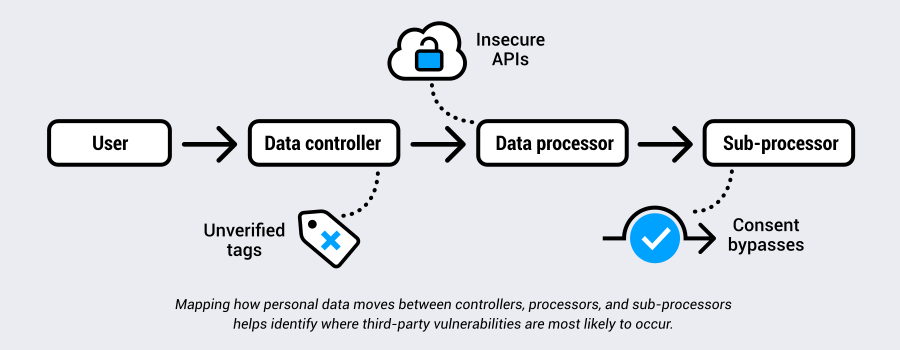
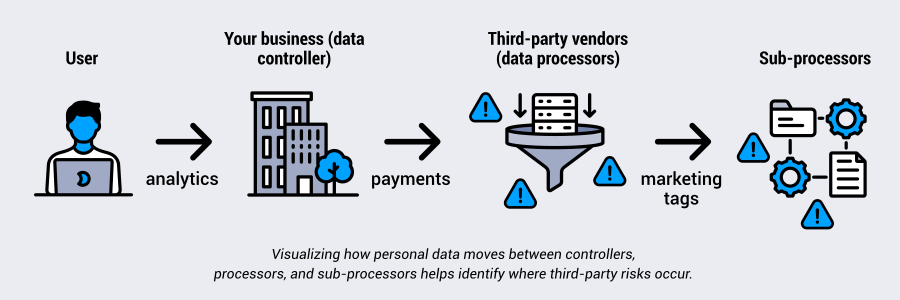
The goal of TPRM is to create visibility and control. It enables businesses to map where personal data travels, evaluate how securely it’s managed, and confirm that all processors are meeting their contractual and regulatory obligations.
It’s important to note that under many data privacy laws, controllers are responsible for the data protection and processing of all third-party contracted processors.
Why is third-party risk management important for modern businesses?
Digital operations run on connected vendors, like marketing platforms, analytics, cloud, payments, and AI. Each connection extends your data environment beyond your direct control, creating more places where data can be lost, misused, or mishandled.
Research from Verizon Business shows data breaches related to third-party vendors doubled between 2024 and 2025 — to 30 percent of the total. When one partner’s security fails, the impact can cascade across every connected system.
Real-world examples of breaches with third-party origins
The following examples demonstrate potential risks introduced with every third-party relationship. The companies’ size is of note as well — the larger a company grows, the more third-party relationships it’s likely to have.
- Oracle Cloud: Attackers exploited vulnerabilities in Oracle’s authentication systems, exposing millions of records across the businesses that rely on its cloud infrastructure. Cybersecurity incidents like this can create a downstream risk for countless customers, even when just one infrastructure vendor is compromised.
- Allianz Life: A third-party vendor managing data services was breached, affecting approximately 1.4 million customers. Although Allianz’s own systems were secure, the incident showed how a pure third-party failure can still lead to large-scale data exposure.
- Jaguar Land Rover: A supplier cyberattack forced Jaguar Land Rover to halt vehicle production temporarily. No customer data was leaked, but the event demonstrated how operational disruptions within the supply chain can be just as damaging as data loss.
Risk identification includes privacy compliance breaches
As privacy expectations rise and data privacy laws in the U.S. continue to evolve, proactive vendor governance is not optional. Unchecked data sharing can lead to GDPR penalties, lawsuits, and reputational damage.
Effective TPRM supports organizations as they maintain innovation and growth while holding every external partner to the same privacy and security standards. TPRM helps build the foundation for Privacy-Led Marketing and responsible data use.
What is a third-party risk assessment?
A third-party risk assessment is the process of evaluating how secure, privacy-compliant, and reliable a vendor or partner is before — and while — they handle your organization’s data. It’s how you verify that every external partner meets your privacy, security, and operational standards.
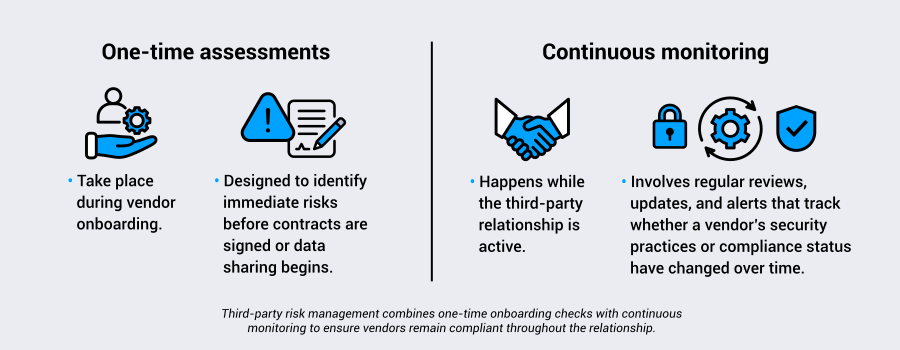
There are two main approaches:
- One-time assessments take place during vendor onboarding. They’re designed to identify immediate risks before contracts are signed or data sharing begins.
- Continuous monitoring occurs while the third-party relationship is active. It involves regular reviews, updates, and alerts that track whether a vendor’s security practices or compliance status have changed over time.
An effective third-party risk assessment framework typically reviews:
- Security posture: encryption, access controls, and incident response readiness
- Data handling practices: how personal data is stored, transferred, and deleted
- Compliance documentation: certifications, audits, and adherence to frameworks like ISO 27001 or SOC 2
- Contractual safeguards: Data Processing Agreements (DPAs), Standard Contractual Clauses (SCCs), and privacy policies
These evaluations are generally based on a standardized third-party risk assessment methodology, which helps ensure each vendor is assessed consistently and objectively.
Many organizations use dedicated tools, such as compliance audit software or GDPR compliance software, to automate these reviews, centralize documentation, and generate ongoing reports.
Combining structured assessment criteria with automated monitoring helps businesses reduce exposure, maintain privacy compliance, and strengthen trust across their vendor ecosystem.
Key types of third-party risks
Behind every vendor relationship lie different kinds of vulnerability: technical, legal, operational, or reputational. Knowing where those risks come from is your first step toward managing them effectively.
1. Cybersecurity risks
When a vendor’s systems are compromised, attackers can gain access to your data through shared integrations or credentials. These risks include data breaches, malware infections, and weak access management.
A single unpatched API or weak access control can open a path into your systems, hence the need for continuous security monitoring.
2. Regulatory compliance and legal risks
Third parties that process personal data on your behalf must meet the same regulatory requirements as your organization. If a vendor fails to comply with the requirements of laws like the GDPR, CCPA, or LGPD, your business may be held responsible.
Contractual gaps or missing Data Processing Agreements (DPAs) can also create exposure during audits or investigations.
Operational risks
Vendors that provide critical services, such as cloud storage, payments, marketing automation, or CRM, can disrupt your business if they go offline or change their service model. Service outages, resource dependency, and vendor lock-in can lead to lost revenue and slow recovery. Develop a contingency plan to reduce your operational risk.
4. Reputational risks
A third-party incident can damage customer trust, even if your organization wasn’t directly at fault. Public breaches or compliance failures often make headlines, and users rarely distinguish between your systems and your partners’. Proactive oversight and clear communication will help preserve your reputation if issues arise.
5. Data privacy and consent risks
Third-party tracking technologies like cookies, tags, and SDKs can collect user data without proper consent or visibility. Misconfigured or unauthorized tools can violate privacy laws and user expectations. Implement a unified consent and tag management system to keep third-party tracking privacy-compliant and transparent.
Managing these risks requires strict control over scripts and integrations, supported by actions like implementing a cookie consent banner and monitoring tracking cookies.
To stay privacy-compliant as browser policies evolve, organizations should also track changes to Google third-party cookies and verify that consent signals are shared consistently across all vendors.
Examples of third-party security and privacy risks
Even with strong governance, everyday integrations can introduce risk if not properly configured or monitored. Here’s what can go wrong, and how to stay in control.
Marketing tags collecting PII without consent
Risk: Personal identifiers (like email or IP address) captured before user consent.
Control: Enforce CMP-based prior blocking, strip PII parameters, and regularly audit tag firing rules.
Unverified e-commerce or CRM integrations
Risk: Shadow IT tools gaining access to customer or transaction data without oversight.
Control: Maintain a vendor allowlist, vet store apps before installation, use least-privilege API keys, and keep your inventory updated.
Unencrypted or misconfigured APIs
Risk: Data exposure during transfer or through shared credentials.
Control: Use transport layer security (TLS) or mutual TLS (mTLS), rotate keys, apply OAuth scopes, restrict by IP allowlists, and pin API versions to prevent drift.
The third-party risk management lifecycle
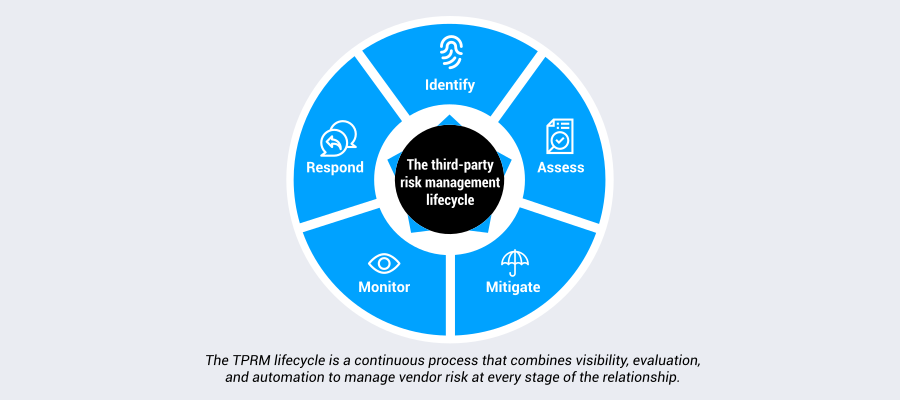
Third-party risk management isn’t a one-time task. It’s a continuous cycle of visibility, control, and improvement. The TPRM lifecycle is a clear structure for managing third-party relationships, from onboarding to incident response, supporting privacy compliance and data protection at every stage of engagement.
The model typically follows five connected phases:
- Identify: Map all vendors and partners that access your data.
- Assess: Evaluate their information security, privacy, and compliance posture.
- Mitigate: Apply contractual and technical controls to reduce risk exposure.
- Monitor: Continuously track performance, compliance, and changes.
- Respond: Act quickly to contain and report incidents when they occur.
Each phase builds on the last to create a loop of continuous oversight and improvement. As your vendor ecosystem evolves, this lifecycle keeps your risk management strategies evolving at the same time. It supports resilience and accountability across every third-party relationship.
Who owns TPRM inside an organization?
Third-party risk management shouldn’t belong to a single team. Instead, it should be a shared responsibility across multiple departments. Each can play a role in identifying, assessing, and monitoring vendor risks to maintain business continuity and regulatory compliance.
- Legal teams review contracts, DPAs, and SCCs to confirm that data protection and liability terms are clearly defined.
- Compliance teams align vendor management with frameworks like the GDPR, CCPA, and ISO 27001 so that ongoing processes meet global and regional standards.
- IT Security manages technical evaluation by reviewing encryption, access controls, API configurations, and incident response readiness.
- Procurement oversees vendor onboarding and due diligence, embedding risk assessment into purchasing workflows to prevent shadow IT and uncontrolled integrations.
- Marketing and Product teams, which often deploy tags and analytics tools, are responsible for ensuring that third-party tracking aligns with user consent and privacy preferences.
- Data Protection Officers (DPOs) and privacy officers act as coordinators among these groups. They lead data mapping efforts, track where personal data is shared, and maintain accountability under privacy laws like the GDPR.
The TPRM process (step by step)
Once you’ve established your third-party risk management lifecycle, it’s time to implement and execute. The following steps outline how to operationalize TPRM through practical actions, tools, and automation.
1. Vendor identification and classification
Document every vendor and tool that interacts with personal or operational data in your organization. Classify each by access level: from full processors to ancillary service providers. Use scanning tools such as UpGuard, SecurityScorecard, Black Kite or OneTrust to detect unlisted integrations, surface hidden vendor risks and verify lawful data collection.
2. Vendor risk assessment
Evaluate each partner’s security and compliance posture using standardized security questionnaires, certifications, and internal reviews. Record the findings from this evaluation in your Record of Processing Activities (RoPA) and perform Data Protection Impact Assessments (DPIAs) where sensitive data is involved.
3. Contractual controls
Define third-party accountability through DPAs, SCCs for international data transfers, and clear notification service level agreements (SLAs) for incident management. Consolidate all vendor documentation in a centralized TPRM repository.
4. Ongoing monitoring
Risk management is not a one-time effort. Perform continuous oversight by scheduling re-certifications, setting up ownership or certification change alerts, and implementing automated notifications for compliance drift. Integrate tools that flag when vendors modify APIs, data scopes, or security controls.
5. Incident response
Prepare a vendor incident runbook with notification templates, escalation workflows, and post-incident review procedures. Apply lessons learned to your risk scoring and onboarding criteria for continuous improvement.
When implemented consistently, these steps turn the TPRM framework into a living system that safeguards privacy compliance, strengthens trust, and scales with your data operations.
Third-party risk management and regulatory compliance
Under Art. 28 GDPR, controllers must use only processors that meet adequate security and compliance standards, and they must verify that status on an ongoing basis. This requirement makes third-party management and oversight essential to every organization’s privacy framework.
Effective TPRM means that key documentation, such as DPIAs, RoPAs, and SCCs, is consistently applied and kept up to date. These records will demonstrate due diligence and help you prove compliance during audits or regulatory investigations.
Cross-border data transfers add another layer of complexity. Mechanisms like the EU–U.S. Data Privacy Framework and SCCs enable lawful data exchange between jurisdictions, but only if all vendors in the chain implement them correctly and maintain compliance.
With new data privacy laws emerging across the U.S., organizations need centralized visibility into their vendor ecosystem to maintain compliance across multiple regulatory environments. Embedding TPRM practices into privacy operations provides the structure and evidence needed to manage international data flows confidently and compliantly.
Integrating consent management into your TPRM strategy
Consent management is often treated as a marketing responsibility, but it’s also a key part of third-party governance. Every vendor that processes user data needs accurate consent signals to determine what they can lawfully collect or share.
When those signals are missing or have misfired, even the most compliant vendors can inadvertently process data unlawfully. Integrating a CMP into your third-party risk management system helps ensure that user permissions flow directly into your vendor controls to activate or restrict data access in real time.
This alignment closes one of the largest gaps in traditional TPRM frameworks: the disconnect between legal compliance and technical enforcement. With consent orchestration embedded across your tag and data layers, third parties act on verified legal bases only. This reduces the need for manual oversight.
Integrating consent management with TPRM gives you a privacy-first governance model where consent, compliance, and control work together. It reduces risk, simplifies audits, and strengthens user trust across your entire vendor ecosystem.
Automating vendor and data risk mitigation
Manual audits and spreadsheets can’t keep pace with the speed and complexity of modern vendor ecosystems. New tags, APIs, and integrations appear daily, often outside direct oversight, and can create gaps that traditional review cycles can’t close.
Automation brings those blind spots under control. When you integrate your third-party risk management technology with tools that monitor data flow in real time, you can detect unauthorized access, validate compliance status, and trigger alerts automatically when changes occur.
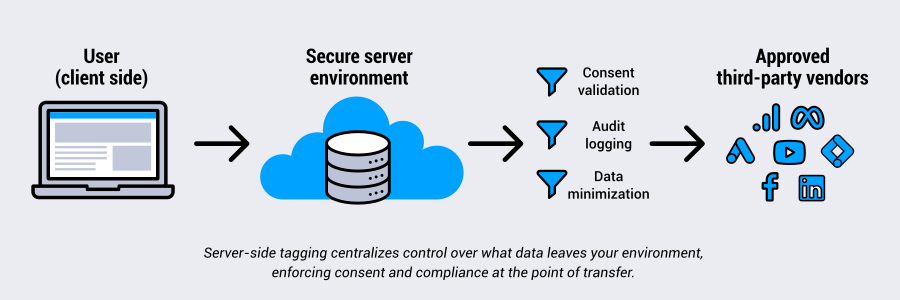
Server-side tagging (SST) plays a crucial role. By routing data through a secure server environment that you control, SST limits unnecessary exposure to third parties while maintaining analytics and performance accuracy. When paired with automated consent enforcement, it helps ensure that only approved vendors receive data, and only under valid legal bases.
This kind of continuous, automated third-party risk monitoring transforms TPRM from a periodic audit process into an active defense system. It enables faster response, stronger documentation, and measurable third-party risk mitigation to create a scalable foundation for privacy-first data governance.
Best practices for effective third-party risk management
To build a mature third-party governance framework, you’ll need to go beyond ticking compliance boxes. You need to create visibility, accountability, and shared responsibility across every vendor relationship.
1. Centralize vendor visibility
Maintain a single, up-to-date inventory of all tools and integrations that process personal data. Create vendor profiles, and tag each one by risk rating and data access level to make oversight and auditing more efficient.
2. Strengthen contractual and privacy compliance foundations
Every partner relationship should include a clear DPA outlining data use, purpose, and lawful basis. For international vendors, include SCCs and defined notification SLAs in your third-party agreements.
3. Keep monitoring and auditing
Adopt tools that support automated third-party risk monitoring to track certification changes, access permissions, and policy updates. Schedule recurring reviews to verify that vendors maintain compliance with the GDPR, CCPA, and other relevant regulations and policies, as well as your own internal standards.
4. Embed privacy culture across teams
Regularly train marketing, procurement, and engineering teams on data handling and privacy compliance. Effective third-party risk management depends as much on people as on policy.
5. Integrate systems for unified oversight
Combine your CMP, tag management system, and TPRM workflows to link legal, operational, and technical controls. Doing so creates a holistic approach to vendor governance in which compliance enforcement happens automatically.
When these processes work together, organizations can move from reactive compliance to proactive resilience.
The future of third-party risk management
Third-party risk management is entering a new phase. It’s one defined by automation, intelligence, and accountability. As vendor ecosystems expand and regulations tighten, manual oversight is giving way to AI-driven vendor scoring, predictive analytics, and real-time monitoring that reveal risks before they turn into incidents.
These innovations mark a shift from static compliance to dynamic governance. Privacy automation and policy-as-code frameworks are embedding data protection directly into infrastructure. They continuously enforce consent and data security policies across every vendor connection.
At the same time, global privacy laws are converging on higher standards of third-party accountability. This evolution is driving the adoption of zero-trust architectures and privacy-centric supply chains, where no integration or data flow is trusted without verification.
The organizations that lead in this environment will treat TPRM as an engine of trust, not just a line of defense. By investing in intelligent automation and transparent governance, they’ll build vendor ecosystems that are as resilient, scalable, and ready for the next generation of data privacy challenges as they are privacy-compliant.
Advancing your third-party risk strategy
Every connection in your digital ecosystem brings both opportunity and responsibility. Third-party risk management is how modern organizations turn that responsibility into resilience. It’s one step towards transforming compliance from a checklist into a competitive advantage.
By uniting vendor governance, consent management, and automation, your business can achieve continuous visibility across data flows and act decisively when security risks arise. You’ll be better able to prevent breaches and meet regulatory requirements, but you’ll also build a foundation of trust that supports sustainable, privacy-first growth.
Integrating the Usercentrics Consent Management Platform (CMP) into your TPRM strategy gives you centralized control over third-party data access. The CMP captures and transmits granular consent signals, automates documentation, and provides reliable audit trails — ensuring vendors only activate when legally permitted. Paired with Server-Side Tagging, it creates a privacy-first architecture you can trust even as the regulatory landscape shifts.

Join our growing community of data privacy enthusiasts now. Subscribe to the Usercentrics newsletter and get the latest updates right in your inbox.
