

Data is only useful if it can be trusted. When data moves among teams, platforms, and tools without clear rules governing how it’s handled, quality degrades, accountability disappears, and compliance becomes a matter of luck rather than design.
Data governance principles are what prevent that. They’re the agreed-upon standards that define how data is collected, managed, used, and protected across an entire organization. They’re not about restricting what can be done with data. They’re about making it possible to do more with it with confidence.
At a Glance
- Data governance principles define the rules, roles, and standards that determine how an organization collects, manages, and protects data.
- Strong data governance directly supports GDPR compliance by embedding accountability, transparency, and purpose limitation into day-to-day data operations.
- The six core principles of data governance are accountability, transparency, data quality, security, purpose limitation, and data retention.
- Poor data governance costs organizations through regulatory fines, damaged customer trust, and data that cannot be reliably used for decision-making.
What Are Data Governance Principles?
Data governance principles are the documented rules that determine how data should be handled across an organization. They define who owns data, who can access it, what it can be used for, how quality is maintained, and what happens when something goes wrong.
Without them, data handling can become inconsistent across a company. For instance, a customer record might be treated differently by the marketing team, the legal team, and the analytics team, without data governance principles in place. A data governance framework replaces that inconsistency with enforceable standards that apply across the board.
They cover the full data lifecycle: from the moment data is collected, through how it’s stored, shared, and activated, to how and when it’s deleted.

How Data Governance Supports Privacy Regulations
Privacy regulations do not create the need for data governance. They expose it.
Laws like the EU’s General Data Protection Regulation (GDPR) and the California Privacy Rights Act (CPRA) turn governance principles into legal obligations. Accountability, transparency, data minimization, and individuals’ rights over their own data are not just best practices anymore. They are requirements, backed by regulatory scrutiny and financial penalties.
Art. 5 GDPR lays out principles for lawful data processing that closely mirror what a structured data governance framework is supposed to establish: purpose limitation, accuracy, storage limitation, and integrity.
Organizations that have already embedded those principles into day-to-day operations tend to find compliance much easier to demonstrate and maintain. Those that have not are often left scrambling to reconstruct documentation, decisions, and accountability chains when regulators come asking.
The European Data Protection Board (EDPB) has repeatedly emphasized accountability as a cornerstone of GDPR enforcement. It’s not enough to claim that governance exists. Organizations need to be able to prove it through documented principles, assigned ownership, and auditable processes.
For companies operating across multiple jurisdictions, a coherent data governance strategy also reduces the burden of adapting to new regulations. The legal details may vary by market, but the underlying governance principles stay remarkably consistent.
What Are the Six Core Data Governance Principles?
There’s no single authoritative list of data governance principles. Ask a technical architect citing DAMA’s Data Management Body of Knowledge (DMBOK), a security lead working from the NIST framework, or a lawyer interpreting the GDPR, and you’ll get a different set of terms.
However, effective governance isn’t just about following rules. It’s about making sure that data remains usable. The following six principles bridge the gap between regulatory requirements and business utility, creating a framework that satisfies both legal scrutiny and marketing needs.
1. Accountability
Every dataset needs an owner. Accountability means assigning clear responsibility for data assets across the organization, at both individual and team levels. Without it, nobody acts when something goes wrong, and nobody can be held to account when it does.
Accountability is implemented through data stewardship: designated individuals who understand what data exists, how it flows, and who’s authorized to access or modify it. Data stewards aren’t necessarily technical roles. They’re governance roles, responsible for maintaining standards and escalating issues.
At the organizational level, accountability means executive leadership takes ownership of data governance strategy. The GDPR formalizes this through the requirement for a Data Protection Officer (DPO) in many organizations, but the principle extends beyond any single legal obligation.
2. Transparency
Transparency means being able to clearly explain what data you hold, why you hold it, how it was collected, and where it goes. It applies internally, to teams working with data, and externally, to the individuals whose data is being processed.
Transparent data collection also builds trust. Users who understand what they’re consenting to and why are more likely to provide consent. That has a direct effect on consent rates and the quality of the first-party data organizations can actually activate.
Transparency is also what makes a data subject access request (DSAR) answerable. If an organization can’t map a user’s data across its systems, it can’t respond accurately. That’s both a governance failure and a regulatory one.
3. Data Quality
Data quality is a governance principle because bad data isn’t just an operational inconvenience. It’s a liability. Decisions made on inaccurate, incomplete, or outdated data can produce poor outcomes, and in regulated contexts, they can result in compliance failures.
Quality governance defines standards for accuracy, completeness, consistency, and timeliness. It establishes who’s responsible for maintaining those standards and what happens when data falls below them.
For marketing teams, this means no wasted budget on duplicate leads or cold email lists. For the C-suite, it means dashboards that can actually be trusted for strategic decisions.
4. Security
Security as a governance principle goes beyond firewalls and encryption. It’s about defining who has access to what data, under what conditions, and with what oversight. Access controls, audit logs, and data classification policies are all governance instruments.
Security and privacy are related but not interchangeable. Security protects data from unauthorized access. Privacy governs what authorized access is permitted. Both are necessary, and neither is sufficient on its own.
A breach doesn’t just expose data. It exposes the organization’s entire governance posture. GDPR’s requirements around technical and organizational measures (TOMs) make security standards a documented, reviewable obligation rather than an assumption.
5. Purpose Limitation
Purpose limitation means data collected for one reason can’t simply be repurposed for something else. If a user provides their email address to receive a newsletter, that address can’t be fed into a retargeting campaign without a separate, valid basis for doing so, and in many cases, fresh consent.
This principle keeps data operations focused. Rather than accumulating data on the assumption it might be useful later, purpose limitation requires clarity upfront: what is this data for, and does the intended use align with what users were told? That discipline reduces storage costs, simplifies governance, and eliminates a significant category of compliance risk.
6. Data Retention
Retention governs how long data is kept and what happens when it’s no longer needed. Holding onto data indefinitely isn’t a safe default. It’s a liability. Outdated records, stale leads, and old customer data that no longer serve any active purpose all carry risk without adding value.
The GDPR’s storage limitation principle requires that personal data be kept for no longer than necessary. Operationalizing that means defining data retention periods for each data category, building deletion workflows into data systems, and honoring erasure requests under the right to be forgotten. A leaner data environment is also likely a faster, cheaper, and lower-risk one.
What Are the Benefits of Following Data Governance Principles?
Governance has a reputation for being the team that says no. The reality is the opposite. Clear governance is what enables organizations to say yes confidently to new tools, new data uses, and new markets, because the rules are already defined.

Organizations with documented governance can respond to audits, DSARs, and enforcement inquiries with evidence. That’s a fundamentally different position than reconstructing accountability chains after the fact.

Accurate, consistent, well-documented data is trustworthy data. When the people using it know where it came from and what it represents, they can act on it without second-guessing the source.

AI systems operating on personal data require defined rules about permitted use, purpose, and oversight. Governance is what makes AI deployment auditable rather than a liability.

Organizations that handle data responsibly and honor consent preferences build the kind of trust that’s difficult to earn and easy to lose. That trust has measurable value in consent rates, customer retention, and brand reputation.

Clear ownership and quality standards reduce the time teams spend resolving data conflicts, tracing record owners, or rebuilding processes after compliance issues surface.
Data Governance and Marketing Data
Marketing operations involve collecting data at high volume, activating it quickly, and passing it to multiple third-party platforms. Each of those steps is a governance moment where principles either hold or break down.
Consent collection is the starting point. Valid consent under GDPR must be:
- Freely given
- Specific
- Informed
- Unambiguous
- Clearly communicated
- Easy to withdraw
- Properly documented
Without proof that a user consented to a specific purpose, that data can’t be lawfully activated for that purpose. In the United States and some other jurisdictions, data collection and processing does not generally require prior consent, though notice, opt-out rights, and special rules for sensitive data categories still apply.
The harder challenge is making sure consent travels with the data. When a user’s information is passed to an ad platform, a CRM, or an analytics tool, the receiving system needs to know what that user consented to.
However, in many organizations, that context gets lost. Consent is captured on the front end, but by the time the data reaches downstream systems, the consent signal has been stripped away. The result is that organizations may continue activating data without being able to prove they had permission to do so.
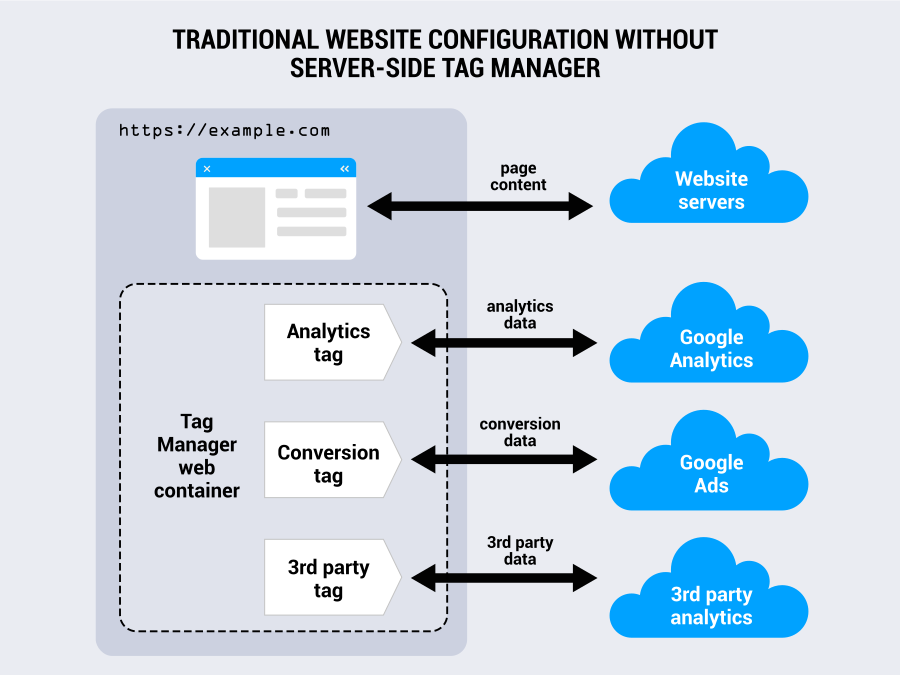
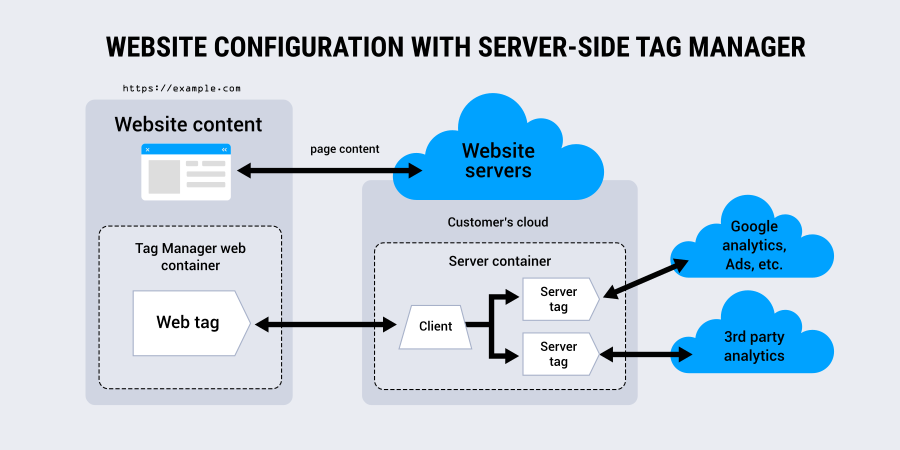
Server-side tagging addresses this directly. Instead of sending data directly from the browser to third parties, organizations route it through a controlled server environment first. That gives them a chance to:
- Filter data before it is shared
- Validate and enrich incoming data
- Preserve consent signals
- Stop unauthorized data flows
The same principle applies to Google Consent Mode. Consent Mode changes how Google’s advertising and measurement tools behave based on user consent signals. But for those signals to work, they need to be accurate, timely, and consistent across every system they touch.
That requires governance infrastructure, not just a consent banner.
How to Build a Data Governance Framework
A data governance framework is the structure that puts principles into operation. It documents what data exists, who’s accountable for it, what rules govern its use, and how those rules are enforced and maintained over time.
Building one doesn’t require a dedicated team or a large budget, but it does require people with clear authority, a structured approach, and genuine organizational buy-in.
Run a Data Audit
Define and Document Governance Standards
Implement a Consent Management Platform
Establish a Data Stewardship Structure
Build in Regular Reviews
Run a Data Audit
Before rules can be written, an organization needs to know what data it actually holds. That means mapping every data asset:
- Where it originates
- How it moves
- Who can access it
- How long it’s retained
A data inventory typically lives in a centralized register, often a spreadsheet or a dedicated data catalog tool, that documents each dataset’s owner, classification, source, and permitted uses. Gaps in that documentation are where governance risk hides.
Define and Document Governance Standards
Once the data landscape is clear, the principles need to be made explicit. That means writing down what quality standards apply to each data category, what constitutes valid consent, how long different data types are retained, and who holds accountability for each domain.
This document becomes the reference point for every data-related decision. It’s worth storing it somewhere accessible and version-controlled, such as a shared internal wiki or document management system, so updates are trackable.
Implement a Consent Management Platform
Consent is the legal basis for a lot of personal data processing under GDPR. A consent management platform (CMP) makes it possible to collect, record, and signal user consent at scale, and to connect those consent decisions to the data flows that depend on them.
It’s also the most visible expression of the transparency and purpose limitation principles. Without it, consent governance is manual, fragile, and difficult to audit.
Establish a Data Stewardship Structure
Each major data domain needs a named owner. Customer data, campaign data, HR data: each should have a designated steward who maintains quality, manages access, and keeps the data register current.
Alongside stewards, a DPO (where required) and clear executive accountability form the minimum structure needed to make governance functional rather than theoretical.
Build in Regular Reviews
Regulations change, data systems evolve, and business processes shift. A governance framework that reflects how the organization operated two years ago isn’t governing the organization as it operates now.
A defined review cadence, whether quarterly or annual, helps keep the framework accurate and supports its continued alignment with both current law and current practice.
Who Oversees Data Governance?
Data governance is not the exclusive responsibility of any one team. It requires clear leadership, but effective oversight is usually shared across several roles, each with distinct accountability.
At the operational level, data stewards manage governance at the asset level. Each major data domain should have a named steward responsible for maintaining standards, managing access, and keeping documentation up to date.
Where one is appointed, the Data Protection Officer (DPO) holds formal responsibility for monitoring compliance with data protection laws. They advise on governance questions, help interpret regulatory obligations, and act as the main point of contact for supervisory authorities.
Explore all global privacy laws and regulations around the world.
At the strategic level, the C-suite and board remain ultimately accountable. Decisions about risk tolerance, investment in compliance infrastructure, and the organization’s broader culture around data all need to come from the top. Treating governance as purely an IT or legal issue, rather than a business priority, is itself a governance failure.
In marketing-led organizations, this responsibility often becomes especially visible in the relationship between data utility and compliance. That tension frequently sits with the CMO or Head of Digital, who must balance the commercial value of data with the need to use it responsibly.
Common Data Governance Failures
Most governance failures don’t start with a dramatic breach. They start with small, accumulated gaps that go unaddressed until a regulator, an audit, or a customer complaint forces them into view.
Unclear Ownership
When nobody is specifically responsible for a dataset, nobody maintains it, documents it, or monitors how it’s being used. Problems accumulate silently. By the time they surface, the data may have been misused, shared without authority, or processed without a valid legal basis.
Under the GDPR, the inability to demonstrate accountability is itself a violation, independent of whether any harm occurred.
Consent Drift
Organizations collect consent at one point in time, under one set of conditions, and then continue processing data as purposes and platforms evolve. What was lawful at the point of collection may not remain lawful as the organization’s data practices change.
Without active governance over consent records, that drift is invisible until a DSAR or an enforcement inquiry makes it visible. Revisiting old consent records is a common discovery in regulatory investigations.
Data Silos
When customer data lives in separate, unconnected systems, it can’t be reconciled, audited, or responded to consistently. A DSAR that spans five different systems without a unified data map is nearly impossible to answer accurately.
Regulators expect a coherent response. Siloed data makes that structurally difficult, regardless of intent. The operational cost compounds: teams duplicate work, inconsistencies multiply, and the data itself becomes less reliable over time.
Avoid these costly mistakes and more, discover data governance best practices.
Data Governance Is the Precondition for Everything Else
Every compliance program, AI initiative, and marketing data strategy depends on the same thing: data that can be trusted. Governance is what makes that possible.
Without defined principles, assigned ownership, and documented standards, even the best tools operate on an unreliable foundation.
Getting GDPR compliance right is one of the clearest tests of whether data governance is working. If the principles are embedded, compliance follows. If they’re not, every audit, investigation, and access request exposes the gap.

Join our growing community of data privacy enthusiasts now. Subscribe to the Usercentrics newsletter and get the latest updates right in your inbox.
