

Strategies to re-engage your audience using cookieless retargeting
Your best prospects are the ones who’ve already visited your site. They’ve explored your products, read your content, maybe even filled a cart — but haven’t converted.

Traditional retargeting was built to bring them back. A simple pixel and third-party cookie enabled you to follow visitors across the web with targeted ads. It worked because it was invisible, automatic, and easy to set up.
However, that invisibility is now disappearing. The old infrastructure is being replaced with cookieless retargeting, which is more transparent and privacy-focused. Retargeting without cookies brings with it new tools, tactics, and strategies that marketers need to embrace.
Key takeaways
- Traditional cookie-based retargeting relies on cross-site tracking that browsers and regulations are eliminating.
- Higher match rates, better privacy compliance, and stronger audience ownership make cookieless retargeting more effective than cookie-based methods.
- With cookieless retargeting, first-party data becomes your primary retargeting asset — email addresses, phone numbers, and on-site behavior that you collect directly.
- Server-side tracking helps preserve conversion data and audience signals when browsers block client-side cookies.
- Conversion APIs send data directly to platforms, bypassing browser restrictions.
How does traditional retargeting work?
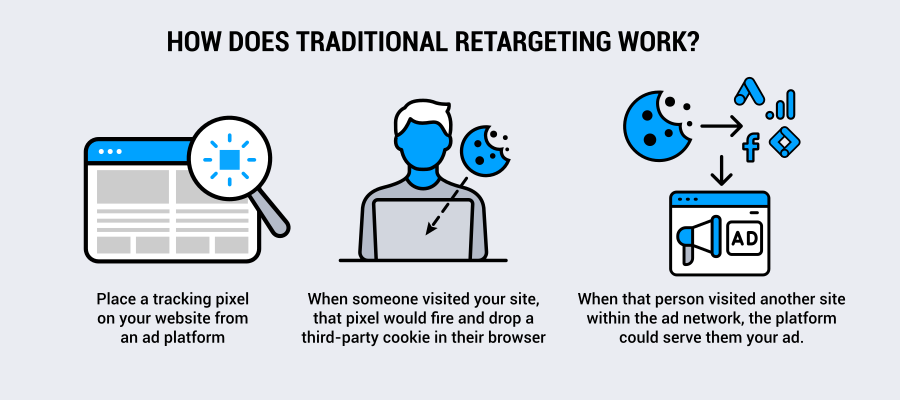
Traditional retargeting relies on one core mechanism: placing a tracking pixel and third-party cookies.
You’d place a pixel on your website, usually from an ad platform like Meta or Google. When someone visited your site, that pixel would fire and drop a third-party cookie in their browser.
This cookie acted as a marker, identifying that person as part of your audience while they browsed other sites. When that person visited another site within the ad network, the platform could read the cookie, recognize them as someone who’d visited your site, and serve them your ad.
This system made it easy to build audiences at scale. You could segment visitors based on behavior. People who viewed specific products, abandoned carts, or spent time on pricing pages would be served ads tailored to where they were in the funnel.
The cookie served as the red thread that enabled advertisers to use their first-party data for targeting and retargeting the right audience. But it was the third-party nature of these cookies — set by external domains and readable across sites — that made cross-site tracking possible. And that’s precisely what’s under fire now.
The pitfalls of using third-party cookies for retargeting
The problems with cookie-based retargeting aren’t new, but they’ve reached a tipping point.
For starters, cookie lifespans have shortened dramatically. Even when cookies aren’t blocked, they often expire within days instead of weeks. If you’re running campaigns with longer nurture cycles, this compression makes it challenging to stay in front of prospects over time.
In addition, browsers increasingly restrict third-party cookies. For example, Safari introduced Intelligent Tracking Prevention (ITP) in 2017, and Firefox rolled out Enhanced Tracking Protection (ETP) in 2019.
These features block third-party cookies by default, meaning millions of users were already invisible to retargeting efforts before they even knew what cookies were.
Ad platforms feel this loss. When cookies are blocked, conversion events don’t reach them, and audience data degrades. Campaign optimization suffers because platforms can’t attribute conversions accurately or build reliable lookalike audiences. As a result, budgets are spent on campaigns that are harder to measure and optimize effectively.
Also, global privacy regulations such as the EU’s General Data Protection Regulation (GDPR) and the California Privacy Rights Act (CPRA) don’t just restrict how cookies work; they restrict how you can use them legally. And if companies don’t comply, they risk fines and GDPR penalties.
The result is a shrinking pool of trackable users and campaigns that no longer scale as they once did.
What is cookieless retargeting?
Cookieless retargeting flips the model. Instead of relying on third-party cookies to track users across the web, you build retargeting audiences from data that users give you directly. Using information like email addresses, phone numbers, or behavioral data from your site, you can match that data against ad platform audiences using privacy-preserving methods.
Therefore, retargeting without cookies means you’re not surreptitiously following people across the web. You’re activating data they’ve explicitly permitted you to use. This respects browser restrictions and user consent while maintaining your ability to reach people who’ve already interacted with your brand.
Benefits of cookieless retargeting
The advantages of cookieless retargeting go beyond simply staying privacy-compliant. This approach improves how you build and activate audiences, leading to better performance and stronger relationships with your customers.
Easier to achieve and maintain privacy compliance
When you build retargeting audiences from consented first-party data, privacy compliance becomes easier. You’re not tracking users across sites. You’re using data they’ve explicitly shared with you under clear terms.
The GDPR, CCPA, and other privacy regulations are designed to restrict invisible, nonconsented tracking, not the legitimate use of data users willingly provide. This alignment helps reduce legal risk and builds trust with your audience.
More accurate audience data
First-party data is inherently more accurate than inferred behavior from cookies. You know exactly who someone is, what actions they’ve taken on your site, and whether they’ve given you permission to contact them (and for what purposes.)
This precision leads to better segmentation and more relevant ads. Instead of guessing based on fragmented cookie data, you’re working from a complete picture of how someone has engaged with your brand.
Stronger audience ownership
Cookie-based retargeting meant renting access to audiences through ad networks. Cookieless retargeting means owning the relationship. Your CRM data, email lists, and customer records become the foundation for your campaigns.
This gives you independence from third-party tracking infrastructure and helps ensure your audiences remain accessible regardless of how browser restrictions or platform policies evolve.
Improved signal reliability
Server-side tracking and conversion APIs capture events even when browsers block client-side tracking cookies. This helps optimize campaigns and ensures ad platforms receive the data they need for attribution and audience building.
The result is more consistent performance and better ROI, even as browser restrictions continue to tighten.
How does cookieless retargeting work?
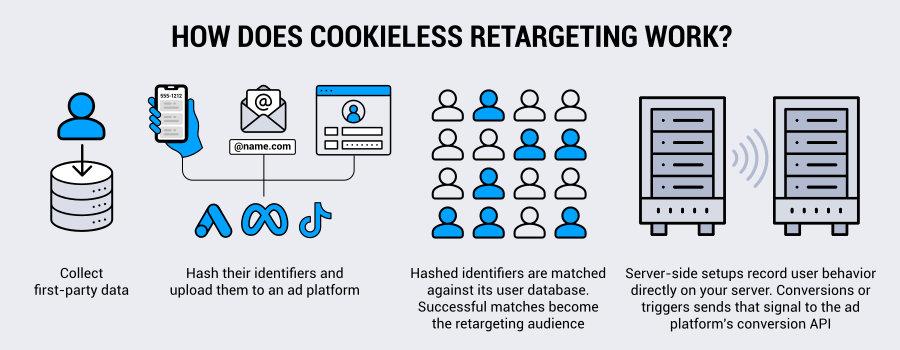
The mechanics of advertising without cookies become clear once you understand the data flow.
Everything starts with first-party data collection, including purchase history, surveys, account settings, communication preferences, and much more. This data lives in your systems: your CRM, your CDP, your marketing platform.
When you want to retarget someone, you hash their identifiers — such as email addresses, phone numbers, or user IDs — and upload them to an ad platform like Meta, Google, or TikTok.
Hashing transforms the data into a privacy-preserving format that can’t be reverse-engineered to reveal personal information. The platform receives these hashed identifiers and matches them against its user database. Successful matches become your retargeting audience.
Server-side tracking adds another layer. Instead of relying on browser-based pixels that can be blocked, server-side setups record user behavior directly on your server.
When someone completes a conversion or triggers an important event, your server sends that signal to the ad platform’s conversion API. This happens server to server, thus completely bypassing browser restrictions.
Consent-based identifiers like Unified ID 2.0 take this a step further. These technologies use hashed, consented email addresses as a privacy-preserving alternative to cookies. Users opt in explicitly, and their identifier can be used for audience matching across participating platforms without exposing their actual email or personal data.
The key to making this work is system integration. You collect and manage user permissions. Your CRM or CDP stores first-party data. Your server-side tagging setup captures behavioral data and sends it to an ad platform through conversion APIs. Each component reinforces the others, creating a system that functions reliably without third-party cookies.
Setting up retargeting without cookies
Building a cookieless retargeting strategy requires rethinking how you collect data, manage consent, and integrate with ad platforms. Here’s how to approach it.
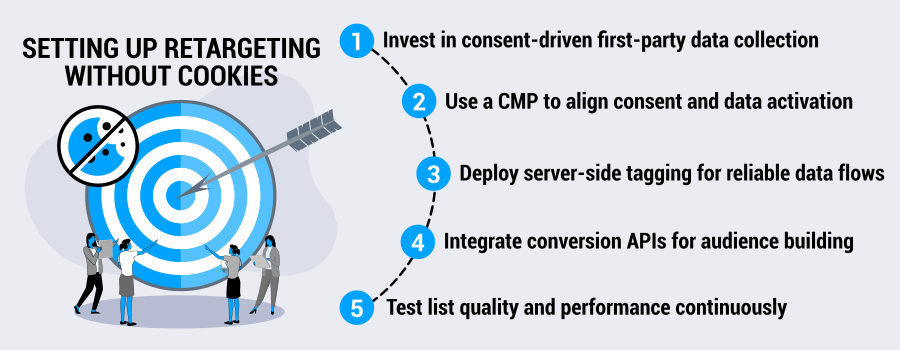
Invest in consent-driven first-party data collection
Everything starts with permission. If users don’t consent to data collection, you can’t build audiences. Use a consent management platform (CMP) to present clear, legally-compliant information and consent requests, and respect user preferences. Only collect data from users who’ve opted in (where legally required.)
Focus on high-value touchpoints: email signups, account creation, purchases, and content downloads. These interactions give you explicit identifiers you can use for retargeting. When asking for this information, make the value exchange clear.
People are more willing to share data when they understand what they’ll get in return — whether that’s a discount, early access, or personalized recommendations.
Progressive profiling also helps. Instead of asking for everything up front, collect data over time as users engage with your brand. This reduces friction and improves completion rates.
Use a CMP to align consent and data activation
A CMP does more than display cookie banners. It ties user preferences to data activation, helping to ensure you only use data in ways users have approved. When someone consents to the use of marketing cookies, your CMP signals that permission to your tagging setup, enabling retargeting pixels and audience matching.
This alignment is critical for privacy compliance. You can’t rely on assumed consent or outdated permissions. Your CMP creates an audit trail that shows exactly what users agreed to and when, along with changes to those preferences over time.
Deploy server-side tagging for reliable data flows
Server-side setups record user behavior without relying on cookies. The container you create sits between your website and ad platforms. It receives events from your site and forwards them to platforms like Meta, Google, and TikTok through secure server-to-server connections.
This approach offers several advantages. It bypasses browser restrictions, reduces data loss from ad blockers, and gives you more control over which data is sent to each platform. It also improves data accuracy by eliminating client-side variables like inconsistent cookie lifespans or blocked tracking pixels.
It’s true that setting up server-side tagging requires technical infrastructure — either a cloud server or a managed solution — but the payoff is reliable data flows regardless of browser restrictions.
Integrate conversion APIs for audience building
Conversion APIs connect your server directly to ad platforms, thus sending conversion events and audience data without depending on browser-based tracking. Facebook CAPI, Google Enhanced Conversions, and TikTok Events API all work this way.
These APIs accept hashed identifiers, for instance, email addresses, phone numbers, or user IDs, along with event data like purchases, signups, or page views. The platform matches these identifiers against its user base and attributes conversions or builds retargeting audiences based on the match.
However, for optimal implementation, map your data schema to the platform’s API format and set up secure authentication. But once configured, these APIs deliver more reliable attribution and audience building than client-side pixels ever could.
Test list quality and performance continuously
Cookieless retargeting depends on data quality. If your email list is outdated or your CRM data is incomplete, match rates suffer and campaigns won’t perform.
Therefore, it’s important to regularly audit data sources, clean invalid records, and test how well audiences match against ad platform databases. Monitor match rates, audience sizes, and campaign ROI. If match rates are low, look into why. Are you collecting the right identifiers? Are users providing accurate information?
Then, iterate based on what you learn. If email-based matching outperforms phone numbers, prioritize email collection. If certain segments perform well, invest more in building similar lists.
Server-side tracking and cookieless retargeting
Server-side tracking is the backbone of retargeting without cookies. When someone interacts with your site, your tagging setup sends event data to your server, rather than directly to ad platforms. Your server processes the data, enriches it with first-party identifiers from your CRM, and forwards it to ad platforms through conversion APIs.
This bypasses browser restrictions entirely. You decide what data gets sent, how it’s formatted, and which platforms receive it. You can include context like customer lifetime value or purchase history that wouldn’t be available through client-side tracking. And because data flows server to server, ad blockers and browser settings don’t interfere.
However, it’s worth noting that server-side tracking still requires user consent. Simply because data isn’t stored in a browser doesn’t mean it’s exempt from the requirements of privacy regulations. It’s important to respect user preferences and only activate tracking for users who’ve explicitly consented.
Learn more about the basics of server-side tracking and how to set it up.
Retargeting in a cookieless world is possible
Retargeting isn’t ending; it’s transforming. The shift away from third-party cookies creates an opportunity to build more transparent, resilient strategies rooted in consent and first-party data.
By investing in server-side tracking, conversion APIs, and strong data collection practices, you maintain the ability to re-engage your best audiences while respecting privacy and future-proofing your campaigns.