
Authority in the AI Era: How Citations Shape Who Gets Recommended
The first three chapters of this guide covered the mechanics of AI-driven discovery: why clicks are declining even as AI visibility grows, how AI systems assemble answers from multiple sources, and what it takes to produce content that gets extracted and trusted.
Now I want to add a layer that most teams miss.
You can build strong content, structure it correctly, rank well, and still not appear in AI-generated answers. I have seen it happen.
The reason is simple: AI search engines do not evaluate your site in isolation. They look for independent confirmation across the web before they treat your brand as safe to recommend.
That third-party consensus is what this chapter is about. I lead Skale’s off-page team, so this is the part of the system I work with every day: outreach, placements, and citations. It’s the work that helps brands earn the third-party proof they need to get mentioned and recommended in AI search engines.
I will walk you through:
- Why off-page visibility now shapes recommendations
- How AI citation inclusion differs from traditional link building
- Which signals matter most
- What putting this into practice actually looks like
At a Glance
- Traditional SEO still matters, but rankings do not guarantee inclusion in AI answers.
- Strong content is your foundation, but it requires off-page support. AI systems need third-party confirmation before they will recommend your brand.
- Link building and AI citation inclusion use similar processes but serve different outcomes and require different targeting logic.
- Messaging consistency across the web reduces ambiguity and strengthens AI confidence in recommending you.
- The sources AI systems cite vary by category. Instead of targeting them all, reverse engineer from those already favored.
- Getting into the AI citation layer early compounds with continued effort. Once a brand is embedded there, it is harder to displace.
Why AI Visibility Depends on Third-Party Consensus
As my colleagues covered in the earlier chapters of this guide, AI answers are assembled from various pages across the internet.
A user asks a question. The system expands that into related sub-questions. It retrieves multiple sources, compares them, and synthesizes a response. And your page is one input into that process.
I like to think of it like how a journalist approaches a story. You wouldn’t publish a claim based on a single source. You would verify it and look for independent corroboration. AI systems operate the same way.
Before including a brand in a recommendation list, AI search engines look at a range of third-party websites to confirm it belongs there, considering questions like:
- Does this product exist and operate in this category?
- Is it relevant to this specific use case?
- Do independent sources describe it consistently?
- Is there enough evidence to make recommending it safe?
When external sources reinforce your brand clearly and consistently, AI systems can piece together a coherent entity profile. That profile is the raw material an LLM draws on when it decides who to reference.
When those sources are absent or contradictory, the model will default to a brand it understands more confidently.
So, how do you get AI systems to include you? The first step is ranking well. The next is ensuring AI systems trust your brand. Here are three things you can do to drive confidence in your brand:
- Repetition: The more often your brand appears across trusted, relevant sources, the more recognizable it becomes to AI systems. Repeated exposure across the right contexts moves a brand from being occasionally visible to consistently included.
- Consistency: When independent sources describe your brand in similar terms (i.e. same category, use cases, and core positioning), AI systems can form a clear picture of what you do and who you serve. When those descriptions conflict, there’s no consensus to build on, and it is easier for AI systems to leave your brand out and default to one they can understand more clearly.
- Coverage depth: Appearing in one type of source is not enough. When your brand shows up across articles, review platforms, community discussions, and comparison pages, it signals to AI systems that you have a genuine footprint in your category.
Off-page SEO is no longer just about building authority and improving your ranking on search engines. You now need to build the external presence that determines whether AI systems include your brand in their answers in the first place.
Off-Page SEO Is Now the Recommendation Layer
I’ve been doing off-page SEO for almost 10 years, so take it from me: the fundamentals in the age of AI search are still the same. You are still trying to build authority beyond your site. What has changed is the ecosystem you are building it in.
In traditional off-page SEO, the ecosystem was smaller. You identified competitor pages ranking for target keywords, estimated their link equity, and closed the gap to show Google your brand was a credible source on a given topic. That still matters.
But now, off-page signals are doing another job as well. They determine whether your brand appears in the set of options AI systems surface before a user ever reaches your site. We call this the recommendation layer (as you can see in the screenshot below).
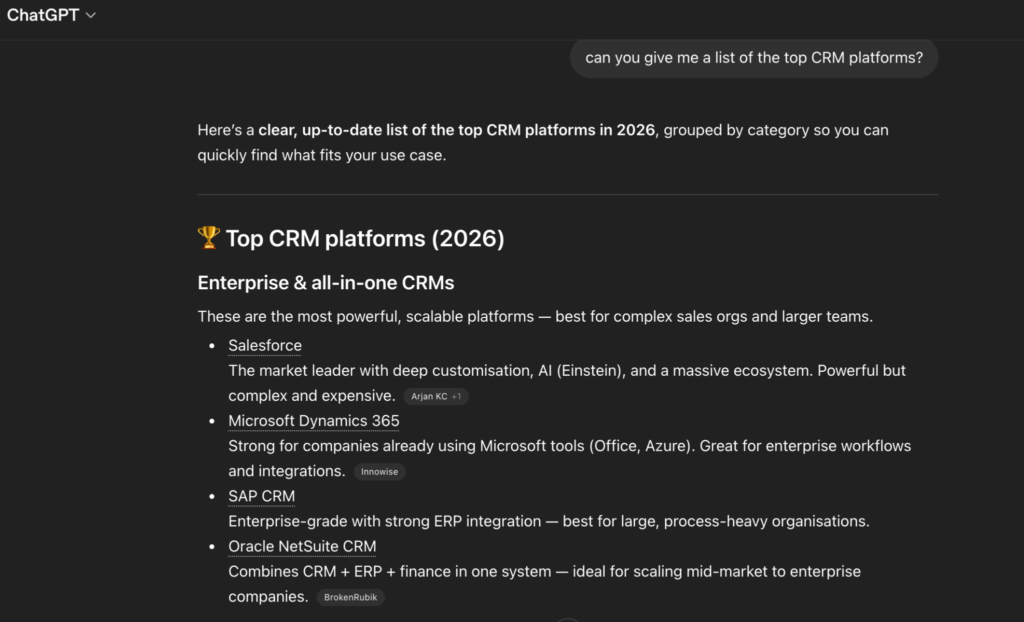
And that layer draws from a much broader source set than Google rankings ever did:
- Editorial listicles and comparison pages
- Review platforms like G2 and Capterra
- YouTube creator content
- Reddit threads and niche community discussions
So off-page work now influences two outcomes:
- How well you perform in traditional search
- Whether AI systems include your brand in their answers
These outcomes are related, but they are not driven by the same work. They require different targeting, different criteria, and a different understanding of what a good link placement actually looks like.
A link from a high-authority website might strengthen your rankings without moving your AI visibility. And a mention in a well-cited comparison page or review platform might significantly improve your chances of being recommended by AI search engines, even if it carries no traditional SEO value.
That is why off-page SEO now requires two distinct approaches: link building and AI citation inclusion.
Link Building vs. AI Citation Inclusion
People have a hard time distinguishing AI citation inclusion from traditional link building, and I understand why.
The work looks the same from the outside: you are doing outreach, trying to earn placements on external sites, and building relationships with editors and site owners.
But the question you ask when looking for opportunities is completely different. A site’s DR and traffic are the initial filtering criteria that determine whether a placement is worth pursuing. The most important factor is topical relevance. The more the linking website and page are contextually aligned with your content, the better.
With AI citation inclusion, DR and traffic don’t matter. The only thing you need to look at is whether a source is cited in an AI search engine for a prompt relevant to your ICP.
You still want to look for sites with high quality, relevant content, of course. But for AI citation inclusion, a site that AI systems consistently pull from when generating answers in your category is worth more than a high-authority domain that never appears in those answers.
To make the distinction concrete, we will look at three things: what link building and AI citation inclusion share, where they differ, and when to prioritize one over the other.
Where They Overlap
Both link building and AI citation inclusion:
- Involve outreach to external sites
- Aim to build presence and authority across the web
- Contribute to organic visibility and growth
Because the outreach process is similar, teams that already run link building programs have a head start operationally. But while the infrastructure transfers, the targeting logic and ecosystem don’t.
The Ecosystem Difference
Link building primarily targets web pages (typically blog articles) optimized for Google search.
And as I mentioned above, AI citation inclusion operates across a much wider ecosystem that includes everything from comparison pages and review platforms to YouTube content and Reddit threads.
Which targets you go after depend on which sources are directly influencing answers for the prompts you want to appear in.
Another key difference here is that an AI citation placement doesn’t have to include a link. It’s preferable that it does, as a link strengthens the authority signal. But as long as you have presence in the right places, AI systems register brand mentions and contextual inclusions, even without links.
When Each Matters
Link building is still a foundational practice, especially for brands that are establishing authority or entering competitive search categories. It strengthens your ability to rank in traditional SERPs, and though it’s not the main goal, that creates the on-site credibility that off-page signals then reinforce.
AI citation inclusion makes sense as you move into growth and maturity stages, where strong rankings stop translating into AI inclusion. That gap between Google search visibility and AI recommendations is usually the signal that citation inclusion is the missing piece.
But neither of these off-page strategies will work if you’re missing technical SEO requirements, a strong organic growth strategy, and quality content that’s relevant to your ICP.
Once you have those foundations in place and have established a certain level of brand authority, link building and AI citation outreach can work together to ensure you show up across the full buyer journey, from discovery through evaluation to decision.
The Off-Site Signals That Shape AI Recommendations
In my experience, no source type is inherently more valuable than another.
In some categories, editorial listicles dominate. In others, Reddit threads carry more weight. And certain industries may see AI systems pull most frequently from YouTube creator reviews.
The only thing that matters for your brand is whether AI systems actually cite them when responding to prompts about your category. You find that out by reverse engineering what AI search engines reference when generating answers to your target prompts. We’ve covered how to do this in previous chapters of this guide.
But before we look at source types closer, I want to emphasize the importance of consistent positioning across the web, otherwise known as entity hygiene.
Like I’ve said, AI systems need a stable picture of your brand.
If those details don’t line up across your own site and third-party sources, that weakens recommendation confidence. This can cause AI systems to describe your brand differently across different answers, or not mention it at all.
So before seeking placements, start with your own website, and ensure you speak about your brand consistently.
Then, audit third-party mentions and conduct outreach to fix inaccuracies and out of date information. Most site editors will be willing to fix outdated category labels, incorrect team details, or positioning that no longer reflects what you do.
When it comes to new placements, your core positioning, from USP to primary use cases, needs to be consistent everywhere.
That does not mean identical, copy-paste wording. The goal is a consistent boilerplate and messaging that is expressed in varied, contextually appropriate language.
Now that you understand that, let’s take a closer look at the main source types that shape LLM recommendations. For each one, I’ll explain how to show up in a way that actually influences AI answers.
Editorial Listicles and Comparison Pages
Pages structured around “best tools for X,” “top platforms for Y,” or “alternatives to Z” are built to synthesize options across a category. That structure maps well to how AI systems compile recommendations, which is why these pages tend to be cited.
Beyond inclusion in these articles, the way your product is described in those placements impacts how AI systems understand and position your brand.
The ideal placement is a natural fit that adds value. Find a listicle covering your category and give the editor a genuine reason to include you, whether that’s a feature listed competitors lack or a use case that fills a gap for readers.
You don’t want to shoehorn your company name into a listicle. That is not enough to influence AI answers. But when the fit makes sense and brings value to the reader, inclusion is easier to secure, and the way LLMs describe your brand tends to be more accurate.
Review Platforms and Category Aggregators
Review platforms are one of the strongest sources of third-party validation you can give AI systems. They confirm your product exists, operates in a specific category, and has been evaluated by real users. AI systems treat reviews as trust anchors.
Having a five-star rating is not necessarily the most important thing. What really matters is that reviewers reference the use cases your product solves and describe the outcomes it delivers. Also, comparisons to alternatives are a bonus when they happen.
You can encourage and incentivize satisfied users to leave reviews, but of course you can’t control those answers. What you can control is your company profile on these sites and how you talk about your product, so make sure that’s always accurate and up to date.
YouTube
YouTube is increasingly cited by AI systems, particularly in categories where creator-driven content is part of how buyers research tools.
Review videos, roundup comparisons, and educational content that naturally integrates a product can all earn AI citations. AI systems surface them in answers the same way they use articles.
What makes YouTube different is the time videos take to produce. But while it can be time- and resource-intensive to secure, a video from a credible creator in the right niche can carry significant citation weight.
The format, creator relevance, and authentic product representation all determine whether a placement is likely to gain an AI citation.
A creator with a few thousand subscribers in exactly your buyer’s niche, and who reviews your brand in-depth, will probably do more for your AI visibility than a larger, general-audience creator who mentions you in passing.
Community Discussions
AI systems frequently draw from Reddit threads, LinkedIn conversations, and niche community forums, particularly for evaluation-stage and comparison queries.
This signal is different from editorial content because it’s authentic, unstructured, and peer-generated. This is what makes it valuable and hard to replicate.
It takes time to build presence here. Doing so calls for consistent participation across many threads and discussions.
The key is to provide value. Share your expertise and advice before pushing your brand, and only mention your solution when it directly solves the pain point being discussed.
Don’t overlook older conversations, either. A Reddit thread posted two years ago can still be cited today. If it answers a buyer’s question clearly and has been indexed by the right platforms, it keeps generating citation value long after it was written.
One last point: be careful with sharing website or brand links in Reddit discussions. Links are allowed in some communities, but they can quickly look like spam or self-promotion if they’re dropped into multiple threads or shared without enough context. Always check subreddit rules first, build a genuine comment history, and make the link secondary to the advice.
What Implementation Looks Like at a Strategic Level
Now that we have covered the main off-site signals shaping AI recommendations, I want to show you what this looks like in practice.
If you have done link building before, a lot of this will feel familiar. What changes is where you focus, what you are trying to influence, and how you judge whether a placement is actually worth it.
TL;DR
- Start with the prompts that actually matter to your buyers, then look at which sources AI systems are already pulling from.
- From there, your job is to win the placements that shape inclusion and reinforce the right positioning. Keep building presence.
- What matters is showing up consistently in the sources that influence AI answers, not how many placements you can get overall.
Start With Real Evaluation Prompts
Select the relevant prompts you want your brand to appear in.
These prompts need to reflect real evaluation behavior. As we have already covered, buyer behavior has changed, and customers often reach your website when they are closer to making a decision.
Your prompts need to reflect this. You must target the kinds of questions a buyer asks when they are actively comparing solutions.
For example, I asked ChatGPT “what is the best consent management platform for a scaling SaaS?”
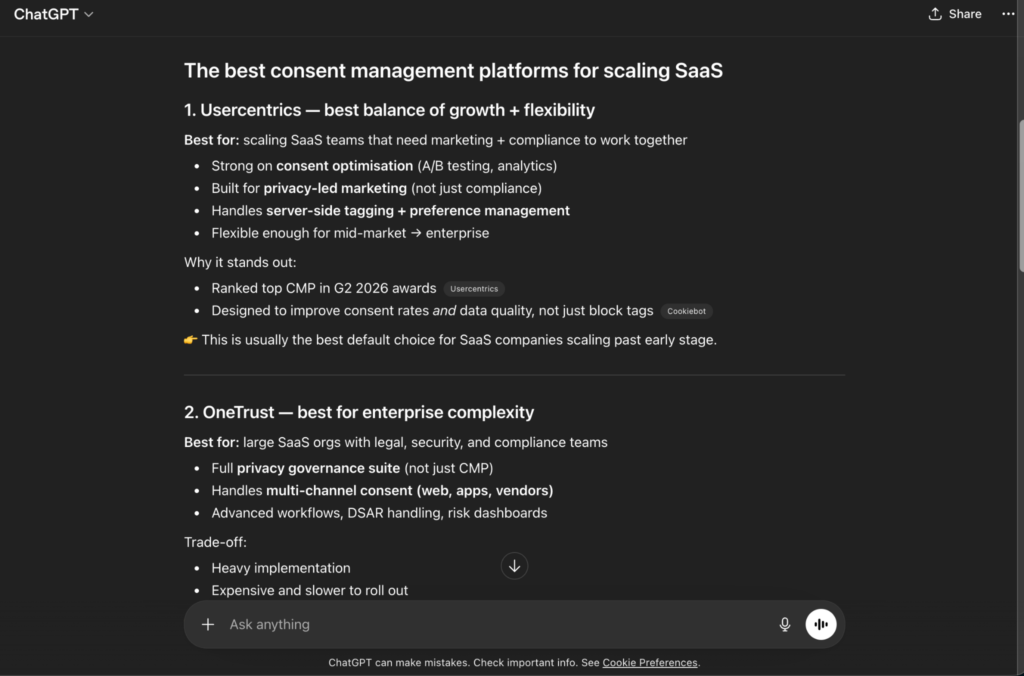
And, as you now know from earlier chapters, a single question fans out across multiple dimensions: functional, comparative, contextual, and implementation. So your prompts should also reflect that full range.
One thing I really want to stress is this: you cannot treat prompt research like keyword research. That is where most teams get it wrong.
They build a list of terms, run those as prompts, and track visibility against them. The numbers might look good. But if those prompts do not reflect how real buyers research in your category, being in those answers does not translate into anything commercially meaningful for your brand.
Identify the Sources Shaping AI Answers in Your Category
Next, run those prompts across AI platforms and look for patterns:
- Which sources appear repeatedly?
- Which formats dominate?
- Which brands are consistently included?
What you are doing here is reverse engineering how AI answers get built in your category. You are not starting from assumptions about which sources should matter. You are looking at what AI systems are actually pulling into answers and mapping where influence really sits.
We apply this rigorously at Skale and use an internal set of tools to monitor what sources are important. If YouTube is a major citation source across your tracked prompts, we build strategy around YouTube creator placements. If appearing in Reddit threads plays a meaningful role, we go there.
If a source type barely appears in your category’s answers, it doesn’t make sense to spend time on it, regardless of how loudly the industry is talking about it.
Prioritize Placements That Reinforce Your Positioning
Remember, how your brand is described is just as important as getting included in the first place.
If a placement matches your product to the wrong use case or category, or gets your positioning wrong, it creates conflicting signals. And as I explained earlier, conflicting signals negatively impact your visibility on AI search engines.
The best placements are the ones where your product genuinely belongs: where adding your brand makes the article more useful for the reader.
Being hyper-relevant also makes the outreach pitch easier. When you can tell a website owner that their list is missing a use case and that your product fills that gap, you are improving their content, not asking for a favor.
Focus on Precision, Not Volume
This is not a volume game.
As I said above, only focus on the sources that AI systems already favor. The question is never, “How many placements can we get?” It is, “Which placements will actually increase our inclusion in the prompts that matter?”
One strong placement in a consistently cited source is worth more than twenty mentions on sites that never appear in the answers across your prompt set.
Do Not Treat This Like A Once-Off Campaign
One placement on its own rarely leads to lasting visibility. AI systems are more likely to recommend brands they keep seeing across the sources they pull from.
Citation outreach must be ongoing. The goal is to build and expand a consistent presence across the sources that matter.
My colleague Kristina Pantelic, Organic Growth Lead at Skale, summed this up well:
“Quick wins are fine. But if your growth strategy depends on constantly chasing quick wins, you probably don’t have much of a strategy at all.”
That is exactly the point. Lasting visibility comes from showing up repeatedly in the right places, with clear positioning, over time.
The brands that win long term do so because they keep showing up while others treat citation inclusion like a once-off campaign.
Stay Active as Citation Patterns Evolve
Consistency matters because the sources AI systems rely on are not fixed.
New content gets published, existing pages are updated, competitors keep earning new placements, and both traditional and AI search engines constantly change what they show.
You need to track this regularly. What you see in that monitoring should determine where you focus off-page work next. A source that was heavily cited six months ago may matter less today.
This is why AI citation work has to stay active. The ecosystem keeps moving, and you need to move with it.
Great Content Is Still the Foundation
If you start citation outreach without a solid content foundation, you are building on nothing.
Great content always wins. In traditional search, in AI search, in any era of search: if your content does not answer the real buyer question, you will not get a conversion. It does not matter how often your brand gets mentioned.
Think about it from the buyer’s side. Someone is researching a product and they have specific questions. Can this tool do this specific task? Is it the right fit for my situation?
If your content answers that clearly and correctly, you earn their trust. If it does not, no amount of third-party mentions will save the conversion.
So, your content shapes what off-page work can actually achieve. Plus, strong on-site content increases the likelihood that your brand gets cited in the first place.
AI systems are more confident including your brand when they can trace external mentions back to substantive, well-structured content on your owned channels. For example, a placement in an editorial listicle carries more weight when your site supports the claims being made about you.
And it works both ways. Consistent, coherent third-party mentions will also increase the likelihood that AI systems pull from your owned content when assembling answers.
Content and off-page reinforce each other. We saw this clearly with the Usercentrics brand.
We built strong content clusters across technical and regulatory consent topics. This meant that when the brand appeared in off-site contexts, there was already a strong foundation behind those mentions. The off-page signals worked harder because the on-page work had already been done.
The complete picture is:
- Content gives AI systems something clear, trustworthy, and extractable to work with
- SEO and GEO work ensures that content is technically visible and competitively positioned in search
- Off-page signals validate those claims through third-party consensus and widen the brand’s footprint in the sources AI systems rely on
Treat any one of these in isolation and you will leave gaps in your strategy. Treat them as a system and they compound.
Why Inclusion Compounds Over Time
A good piece of content on a strong website will keep attracting links for years. That is what made link building such a reliable long-term investment.
AI citations work differently. As I said above, the landscape shifts monthly, so you cannot build a citation footprint once and assume it will hold.
But here is what makes early investment so valuable: when a brand shows up consistently enough across the sources AI search engines cite, it becomes familiar, and inclusion stabilizes.
And once a brand is embedded in the citation layer, displacing it can be expensive and labor intensive.
We saw this play out with a decentralized finance bridging brand we worked with. Within roughly six months of working together, we got the brand to second in its category, but it still sat 17 percentage points behind the leader on share of voice.
We saw an opportunity to move fast to build AI presence for a new ecosystem its ICP was very interested in. After ninety days, we were just 6 percentage points behind the competitor and:
- AI brand mentions were up 133 percent
- Prompt coverage was up 65 percent
- Domain citations were up 61 percent
We also worked with a brand in a motion design SaaS category dominated by Adobe and Canva. This brand had some visibility when we started working together, but they were not consistently included in AI answers yet.
After four months, AI brand coverage increased from 22 percent to 55 percent (150 percent growth)
- Brand mentions grew 90x
- Domain citations grew 90x
- Their citation share doubled
- Their share of voice moved from 10 percent to 18 percent — against two of the biggest design tools in the world
These results came from ongoing outreach into the specific listicles and comparison pages AI was already pulling from in their category. When the brand started appearing across those sources, mentions and citations accelerated, and they became a permanent presence on buyers’ shortlists.
Brands that get cited in relevant AI search prompts early build a position that will become more expensive to challenge. Brands that wait both miss out on current visibility and let their competitors cement a default status that will be hard to overtake.
Authority in AI Search Is Built Deliberately Across the Web
Rankings still matter. But they are no longer the full story.
A brand that invests only in rankings may stay visible in traditional search while becoming weaker in AI-mediated discovery. On the other hand, a brand that focuses only on off-page mentions without strong content may gain surface-level visibility but struggle to convert once surfaced.
The real advantage comes from treating authority as a system: content, SEO + GEO, and off-page working together.
Authority in the AI era emerges when:
- Your brand is consistently mentioned across the sources AI systems trust
- Your positioning is described clearly and coherently everywhere it appears
- Your are present across the formats and platforms AI systems draw from in your category
- Your on-page and off-page signals reinforce each other across every surface
So while strong content still matters, it will not impact your AI search visibility without external reinforcement.
Authority now depends on whether the wider web supports the case your site is making, which is why the brands that win in AI search are the ones with the strongest narrative across the internet.
Chapter five will cover how to measure this new form of visibility: how to track AI citation presence, monitor share of voice, and connect AI-driven discovery to the pipeline and revenue outcomes that matter to leadership.