

Measurement and Attribution in an AI-Shaped Funnel
At a Glance
- Traditional attribution tools miss much of the AI-era buyer journey because discovery, comparison, and validation often happen off-site before a buyer ever clicks through.
- Software attribution and self-reported attribution need to work together to show both trackable funnel activity and the upstream influence that analytics tools can’t capture.
- Leading metrics like AI visibility, branded search, prompt coverage, and citations show whether organic work is gaining traction before commercial outcomes appear.
- Lagging metrics like SQLs, pipeline, and revenue are the clearest proof of business impact, but they should be interpreted alongside the signals that preceded them.
- Snapshot reporting helps teams understand short-term performance, while cohort analysis is better for proving whether organic work compounds over time.
By now, you understand how AI evaluates brands, as well as how to build content that both earns trust with skeptical buyers and can be extracted and summarized by AI search engines.
You also learned why you need to invest in off-page authority building so that AI engines recommend your product.
The next challenge? Understanding organic performance when the numbers don’t tell a clean story.
Monthly reports in the AI search era often look like this: impressions are up but clicks are flat. You may still see pipeline movement, but it’s harder to understand where it comes from. And leadership wants to understand the “why” behind these results.
Most SEO analytics infrastructure was built for a world where clicks were the primary metric to measure organic demand. That world has changed.
Discovery and evaluation now happen off of your site. AI-generated answers pull in the information your buyers need from comparison articles, review platforms, and community threads. And most of that doesn’t produce a traceable session. This is what many in our industry are referring to as the dark GEO funnel.
If your reporting doesn’t account for that reality, you won’t have an accurate view of what drives conversions.
This chapter explains how to build a measurement framework that reflects how buyers actually behave now. That way, you can connect organic inputs to business outcomes, interpret performance in the right context, and give leadership the explanations they expect.
Why Your Current Measurement Framework Is Probably Incomplete
I’ve already explained how the buyer journey has changed. You know now that your buyers come to you later in the process, when they’re closer to a decision. And the path that brought them there is invisible to most analytics tools.
Consider the following scenario. A buyer:
- Searches in Claude
- Sees your brand mentioned alongside two competitors
- Clicks through to a comparison article on a third-party site
- Reads a Reddit thread where your product comes up positively
- Searches your brand name directly and books a demo three days later
The entire upstream journey, from AI discovery to community validation, is invisible. As a result, that conversion is recorded as branded search in GA4. If you rely on software attribution alone, you’re missing most of the story.
This creates an unprecedented reporting challenge. If teams look at flat clicks and conclude their organic program isn’t performing, they may cut investment. But in reality, a strong organic growth system compounds demand upstream in ways these tools can’t detect.
As Kristina Pantelic, Skale’s Organic Growth Lead, explains, AI traffic shows up in GA4 as referral, and the rest of it collapses into direct.
I’ll explain more about this approach throughout the chapter.
Another challenge is interpretation. Even when traffic is there, it doesn’t come in a vacuum. Seasonality, algorithm updates, and broader marketing activity all create noise. So without a framework for reading performance in context, it’s easy to over-credit a strong month or misread a dip that has nothing to do with execution.
Perfect attribution isn’t achievable, and you need to make this clear to leadership when reporting on progress and performance. Instead, your goal is to create a consistent, defensible framework that connects inputs to outcomes, and improves in accuracy over time.
The Two Attribution Lenses You Need to Use Together
As hinted above, to measure organic performance in a zero-click environment, you need two complementary lenses: software attribution and self-reported attribution (SRA).
Neither is sufficient alone. Together, they give you a more complete picture of how organic strategies generate demand and revenue.
Software Attribution: What Tools Can Track
Software attribution captures the trackable path from discovery to action. The data is quantitative, auditable, and essential for operational reporting.
- What tools capture well: Traffic sources, page-level conversion performance, funnel movement
- Where tools fall short: Off-site influence, AI discovery, zero-click evaluation
At Skale, we build custom dashboards that bring all trackable organic performance data into a single view. At a high level they do the following:
- Consolidate software attribution across the stack, so we don’t need to stitch GA4, GSC, AI prompt tracking, and CRM exports by hand.
- Track AI visibility and prompts: which queries trigger AI Overviews, presence in AI search engine answers, and whether we’re cited.
- Make cohort analysis practical: divide by content type, intent, or funnel stage, and make it easier to track dark GEO funnel proxies (AI referrals, branded search, direct, and SRA). I’ll cover the importance of cohort analysis later on.
Remember, attribution software only captures visible, click-based activity.
Your buyer is spending a lot of time doing off-site evaluation and research. That’s shaping their decision before they visit your page. It’s a huge blind spot. To account for that off-site influence, our dashboards also factor in SRA.
Self-Reported Attribution: Insights Into Real Buyer Behavior
Self-reported attribution collects data directly from buyers, most commonly through a “How did you hear about us?” field on a signup or demo form.
It’s qualitative and imperfect, but it’s one of the clearest signals you have of how buyers discovered you.
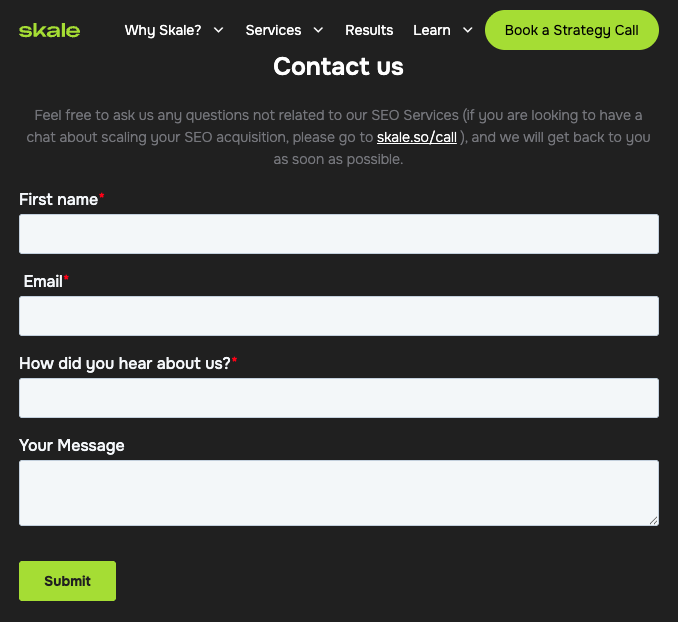
It captures exactly what software attribution misses: the discovery that happened off-site. When a buyer responds with “ChatGPT” or another AI search engine, that’s direct evidence your GEO and off-page investment is working, even if it never produced a traceable session.
- What it captures well: Upstream influence, AI discovery, off-site awareness channels
- Where it falls short: Recall bias, inconsistency, incomplete coverage
Why Using Both Is Non-Negotiable
GA4, your CRM, and other attribution software can only capture what happens after a click. These platforms tell you how users move through your funnel and which pages drive conversions.
But they can’t tell you how much time a buyer spent researching your category in Claude or that they came across your brand in three different AI-generated answers before checking out your pricing page, with their mind mostly made up.
Self-reported attribution fills that gap. “How did you hear about us?” catches the buyer at a high intent moment and highlights the channels that attribution tools can’t trace.
When those responses keep pointing to AI search, comparison sites or community discussions, you’re seeing the part of the journey your analytics tools can’t: buyers discovering, comparing and validating your brand before the click. Without self-reported attribution, that influence stays invisible in your dashboard.
The reverse is also true. Self-reported data without software attribution gives you source signals but no funnel visibility.
You might know buyers first found you through AI search. But you still need click-based data to understand the rest of the funnel, like how they eventually arrived on your site, which pages they used to evaluate you further before converting, or where they dropped off.
In GA4, those sessions may show up as direct, branded search, or referral traffic, even if the original discovery happened somewhere else.
- Software attribution keeps as much of the funnel visible and trackable as possible.
- Self-reported attribution fills in missing insights around the discovery layer.
- Neither is optional if you’re running an organic program in an environment where a meaningful portion of demand creation happens off your site.
Leading vs Lagging Metrics: What to Track and Why
Now you have a clearer picture of what’s driving engagement and conversions. But to interpret performance properly, you need to understand what each metric signals.
Some metrics tell you whether the work is on track. Others tell you whether prior work has paid off.
That’s why we split metrics into two categories: leading metrics and lagging metrics.
Tracking both together keeps teams focused on the right signals at the right time, instead of overreacting to short-term movement or waiting too long to see whether a strategy is creating business value.
| Metric Type | Examples | What It Tells You |
| Leading Indicators | Impressions Rankings Non-brand visibility AI search visibility Prompt coverage AI brand mentions AI citations Backlinks Clicks SRA | Whether organic growth, content, AI visibility, and off-site authority work is starting to create movement before commercial outcomes are visible. |
| Lagging Outcomes | MQLs SQLs Qualified trials Opportunities Pipeline Revenue MRR Retention | Whether organic growth strategies are contributing to commercial outcomes. |
Leading Metrics: The Inputs That Signal Future Outcomes
Leading metrics show whether your organic growth strategies are building momentum before commercial outcomes are visible.
Relevant leading metrics include:
- AI search visibility and share of voice across tracked prompts
- Percentage of self-reported responses citing AI or organic channels as the discovery source
- Rankings movement in priority topic clusters
- Links and AI brand mentions acquired in topically relevant, high-trust sources
- High-impression pages showing CTR improvement
Leading metrics are directional. Rising brand mentions or improved AI visibility shows that the work is gaining traction. It’s not, on its own, evidence of business impact. This is why you also need to track lagging metrics.
Here’s how that looked for Usercentrics. Impressions across priority clusters grew 73 percent QoQ, clicks increased 101 percent QoQ, and AI search traffic grew 27 percent QoQ. Those results suggested the strategy was improving visibility across the topics and journeys that mattered most.
Lagging Metrics: The Outcomes That Prove Your Strategy Is Working
Lagging metrics show whether that momentum is converting into qualified demand, pipeline, and revenue.
They are slower to move and harder to attribute cleanly. But these are the metrics leadership cares about most. It’s also what we focus on at Skale.
Relevant lagging metrics include:
- SQLs and qualified trials generated from organic sources
- Pipeline and revenue contribution
- CAC payback and MRR growth
- Retention and LTV
Expect healthy pushback from stakeholders when presenting lagging metrics. For example, a CFO or finance lead is likely to ask you: “How do you know AI citations contributed to an increase in SQLs?”
Instead of claiming direct attribution, show the connected signals that support your read of what’s happening.
As Kristina explains,
What we do is watch three things together: AI visibility, branded search, and direct traffic. When all three rise and more SQLs come through direct, that’s our signal that AI visibility is doing work.
It’s also why we push clients to ask leads directly how they heard about them. Self-reported attribution catches what no tracking tool can, and finance teams accept it as evidence.”
Snapshot vs Cohort Views: The Difference That Determines How You Prove ROI
As much as we’d like it to, organic growth doesn’t fit neatly inside a monthly reporting window. And if you judge organic performance through a short-term window, you can underestimate its impact.
That’s why you need to understand when to use snapshot views, when to use cohort views, and how both help leadership interpret ROI.
Snapshot Views: Useful for Short-Term Alignment, Not for Proving ROI
A snapshot view shows performance in a fixed period. Most leadership reports use this view by default.
For example, it might show:
- Organic traffic today
- AI search traffic this month
- Clicks or impressions last quarter
- Total YTD MQLs
Presenting data in this way is useful for short-term alignment. It helps teams see whether performance is up, down, or stable in a given time period. It also helps surface anomalies, such as sudden traffic drops, conversion spikes, technical issues, or shifts caused by seasonality or algorithm updates.
But snapshot views can’t show delayed impact. They can tell you that traffic increased this month, but not whether a specific content refresh or citation campaign is still compounding months later.
That makes snapshot reporting useful for monitoring performance, but weak as the only way to prove ROI.
Cohort Views: The Most Accurate Way to Measure Organic ROI
A cohort view looks at a defined group of deliverables and tracks how they perform over, for example, 90 days. That might mean tracking:
- A content cluster published or refreshed in Q1
- Pages optimized during a specific sprint
- Citations or backlinks acquired during a long-term campaign
- A group of high-intent pages tied to one product use case
Cohort views account for the time lag in organic growth, which makes them essential for measuring ROI. For example, a page refreshed in January may gain AI visibility in February, drive more MQLs in March, and influence SQLs later in the year.
They help you see whether work completed in one period continues to generate visibility, traffic, leads or pipeline in the months that follow.
“The ideal setup is cohort-by-input across a 90-day window,” explains Kristina. “Each activity should be tagged with its start date, whether that’s a content update, a new URL, on-page work, or a citation placement.
From there, you can track the cohort against the outcomes that matter: AI citation lift on related prompts, branded search lift, direct traffic from the source, and SQLs that touched the input on the way in.
“Rankings typically settle over four to 12 weeks, while pipeline impact usually becomes measurable around 60 to 90 days. Earned citations can move faster on the AI side, because the source is already trusted and surfaced by LLMs.”
This is what makes cohort analysis useful for leadership reporting. Instead of judging a specific set of deliverables by what happened this month, you can show whether that cohort is compounding over time and moving closer to commercial outcomes.
TL;DR for How to Use Both
Use snapshot views to:
- Report short-term performance trends
- Keep stakeholders aligned on recent movement
- Identify unusual spikes, drops, or anomalies
Use cohort views to:
- Measure ROI over a longer period
- Understand whether a particular initiative continues to create value
- Connect organic work to lagging outcomes like MQLs, SQLs, pipeline, and revenue
How to Report on Performance the Way Leadership Expects
One of the most common mistakes I see organic growth teams make is opening a performance review with leading metrics like traffic or impressions. Leadership’s response is usually some version of: “So… is our strategy working?”
Traffic doesn’t tell a C-suite whether organic is contributing to revenue. It only shows you whether pages are getting seen (which is the tip of the iceberg).
That means your reports are answering the wrong questions.
We approach reporting the same way we approach strategy: starting from the business outcome and working backwards.
Start With the Goal, Not the Indicators
If your north star for the quarter was SQLs, start your report there. Show how many SQLs were generated, how many came through organic, and whether that number increased, declined, or held steady against your target.
Then work backwards through the inputs that likely contributed to that movement:
- What AI visibility looked like in the months before pipeline moved
- Which citations were placed
- Which clusters were active
This is our reverse engineering principle. The same logic we use to build organic growth systems (define the outcome, identify the inputs, prioritize by impact) is the logic leadership needs to see.
It also makes the case for continued investment far more clearly than traffic charts ever can. A CFO who can see a direct line from content cluster investment to SQL growth will fund the next phase. A CFO looking at an impressions trend will not.
Establish a Baseline Before Drawing Conclusions
The other common mistake is presenting performance without a reference point. A ten percent drop in clicks looks alarming in isolation. But in the context of a seasonally quiet period where the prior year showed the same pattern, it’s expected.
Before you can interpret any movement, up or down, you need a baseline that accounts for the historical trajectory of the program and any external factors running in parallel. This could include seasonal spikes or dips, product launches, paid campaigns, algorithm updates, or changes to the site itself.
Without that context, leadership has no way of knowing whether a number is meaningful or expected. For example, while AI analytics tools can give us useful data in as little as two weeks, that’s just a snapshot. It takes around eight weeks to establish a really solid baseline.
“In the meantime, the early baseline is the competition itself: from week two you can already see where you sit next to competitors, which gives finance something to hold onto while you build up a history,” explains Kristina.
Realistically, the first month is for figuring out what normal looks like: which prompts give steady answers and which give different ones every time.
“Each AI tool also behaves differently,” she says. “Perplexity tends to be steadier because it pulls fresh from the web each time, while ChatGPT and Gemini can shift the moment they update their model or how they search. So track each one separately instead of treating AI visibility as one number.”
Separate Signal From Noise
In chapter one, I outlined how we pressure-test performance so we don’t over-credit organic for a spike or misread a dip as failure. The same diagnostic applies here when you’re building a report leadership can trust.
When performance shifts, run through these checks before drawing a conclusion:
- Is this consistent with seasonality or prior-year trends for this period?
- Did a technical change or content edit on the site precede the shift?
- Did a specific cluster move, or is this site-wide?
- What does self-reported attribution show; is demand still coming through in form responses even if sessions are flat?
These are some checks our team runs.
“For a Google update, we match the timing against known update dates and check GSC for which queries and pages lost clicks. A core update shows up as organic-only and is concentrated on a specific set of pages,” says Kristina.
“For an AI shift, we check our AI analysis tool to see whether citations stayed stable or moved alongside the Google drop, then we look at the traffic mix. AI shifts tend to also pull on direct traffic and branded search, because when AI stops recommending you, fewer people type your name into Google or go straight to your site.”
Build A Reporting Framework Leadership Can Trust
AI search has made organic performance harder to measure by pushing more of the buyer journey into places traditional analytics tools can’t fully see.
The path from first exposure to conversion is more fragmented. As a result, it’s harder to track, and no single tool captures all of it.
- Software attribution fails to track off-page activity.
- Self-reported data alone is too thin.
- Lagging metrics without leading ones leave you waiting too long to know whether the strategy is working.
- And snapshot views without cohort analysis make organic investment look weaker than it is.
So you have to combine them all. When used together, you can show leadership where demand is building and whether your work is actually compounding.
But there are a few realities worth stating plainly before you walk into that boardroom:
You can’t cleanly isolate organic impact from everything else running in parallel, whether that’s a product launch, a paid push, or a PR campaign. Our framework builds a defensible case, but it’s not a controlled environment.
Self-reported attribution is imperfect. Recall is unreliable, and not everyone fills in the form. But directionally consistent data pointing to AI discovery is more useful than no data at all.
There is no universal model. What good looks like depends on your growth stage, funnel velocity, and ICP. The first months of an organic growth program are about learning what normal looks like for your business.
The goal is to be able to walk into a review and show leadership, in plain terms, what moved, what drove it, and where the organic growth is headed. That’s what builds trust over time.
In chapter six, we put everything into a 90-day plan to help you build out the start of your organic growth program without overloading your team.