
Cookies power much of what makes websites work. They “remember” login details, personalize experiences, and help you understand how users interact with your site. For brands, cookies are essential for analytics, marketing, and delivering the kind of personalized service users expect.
But collecting this data comes with responsibility. Privacy regulations require you to get permission first. Cookie consent isn’t just about avoiding fines; it’s about building trust with your audience while maintaining the functionality and gaining the insights your business needs.
This guide explains what cookie consent is, which cookies require it, how regulations differ across regions, and how to implement consent management correctly.
At a glance
- Cookie consent is the permission websites obtain before collecting user data through cookies and trackers.
- Most cookies require explicit user consent under regulations like the GDPR and guidelines like the ePrivacy Directive.
- Consent must be freely given, specific, informed, and unambiguous to be legally valid.
- A consent management platform (CMP) can help with cookie consent by automating the collection, storage, management, and signaling of user consent.
- Proper implementation of cookie consent processes helps protect your business from fines and loss of brand reputation while maintaining marketing performance.
What is cookie consent?
Cookie consent is the permission you need from website visitors before collecting, storing, or using their personal information through tracking cookies and technologies.
Data privacy regulations like the EU’s General Data Protection Regulation (GDPR) and the ePrivacy Directive guidelines establish strict requirements for obtaining this permission. You need to inform users about what data you’re collecting, why you’re collecting it, who has access to it, and how long you’ll keep it.
Most websites use a cookie consent banner that appears when someone first visits. This banner presents information about cookies in use and gives users clear options to accept or reject them.
In the EU, you need explicit opt-in consent before any non-essential data collection. In some U.S. states, you must provide users with an opt-out option, and sometimes provide additional functions, like including a “Do Not Sell or Share My Personal Information” link on your site for users based in California.
Types of cookies that require consent
Understanding which cookies need consent helps you configure your consent banner correctly and avoid privacy compliance gaps.
- Functional cookies enable specific features, like remembering login status, language preferences, or items in a shopping cart. The ones that enable basic site functionality are generally considered essential, and don’t require prior consent, but additional ones that improve user experience do require consent.
- Preference cookies store user choices about site settings, themes, or display options. These require cookie acceptance because they create a profile of user behavior and preferences over time.
- Performance cookies measure site performance and help identify technical issues. Even though these serve legitimate business purposes, they need cookie consent if they collect data that could identify individual users.
- Advertising cookies power retargeting campaigns and measure ad effectiveness. These always require cookie agreement because they track users across sites and build detailed profiles for ad targeting.
Ultimately, if a cookie collects personal data or tracks user behavior beyond what’s necessary for basic site operation, you need website cookie consent before setting it.
How does cookie consent work?
When someone lands on your website, a consent management platform (CMP) with geolocation functionality detects their location in most cases and displays the appropriate consent banner based on local regulations and in their preferred language.
The banner explains what cookies and trackers are in use, organized by category (necessary, functional, analytics, marketing). Users can then make informed choices about which types of cookies they’ll allow.
It’s worth noting that many privacy laws require you to block all non-essential tracking until a user gives permission, and keep a verifiable record of their choice. Therefore, while a CMP is not mandatory, it’s an established and reliable way of performing these checks and keeping your records accurate.
Here’s what happens behind the scenes when you use a CMP:

The CMP identifies the user’s location to determine which privacy laws apply.

A consent banner appears with clear information about cookies in use.

Users select their preferences through accept/reject buttons or granular controls.

The CMP blocks non-essential cookies until users grant permission (where legally required).

Consent records are securely stored for compliance documentation and updated over time

User consent preferences are communicated to analytics and advertising platforms.
Your CMP continues working after that initial interaction. It stores consent records securely, enables users to change their preferences at any time, and automatically blocks unauthorized data collection if consent is withdrawn or expires.
This system protects your users and your company while giving you the documentation needed to demonstrate compliance if audited or in data access requests.
Do all cookies require consent?
No, not all cookies require consent, but the majority of cookies used for business purposes do.
A 2019 ruling by the Court of Justice of the European Union clarified consent requirements under the GDPR. The ruling emphasized that website owners cannot assume or coerce users to consent. You must obtain explicit permission before or at the start of data collection, particularly for cookies that affect user privacy.
Cookies that require explicit cookie consent include:
- Third-party cookies, which are placed by domains other than yours and typically track user behavior across multiple sites. These are commonly used by advertising networks and analytics services. Third-party cookies need to be part of your cookie consent policy because they collect extensive data that can identify individual users across the web.
- Analytics cookies, which monitor how users interact with your site, tracking metrics like page visits, time on site, and navigation patterns. While these provide valuable business insights, they generally require cookie consent unless configured to collect data in a completely anonymous way that cannot be linked to individual users.
- Marketing cookies, which build user profiles and track behavior to deliver targeted advertising. These must be part of your cookie consent policy because they collect detailed information often tied to user accounts (like Google profiles) and can easily identify individuals.
- Social media cookies, which are placed by platforms like Facebook, LinkedIn, and TikTok. They track users both on and off these platforms, collecting data for advertising and market research. Social media cookies always require prior consent to cookies.
Under the GDPR, valid cookie consent requires prior opt-in. You can only collect and use personal data for marketing after users actively agree. Consent also needs to meet other GDPR criteria like being freely given, specific, informed, and unambiguous.
If a user closes your banner without making a choice, or ignores it and continues browsing, this doesn’t count as legitimate consent under the GDPR. Neither does consent obtained via dark patterns, like only providing an “Accept All” option.
Dive deeper into the 7 criteria for GDPR-compliant consentHow cookie consent impacts marketing and analytics
Cookie consent directly affects how marketers track and measure user behavior. When users decline cookie consent, you lose access to some tracking data. This affects attribution modeling, audience building, remarketing campaigns, and conversion measurement. For companies that rely heavily on personalized marketing, this creates real challenges in understanding what drives conversions.
The good news is that thoughtful consent implementation helps maintain strong data quality. A well-designed consent banner with clear messaging and easy-to-understand categories tends to perform better. When users understand what they’re agreeing to and feel respected in the process, they’re more likely to give consent.
Here’s a handy cookie banner design checklist.
In addition, tools like Google Consent Mode and Microsoft UET Consent Mode help bridge gaps when users decline consent. These frameworks use conversion modeling and aggregated data to maintain directional insights about campaign performance, even if you lose some granularity.The brands that succeed treat consent as part of their value proposition rather than an obstacle. They focus on first-party data strategies, communicate transparently about data use, and continuously optimize their consent experience.
Cookie consent for mobile apps
Mobile apps don’t use cookies in the traditional sense, but they collect similar types of data through SDKs, tracking identifiers, and app-specific storage. Privacy regulations still require mobile app cookie consent for this data collection.
Apple’s App Tracking Transparency (ATT) provides a mandatory platform framework, but this does not replace your need to comply with global laws like the GDPR or the California Privacy Rights Act (CPRA).
An app-focused CMP solution is essential, showing the right consent prompts based on where the user is, managing consent for different types of data collection, and securely storing those records. The process should be clear and easy for users, without unnecessary pop-ups that disrupt user experience.
Why cookie consent matters for privacy compliance
Cookie consent may not be explicitly referenced in all global data privacy laws, but consent for data collection, which definitely includes cookie use, is a fairly universal requirement. They all share a common principle: users should control their privacy and access to their personal data.
Cookie and tracker use represents one of the primary ways businesses collect personal information online. Even as third-party cookies phase out, other tracking technologies like first-party data, tracking pixels, and fingerprinting will continue collecting user data.
Therefore, privacy compliance isn’t optional. Regulators actively enforce these laws and investigate complaints from users. Data protection authorities in Europe have issued hundreds of millions in fines for cookie consent violations alone.
The requirements keep evolving, too. Advertising platforms like Google and Microsoft now mandate consent management for businesses running campaigns in certain regions. Without proper consent mechanisms, you’ll lose access to essential marketing platforms, tools, and features.
Global cookie consent requirements
Privacy regulations vary by region, but they share core principles about transparency and user control. Understanding the specific requirements in each jurisdiction helps you configure your consent cookies correctly.
- European Union (GDPR and ePrivacy Directive): You need explicit opt-in consent before setting any non-essential cookies. Consent must be freely given, specific, informed, and unambiguous. Users must be able to reject cookies as easily as they accept them.
- United States: No federal privacy law exists, but a number of state laws create consent requirements. All states with privacy laws to date require clear opt-out mechanisms and typically require prior consent for sensitive data, including children’s.
- United Kingdom: Post-Brexit, the UK maintains GDPR-equivalent standards through the UK GDPR and Privacy and Electronic Communications Regulations (PECR).
- Brazil (LGPD): Brazil’s General Data Protection Law requires explicit consent for data processing unless another legal basis applies. Cookie consent follows similar principles to the GDPR.
- Canada (PIPEDA): Canada’s Personal Information Protection and Electronic Documents Act requires meaningful consent for the collection and use of personal information. Express opt-in consent is needed for sensitive data.
Opt-in vs opt-out cookie consent models
Different privacy regulations require different consent approaches, but typically one of two models is in effect.
Opt-in consent requires users to actively agree before any non-essential data collection starts. This model applies under the GDPR, ePrivacy Directive, and similar regulations in Brazil, South Africa, and other jurisdictions. Your default position is that no cookies are set until the user explicitly agrees.Opt-out consent assumes permission for data collection but requires clear information and an easy way for users to refuse or withdraw consent. This model is common under U.S. state privacy laws like the CCPA and CPRA (though for children’s data or other sensitive categories, prior consent is typically required). You must display prominent notices about data collection and some laws have specific requirements for opt-out mechanisms.
| Consent model | How it works | Where it applies | Key requirements |
| Opt-in consent | Users must actively agree before any non-essential data is collected. No cookies or tracking activate until consent is given. | GDPR, ePrivacy Directive, and similar laws in Brazil, South Africa, and other regions. | Explicit user agreement before collection; default is no tracking. |
| Opt-out consent | Most data collection is allowed by default, but users must be given a clear way to refuse or withdraw consent. | U.S. state laws like the CCPA and CPRA. | Prominent notices, easily accessible opt-out options, and links with specific text, such as “Do Not Sell or Share My Personal Information.” |
Effective cookie consent solutions automatically detect user location and display the legally appropriate consent model. This geotargeting supports privacy compliance across different jurisdictions without creating separate versions of your site.
Consequences of not obtaining cookie consent
Failing to obtain proper cookie consent can lead to serious financial and reputational damage. For instance, GDPR penalties can result in fines of up to 4 percent of global annual revenue or EUR 20 million for issues like collecting data without consent or repeatedly ignoring regulatory compliance requirements.
Beyond fines, the reputational impact can be even more damaging. Users are increasingly aware of their privacy rights and tend to lose trust quickly when they feel their data is mishandled.
Consumer advocacy groups actively monitor and report violations, and once noncompliance becomes public this often triggers heightened regulatory attention and more frequent audits. This kind of exposure can undermine credibility and weaken customer confidence over the long term.
How to implement cookie consent: best practices
Implementing cookie consent is crucial to comply with data protection regulations such as the GDPR. Below are some key dos and don’ts to consider in your cookie consent strategy.
Cookie consent dos
- Provide clear information: Explain which cookies are in use, their purpose, how they track user data, who may access that data, and how long they remain in place. This transparency in your cookie consent policy helps keep your cookie consent rate high.
- Offer granular choices: Enable users to accept or decline all cookie use, or different types of cookies individually in your cookie pop-up.
- Simplify consent change or withdrawal: Include clear information in your cookie notice and easily accessible options so that users can change their consent preferences at any time.
- Document consent: Always maintain records of when and how users consent, with changes over time, as proof of compliance in case of an audit or data subject access requests (DSAR).
Cookie consent don’ts
- Avoid pre-checked boxes: Cookie consent must be given actively, so pre-checked boxes don’t constitute valid consent. Accept and deny options must also be equally visible and accessible.
- Don’t hide information: Keep details about cookies and their use clear and accessible. Ensure key information isn’t buried in lengthy legal documents. Make links to your privacy policy easy to find.
- Don’t eschew consent for non-essential cookies: Users must be able to access your website and its functions without having to agree to non-essential cookies.
- Regularly update consent practices: Keep your cookie consent policy up to date and in line with current legal requirements and technological standards.
Choosing the right cookie consent solution for your company
The right consent management platform depends on your business size, technical requirements, and compliance needs.
Small businesses and startups benefit from easy implementation, pre-built templates, and clear pricing. You need a solution that works out of the box without requiring extensive technical resources.
Growing companies typically prioritize scalability, customization options, and integration capabilities. As traffic increases and you add new tools to your stack, the right solution should adapt without requiring a complete rebuild.
Enterprises most likely need multi-domain support, advanced reporting, dedicated account management, and enterprise security standards.
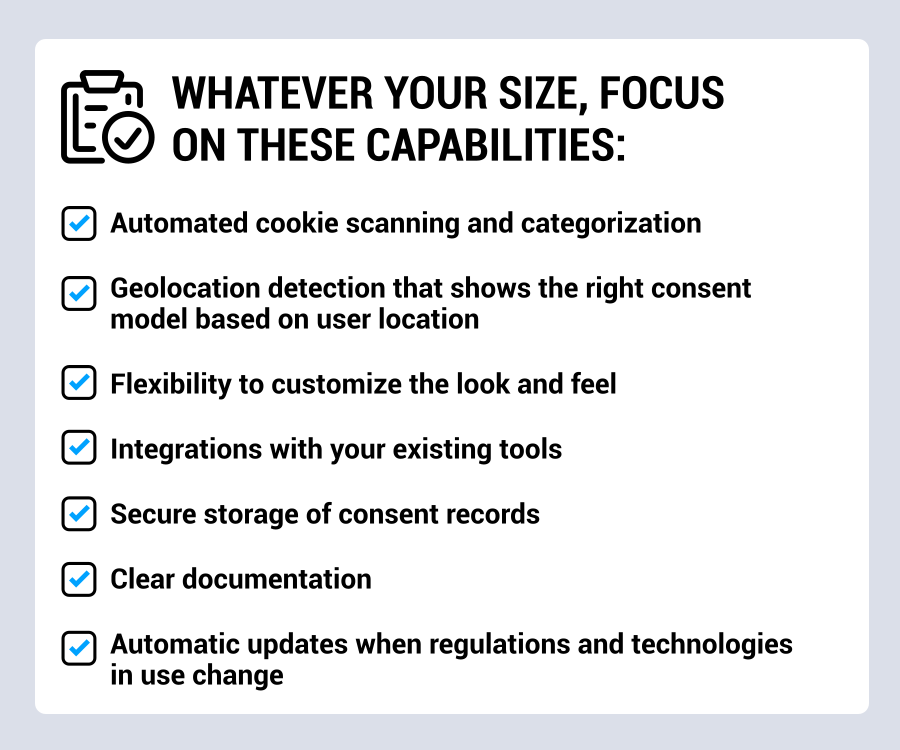
Whatever your size, focus on these capabilities:
How Usercentrics helps you with cookie consent management
Managing cookie consent can be complex, especially with multiple web and app properties and varying regulations across regions. Usercentrics CMPs simplify this process with automatic scanning to identify cookies and trackers, then blocking non-essential ones until users grant permission. This automated approach reduces manual configuration while helping you stay privacy-compliant.
When visitors arrive on your site or launch your app, they see a consent banner tailored to their location: GDPR-compliant opt-in for users in Germany, and CCPA-style opt-out notices for visitors in California. Geolocation detection happens automatically, ensuring the right experience for each user.
The platform also gives users meaningful control over their data. They can accept or reject all cookies with a single click, or select specific categories through granular settings. Preferences are securely stored and can be updated any time via an easy-to-access privacy center.
For businesses using Google Ads or Microsoft Advertising, Usercentrics is integrated with Google Consent Mode, Microsoft UET Consent Mode, and Microsoft Clarity Consent Mode. This enables measurement, insights, and conversion modeling even when users decline certain cookies, maintaining analytics while respecting user choices.
All consent records are documented automatically with timestamps and user selections. This audit trail is essential for regulatory inquiries or data subject access requests, providing proof of compliance without manual record-keeping.

Join our growing community of data privacy enthusiasts now. Subscribe to the Usercentrics newsletter and get the latest updates right in your inbox.