
Reduce Campaign Costs With Meta Signals Gateway

Proven impact of first-party data
Deloitte research* shows that businesses using custom, data-driven strategies based on first-party data report better marketing results and lower acquisition costs.
Increase in conversion rate
Increase in customer satisfaction
Increase in spend per customer
Reduced acquisition costs
Get more from your data
First-party data comes straight from your audience. Activate Signals Gateway with Usercentrics to make the most of your data.


Ready to improve your Meta performance with Meta Signals Gateway?
How to reduce cost of acquisition
The example below shows a business with existing €10 CPAs on Meta that moves from a basic Meta tracking setup (using the client-side Meta Pixel) to an optimal setup using the Meta Pixel, Conversions API, and Signals Gateway Pixel together.
Basic setup
- Meta Pixel (client-side)

Mid-way setup
- Meta Pixel (client-side)
- Conversions API
13% lower cost Optimal setup
- Meta Pixel (client-side)
- Conversions API
- Signals Gateway Pixel
33% lower cost Why activate Signals Gateway with Usercentrics
Get Signals Gateway hosting today
Activate your Meta Signals Gateway and start improving campaign performance.

No maintenance needed
We take care of hosting, updates, and performance monitoring.
Faster time to value
Start sending high-quality, consented signals to Meta in days, not weeks.
Seamless integration
Works perfectly with your existing CMP and tracking setup, Meta Conversions API, and other marketing destinations.
Compliance-first
You can set it to send only consented data to Meta advertising platforms.

Pricing plans
 Special Launch Offer
 Get your first 20,000 events for free
No upfront commitments. Just start free.
Disclaimer: Offer valid for new users only. Free access for up to 20,000 events. Standard rates apply thereafter.
Usercentrics reserves the right to modify or end this offer at any time.
Frequently asked questions
Usercentrics Meta Signals Gateway is a fully managed, easy-to-activate solution that simplifies the setup and operation of Meta Signals Gateway, facilitating first-party data transfer from online and offline channels to Meta and beyond.
Instead of requiring you to deploy and maintain the infrastructure yourself, we handle the hosting for you, providing a secure, scalable, and privacy-friendly environment out of the box.
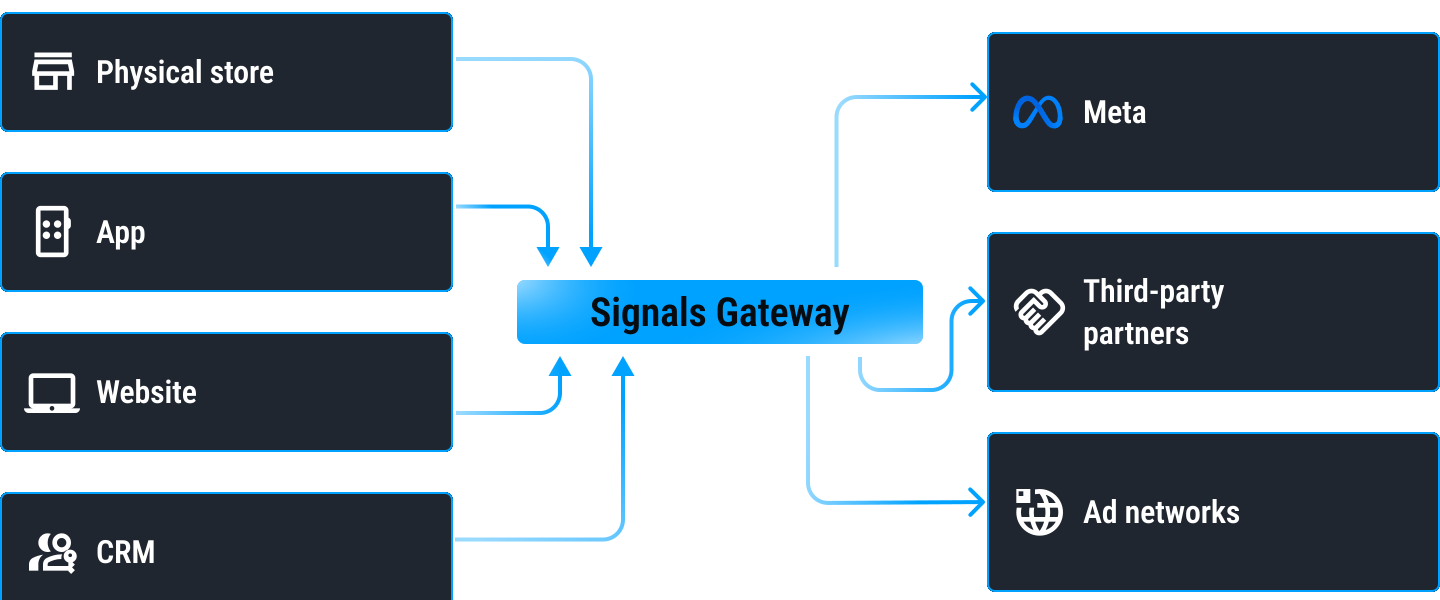
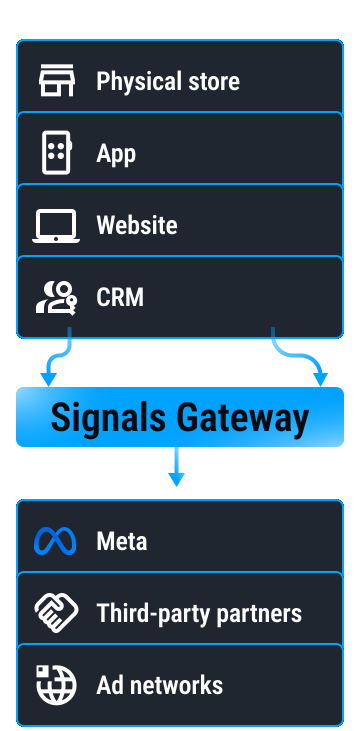
Signals Gateway is Meta’s new all-in-one data solution that helps you maximize the value of your first-party data by streamlining data connections from any source to any destination — Meta or beyond. It enables you to improve campaign performance, reduce acquisition costs, and get more from your ad spend on Meta.
How it works (simplified):
- A user interacts with your site or app.
- Event data is sent to your Meta Signals Gateway endpoint (hosted by you or a provider like Usercentrics).
- The Gateway securely forwards this data to Meta.
- Meta uses it to improve attribution, targeting, and campaign results.
The Usercentrics platform is a managed hosting layer for Meta Signals Gateway, enabling customers to quickly:
- Launch their own gateways with one click (no need to manage cloud hosting setups)
- Manage usage, domains, and credentials in one place
- Benefit from more resilient and performant data delivery to Meta
Advertisers who implemented the Signals Gateway Pixel along with their Meta Pixel and Conversions API integration saw on average a 23% reduction in Cost per Action over using Meta Pixel and Conversions API alone.*
This is incremental to the 13% Cost per result improvement on average for businesses with the Meta Pixel who set up the Conversions API**
Source: Based on meta-analysis of 15 A/B experiments at 99% confidence with Conversions API Gateway advertisers conducted between May 2024 to Jan 2025 in APAC, EMEA and NORAM, with incentives
While both Meta’s Signals Gateway and Google’s Server-side Tag Manager (sGTM) operate on server infrastructure, their purposes differ. sGTM is a flexible data router — a general-purpose server that lets you collect, transform, and distribute data to multiple destinations like Meta, Google Analytics, or TikTok.
In contrast, the Meta Signals Gateway is an easy-to-use event processing system optimized for sending high-quality conversion data to Meta. It’s preconfigured and managed for performance and reliability, giving advertisers the benefits of server-side tracking without the technical complexity of running their own infrastructure.
It depends on your goals. If Meta is an important advertising channel for you and you want a simple, guided setup focused on Meta Ads performance, Usercentrics Meta Signals Gateway Hosting could be the right choice. It makes it easy to connect your web and offline data to Meta, improve tracking accuracy, and build custom audiences — all without technical expertise.
If you’re looking for a more advanced, multi-platform solution, Server Google Tag Managing (sGTM) hosting may be better suited. It offers greater control over tracking across platforms like Google, Meta, and TikTok, enabling powerful data enrichment and centralized governance in a privacy-safe environment.
Usercentrics Meta Signals Gateway makes Meta tracking easy, fast, and privacy-safe. It’s simple to activate, requiring no complex setup or technical expertise. The solution is fully hosted and maintained by Usercentrics, so you don’t need to manage servers or updates.
It’s compliance-friendly, helping to ensure that only consented data is sent to Meta’s advertising platform. You can be up and running in days, with integration into your existing CMP, Meta Conversions API, and other marketing tools — delivering high-quality, consented signals effortlessly.
Furthermore, using the Signals Gateway Pixel alongside the Meta Pixel and Conversions API, businesses observed several benefits:
- Clarks: −25% CPA, +32% ROAS, +33% conversions
- Terranova: −17% CPA, +22% ROAS, +21% conversions
- SBLY Media: −25% cost per result, +22% conversions
- YOIMEDIA: −22% CPA, +29% ROAS, +31% conversions
- PiKoYa: −21% cost per result, +33% ROAS, +27% conversions
Source: Meta Case studies
Yes. You can use both Server-Side Google Tag Manager (sGTM) and the Signals Gateway together.
sGTM manages and processes your server-side tagging setup, while Signals Gateway provides first-party Meta Pixel support, offline conversion data processing, and custom audience building.
Not exactly — because Signals Gateway and Server GTM serve different purposes, it’s not a direct migration but rather a combination or expansion.
Yes — it’s highly recommended to use a custom domain for your Signals Gateway (and for your Server GTM container, if you use one).
A custom domain helps to ensure that all data requests and signals are sent through your own trusted domain rather than a third-party endpoint. This makes your measurement setup more resilient and future-proof.
Meta Signals Gateway fully supports the upload of offline conversions, including in-store purchases and CRM events.
You can upload point-of-sale transactions, loyalty program data, call center conversions, or other CRM-tracked outcomes.
Event identifiers are SHA-256 hashed and transferred securely. Any unmatched hashes are discarded after processing.
Yes. Signals Gateway supports sending data to custom destinations and to your BigQuery data warehouse.
The Meta CAPI Gateway provides a first-party endpoint that receives data from the classic Meta Pixel (e.g., from websites) as well as event data from offline sources like CRM systems, which is then forwarded to the Meta Conversions API (CAPI). It improves tracking accuracy by providing an alternative to browser limitations.
The Meta Signals Gateway builds upon the CAPI Gateway, providing the same capabilities — and more. It lets you create the new Signals Pixel, which is the Meta Pixel hosted under your domain, making it more resilient. It also acts as a data hub for first-party data from multiple sources, including websites, mobile apps, and offline/CRM systems. It processes and routes that data not only to Meta but also to other platforms if needed.
In short:
- CAPI Gateway = dedicated pipeline to send web and server events to the Meta CAPI.
- Signals Gateway = supports the new first-party pixel from Meta and acts as a centralized platform for managing and routing first-party data from multiple sources (websites, apps, and offline) to Meta and beyond.
First-party data is information you collect directly from your audience — through your website, app, CRM, or other owned channels. It’s consented, accurate, and fully under your control. Because it reflects real interactions with your brand, it’s the most reliable foundation for marketing decisions and targeting.
Third-party data, by contrast, is collected by other entities (like external platforms, websites, or tools) and then shared or sold. It’s often cookie-based, harder to verify, and increasingly limited by privacy laws and browser restrictions.
Building your marketing strategy on first-party data helps you:
- Improve targeting accuracy
- Maintain consistent tracking across platforms
- Reduce reliance on external sources
- Stay compliant with privacy regulations
- Future-proof your performance as third-party tracking fades