
Businesses are handling more customer and operational data than ever. Keeping that data organized (and compliant) needs to be a shared priority across teams. Data governance tools make that possible by setting clear rules for how data is collected, stored, and shared.
In this guide, we’ll explain what data governance software does, why it’s important, and how to find the right solution based on your business goals. We’ll share how consent management fits into a strong governance strategy and which tools are leading the way in 2026.
At a glance
- Data governance tools are essential software solutions to help ensure that data is collected, stored, and used in compliance with regulatory requirements.
- Key functions of governance tools include policy management, metadata tracking, access control, and compliance automation for greater accountability and risk reduction.
- The best data governance platforms for 2026 fall into these categories: Enterprise/Technical, Privacy/Consent, Marketing/Tag Control, and Cloud-Native.
- Integrating consent management is critical to modern governance so that data collection aligns with user privacy preferences from the start.
- Server-Side Tagging (SST) enhances data governance by centralizing tag control and validating that only consented data is transferred, improving security and data accuracy.
- When selecting data governance software, businesses must prioritize compliance support, seamless integration with their existing tech stack, scalability, and automated reporting capabilities.
- The future of data governance is moving toward AI-driven automation, real-time monitoring of third-party data flows, and the convergence of PrivacyOps and DataOps.
What are data governance tools?
Data governance tools are software solutions that help organizations manage how they handle data assets across business operations. They bring together policies, processes, and technology to make sure data is reliable, secure, and used in the right way.
These tools support four main functions:
- Policy management: Define and enforce data rules, from collection to retention.
- Metadata management: Organize and track information about data assets, including where they come from and how they’re used.
- Access control: Manage permissions so only authorized users can access or modify data.
- Compliance automation: Map data to regulatory requirements and generate reports to demonstrate accountability.
Together, these features help businesses maintain transparency and reduce risk, both of which are critical for meeting international standards like those mandated by Europe’s General Data Protection Regulation (GDPR) and the state-by-state data privacy laws in the U.S., including the California Consumer Privacy Act (CCPA).
As you determine who is responsible for GDPR compliance on your team, be aware that data governance isn’t the responsibility of IT alone. Marketing, analytics, privacy teams, and others also rely on accurate, consent-based data.
Good data governance software connects its core functions, helping organizations maintain trust while improving data quality and decision-making.
Why are data governance tools important for compliance and privacy?
Strong governance is central to data protection and regulatory compliance. Frameworks such as the GDPR, CCPA, and ISO 27001 all require organizations to know where personal data lives, how it’s used, and who has access to it. Noncompliance puts both trust and revenue at risk, as regulators increasingly impose high-value GDPR penalties.
Data governance tools give organizations the visibility they need to prove compliance, demonstrate accountability, and respond quickly to audits or user requests.
For privacy teams, they serve as the operational backbone of compliance by supporting lawful processing, consent tracking, and consistent documentation. For IT and security, they reduce risk through standardized access control and data lifecycle management.
Beyond compliance, governance can also support business goals and add value to the company. Accurate, consistent, and traceable data gives teams the confidence to act decisively, because they know every insight is privacy-safe.
Types of data governance tools
Data governance tools serve different purposes. Some are designed to manage compliance workflows, while others focus on technical control or marketing data visibility. Organizations should choose a solution that fits their structure, data maturity, and compliance goals.
Most tools fall into one of the following four categories.
1. Compliance-focused data governance tools
These tools help organizations meet privacy, data security, and industry regulations’ requirements. They automate audit trails, manage consent, and map data against compliance frameworks such as the GDPR, CCPA, and ISO 27001.
Typical features include:
- Policy and consent management
- Data mapping and records of processing
- Automated reporting and documentation
- Role-based access control
They’re best for: legal, risk, and privacy teams that need consistent, auditable compliance processes.
2. Technical data governance tools
Technical or enterprise-grade governance platforms focus on the data itself. They manage how it’s structured, stored, and accessed across complex systems. They’re often integrated into broader enterprise information management software or data management platforms.
Typical features include:
- Metadata and data lineage tracking
- Data cataloging and data classification
- Quality and validation controls
- Workflow automation for approvals and changes
They’re best for: IT compliance, data engineering, and supporting analytics teams that need detailed visibility and control across multiple data silos.
3. Marketing and analytics data governance tools
Marketing and analytics teams also rely on data governance. Their focus is on managing user consent, ensuring data accuracy, and maintaining control across advertising and analytics platforms.
Tools in this category often integrate tag management, server-side tracking, and consent management. They help teams collect and process data responsibly while preserving measurement accuracy.
Typical features include:
- Consent-based data collection
- Tag and tracking governance
- Audience and attribution data management
- Data integration with ad tech and analytics tools
They’re best for: marketing and digital teams that need reliable, privacy-compliant data for performance analysis and personalization.
4. Cloud-native governance tools
Cloud service providers now include governance capabilities within their data management ecosystems. These data governance platforms provide centralized control over access, encryption, and compliance across multi-cloud and hybrid environments.
Examples include:
- AWS Lake Formation
- Google Cloud Dataplex
- Microsoft Purview
They’re best for: organizations operating across multiple cloud environments that require scalable, automated governance controls.
Comparing data governance tools
The right data governance tool sets your organization up for smarter, safer, and more strategic use of data. The platforms below are among the most trusted and forward-thinking on the market, offering the visibility and control businesses need to stay compliant, competitive, and future-ready.
Best enterprise data governance platforms
These platforms provide the functions you need for enterprise data governance, including data discovery, data cataloging, and workflow management across departments and systems.
Collibra Platform
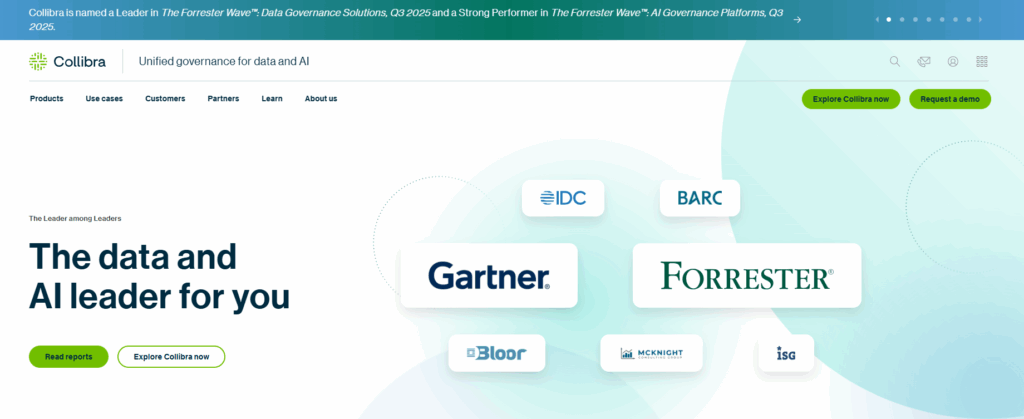
Collibra is one of the most established enterprise data governance platforms. It’s designed to help organizations manage data assets, maintain compliance, and improve data quality. Collibra is built for large-scale data environments, so it connects business, IT, and compliance teams through a single, collaborative platform.
Its features support the entire governance lifecycle, from data discovery to policy enforcement and reporting. It’s a strong choice for companies seeking structure, consistency, and accountability in their data management processes.
Notable features:
- Data catalog and lineage: Discover, organize, and visualize relationships across data sources.
- Policy management: Define governance rules and workflows across business units.
- Data quality automation: Monitor, validate, and improve data accuracy.
- Collaboration tools: Connect teams with shared glossaries, workflows, and issue tracking.
- Regulatory compliance support: Aligns with the GDPR, CCPA, and other major frameworks through documented governance processes.
Pricing: Custom, based on user numbers, deployment size, and modules selected.
| Pros | Cons |
| Comprehensive platform for large organizations | Complex setup and steep learning curve |
| Strong integrations with cloud and analytics tools | Premium pricing for enterprise users |
| Robust metadata and data lineage features | Implementation requires significant effort |
| Clear audit and compliance documentation | Interface can feel complex for non-technical teams |
Informatica Axon Data Governance
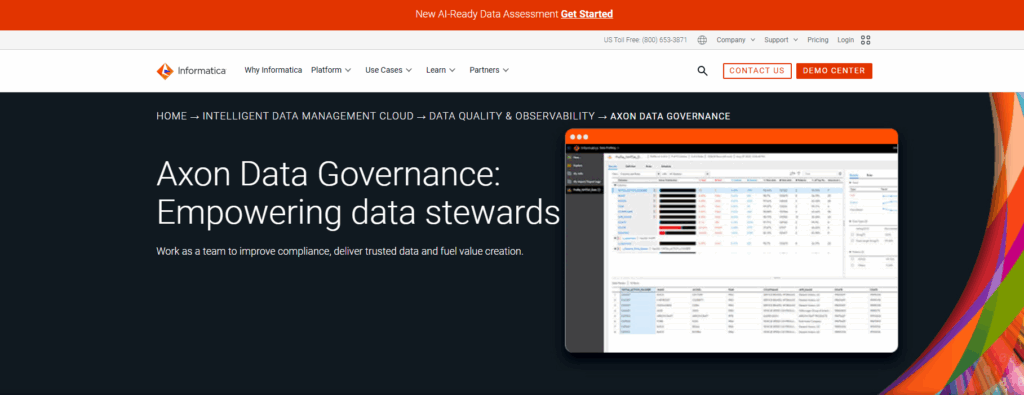
Informatica Axon Data Governance is part of Informatica’s broader Intelligent Data Management Cloud (IDMC) platform. It provides enterprise-grade tools for governing data quality, metadata, and policy management across complex ecosystems.
Designed for large organizations that manage diverse data sources, Informatica Axon offers an integrated workspace that connects governance with master data management, data quality, and data integration. It’s a comprehensive option for organizations pursuing full data lifecycle governance.
Notable features:
- Centralized governance workspace: Manage policies, processes, and stewardship activities in one place.
- Data lineage and discovery: Map how data moves and transforms across systems.
- Automated quality scoring: Identify and correct inaccurate or incomplete data.
- Integration with Informatica ecosystem: Works seamlessly with Data Catalog, MDM, and Data Quality modules.
- Collaboration tools: Enables business users and data stewards to share definitions and approve changes.
Pricing: Enterprise licensing model costs depend on the scale of deployment and number of users.
| Pros | Cons |
| End-to-end governance integrated with other Informatica tools | Complex setup and learning curve |
| Advanced automation for data quality and lineage | Requires skilled data governance professionals |
| Supports large-scale, hybrid and multi-cloud environments | Cost may be prohibitive for smaller organizations |
| Well-established vendor with strong enterprise support | Customization can add to implementation time |
Alation
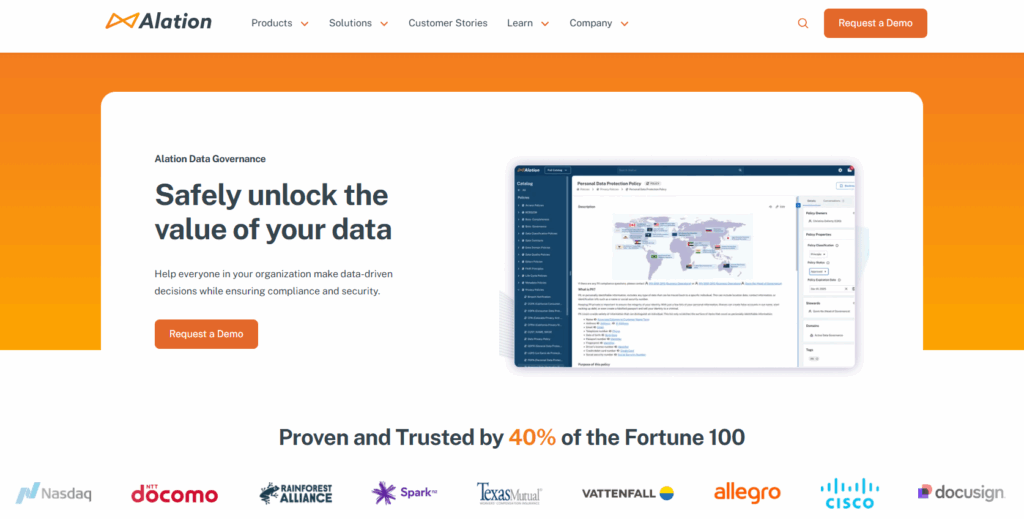
Alation is a data intelligence and governance platform known for its user-friendly interface and collaborative approach to data management. It combines a powerful data catalog with governance, data stewardship, and analytics tools to make it easier for organizations to discover, understand, and trust their data.
Alation focuses on usability and adoption, aiming to make data governance a natural part of everyday decision-making. Its AI-driven search and recommendation features help data users find and apply the right data quickly while staying privacy-compliant.
Notable features:
- Data catalog and search: Automatically index and surface data assets from across the organization.
- Policy and data stewardship workflows: Define, review, and approve governance rules through guided processes.
- Data lineage visualization: Track where data comes from and how it changes over time.
- AI-assisted insights: Recommends datasets and flags potential compliance issues automatically.
- Collaboration tools: Facilitate teamwork with built-in commenting, annotations, and shared glossaries.
Pricing: Subscription-based model. Costs vary based on data volume, user count, and selected modules.
| Pros | Cons |
| Intuitive interface encourages broad adoption | Governance features may require additional configuration |
| Strong search and collaboration capabilities | Costs scale with usage and integrations |
| AI-driven data discovery and recommendations | Some advanced features are only available in higher tiers |
| Supports multi-cloud and hybrid environments | Requires governance framework alignment before deployment. |
Best privacy and consent management tools
Tools that focus on transparency, consent, and compliance with global data privacy laws are a crucial part of any privacy and data governance strategy. Below are three of the best options currently on the market.
Usercentrics CMP
Usercentrics Consent Management Platform (CMP) enables organizations to collect, manage, securely store, and document user consent seamlessly across websites and apps. The goal is to support privacy compliance while preserving marketing performance.
As a verified Gold Tier Google CMP Partner, Usercentrics integrates directly with Google Tag Manager, Google Analytics, and Consent Mode v2, as well as major ad tech frameworks like IAB TCF v2.2.
Designed for scalability, transparency, and brand consistency, Usercentrics CMP transforms regulatory compliance into an advantage. It helps businesses build trust and meet global privacy laws’ requirements, including the GDPR, UK GDPR, CCPA/CPRA, PIPEDA, LGPD, and POPIA.
Notable features:
- Automated privacy compliance: Block non-essential scripts until consent is granted.
- Seamless integrations: Native compatibility with leading platforms like Google, Microsoft, and WordPress.
- Customizable consent banners: Adapt design, language, and display rules to reflect brand identity.
- Advanced analytics and A/B testing: Monitor consent rates and optimize banner performance with actionable insights.
- Multi-domain and multi-language support: Manage consent across global markets from a single dashboard.
- Consent history and audit logging: Retrieve proof of consent instantly to demonstrate compliance.
Pricing: Usercentrics provides a 14-day free trial for Web CMP, with five scalable plans: Essential, Plus, Pro, Business, and Corporate. Each one is tailored to business size and regulatory scope. Enterprise clients benefit from customized configurations, A/B testing, and dedicated support.
| Pros | Cons |
| Verified Google CMP partner | Advanced configurations require setup support |
| Combines compliance and marketing performance | Multi-domain setups benefit most from enterprise plans |
| Highly customizable with multi-language support | |
| Real-time analytics and optimization tools | |
| Automated blocking supports true privacy by design |
OneTrust
OneTrust provides a broad governance, risk, and compliance (GRC) platform that spans privacy management, security assurance, and environmental, social, and governance (ESG) initiatives.
Its data governance module helps organizations centralize policies, automate workflows, and manage regulatory obligations across global frameworks like the GDPR, CCPA, and ISO 27001.
Since it’s built for large enterprises, OneTrust offers extensive compliance coverage and reporting functionality. However, its scale and multi-solution design can make configuration and onboarding complex for smaller teams that need fast implementation or marketing alignment.
Notable features:
- Unified compliance platform: Manage privacy, security, and ESG programs in one place.
- Data discovery and classification: Identify personal and sensitive data across cloud and on-premises environments.
- Vendor risk assessments: Monitor third-party compliance and automate due diligence workflows.
- Regulatory research hub: Access insights from 40+ in-house researchers and 300+ jurisdictions.
- Workflow automation: Build custom review, approval, and documentation processes.
Pricing: OneTrust uses a solutions-based pricing model in which organizations select from bundled capabilities. Costs vary depending on the number of modules, users, and features selected.
| Pros | Cons |
| Comprehensive privacy and GRC coverage | Complex setup and longer implementation timelines |
| Strong automation and reporting tools | May include features beyond most privacy teams’ needs |
| Extensive regulatory intelligence network | Enterprise-focused pricing |
| Suitable for large, global organizations | Interface can feel heavy for marketing or analytics use cases |
TrustArc
TrustArc is a long-established privacy management and compliance platform that supports organizations in meeting global data protection requirements. It emphasizes automating compliance workflows, conducting risk assessments, and maintaining up-to-date records of processing activities.
The platform provides a solid foundation for privacy operations, with assessment templates, policy management tools, and configurable dashboards. However, its modular approach and pricing structure can make it less accessible for smaller or fast-moving organizations that are looking for simplicity and speed.
Notable features:
- Centralized privacy management: Oversee all compliance activities from a single interface.
- Data inventory and mapping: Track where personal data resides and how you process it.
- Risk and impact assessments: Automate DPIAs and vendor risk reviews.
- Pre-built templates: Speed up compliance documentation for common regulations.
- Reporting and audit readiness: Generate structured reports for regulators and internal stakeholders.
Pricing: Tiered subscription plans available, with pricing based on organization size and selected modules. Enterprise options include additional configuration and dedicated support.
| Pros | Cons |
| Broad coverage across multiple privacy regulations | Limited flexibility for smaller organizations |
| Automated risk and impact assessments | Interface less tailored for marketing or consent workflows |
| Mature platform with proven enterprise adoption | Implementation may require technical support |
| Strong reporting and audit tools |
Best tag and data flow control tools
The following tools focus on data collection governance. They control how tracking, analytics, and marketing data move through digital ecosystems.
Usercentrics Server-Side Tagging (SST)
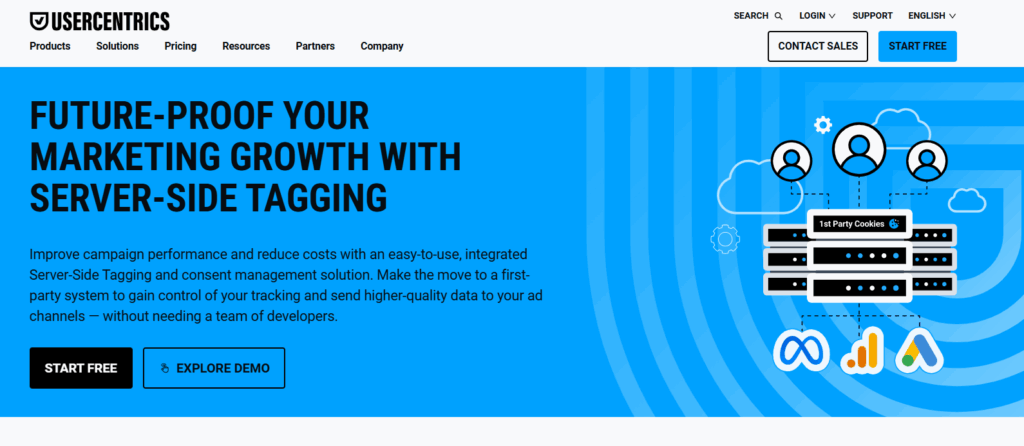
Usercentrics Server-Side Tagging (SST) provides organizations with full control over how user data flows among their websites, apps, and third-party platforms.
SST moves data collection from the client side to a secure server environment, which helps businesses improve privacy compliance, reduce data exposure, and enhance performance.
Unlike traditional tag managers, Usercentrics Server-Side Tagging enforces user consent at the point of transfer, which means only consented data is shared. It’s an ideal solution for companies looking to modernize their marketing and analytics infrastructure while maintaining trust and transparency.
Notable features:
- Centralized tag control: Manage and monitor all tags from a secure environment that supports privacy compliance.
- Consent validation: Filter data flows automatically based on user consent preferences.
- Enhanced security: Prevent unauthorized third-party access to personal data.
- Optimized site performance: Reduce browser load and speed up page delivery.
- Advanced analytics compatibility: Seamlessly integrate with Google Tag Manager Server-Side, Consent Mode v2, and key analytics platforms.
- Compliance by design: Align with the GDPR, CCPA, and other privacy regulations.
Pricing: Usercentrics SST is available as a standalone solution and as part of the Usercentrics Enterprise Suite. Tailored configurations are available for businesses managing high-volume or multi-domain data environments.
| Pros | Cons |
| Enforces consent compliance at the data transfer level | Requires coordination with technical teams during setup |
| Improves data accuracy and site performance | |
| Strengthens privacy and security controls | |
| Reduces third-party exposure and data leakage risk | |
| Integrates seamlessly with Usercentrics CMP |
Tealium

Tealium is an enterprise-grade data orchestration platform that brings together tag management, customer data integration, and real-time data activation.
Its flagship solutions, Tealium iQ Tag Management and Tealium AudienceStream CDP, give organizations detailed visibility and control over data collection, which helps them unify customer insights while maintaining compliance.
While Tealium’s strength lies in connecting data across marketing, analytics, and customer engagement tools, its privacy and consent capabilities are most effective when paired with a dedicated CMP — such as those from Usercentrics — for regulatory compliance.
Notable features:
- Enterprise tag management: Centralize and control data collection across websites and apps.
- Data layer standardization: Normalize customer data for consistent use across systems.
- Real-time data orchestration: Route consented data instantly to approved vendors.
- Extensive integrations: Connect with over 1,300 marketing and analytics tools.
- Privacy and consent controls: Integration support for leading CMPs.
- Server-side delivery: Reduce browser load and improve data accuracy.
Pricing: Tealium offers custom enterprise pricing based on scale, integrations, and selected product modules.
| Pros | Cons |
| Strong data orchestration and integration ecosystem | Complex implementation for smaller teams |
| Scalable across enterprise environments | Requires a separate CMP for consent management |
| Real-time data flow control | Advanced functionality tied to higher pricing tiers |
| Proven reliability for large data ecosystems | Setup may require developer resources |
CHEQ

CHEQ Privacy & Security Suite focuses on client-side data security, tag governance, and threat prevention. By acquiring Ensighten, CHEQ expanded its capabilities beyond bot mitigation and web security to include advanced tag auditing, compliance, and data leakage prevention.
The platform now combines Ensighten’s privacy governance expertise with CHEQ’s real-time security monitoring. It helps organizations control third-party scripts, prevent unauthorized data collection, and protect sensitive information in real time.
CHEQ does strengthen website security primarily as a protective layer, and often complements a dedicated consent or governance platform like those from Usercentrics, rather than replacing it.
Notable features:
- Tag auditing and governance: Monitor, classify, and control all third-party tags and scripts.
- Client-side security: Identify and block unauthorized or malicious activity in real time.
- Data leakage prevention: Detect and prevent unapproved transfers of personal or sensitive data.
- Compliance monitoring: Enforce privacy and security rules automatically across digital properties.
- Real-time alerts and reporting: Provide visibility into client-side risks and performance.
Pricing: CHEQ offers custom enterprise pricing based on deployment size, website traffic, and selected modules.
| Pros | Cons |
| Strong focus on client-side security and data leakage prevention | Primarily security-driven with limited data governance capabilities |
| Real-time monitoring and anomaly detection | Requires integration with a CMP for full compliance |
| Helps prevent unauthorized data collection | Fewer marketing and analytics use-case tools than some other options |
| Complements data and analytics governance platforms |
Cloud-native governance solutions
Cloud storage providers now include governance and compliance features directly within their ecosystems. This integration positions them as vital components of enterprise data governance frameworks.
AWS Lake Formation
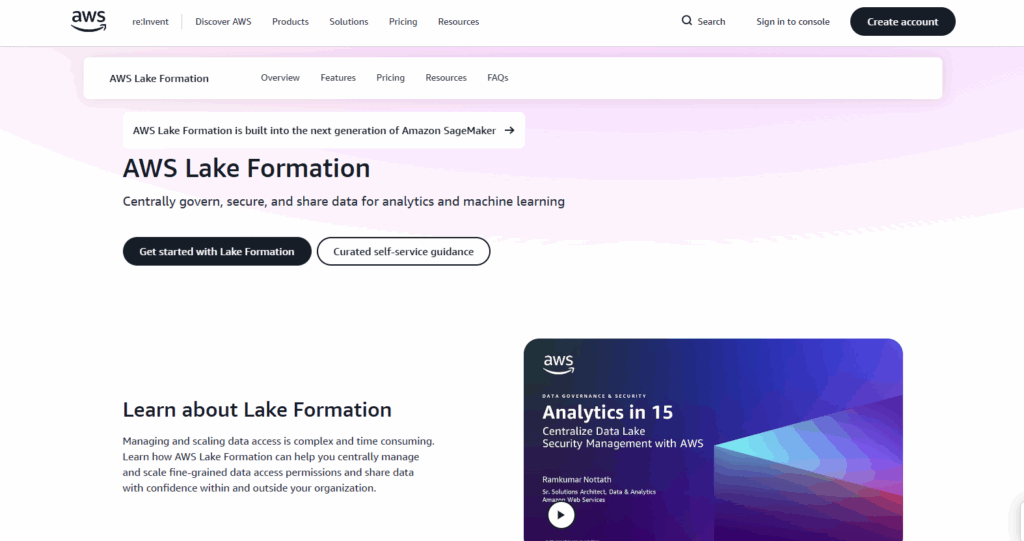
AWS Lake Formation is a cloud-native data governance service that helps organizations securely manage, catalog, and share data across their Amazon Web Services (AWS) environments. It streamlines how enterprises set up data lakes by automating governance tasks like access control, data classification, and policy enforcement.
As part of the broader AWS ecosystem, Lake Formation integrates deeply with other AWS tools, like Glue, Athena, and Redshift. That cooperation supports scalable and compliant data management across large, complex infrastructures.
Notable features:
- Centralized access control: Manage permissions for data stored in S3, Glue, and Redshift from one place.
- Automated data cataloging: Classify and tag datasets for easier discovery and governance.
- Granular security policies: Apply access rules at the table, column, or row level.
- Integration with AWS analytics services: Supports consistency across data pipelines.
- Audit and compliance logging: Track access and changes to support privacy and security audits.
Pricing: AWS Lake Formation follows a pay-as-you-go pricing model. Costs are based on data catalog storage, requests, and access control policies.
| Pros | Cons |
| Deep integration with the AWS ecosystem | Limited visibility beyond AWS environments |
| Scalable and highly secure infrastructure | Requires AWS expertise for configuration |
| Fine-grained access control | Designed primarily for technical users |
| Strong compliance logging capabilities | Not a complete privacy governance solution |
Google Cloud Dataplex
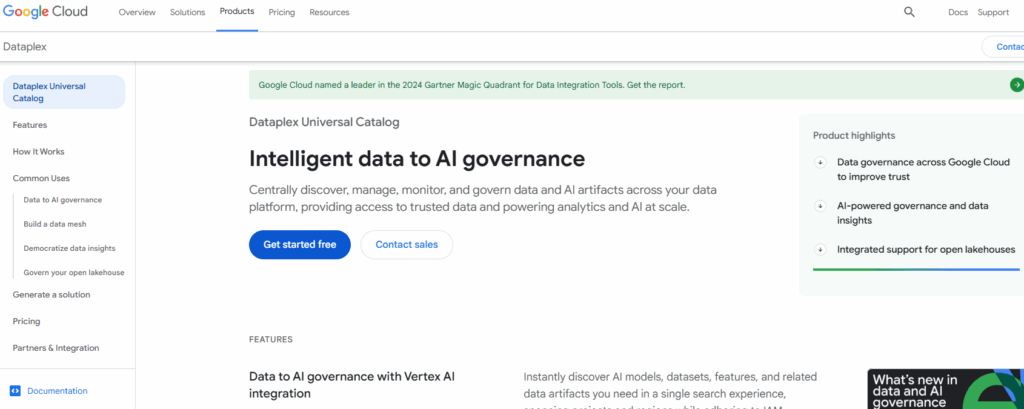
Google Cloud Dataplex is a unified data management and governance platform that enables organizations to organize, secure, and analyze data across Google Cloud and hybrid environments. It automates data discovery, classification, and policy enforcement to make governance more scalable and efficient.
Dataplex integrates closely with Google’s analytics and AI ecosystem, including BigQuery, Looker, and Vertex AI. Enterprises are better able to standardize governance practices across distributed data sources while maintaining visibility and control.
Notable features:
- Unified data catalog: Centralize metadata and automate data discovery.
- Automated classification: Identify sensitive data to support compliance and protection.
- Policy-based access control: Manage and apply governance rules consistently across projects.
- Integration with BigQuery and Vertex AI: Enable analytics and machine learning on governed data.
- Data quality and lineage tracking: Monitor datasets for accuracy, reliability, and usage.
Pricing: Google Cloud Dataplex has a usage-based pricing model based on active metadata storage, scanning, and query volumes.
| Pros | Cons |
| Deep integration with Google Analytics and Google Cloud | Limited compatibility with on-premises or non-Google data sources |
| Automated data classification and discovery | Requires setup with Google Cloud infrastructure |
| Strong visibility and lineage tracking | Primarily technical, not privacy-specific |
| Scales easily for multi-domain governance | May require additional tools for consent management |
Microsoft Purview
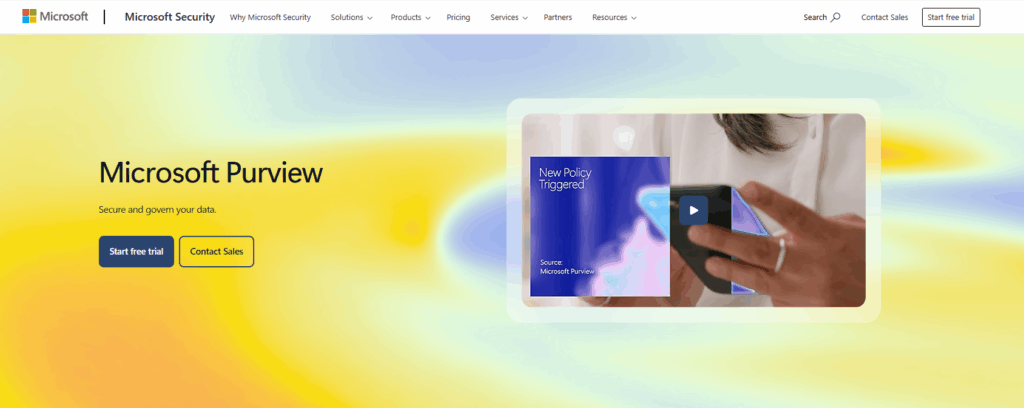
Microsoft Purview is an enterprise data governance solution that unifies data discovery, cataloging, compliance, and risk management across on-premises, multi-cloud, and Software as a Service (SaaS) environments.
Designed for organizations that operate within the Microsoft ecosystem, Purview helps centralize visibility and automate governance through built-in integrations with Azure, Microsoft 365, and Power BI.
Its strength is in how it combines data governance, compliance auditing, and data security into one platform, which provides organizations with a centralized view of their data environment.
Notable features:
- Data catalog and lineage tracking: Support for data profiling, discovery, and mapping across cloud and hybrid environments.
- Unified compliance and risk management: Align data handling with regulatory frameworks and internal policies.
- Integration with Microsoft 365 and Azure: Enable seamless governance across productivity, analytics, and infrastructure tools.
- Access and policy controls: Apply permissions and track sensitive data across multiple systems.
- Automated insights and reporting: Generate compliance and security dashboards in real time.
Pricing: Microsoft Purview operates on a consumption-based pricing model, which depends on data volume, scanning frequency, and selected modules.
| Pros | Cons |
| Deep integration with Microsoft environments | Limited flexibility for non-Microsoft tech stacks |
| Combines governance, compliance, and security | Pricing can fluctuate with data usage |
| Strong analytics and reporting dashboards | Initial setup can be complex for hybrid systems |
| Scalable for large enterprises | Less tailored for marketing or consent workflows compared to other solutions |
How to choose the right data governance tool for your business
Each of the many data governance tools available has different strengths and capabilities, so it’s important to choose carefully. Consider your business goals, operational size, and data maturity. The best solution will fit naturally into your existing systems, support your compliance needs, and scale as your data ownership grows.
Here are the primary factors to consider when comparing data governance software.
1. Compliance requirements
As you consider each tool, start by checking which privacy and security standards it supports. Look for platforms with automated workflows for generating audit reports, managing consent, and documenting processing activities.
2. Integration with your tech stack
A governance tool should connect easily with your current data infrastructure. That includes customer relationship management (CRM) systems, analytics platforms, and marketing tools. Good integrations reduce manual work and make governance part of everyday operations.
3. Scalability and automation
As your assets grow, manual governance can quickly become unmanageable, even for teams with strong data literacy. Choose a platform that automates key processes — like policy enforcement, access controls, and reporting — while scaling across departments, markets, and data sources.
4. Reporting and visibility
Effective data governance platforms provide real-time visibility into your data estate. Look for custom dashboards and automated reporting, which make it easier to monitor compliance, detect anomalies, and share updates with stakeholders.
5. Vendor reliability and support
Governance is an ongoing process. Choose a vendor with proven privacy expertise, clear documentation, and responsive support. Global organizations should also consider multi-language and multi-region support.
Integrating consent and tag management into data governance
Modern data governance focuses on managing databases or compliance records as well as controlling how user data enters your systems in the first place. It begins with consent and tag management.
Every interaction in which data is collected, whether through a website, app, or analytics tool, creates a governance responsibility. Integrating consent and tag management helps ensure that data is gathered, processed, and shared in a way that respects user choices and complies with privacy laws.
How consent fits into governance
Consent management platforms record when and how users give permission for their data to be used. This is often done via a displayed cookie banner or an in-app prompt. Linking this consent data with your broader data governance platform creates a single, reliable record of lawful processing.
This integration enables teams to:
- Enforce consent rules automatically across analytics and marketing tools
- Demonstrate data compliance with relevant privacy laws
- Maintain transparency with users and regulators
The role of tag management
Tag management controls how tracking cookies and marketing tags collect and share data. When connected to a data governance solution, it helps prevent unauthorized data transfers and keeps tags operating in alignment with approved compliance policies.
Technologies such as server-side tagging add another layer of control. Instead of sending data directly from a user’s browser to third-party vendors, information is routed through a secure server environment.
This approach:
- Reduces exposure of personal data to external parties
- Centralizes oversight and audit logging
- Validates that only consented data is shared
Usercentrics combines both consent management and server-side tagging to help organizations align their marketing data practices with governance requirements. Together, these capabilities support privacy-first data management that’s accurate, transparent, and compliant by design.
The future of data governance tools
As data volumes grow, audience expectations for robust data privacy management increase, and regulations evolve, data governance tools are becoming smarter, more automated, and more connected across business needs. The next generation of platforms is being built around real-time insight, AI-driven automation, and integrated privacy management.
AI-driven compliance automation
Artificial intelligence (AI) is transforming how organizations identify and resolve compliance risks. It can automatically classify personal data, detect anomalies in processing activities, and map data flows across complex systems. It takes care of tasks that once took teams weeks to complete manually.
By combining automation and machine learning, AI is turning data governance from reactive to proactive. With AI and data privacy working together, privacy teams can now predict where risks might occur, flag potential policy breaches in real time, and continuously improve data accuracy and accountability.
Real-time monitoring of third-party data flows
Businesses now expect full visibility into how vendors and partners handle shared data. New governance technologies make that possible by offering continuous monitoring of third-party data flows and automated alerts for potential leaks, policy violations, or unauthorized transfers.
As vendor ecosystems grow more complex, these tools help privacy and compliance teams stay one step ahead and make sure that accountability includes third parties.
Unified privacy dashboards
As privacy laws continue to expand across regions, managing compliance through disconnected systems no longer makes sense. The next generation of governance tools will unify privacy dashboards to give organizations a real-time view of their compliance status across jurisdictions.
These dashboards will consolidate regulatory updates, risk alerts, and audit trails into a single interface. They’ll help privacy and compliance teams act faster, coordinate globally, and maintain transparency with both regulators and users.
PrivacyOps and DataOps convergence
The future of governance is connection. PrivacyOps and DataOps are no longer separate disciplines; they’re converging into a unified framework that blends compliance, security, and performance. In this model, governance acts as the bridge, so privacy is built into every process.
Turn compliance into confidence
Strong data governance gives organizations the confidence to use data responsibly by balancing compliance, transparency, and business performance. The right tools transform data from a liability into a trusted business asset, and help keep information accurate, usable, and protected across every department.
As privacy expectations rise and regulations expand, governance is becoming inseparable from business strategy. Integrating consent and tag management into that framework creates a single, reliable source of truth that upholds user rights while unlocking smarter, privacy-safe growth.

Join our growing community of data privacy enthusiasts now. Subscribe to the Usercentrics newsletter and get the latest updates right in your inbox.
