

At a Glance
- Targeted advertising isn’t inherently invasive, but can be a privacy problem when businesses collect data without transparency, ignore consent requirements, or obstruct opt-outs.
- Legality depends on jurisdiction, data type, tracking technology, and whether the right consent or opt-out mechanism is in place before data collection begins.
- Privacy compliance is a technical requirement, and consent signals must be enforced in tag firing logic, not just displayed in a banner.
- Privacy-first advertising is not a performance trade-off; visitors who feel in control of their data are more likely to engage further and trust the businesses they interact with.
- A consent management platform makes responsible targeted advertising scalable across regions, regulations, and vendor networks.
Personalized ads and user privacy don’t have to conflict. Learn how targeted advertising works, where it crosses legal and ethical lines, and how to build a consent-first ad strategy that holds up across global regulations.
Targeted advertising works because it’s personal. When an ad is shown at the right moment, in the right place, it feels more relevant. The problem is how that relevance gets built.
Behind most targeted ads is a detailed picture of individual behavior, from the pages someone visits to the content they engage with. When that data is collected without clear notice or used in ways they never agreed to, advertising can feel invasive.
What determines whether targeted advertising is an invasion of privacy or not is how businesses collect data, what they do with it, and whether users have a real say in the process. Done responsibly, personalization can coexist with privacy. Done carelessly, it creates legal risk and erodes the trust that drives customer loyalty.
Below, we break down how targeted advertising works, identify where it crosses the line from relevant to intrusive, and explain what data privacy regulations require from businesses that run targeted campaigns. Most importantly, we outline ways to support compliance with privacy laws without sacrificing personalization.
How Does Targeted Advertising Work?
Targeted advertising is the practice of serving ads to specific users based on data collected about them. This can include:
- Browsing history
- Search activity
- Location
- Purchase behavior
- App usage
- Interactions with previous ads and content
Rather than showing the same ad to everyone, businesses use this data to segment audiences and match ad creative to people most likely to find it relevant. For example, users who spend time researching project management software will see a different ad than those browsing travel deals.
That data comes from several sources:
- First-party data collected directly by a brand
- Third-party data purchased from sellers
- Behavioral signals gathered through cookies, pixels, and device fingerprinting
Additionally, ad platforms like Google and Meta layer their own audience intelligence on top, which gives advertisers tools to target by interest, demographic, intent, and more.
Is Targeted Advertising an Invasion of Privacy?
Targeted advertising becomes invasive when users are tracked across websites, apps, and other platforms without knowing it, and when detailed profiles are built from that data without meaningful disclosure.
This approach erodes trust. There’s a difference between an ad that reflects a recent search and an ad that reveals a platform knows far more about a user than they consented to. And it can even feel like surveillance.
But targeted advertising isn’t surveillance by definition. Personalization can work without crossing privacy lines when businesses:
- Are transparent about what data they collect and why
- Limit collection to what’s strictly necessary
- Give users a genuine choice about whether to participate
- Honor opt-out requests without degrading the user experience
The distinction comes down to transparency and control. Responsible personalization operates in the open: users understand the exchange, can influence it, and can easily withdraw from it. Intrusive tracking operates in the dark: data is collected by default, consent is implied rather than given, and users have no practical way to push back.
Real-Life Examples of Targeted Advertising: Ethical or Not?
Whether targeted advertising is privacy-friendly or not depends on how your infrastructure is configured. Take a look at what that difference can look like in practice.
A compliant approach
A user visits an e-commerce site for the first time. Cookies and similar technologies are switched off by default, so before any tracking begins, a consent banner appears with clear options: accept all, reject all, or manage preferences by category.
The user selects their preferences, and only then does the site enable the tracking technologies that correspond to their choices. If they opt out of advertising cookies entirely, no behavioral data is collected for targeting purposes.
A non-compliant approach
A different online shop loads advertising trackers the moment a user arrives, before the consent banner has even finished rendering. The banner itself has “Accept All” prominently displayed and a small, faint “Manage Settings” link in grey text.
Inside those settings, all cookie categories are pre-ticked. The user has to manually deselect each one, and even after doing so, some third-party pixels remain active. Consent wasn’t obtained before tracking began, and the default settings were biased toward collection.
Is Targeted Advertising Legal? What Different Regulations Say
Targeted advertising isn’t overtly prohibited by any privacy regulations, but the legality of any given campaign depends on several overlapping factors:
- Where the user is located
- What type of data is being collected
- Which tracking technologies are in use
- Whether the business has the appropriate consent or opt-out mechanism in place before data collection begins
There’s no single global standard, so a practice that’s permissible under one jurisdiction’s rules may be a clear violation under another. A business running campaigns across multiple regions, or using third-party ad networks that do, should be aware of that complexity.
A few variables consistently determine whether a targeted advertising setup is legally sound.
| The user’s location | Most modern privacy laws are extraterritorial. Applicability depends on where the user is, not where the business is headquartered. For example, a U.S.-based advertiser targeting users in the EU is subject to European privacy compliance requirements. |
| The consent model (opt-in or opt-out) | Some laws require users to actively agree before tracking starts. Others require that users are given a clear, easy way to opt out at any time. Which standard applies depends on the regulation. |
| The types of data | Behavioral data, device identifiers, and IP addresses are considered standard personal data, but sensitive categories like health or financial information carry stricter requirements under most frameworks. |
| The tracking technologies | Cookies, pixels, fingerprinting, and cross-device tracking are treated differently across jurisdictions. Some require explicit consent before any tracking begins. Others permit it as long as a viable opt-out mechanism is in place. |
The sections below cover how the major frameworks approach targeted advertising specifically.
How the GDPR Addresses Targeted Advertising
Under the General Data Protection Regulation (GDPR), processing personal data for advertising purposes requires a lawful basis. For most adtech setups, like behavioral tracking and cross-site profiling, consent is the lawful basis regulators consistently require.
That consent must be freely given, specific to the purpose, informed, and as easy to withdraw as it was to give. Pre-ticked boxes, bundled permissions, and consent collected after tracking has already started are all non-compliant.
CCPA/CPRA Stance on Targeted Advertising
California’s privacy laws — and to date, those enacted in other states as well — take a different approach. Rather than requiring consent before data collection begins in most cases, the California Consumer Privacy Act (CCPA) and its successor the California Privacy Rights Act (CPRA) focus on giving users the right to opt out after the fact.
The key trigger is whether a business is selling or sharing personal information. Under California law, sharing data with ad networks for cross-context behavioral advertising qualifies, even when no money changes hands.
Businesses subject to these laws must explain their data collection practices, commonly done via a cookie banner. They must also provide an accessible “Do Not Sell or Share My Personal Information” link, and honor opt-out requests without penalizing users for making them. Where collected data qualifies as sensitive, an accessible “Limit the Use of My Sensitive Personal Information” must also be provided to enable opt-outs.
Other Regulations Relevant to Marketers
Within the EU, individual member states have implemented their own cookie and tracking rules through national law. For example, France and Germany have each issued guidance that goes beyond the baseline and specifies how consent banners must be structured, how long consent can be stored, and what constitutes a valid opt-out.
Beyond Europe, Brazil’s Lei Geral de Proteção de Dados (LGPD) follows a structure similar to the GDPR. It requires a lawful basis for data processing and gives users rights over their personal information, including data used for advertising.
Canada’s Personal Information Protection and Electronic Documents Act (PIPEDA) requires meaningful consent for collecting and using personal data. Quebec’s Law 25 introduced stricter consent and transparency requirements that bring data privacy obligations to residents of that province closer to GDPR standards.
How To Run Privacy-First Targeted Advertising
Running privacy-compliant targeted advertising starts with understanding what your marketing infrastructure does with user data and building controls around that. Here are five steps for setting up your targeted advertising system so it prioritizes privacy.

1. Know What Data You Collect and Who Receives It
Before you can make meaningful decisions about consent or disclosure, you need a clear picture of your adtech stack. That means identifying every tool that touches user data:
Without a systematic audit, there’s no reliable way to disclose data practices accurately, obtain valid consent, or honor opt-out requests. And note that you should revisit these data mapping practices whenever tools or vendor relationships change.
From there, the priorities are practical: block advertising trackers until valid consent is collected, and make it genuinely easy for users to update or withdraw their preferences.”
2. Use a Consent Banner With Clear, Granular Choices
A properly configured consent banner enables users to accept or reject advertising-related tracking specifically, not just toggle all cookies on or off as a single decision.
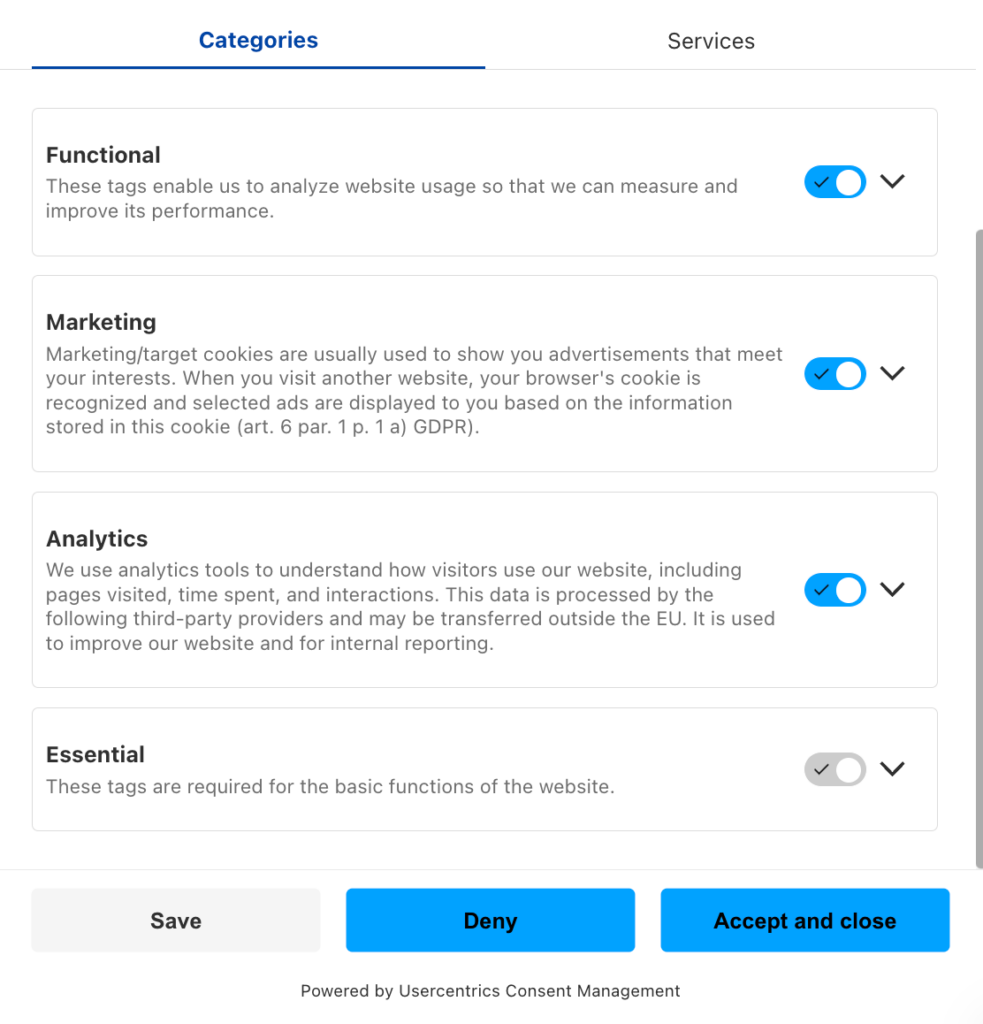
That means separating ad tracking from functional or analytics purposes, labeling each category clearly, and making the reject option as visible and accessible as the accept option. Pre-ticked boxes and multi-step opt-outs are not compliant under most frameworks and are increasingly targeted by regulators.
Ad-related purposes should be named explicitly as “personalized advertising” or “cross-site behavioral tracking,” not bundled under vague language like “improving your experience.”
For example, take a look at the Usercentrics consent banner’s granular choices, which clearly explains what marketing cookies do and why they’re used:
3. Where Required, Don’t Fire Advertising Trackers Before Consent
Under European privacy law, advertising cookies and pixels must be blocked and prevented from firing until a user has given valid consent.
In opt-out jurisdictions like the U.S., the obligation is distinct. If a user exercises their right to opt out of the sale or sharing of their data, or targeted advertising, advertising trackers tied to that processing should be suppressed as soon as is feasible, but at maximum it must be done within 15 business days.
In both cases, the standard is the same: consent signals must be wired into the tag-firing logic.
4. Make Opt-Out and Preference Updates Easy
In addition to sharing their consent choices when first visiting your website, visitors must also be able to change their minds at any point. And doing so should not require a support ticket or multiple, complicated steps.
Under the GDPR, withdrawing consent must be as easy as giving it. Under CCPA/CPRA requirements, businesses must honor opt-out requests for the sale or sharing of personal information promptly without degrading the user’s experience as a consequence.
In practice, this means ensuring that updated choices are reflected in tag-firing behavior immediately, not just logged.
5. Use a CMP To Enforce and Document Choices
Collecting consent manually or relying on a basic cookie banner without backend infrastructure creates compliance gaps that are difficult to defend. A consent management platform (CMP) handles the operational complexity that privacy-compliant advertising requires.
A CMP:
- Collects and stores consent records
- Passes consent signals to ad vendors and tag managers
- Applies geo-based rule sets so that users in different jurisdictions are served the correct consent experience
- Keeps preference data updated as users change their choices over time
- Provides an audit trail that regulators expect if a business is asked to demonstrate compliance
This software serves as the mechanism that makes privacy-first advertising operationally possible.

Balance Personalization and Privacy With Usercentrics
Targeted advertising only becomes an invasion of privacy when businesses treat user data as something to capture rather than something to earn.
The businesses that get it right are building the kind of trust that makes marketing more durable. Users who understand the data exchange and feel in control of it are more likely to engage, convert, and stay.
Usercentrics takes care of the operational side of consent-based marketing. The CMP enables businesses to collect valid consent, manage user preferences across sessions, forward consent signals to ad vendors and tag managers, and automatically apply the right rules for users in different regulatory jurisdictions.
The result is a targeted advertising setup that can perform across regions while staying defensible under the frameworks that govern each one.
With the right infrastructure in place, your business can personalize effectively, respect your users, and reduce the legal and reputational risk that comes with targeted advertising.
Usercentrics does not provide legal advice, and information is provided for educational and informational purposes only. We always recommend engaging qualified legal counsel and/or your compliance team regarding data privacy and protection issues and operations.

Join our growing community of data privacy enthusiasts now. Subscribe to the Usercentrics newsletter and get the latest updates right in your inbox.
