

Cookieless Advertising: Target, Retarget, and Measure Without Third-Party Cookies

At a Glance
- Third-party cookies are unreliable across a number of browsers, which makes cookieless advertising an important operational problem marketers need to consider.
- Cookieless advertising works by combining first-party data, consented signals, and contextual targeting.
- Server-side tagging is the most important infrastructure change advertisers can make to reduce signal loss and maintain data accuracy without browser-based tracking.
- Consent directly affects the size of your usable audience, as higher opt-in rates mean more data available for targeting, personalization, and measurement.
- Cookieless attribution relies on a combination of predictive modeling, conversion modeling, and media mix modeling rather than individual user-level tracking.
Third-party cookies are no longer a reliable foundation for digital advertising. This guide covers how cookieless advertising works in practice, from consent-based data collection and contextual targeting to server-side tracking and privacy-compliant measurement.
Due to privacy regulations and browser restrictions marketers are already operating without third-party cookies on a significant share of their audience, whether they’ve planned for it or not. That means the targeting, measurement, and personalization methods that have defined digital advertising for decades are no longer reliable.
The solution to these challenges is cookieless advertising. This guide covers what cookieless advertising looks like in practice, including:
- How to replace behavioral targeting with contextual and consent-based alternatives
- Which identity solutions and data strategies fill the gap
- How to rebuild measurement without leaning on third-party signals
Whether you’re rethinking your ad stack or just getting started, you’ll find the context and the practical steps to move forward.
Why Are Marketing Strategies Increasingly Moving Away From Third-Party Cookies?
Safari and Firefox have blocked third-party cookies for years. Google abandoned its full Chrome phase-out in July 2024, initially proposing a user-choice prompt model. Then in April 2025, dropped that plan too, confirming it would not introduce any new standalone prompt for third-party cookies.
Third-party cookies remain allowed in Chrome by default, manageable only through existing browser settings. While that represents a significant retreat from deprecation, it doesn’t change the underlying pressure: browser fragmentation, regulatory requirements, and declining user trust mean third-party cookies are already unreliable across a significant share of any given audience.
Add in the compliance requirements introduced by privacy laws like the General Data Protection Regulation (GDPR), ePrivacy Directive, and the California Consumer Privacy Act (CCPA), and tracking via third-party cookies is even more limited.
Marketers need to make the switch to cookieless tracking and attribution if they want to keep measurement accurate and comply with data privacy regulations.
2017 — Apple Safari Intelligent Traffic Protection (ITP) 1.0
2018–2019 — Firefox Enhanced Tracking Protection (ETP) blocks third-party cookies by default
2018–2019 — Apple Safari reduces validity of first-party cookies to 24h
2020 — Google announces intention to phase out third-party cookies in Chrome by 2022
2021 — Apple IDFA requires explicit user permission to collect IDFA, allowing tracking across apps and services
2022 — Google delays Chrome deprecation to 2024
January 2024 — Google restricts third-party cookies for 1% of Chrome users
April 2024 — Google delays Chrome deprecation again (third postponement); new target early 2025
July 2024 — Google cancels forced phase-out entirely; announces user-choice model in Chrome settings
April 2025 — Google reaffirms no opt-in prompt; third-party cookies remain on by default in Chrome
What’s Replacing Third-Party Cookies?
No single solution replaces everything third-party cookies did. Today, advertisers are combining several approaches.
Consented, first-party data
This data is collected directly from your own users through purchases, logins, sign-ups, and on-site behavior is the most reliable foundation. It’s accurate and not subject to browser or data privacy restrictions.
Contextual advertising
These targets are based on the content of the page rather than the behavior of the user. Ads are matched to relevant content rather than relevant audiences, which means no tracking is required.
Privacy-preserving identity solutions
Solutions such as Unified ID 2.0 (UID2) use encrypted, consent-based identifiers to enable audience targeting, personalization, and frequency capping across publishers without relying on browser cookies. The identity solutions space continues to evolve, and UID2 is one of several approaches currently in use.
What Is Cookieless Advertising and How Does it Work?
Cookieless advertising refers to running targeting, personalization, measurement, and attribution without relying on third-party cookies to track users across sites.
Third-party tracking cookies were never a stable foundation. They required no user consent, could be blocked by browsers or ad blockers, and are now restricted by default across multiple browsers. For advertisers, that means audience data built on third-party cookies has always had gaps, and those gaps are widening.
Cookieless advertising fills them differently. Rather than following users across the web without their knowledge, it builds on signals that are consented or contextually derived. This includes first-party data users share directly, behavior captured on your own properties, and ad placements matched to content rather than audiences.
The practical flow of cookieless advertising looks like this:
User interaction. A user lands on your site or app. This is where the data collection process begins and consent determines what’s possible next.
Consent collection. A consent management platform (CMP) presents the user with clear notice and choices about data use. What they accept or decline determines which data can be legally captured and activated downstream.
First-party data captured. For users who consent, on-site behavior is recorded against a first-party identifier. For users who share data directly, preferences and interests are captured through surveys, sign-ups, or preference centers.
Server-side event processing. Rather than relying on browser-based tags that can be blocked or restricted, events are processed server-side. This improves data accuracy and reduces signal loss.
Audience activation. Consented, first-party data is pushed to ad platforms or identity solutions like Unified ID 2.0 to build targetable audiences.
Measurement and attribution. Campaign performance is measured using privacy-compliant methods like modeled conversions and cookieless multi-touch attribution.
How Can You Target Audiences Without Cookies?
You can still reach relevant audiences without third-party cookies. But the signals used to define and activate those audiences change. The three most reliable approaches are contextual targeting, first-party audience targeting, and consented CRM activation.
Used together, these three approaches cover most of what third-party cookie targeting did, with the added advantage that the underlying data is more accurate and legally sound.
Contextual Targeting
Contextual targeting places ads based on the content of the page rather than the profile of the user. These platforms use natural language processing to analyze page content in more detail, going beyond broad category matching to understand topic, sentiment, and intent
This means you can still reach people in relevant moments without tracking users across the web.
First-Party Audience Targeting
First-party audience targeting uses behavioral data collected on your own properties to build segments that can be activated directly on ad platforms. This data remains available, regardless of browser restrictions, because it’s collected with consent and tied to first-party identifiers.
As first-party audiences reflect users who have already interacted with your brand, this approach works best for retention and re-engagement rather than prospecting.
Customer Match and Consented CRM Activation
Customer match and consented CRM activation enables advertisers to upload hashed customer data like email addresses or phone numbers directly to ad platforms. Platforms then match that data against a logged-in user base and activate the audience without exposing any raw personal data. This gives advertisers another privacy-safe route to reach known customers.
Which Challenges Does Cookieless Advertising Present To Campaign Execution?
Cookieless advertising solves compliance and data accuracy problems but can create new ones. Here are a few challenges marketers should look out for.
Reduced Audience Visibility and Segmentation
Without third-party cookies, it’s harder to identify user interests across websites. This limits marketing teams’ ability to create detailed audience segments and reach people based on behavior across platforms.
The shift to zero-party and first-party data means marketers need to rely on information users choose to share. While this data is more limited, it tends to be more accurate and useful. That means even with less of it, you can still gain meaningful insights.
Barriers to Personalization
Personalization used to rely heavily on tracking users’ past behavior across the web. Now, that level of insight requires users to directly share their preferences with your brand.
If you don’t have a strategy to collect and act on this kind of data, personalized content and ads will be less effective.
Disruptions to Measurement and Attribution
Standard attribution models built on third-party data no longer work. It’s harder to see how users move between devices or platforms before converting, which makes it difficult to measure the impact of different channels.
Fortunately, there are privacy-supporting ways to fill these gaps, like using anonymized data, modeled conversion paths, and other tools that help estimate performance even when tracking is limited.
How to Protect Ad Performance in a Cookieless World
The gap left by third-party cookies doesn’t close on its own. Advertisers that maintain performance in a cookieless environment have rebuilt their data collection, tracking, and measurement around the following three approaches.

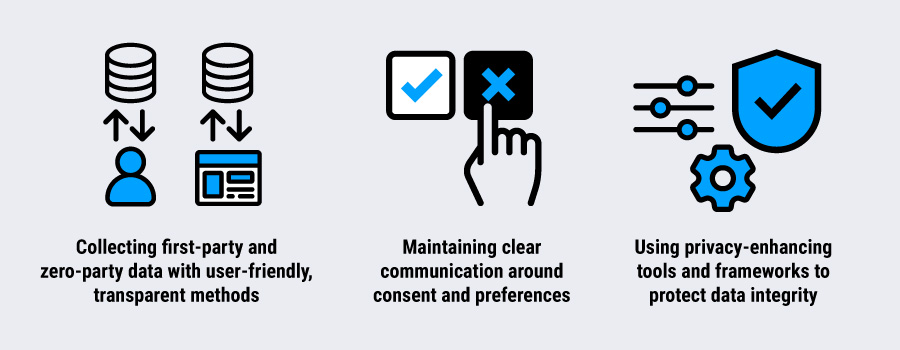
1. Collect Accurate, Consented Data
“Consent is the prerequisite that everything else depends on,” explains Usercentrics CMO Adelina Peltea. “Data is only useful if it was collected with valid user consent.” So the infrastructure that supports cookie-based advertising needs to be rebuilt.
Zero-party data is the most accurate data available. It comes with built-in consent and reflects what users have chosen to share. First-party data collected through on-site behavior is equally important.
A CMP should sit at the center of your data collection practices. These platforms capture and communicate user consent across your tech stack so data is only collected where permission exists.
2. Implement Cookieless Tracking Solutions
Server-side tagging is perhaps the most important infrastructure change for cookieless advertising. It moves data processing from the browser to a secure server environment.
Event-based measurement works alongside it, capturing meaningful interactions like clicks, form completions, and video views as first-party events within your own properties. Paired with a CMP and customer data platform (CDP), this gives marketers a consented, accurate data foundation that browser restrictions can’t touch.
3. Adopt Cookieless Attribution and Measurement
Traditional multi-touch attribution breaks without third-party cookies. Three approaches fill the gap:
Predictive modeling uses machine learning to estimate likely conversions based on available signals, from past interactions to contextual data, without requiring personal identifiers.
Conversion modeling estimates conversions that can’t be directly observed using privacy-safe signals. It maintains measurement continuity even when users decline tracking.
Media mix modeling (MMM) evaluates channel performance using aggregated data rather than individual user journeys which makes it useful for budget allocation decisions where granular attribution isn’t available.
Server-side tracking supports all three by improving the quality of the underlying data before it reaches your measurement tools, and reducing data loss from browser restrictions and ad blockers at the source.
Align Marketing and Privacy Teams to Make Cookieless Advertising Work
The shift toward cookieless advertising is a turning point in how businesses approach privacy, compliance, and user trust. Regulations like the GDPR and the CCPA are driving the need for more transparent data practices, and browsers are enforcing these changes with stricter tracking limitations.
Building stronger first-party data strategies, investing in technologies that prioritize the user’s privacy first, and integrating solutions like a CMP to support ongoing compliance are all steps that businesses need to take to adapt in a cookieless world.
For advertisers building this infrastructure, Usercentrics provides the consent and privacy compliance foundation the rest of the stack depends on.
The CMP captures and communicates user permissions across your tech stack, while a server-side tagging solution improves data accuracy and reduces signal loss during data collection. These tools give teams a privacy-supporting, first-party data foundation and the measurement reliability that cookieless campaign execution requires.