

Best privacy policy examples 2026
Across industries, companies structure their privacy policies differently depending on the data they collect, the regulations they follow, and the expectations of their audiences. Studying these examples can help provide a framework for what “good” looks like, balancing clarity, comprehensiveness, and customization.
In this chapter, we look at some of the best privacy policy examples from websites, apps, and platforms across multiple sectors, including SaaS, e-commerce, nonprofits, marketplaces, agencies, public services, and more.
For each example, you’ll find an explanation of what the company does well, where it could improve, and how you can apply the same principles to your own privacy policy.
At a glance
- Strong privacy policies use clear language, structured sections, and transparent explanations of what data is collected and why.
- Different industries require different levels of detail: SaaS, e-commerce, apps, marketplaces, agencies, gaming, and public-sector sites all approach privacy differently.
- Reviewing real privacy policy examples helps you identify best practices for data categories, legal bases, third-party sharing, retention, and user rights.
- A privacy policy must be tailored to your own data practices. Use examples or a template for inspiration, then create your own version with a tool like the Usercentrics Privacy Policy Generator to achieve and maintain privacy compliance.
SaaS / B2B privacy policy examples
SaaS and B2B companies handle a wide range of user data, from account information to usage analytics and customer support logs. Strong policies in this category balance legal accuracy with practical explanations. The best examples use clear language, structured navigation, and straightforward disclosures about cookies, analytics, and cross-border transfers.
Slack
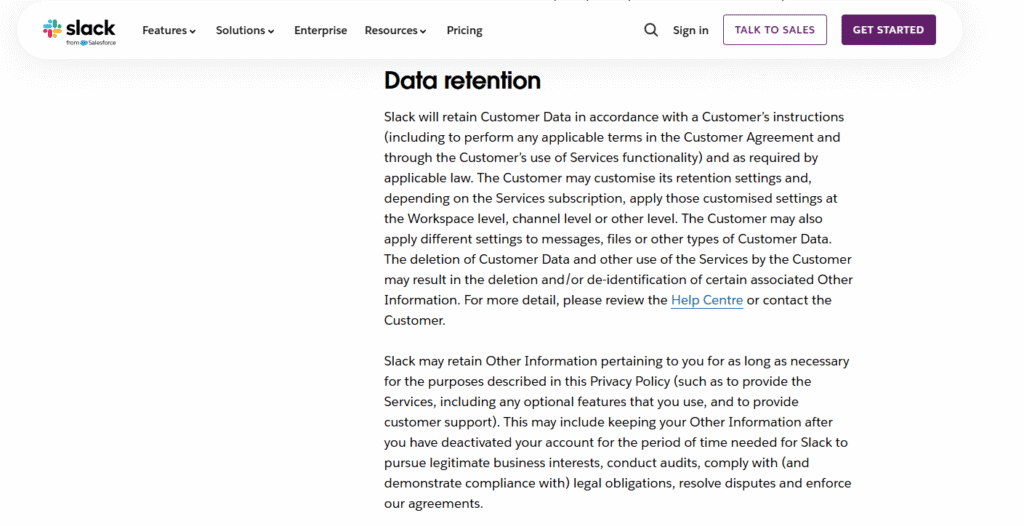
Slack’s privacy policy is a strong example of a well-structured, enterprise-level document that still feels approachable. It uses clear headings, explains data categories in plain language, and provides detailed information about workspace data, message content, and integrations.
It also separates “information provided to Slack” from “data processed on behalf of a workspace,” which helps readers understand shared responsibilities.
Pros
- Breaks down data categories with real-world examples
- Clarifies the roles of workspace owners vs. Slack as a processor
- Includes transparent explanations about cookies and device identifiers
- Uses accessible navigation with collapsible sections
Cons
- Some sections are text-heavy and require scrolling
Notion
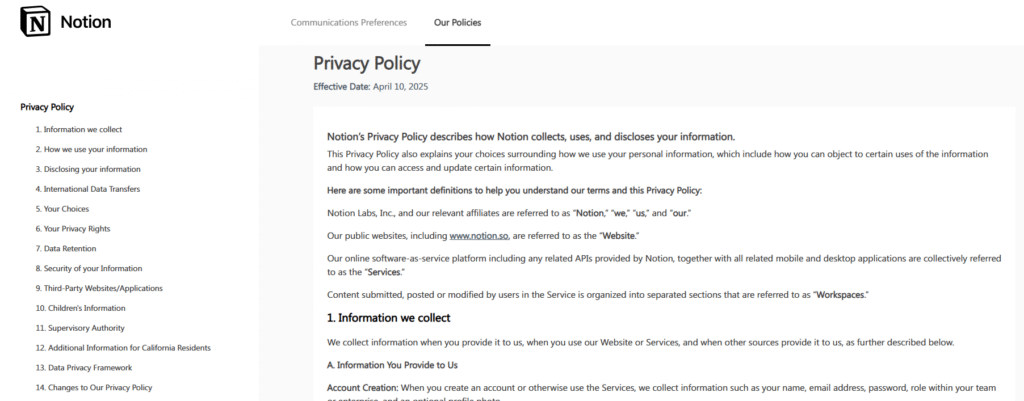
Notion’s privacy policy is notably readable for a productivity platform with complex data flows. It leads with a clean summary, followed by clear sections on usage data, synced content, and optional features. The policy is formatted with strong spacing, which improves readability and helps users scan for the information they need.
Pros
- Provides a high-level summary at the top
- Uses plain language to explain how content is stored
- Offers clear examples, e.g., “pages, databases, comments”
- Includes straightforward explanations of integrations and APIs
Cons
- Could provide more detail on retention periods for specific data types
Monday.com
Monday.com provides one of the better SaaS examples of a layered privacy policy. It introduces the content with a short summary, then expands into detailed sections covering data sources, processing purposes, retention, and user rights. The policy also includes helpful diagrams showing how data flows through its platform.
Pros
- Clear distinction between “User Data” and “Customer Data”
- Strong transparency about sub-processors
- Helpful visual elements that show data flows
- Straightforward explanations aro
Cons
- Some third-party lists require downloading attachments, which can slow navigation
E-commerce privacy policy examples
E-commerce businesses collect a wide range of personal data, including account details, shipping information, payment data, browsing behavior, and past purchase history.
Strong privacy policies in this category explain these practices clearly, use approachable language, and help customers understand how their information supports transactions, fulfillment, fraud prevention, and marketing preferences.
Patagonia
Patagonia’s privacy policy demonstrates how a large retail brand can be clear, transparent, and consumer-friendly. The policy uses plain language and offers strong explanations around ordering, returns, and marketing preferences.
It also includes a dedicated section on children’s privacy, which is important for brands with youth product lines that need to comply with privacy laws such as the Children’s Online Privacy Protection Act (COPPA).
Pros
- Uses accessible, conversational language
- Clearly distinguishes between “information you provide” and “information collected automatically”
- Transparent about third-party services, including payment processors and fraud-prevention tools
- Includes strong, clear user rights and contact information
Cons
- Cookie section could be more detailed for international users
Glossier
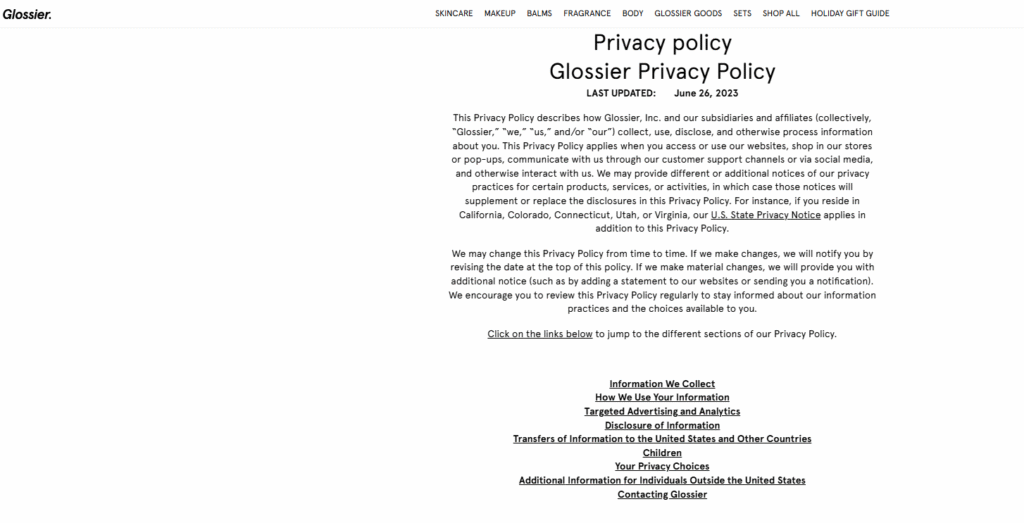
Glossier’s privacy policy is a good example for brands that use both first-party and partner-driven marketing. It explains cookies, pixels, and advertising networks in approachable terms and includes a dedicated section on how personal data supports customer experience and personalization.
Pros
- Plain-language explanations of advertising technologies
- Clear structure around purchase information and returns
- Strong use of examples to describe device and cookie data
- Helpful breakdowns of data types and purposes
Cons
- Some sections could benefit from improved cross-linking to support navigation
- Hasn’t been updated recently — regular revisions help maintain privacy compliance
IKEA
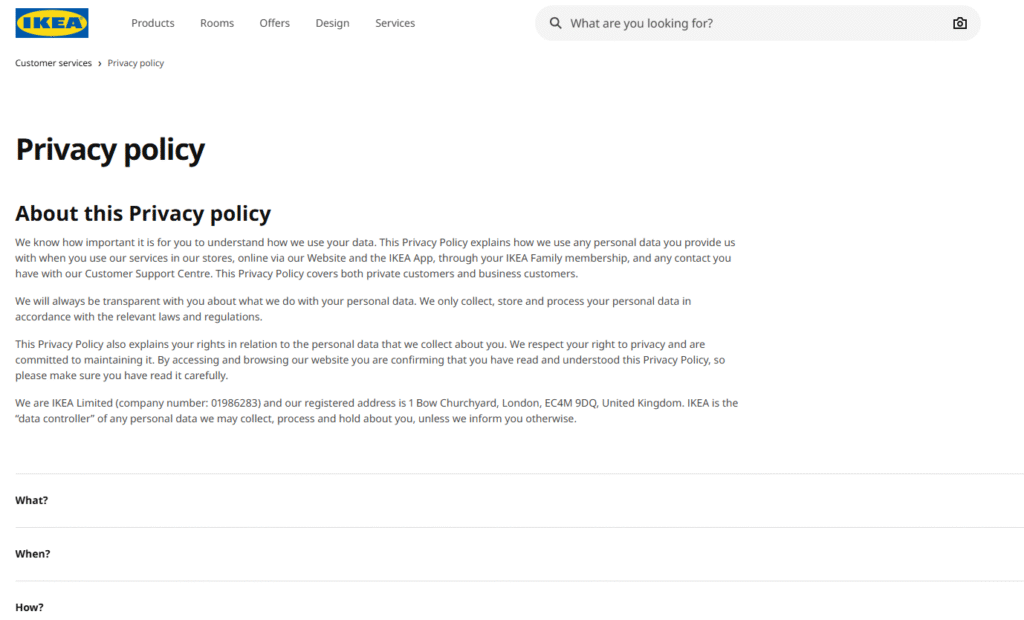
IKEA’s privacy policy is a well-structured example from a large global retailer that manages a high volume of customer data across online ordering, home delivery, loyalty programs, and in-store services.
The policy is comprehensive but still accessible, with clear language around account information, payment processing, and personalization based on browsing behavior.
Pros
- Provides strong explanations of how personal information supports delivery, assembly, and customer service
- Clearly distinguishes mandatory vs. optional data, e.g., loyalty program details
- Transparent about advertising partners and measurement tools
- Uses straightforward language to explain profiling and personalization
Cons
- Navigation varies slightly by region, and some versions are more user-friendly than others
Mobile app privacy policy examples
Mobile apps process personal data differently from websites. They often rely on device identifiers, permissions (camera, microphone, location), push notifications, in-app analytics, and third-party SDKs.
A strong mobile privacy policy explains these elements clearly, uses mobile-friendly formatting, and helps users understand how sharing personal information can support core app functionality.
Headspace
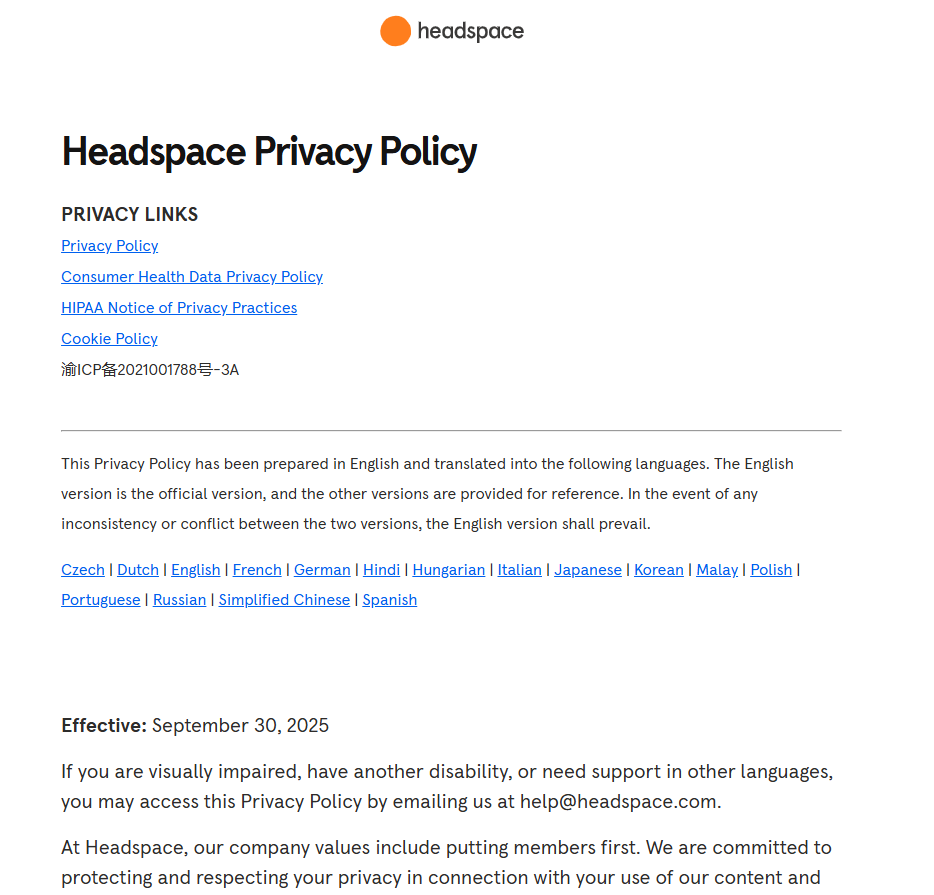
Headspace provides a clear, approachable privacy policy that works well on mobile screens. As a wellness app, it deals with a lot of private personal information. It needs to explain sensitive areas such as chat history, session behavior, and device data. Headspace does this with plain language and concise sections.
Pros
- Clear breakdown of device data, app activity, and optional profile fields
- Strong transparency about analytics and A/B testing tools
- Plain language explanations of how meditation history is used
- Well-structured for mobile scrolling and readability
Cons
- Could offer more detail on data retention timelines
Duolingo
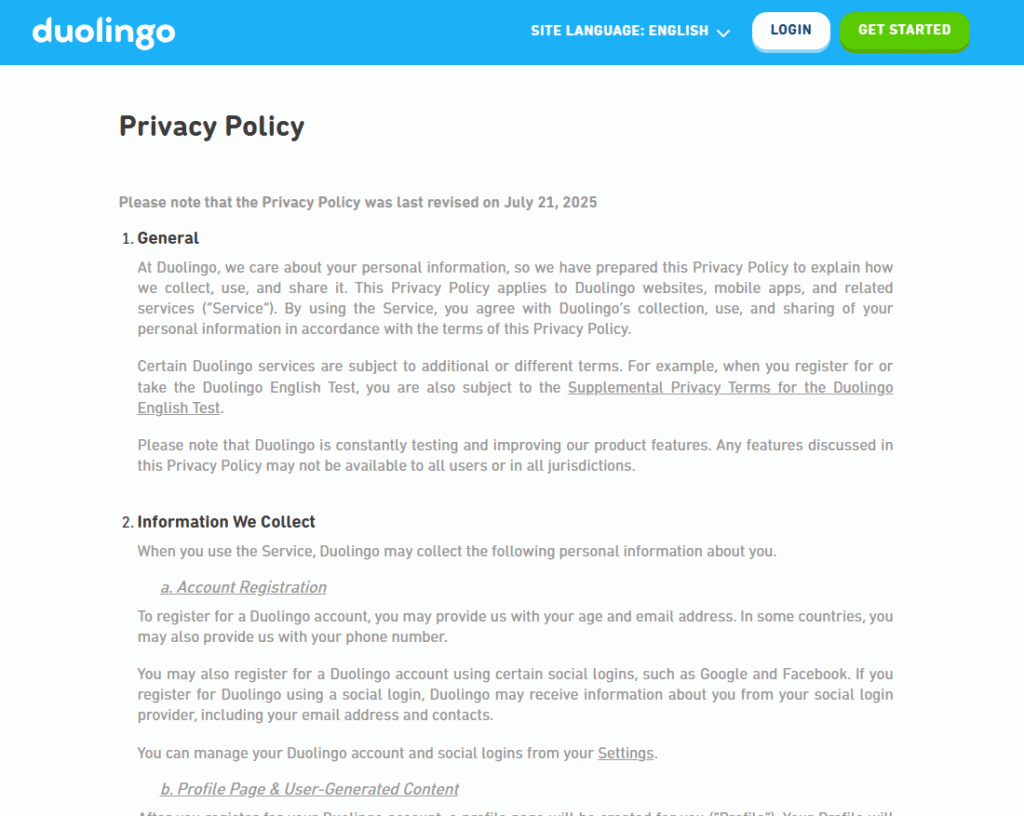
Duolingo’s privacy policy is an excellent example of how a mobile-first product explains data collection and processing in a transparent, structured way. It focuses on learning progress, device identifiers, cookies (for web users), and analytics.
Pros
- Short, scannable sections ideal for mobile user experience
- Clear descriptions of learning data and personalization
- Transparent explanations of advertising partners for the free plan
- Strong breakdown of user rights and deletion options — key for complying with data protection laws like the European Union’s General Data Protection Regulation (GDPR) and the California Consumer Privacy Act (CCPA)
Cons
- Some global versions could clarify cookie practices more consistently
Strava
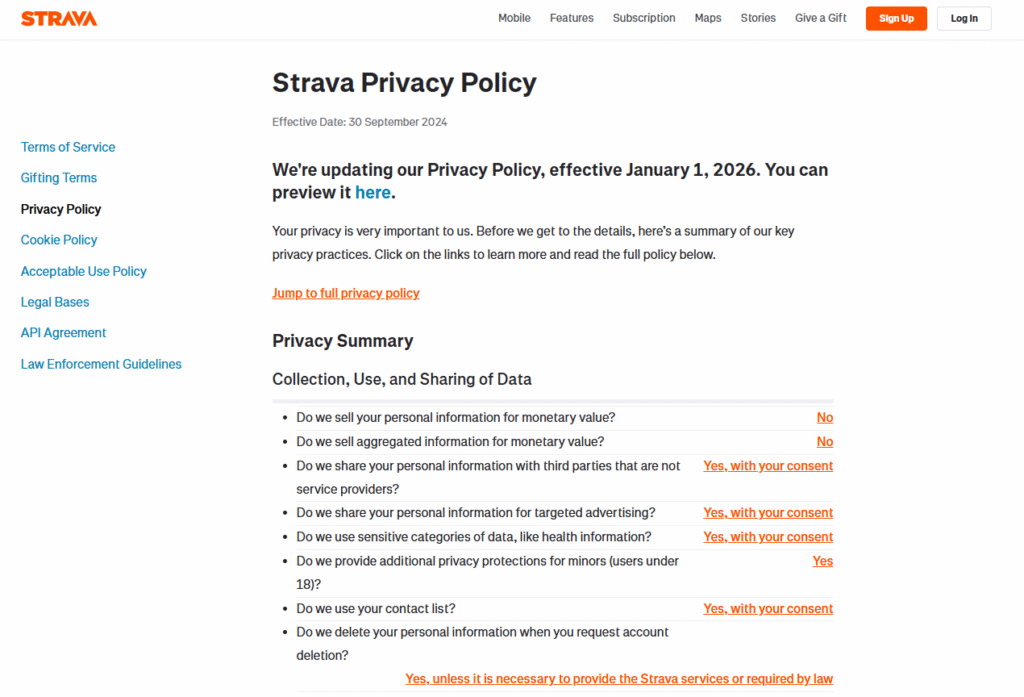
Strava is a strong example for apps that use device sensors, GPS, and community features. Its privacy policy explains how it uses sensitive personal information like location data, route maps, health-related metrics, and social interactions in a direct and transparent way.
Pros
- Detailed but readable explanation of GPS and movement data
- Transparent about optional vs. mandatory data fields
- Clear disclosures around external wearables and integrations, e.g., Apple Health
- Strong structure around privacy controls inside the app
Cons
- Some explanations around “segments” and shared data could be more prominent
Blog and publisher privacy policy examples
Blogs, news sites, and other digital publishers often rely on advertising networks, analytics tools like Google Analytics, embedded media, and affiliate programs. Their privacy policies need to communicate these practices clearly, especially when multiple third-party integrations are involved.
A strong privacy policy explains how cookies work, what cookies are in use, what data is collected during reading sessions, and how users can manage tracking preferences.
The New York Times
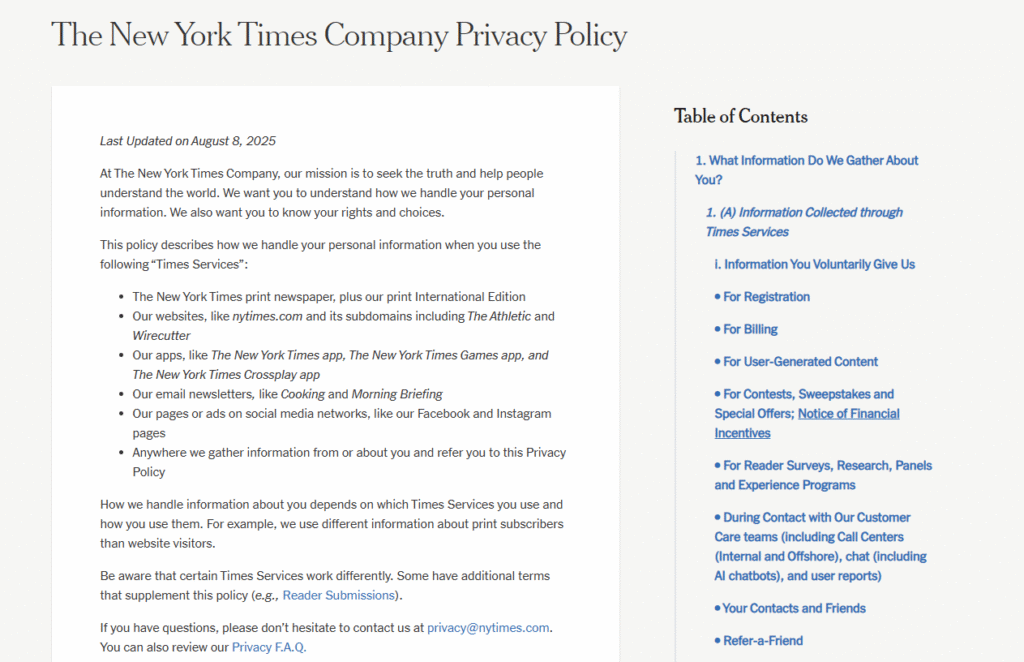
The New York Times provides one of the most detailed and transparent privacy policies in digital publishing. It explains the full advertising ecosystem, analytics tools, and account-level data with structured, well-labeled sections.
Pros
- Highly detailed breakdown of analytics and ad partnerships
- Clear explanations of personalization and reader behavior tracking
- Strong disclosures around third-party cookies and cross-device data
- Easy navigation with a persistent table of contents
Cons
- Some sections are dense and may overwhelm readers
Condé Nast
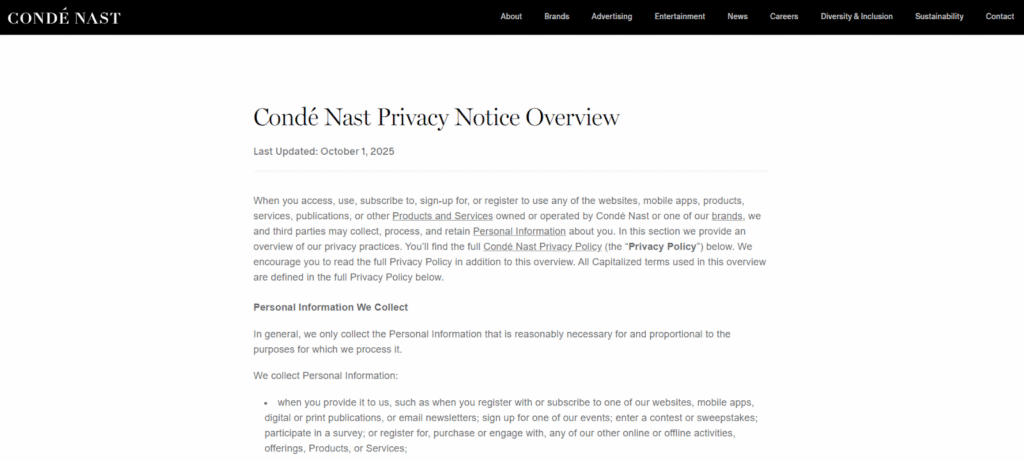
Condé Nast is a global media group that owns major publications like Vogue, Wired, GQ, and The New Yorker. As a large publisher with diverse digital content, it manages complex data flows across articles, videos, newsletters, and advertising partners.
Its privacy policy is a helpful example for content publishers that use multimedia, and clearly explains how interactions with articles, videos, and email links generate personal data.
Pros
- Strong transparency around embedded media (videos, maps, social posts)
- In-depth explanation of how to exercise data subject rights under global privacy laws like the GDPR and CCPA
- Clear breakdown of tracking tools and technologies (cookies, pixels, local storage, web beacons, etc.)
- Highly readable formatting for long-form content sites
Cons
- Could include more details about data retention periods
Medium
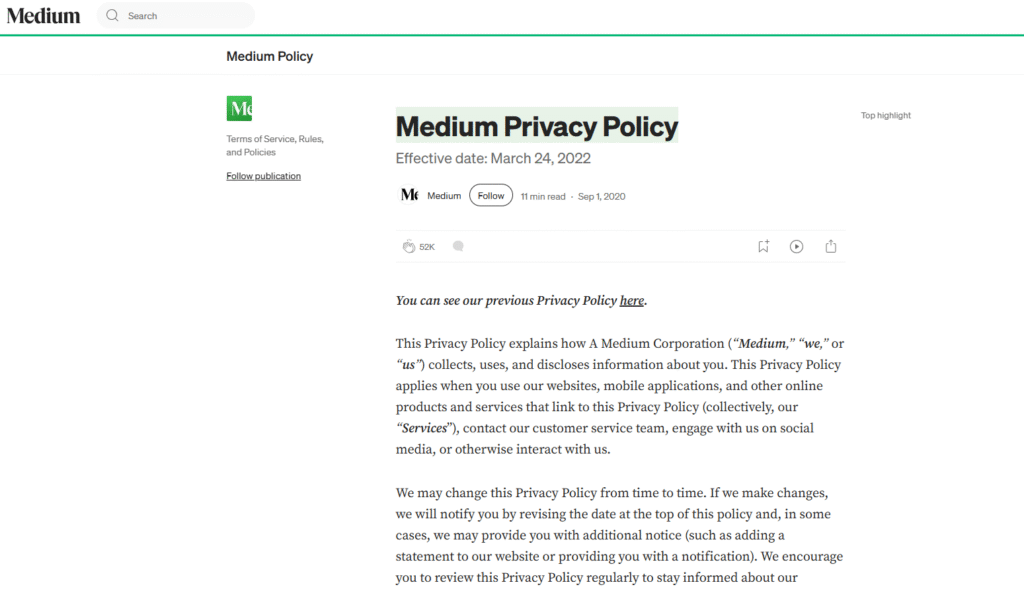
Medium’s policy is a strong example of how to explain data practices for a platform that hosts user-generated content. It covers reader behavior, writer analytics, referral data, and off-platform sign-in options.
Pros
- Clear structure around reading logs, engagement, and article stats
- Helpful examples showing how recommendations are generated
- Transparent explanation of how referrals and social logins work
- Straightforward navigation and mobile-friendly formatting
Cons
- Could provide a more detailed breakdown of advertising tools used in partner stories
Nonprofit privacy policy examples
Nonprofits can collect a wide range of personal data, from donations and membership details to volunteer information, email sign-ups, and community engagement insights. Their privacy policies often balance regulatory requirements with a trust-first approach, using clear language to reassure supporters about how their personal information is handled.
The strongest examples explain donation processing, third-party fundraising tools, and communication preferences in a straightforward, transparent way.
UNICEF
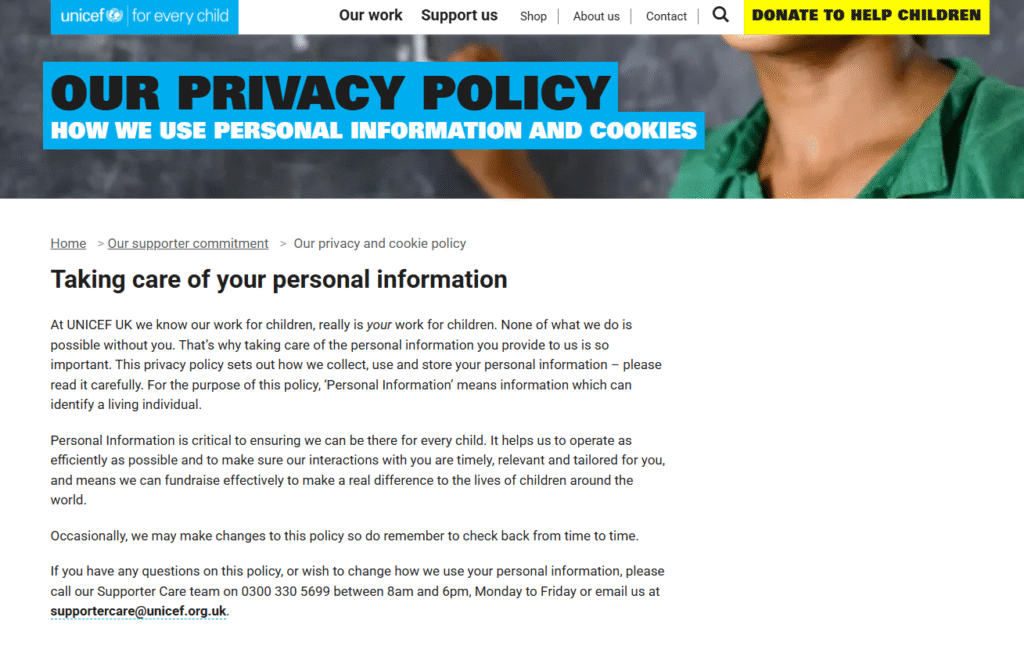
UNICEF’s privacy policy is a strong example of how global nonprofits communicate complex data practices to a broad audience. The policy clearly explains donations, newsletter subscriptions, and interactions with UNICEF’s global websites, which operate across different legal jurisdictions with different privacy laws.
Pros
- Clear explanation of data processing activities and donation-related payment processors
- Transparent breakdown of cookies and analytics tools
- Strong global structure that adapts to regional privacy laws
- Accessible, easy-to-read language suitable for public audiences
Cons
- Some regional versions are more detailed than others
WWF (World Wildlife Fund)
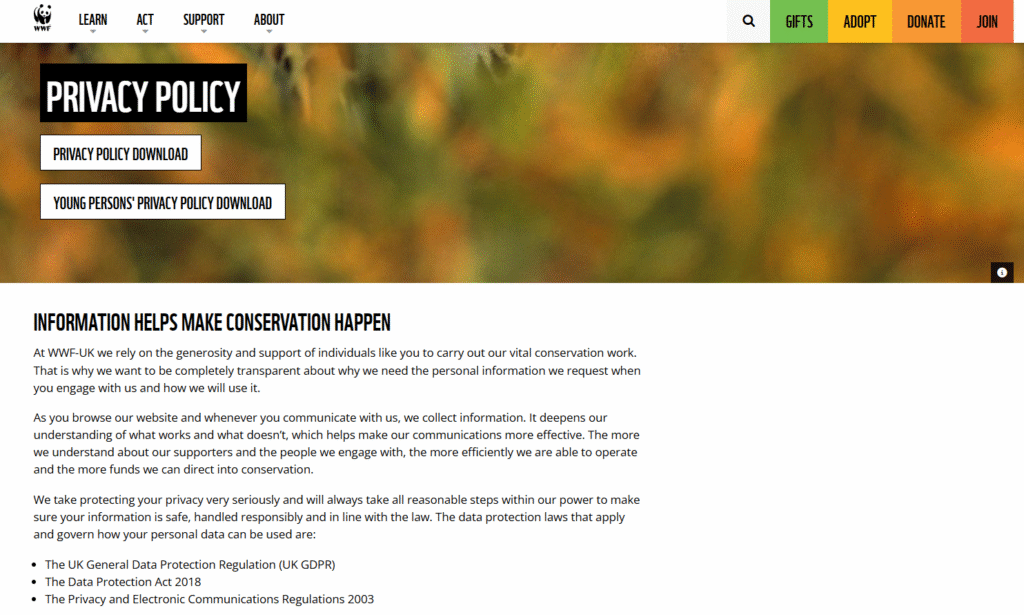
The WWF’s privacy policy is well-organized and supporter-focused. It clearly explains how personal data supports campaigns, fundraising, and conservation programs. The policy also includes helpful disclosures around email tracking, event sign-ups, and optional supporter profiles.
Pros
- Strong overview of how fundraising data is used
- Transparent about the email tracking technologies it uses for measuring engagement
- Clear explanation of event registrations and optional fields
- Simple, plain English structure that reflects nonprofit values
Cons
- Cookie explanations could be more detailed for audiences in the European Union
American Red Cross
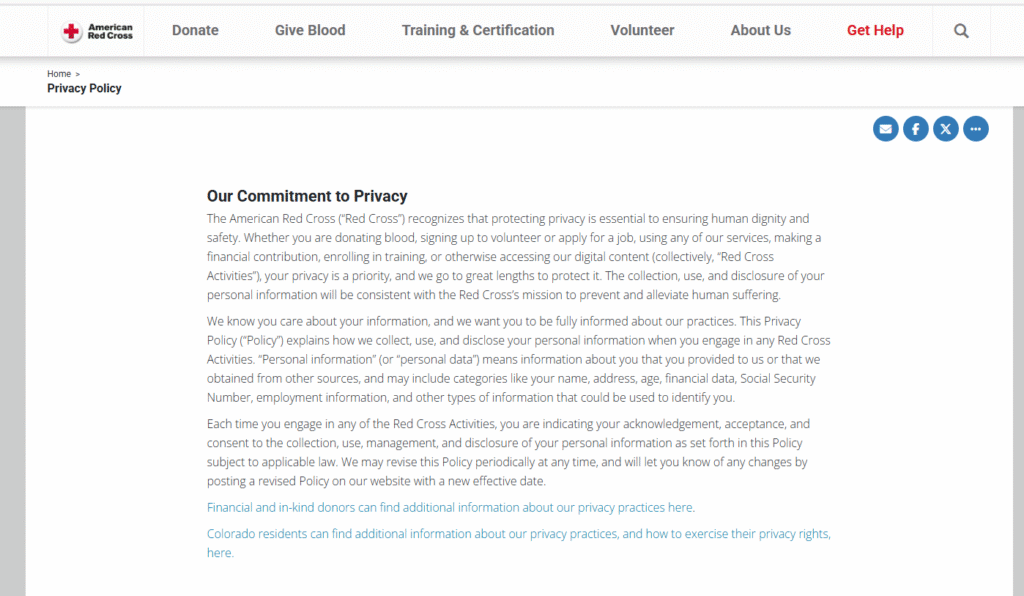
The American Red Cross provides a comprehensive privacy policy that covers monetary donations, blood donations, volunteer programs, and emergency services. Because of the diversity of its programs, the policy needs to explain different data categories in a straightforward and structured way.
Pros
- Clear distinction between donations, volunteer data, and service data
- Strong explanation of third-party processors and payment partners
- Helpful details about email and SMS communication preferences
- Impressive clarity around sensitive categories and optional disclosures
Cons
- Some sections could be more concise for mobile readers
Marketplace privacy policy examples
Online marketplaces collect data from both buyers and sellers, manage payments, enable messaging, and rely on multiple third-party services. Their privacy policies need to explain these complex data flows clearly and transparently.
The strongest examples help users understand how their personal data, browsing behavior, and transaction information support platform functionality and how it’s kept safe.
Etsy
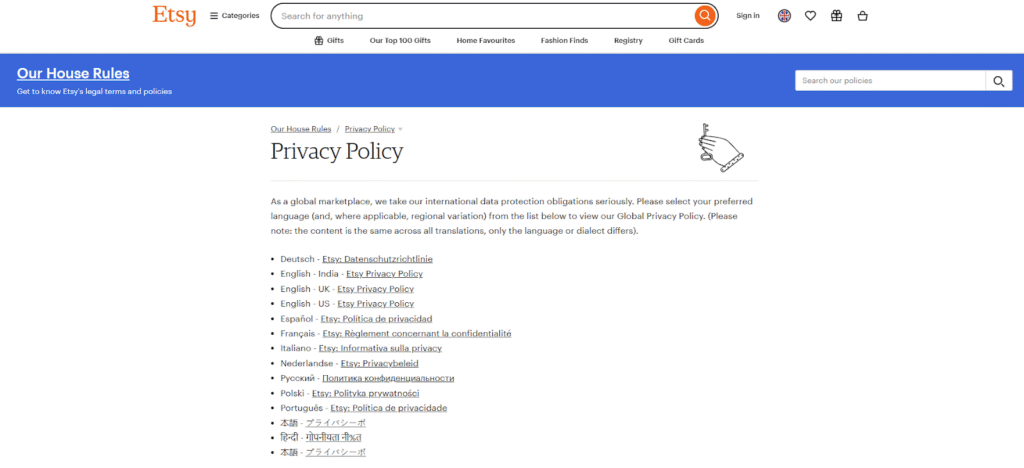
Etsy’s privacy policy is one of the strongest in the marketplace category because it explains data practices for buyers, sellers, and third-party apps in a transparent and accessible way. It also includes a strong section on seller responsibilities and how the platform handles disputes and safety checks.
Pros
- Clear breakdown of buyer vs. seller data
- Transparent explanations of messaging data, reviews, and shop analytics
- Helpful details around payments, delivery data, and third-party processors
- Straightforward navigation with expandable sections
Cons
- Could simplify advertising technology explanations for non-technical readers
Vinted
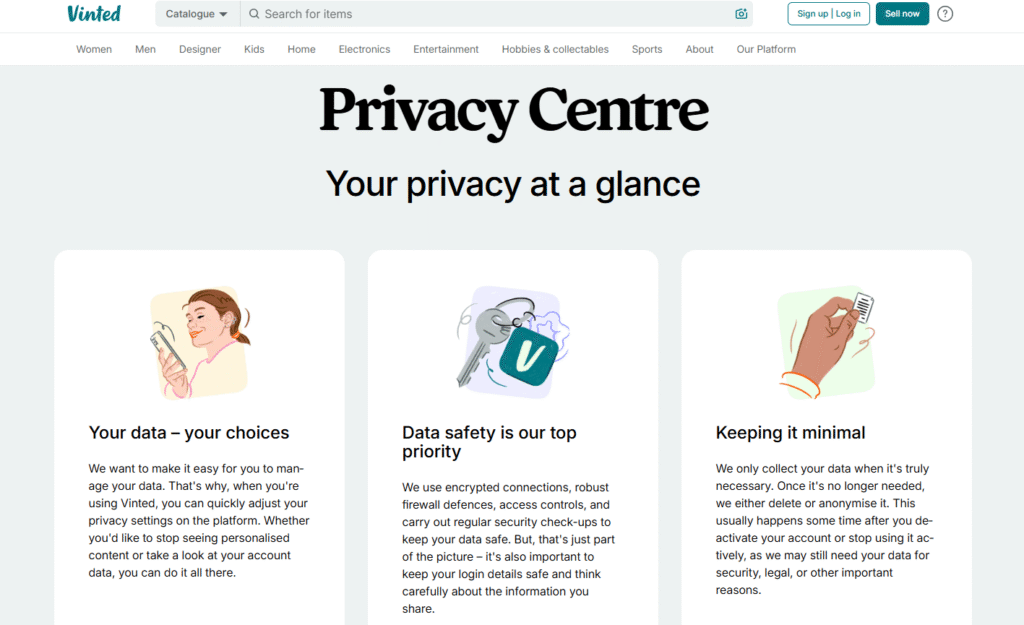
Vinted provides a strong, EU-aligned privacy policy geared toward community marketplaces. It explains messaging, listings, payment processing, and how they resolve customer complaints in accessible language. The policy also clearly describes optional vs. mandatory data fields.
Pros
- Engaging presentation style with accordions, images, and spacing to help users understand complex information quickly
- Clear descriptions of listings, messages, and user interactions
- Good transparency around identity verification and payment data
- Strong user rights section aligned with the GDPR
Cons
- Some sections could benefit from examples to support understanding
eBay
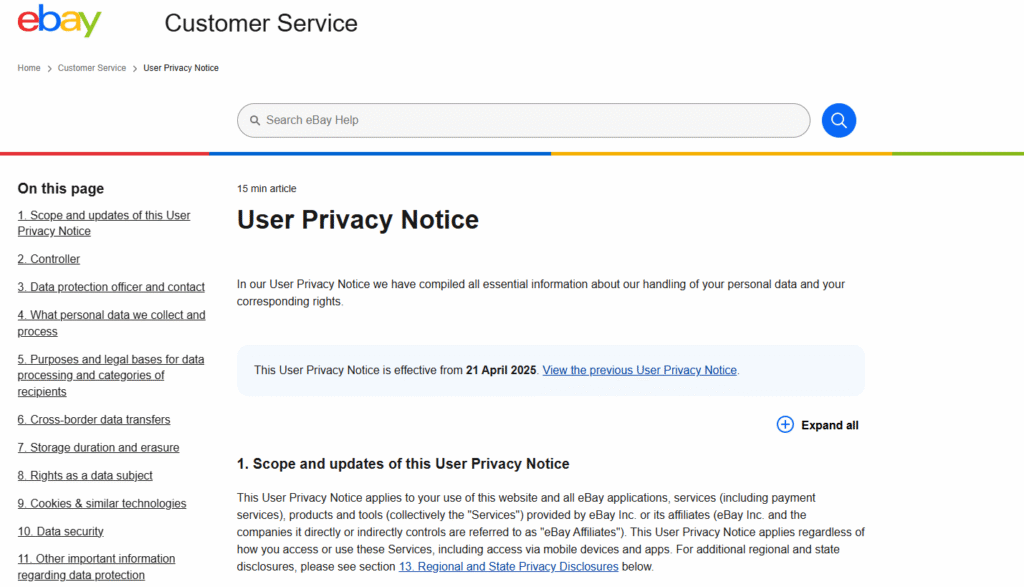
eBay is one of the most established online marketplaces, and its privacy policy reflects decades of refinement. The policy clearly explains buyer and seller data, auction and listing information, payment processing, messaging, and fraud-prevention systems. Despite the platform’s complexity, the structure remains readable and user-focused.
Pros
- Clear distinction between personal data collected for buying, selling, bidding, and messaging
- Strong transparency around security measures, such as fraud detection, identity verification, and dispute resolution
- Detailed explanations of advertising, analytics, and device data
- Straightforward navigation with a well-organized table of conte
Cons
- Some sections are long and could be simplified for mobile users
Financial services and fintech privacy policy examples
Financial services companies handle some of the most sensitive personal data: identity information, payment details, transaction history, credit checks, data used for fraud prevention and detection, and regulatory documentation. Their privacy policies must balance transparency with security safeguards, clarity with legal precision, and user expectations with strict compliance requirements.
PayPal
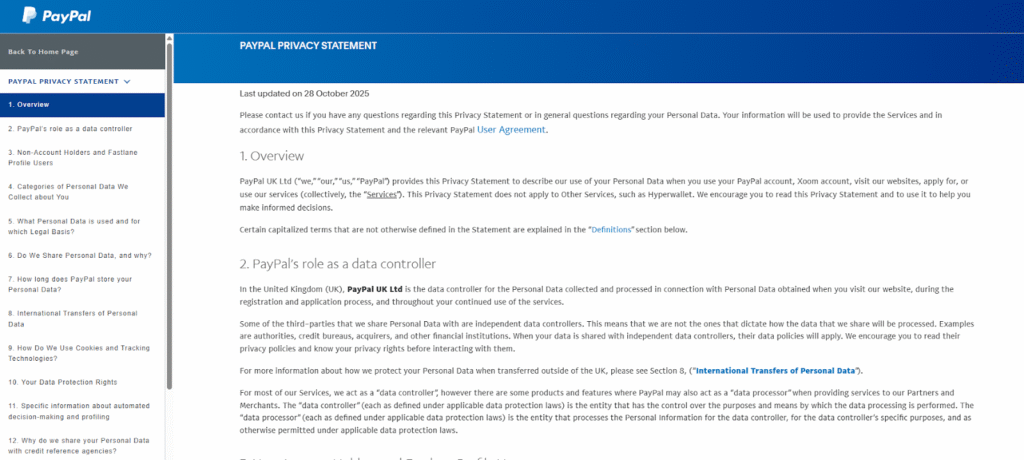
PayPal’s privacy policy is a robust example of how global financial platforms communicate complex processing activities. It covers payments, merchant data, identity checks, device data, dispute resolution, and international transfers in a structured, clear way.
Pros
- Highly detailed explanations of transaction data and payment processing
- Clear breakdown of fraud-prevention and identity-verification measures
- Transparent about cross-border data transfers and international affiliates
- Strong navigation, with well-labeled sections and summaries
Cons
- Length can be overwhelming for users who want a quick overview
Revolut
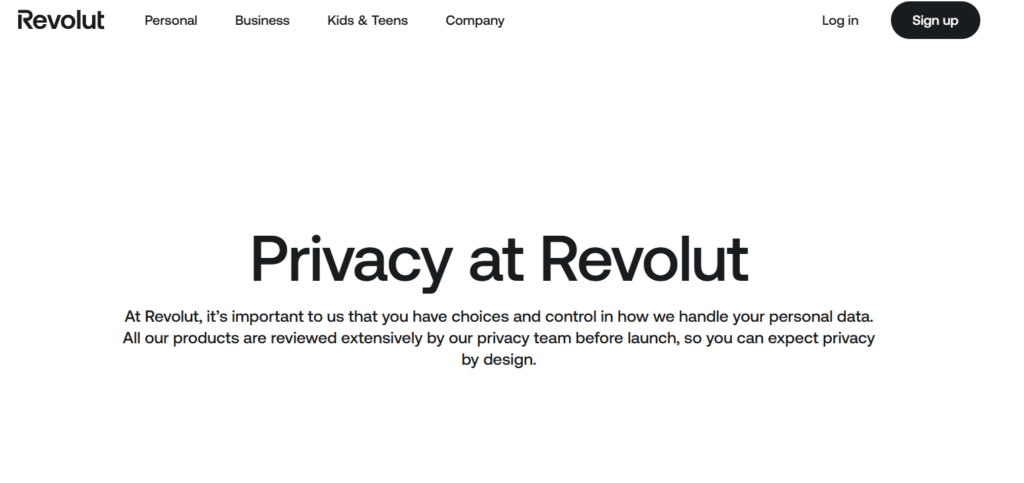
Revolut offers one of the cleaner, more modern fintech privacy policies. It uses a structured layout, concise language, and strong visual spacing to help users understand how their personal information, such as financial, device, and location data, support app features.
Pros
- User-friendly design with straightforward language and bold imagery
- Clear distinction between required personal data (identity verification) and optional data (preferences)
- Transparent explanations around card transactions, transfers, and currency exchanges
- Straightforward overview of device data, app metrics, and crash logs
- Helpful user rights section aligned with UK and EU requirements
Cons
- Could include more detail on retention periods for financial records
Wise (formerly TransferWise)
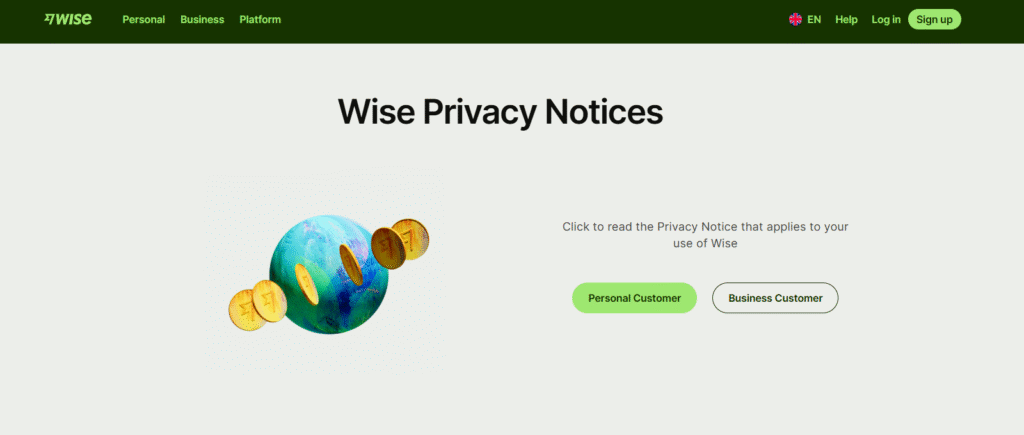
Wise provides one of the most readable international finance privacy policies, with a focus on transparency, cross-border compliance, and user-friendly explanations. It breaks down personal data uses across transfers, account activity, verification, and global partners.
Pros
- Strong, accessible explanations of identity checks and anti-money-laundering requirements
- Clear detail on international transfers and correspondent banks
- Transparent about how it uses personal information from device data, app behavior, and security features
- Well-organized headings that support scanning
Cons
- Could provide more examples showing how optional data is used
Hospitality and travel privacy policy examples
Travel and hospitality companies process large volumes of personal data: identity documents, payment information, booking records, loyalty profiles, travel preferences, and sometimes sensitive personal information like accessibility requirements.
A strong privacy policy in this category balances trust, safety, and transparency while explaining how personal data flows through multiple third-party sites, including hotels, airlines, transportation providers, payment processors, and booking platforms.
Airbnb
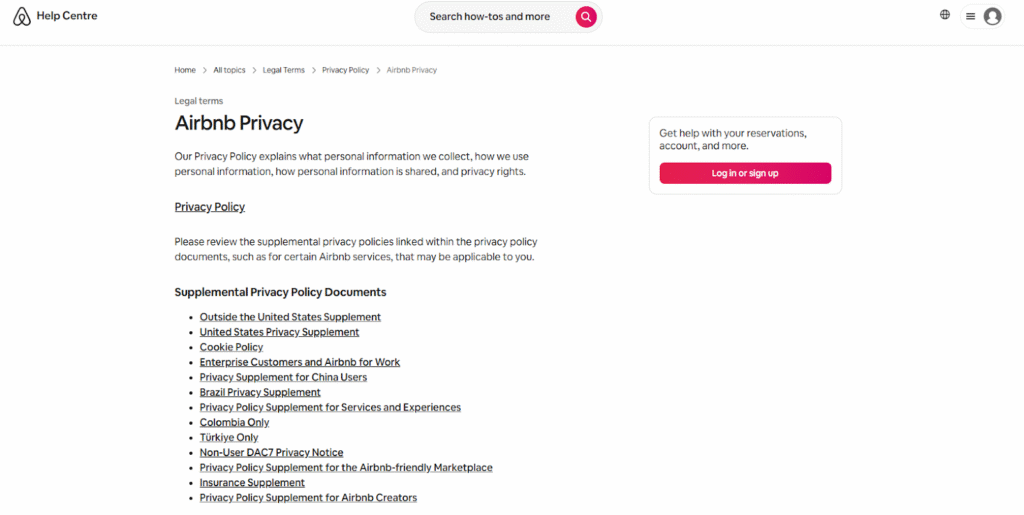
Airbnb manages global accommodation data, guest and host accounts, identity verification, payments, reviews, and safety systems. Its privacy policy is thorough yet accessible, with detailed explanations of how personal data supports reservations, trust, and platform security.
Pros
- Clear, well-structured explanations of identity verification and fraud screening
- Transparent overview of booking, messaging, and review data
- Strong disclosures around device information and geolocation
- Helpful diagrams and summaries that show how data flows through the platform
Cons
- Some sections rely heavily on legal definitions that could be simplified
Marriott International
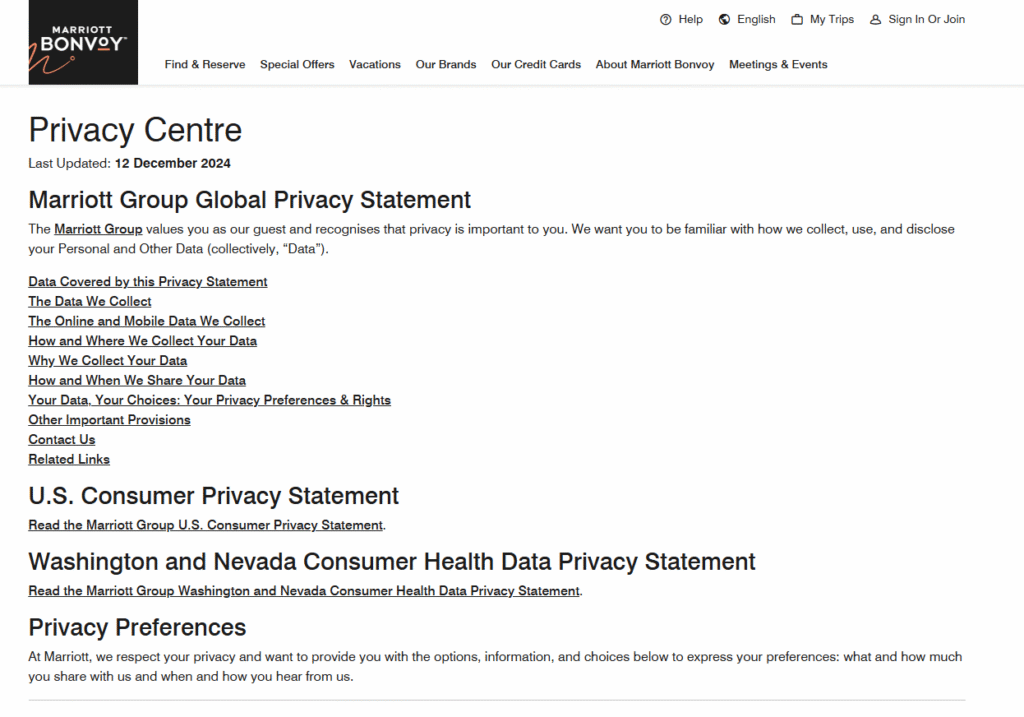
Marriott International’s privacy policy is a strong example for large hotel chains. It explains how personal data is processed through reservations, check-ins, on-property services, loyalty programs, and partner bookings. The policy uses clear headings and accessible language, especially valuable given the scale of Marriott’s operations.
Pros
- Detailed breakdown of reservation, stay-related, and loyalty program data
- Clear explanation of how personal information is shared across hotels and franchised locations
- Transparent disclosures about payment processing and optional preference information
- Strong global compliance alignment across regions.
Cons
- Some regional variations are lengthy and require multiple clicks to navigate
Booking.com
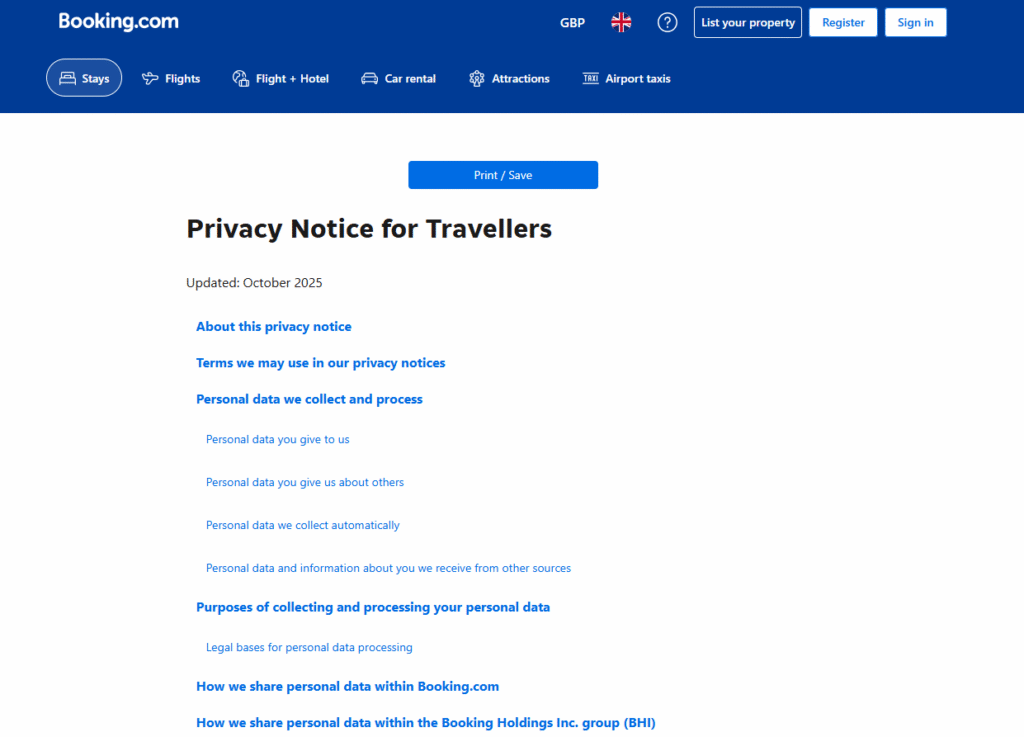
Booking.com provides a comprehensive privacy policy that covers hotels, flights, car rentals, experiences, and travel partners. The policy is well-structured and uses easy-to-understand summaries to explain how personal and booking data is handled.
Pros
- Clear distinction between data required for bookings, payments, and customer support
- Strong transparency around the many third-party integrations involved in travel services
- Well-written explanations of cookies, analytics, and app tracking
- Strong focus on user rights and communication preferences
Cons
- Could simplify its advertising disclosures for casual readers
Agencies and service provider privacy policy examples
Agencies and service providers, including marketing firms, creative studios, consultants, IT services, and B2B support partners, process a mix of client, prospect, and website visitor data. Their privacy policies need to clearly explain what data is collected during project work, how files and communications are handled, and how marketing tools like analytics and CRM systems support business development.
Accenture
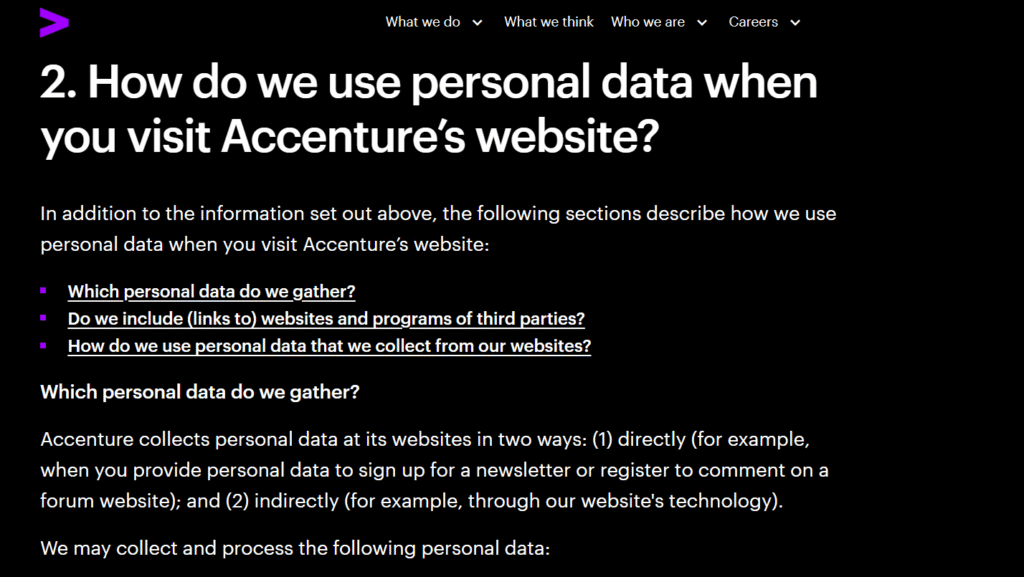
Accenture’s privacy policy is detailed but readable, offering a strong model for large professional service organizations. It covers recruiting, client engagements, website analytics, and global operations. Despite its scale, the policy maintains clarity through well-labeled sections and structured summaries.
Pros
- Strong organization with clear explanations of core data categories
- Transparent disclosures around global offices, data transfers, and sub-processors
- Detailed explanations of analytics, cookies, and personalization
- Straightforward guidance on rights, preferences, and deletion
Cons
- Some definitions run long and could be streamlined for quick scanning
Ogilvy
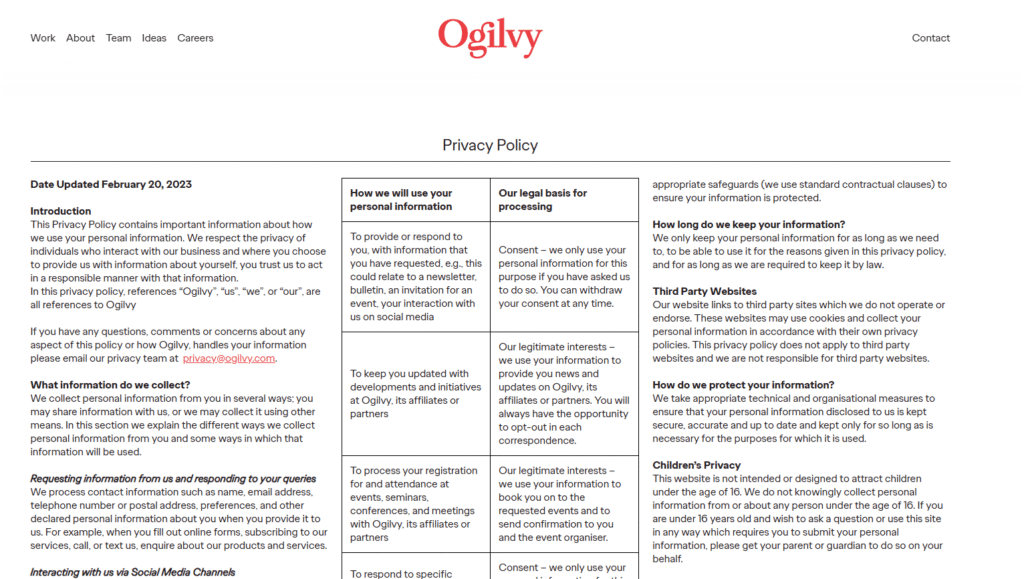
Ogilvy’s privacy policy is a solid example for marketing and advertising agencies that use analytics, CRM tools, and audience insights. The policy explains cookie technologies, recruitment data, client communications, and website tracking in a clear and structured way.
Pros
- Plain language explanations of advertising technologies and cookies
- Strong breakdown of recruitment, client, and marketing contact data
- Clear structure that separates website tracking from client data practices
- Good transparency around global offices and regional requirements
Cons
- Could provide more examples showing how optional client information is used
Deloitte Digital
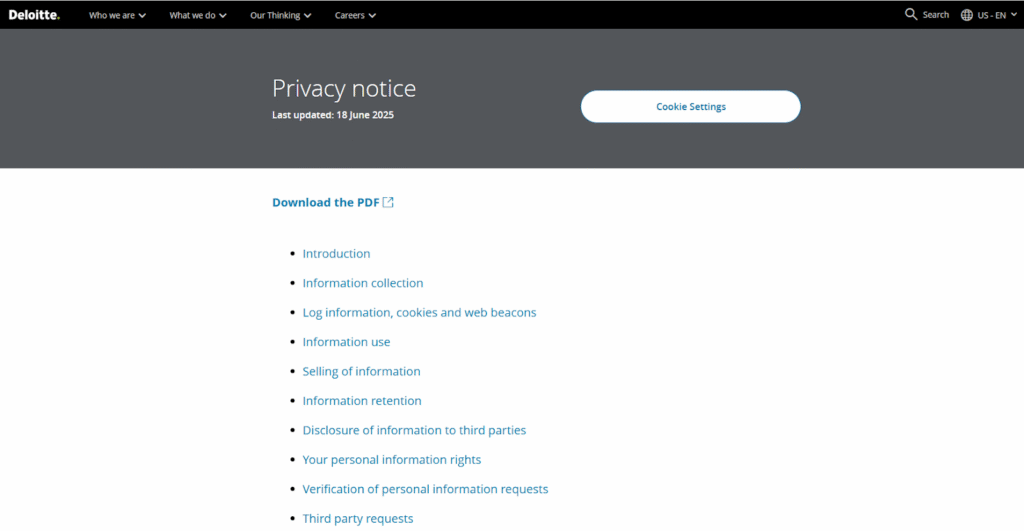
Deloitte Digital provides a strong example for digital transformation and technology consultancies. Its privacy policy outlines how project data, communication history, customer interactions, and analytics metrics are used during client engagements.
Pros
- Strong clarity around project-related data, proposals, and client communication
- Transparent about analytics, tagging, and CRM tools
- Clear navigation and regional privacy addenda for global audiences
- Helpful breakdown of what data is needed to provide services
Cons
- Some sections refer back to broader Deloitte policies, requiring extra clicks
Gaming privacy policy examples
Gaming platforms and apps collect a unique mix of personal data: device identifiers, gameplay activity, chat and community interactions, friend connections, parental controls, and sometimes even sensitive behavioral analytics.
Strong gaming privacy policies explain these data flows in a clear, user-friendly way while addressing online safety, anti-cheat systems, and optional social features.
Epic Games
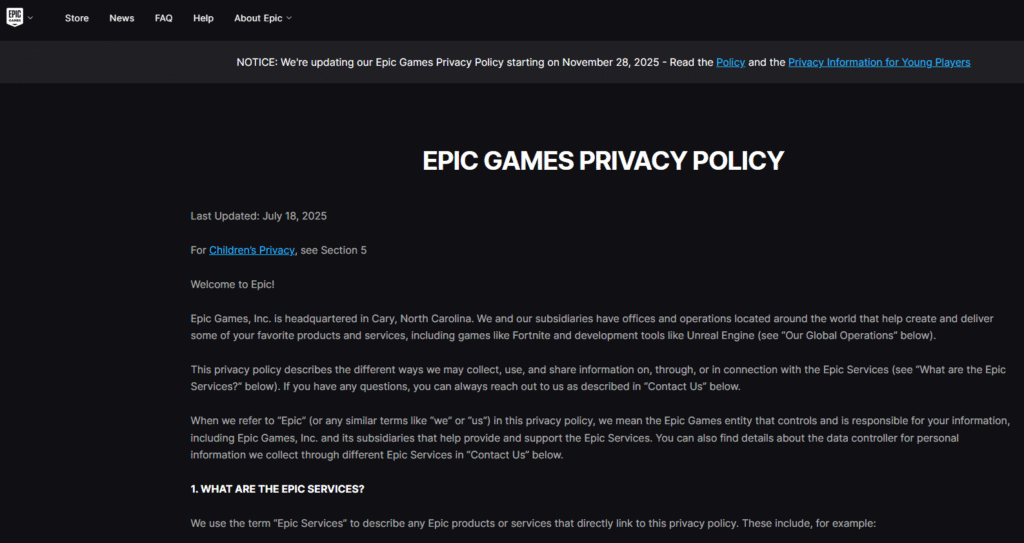
Epic Games, the developer and publisher behind Fortnite and Rocket League, provides one of the most comprehensive privacy policies in the gaming space. It covers account data, purchase history, gameplay analytics, chat features, and interactions across the Epic ecosystem.
Pros
- Clear explanations of gameplay data, device information, and purchase history
- Strong transparency around voice and text chat moderation tools
- Straightforward overview of parental controls and youth privacy
- Well-organized navigation that separates store, launcher, and game-level data
Cons
- Some sections blend platform-wide and game-specific information
Roblox
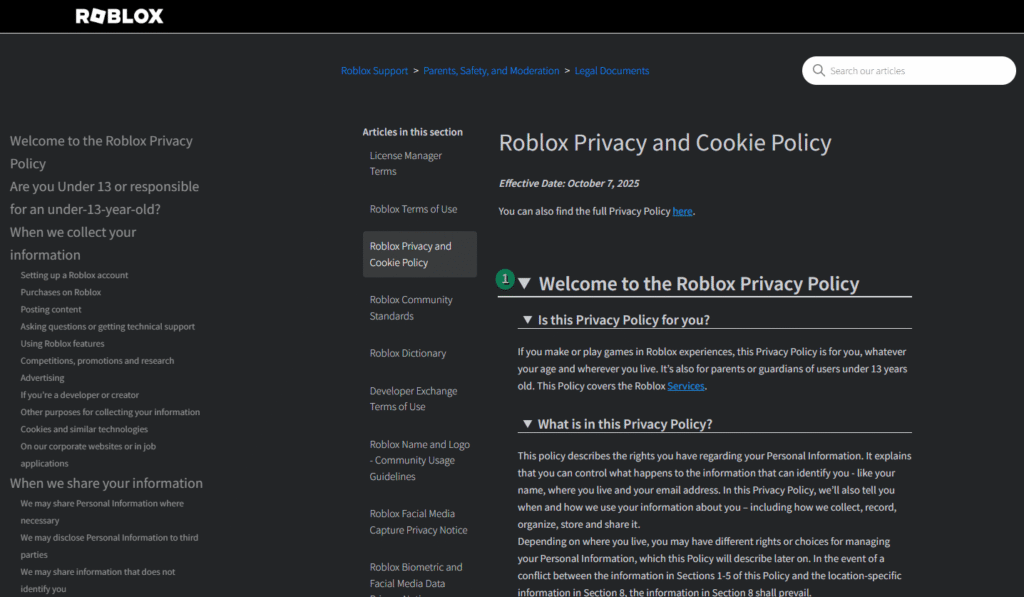
Roblox’s privacy policy is a standout example for platforms with young audiences. It provides clear explanations of account data, parental permissions, community interactions, in-game purchases, and safety tools, all in accessible language.
Pros
- Detailed section on youth data and parental controls
- Clear explanation of user-generated content, chat data, and reporting tools
- Strong detail around device identifiers and app analytics
- Helpful visuals and expandable sections for readability
Cons
- Could simplify some community and moderation explanations
Steam (Valve)
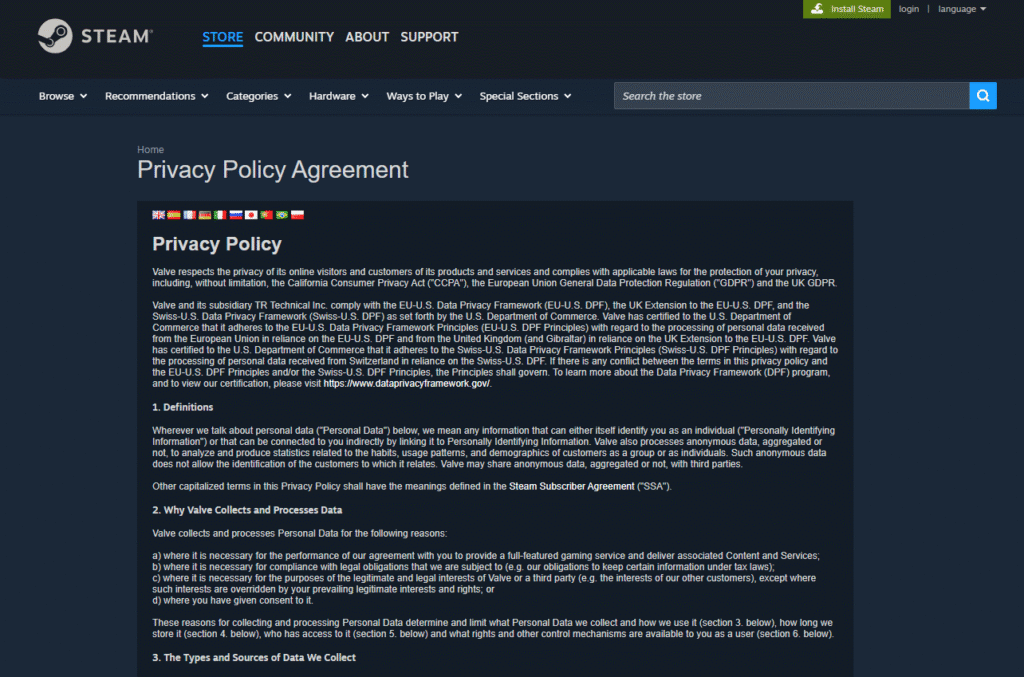
Steam’s privacy policy is a solid example for PC gaming platforms that manage purchases, community interactions, chat logs, and game telemetry. The policy maintains transparency while covering a wide set of data types.
Pros
- Clear explanation of purchase history, wishlists, and gameplay activity
- Transparent disclosures around anti-cheat systems and fraud detection
- Detailed breakdown of community data: chat, groups, workshops, and forums
- Straightforward navigation with region-specific additions
Cons
- Some legacy terminology could be updated for clarity
Government and public sector privacy policy examples
Government and public-sector organizations collect personal data across a wide range of services. They deal with everything from benefit applications and tax filings to transportation tools, public health communications, and community programs. Their privacy policies must be exceptionally clear, because they serve broad audiences with different levels of digital literacy and operate under strict legal standards.
GOV.UK (UK Government Digital Service)
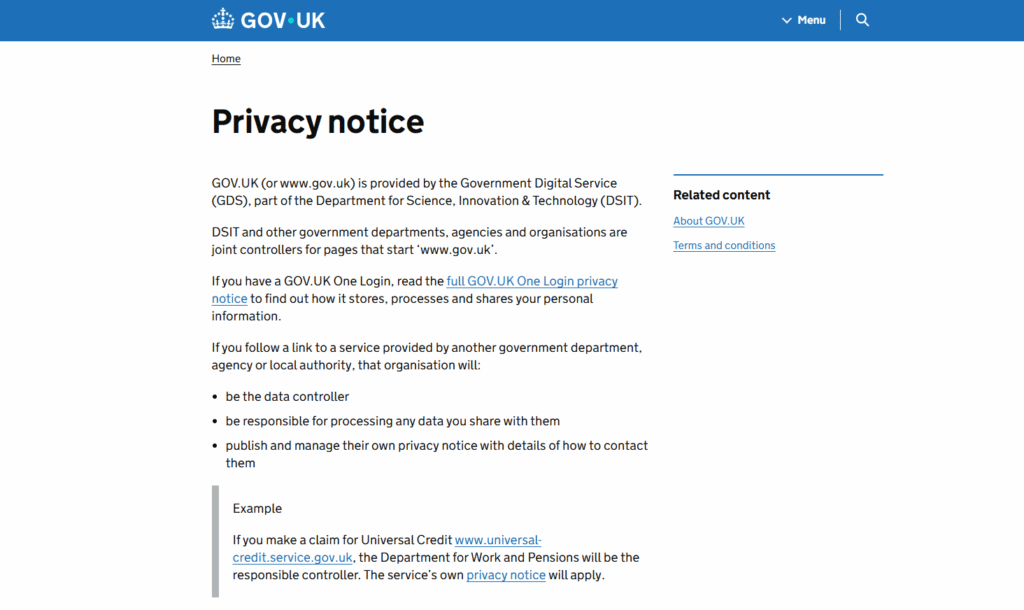
GOV.UK provides one of the most readable and structured privacy policies in the public sector. It uses clear, straightforward language to explain how user data supports digital services, security, and accessibility. Because many government transactions go through GOV.UK, the policy covers a wide spectrum of personal data types.
Pros
- Plain-language explanations accessible to all reading levels
- Clear breakdown of cookies, analytics, and essential functionality
- Transparent about security logging and fraud-prevention measures
- Strong navigation and cross-linking to service-specific policies
Cons
- Some service-level policies vary in detail and require additional clicks
IRS.gov (U.S. Internal Revenue Service)
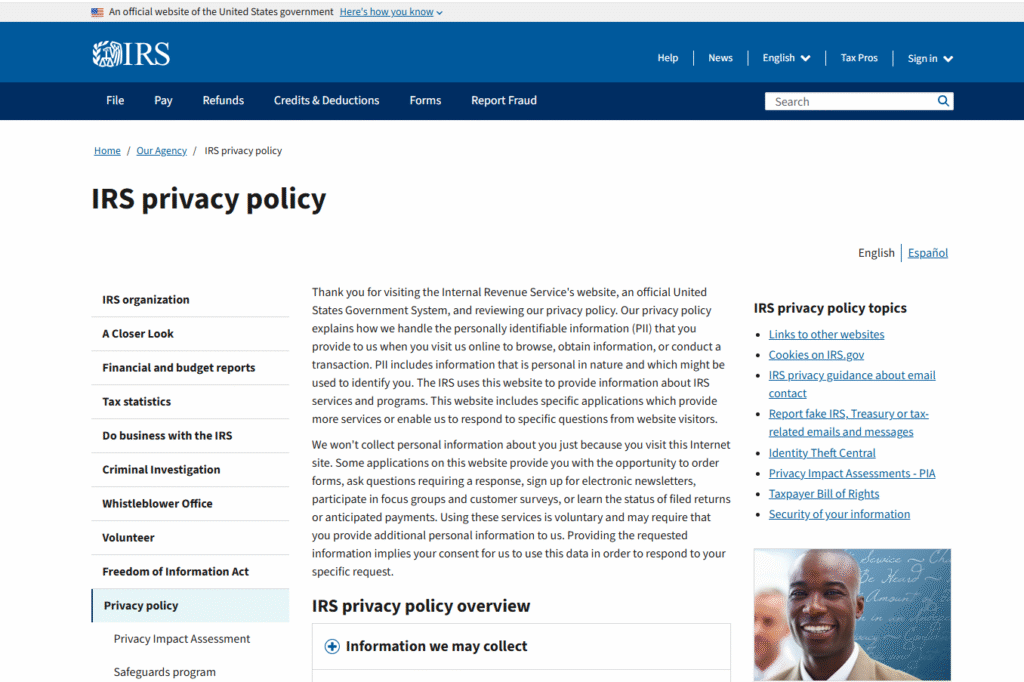
The IRS privacy policy is a strong example of a legally rigorous, security-focused document. While the language is more formal, it provides clear explanations of what tax data is collected, how it is protected, and how citizens’ personal information is shared under federal law.
Pros
- High-level detail around legal requirements and secure handling
- Transparent explanation of what data is mandatory for tax filings
- Straightforward overview of identity verification and anti-fraud tools
- Clear separation of website analytics vs. tax-processing data
Cons
- Could be more user-friendly for non-technical, non-legal audiences
Canada.ca (Government of Canada)
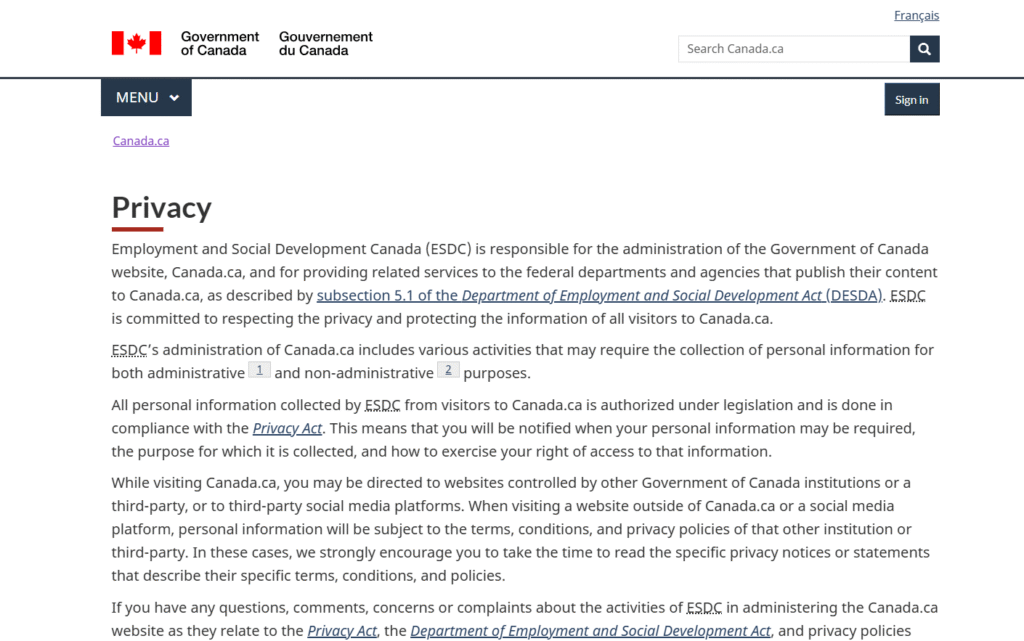
The Government of Canada provides one of the most user-focused public-sector privacy examples. It uses simple language, strong summaries, and bilingual content that explains cookies, analytics, metadata, and account services across multiple platforms.
Pros
- Very readable summaries with accessible explanations
- Clear cookies and analytics section for government websites
- Transparent about metadata used for cybersecurity and performance
- Consistent structure across nearly all government services
Cons
- Some departmental links route to separate privacy notices, increasing navigation steps