

How to write a GDPR privacy policy
If your business operates in the European Union or processes the personal data of EU residents, you need a privacy policy that is transparent, accurate, and aligned with the EU General Data Protection Regulation (GDPR) standards.

The GDPR can seem complex, as we explain in our GDPR overview, but your privacy policy doesn’t have to be. A clear, comprehensive policy helps you demonstrate accountability, support informed decisions, and reduce regulatory risk.
In this chapter of our Privacy Policy guide, we explain what GDPR privacy policy compliance involves, provide a structured privacy policy template, and outline how to create a future-ready policy your business can maintain with confidence.
Why a GDPR privacy policy is mandatory
Under the GDPR, you cannot collect or use personal data without clear disclosure. Art. 13 GDPR and Art. 14 GDPR require organizations to explain how they process personal data, a principle known as the right to be informed. Your GDPR privacy policy is the document that delivers this transparency.
A GDPR-compliant privacy policy publicly outlines your data practices and demonstrates how your organization meets its obligations under the regulation. It is mandatory because it provides:
- Transparency: Users can see who is collecting their personal data, what data is being collected and used, and by whom, why it’s being processed, and how long it will be stored.
- Control: Individuals understand their rights, including access, rectification, deletion, and objection, and are provided information about how to exercise them.
- Accountability: Regulators can verify that your organization processes personal data lawfully and responsibly.
Failing to provide a valid GDPR privacy notice can lead to penalties of up to EUR 20 million or 4 percent of your global annual turnover, whichever is higher.
Who needs a GDPR-compliant privacy policy?
Many businesses assume the GDPR only applies to large technology companies. In reality, the regulation applies to organizations of all sizes, including small and medium-sized businesses, if they process the personal data of individuals in the EU or EEA, including monitoring behavior.
You need a GDPR-compliant privacy policy if your company:
- Is based in the EU or EEA and processes personal data
- Is based outside the EU but offers goods or services to people located in the EU or EEA
- Monitors the behavior of individuals in the EU or EEA, such as through use of cookies, analytics tools, or other tracking technologies
If your website receives visitors from the EU and collects any type of personal data — including names, email addresses, IP addresses, or cookie identifiers — you must follow GDPR requirements and maintain a compliant privacy policy.
Read our article about cookies and personal data to understand more about different cookie types and how GDPR may influence your cookie-related privacy practices.
What should a GDPR privacy policy include?
A GDPR-compliant privacy policy must provide specific, clear information about how your organization processes personal data. General statements like “we care about your privacy” are not sufficient under the regulation.
Your privacy policy should include:
- Identity and contact details: State who you are as the data controller and how individuals can contact you or your Data Protection Officer (if applicable).
- Purposes of processing: Explain what personal data is collected and for what purposes, such as fulfilling an order, managing customer accounts, or analyzing website activity.
- Legal basis for processing: Specify the applicable legal basis for each processing activity. Consent is a commonly required legal basis. A consent management platform can help you compliantly track and manage user consent.
- Categories of personal data: List the types of data you collect, such as contact information, device identifiers, browsing behavior, or payment details.
- Recipients of data: Identify third parties that receive personal data and for what purposes, including payment providers, analytics platforms, hosting providers, and other service partners.
- International transfers: Disclose whether personal data is transferred outside the EU or EEA and the safeguards used, such as adequacy decisions or standard contractual clauses.
- Data retention periods: Explain how long data is stored and the criteria used to determine retention.
- User rights: List the rights available to individuals under the GDPR, such as access, rectification, erasure, restriction, objection, the right to be forgotten, and data portability, and how they can be exercised, including an accessible contact method.
- Right to withdraw consent: Clarify that users can withdraw consent at any time and how to do so. This is essential for valid consent management.
- Right to lodge a complaint: Inform users that they may file a complaint with a supervisory authority, and provide information on how to do so.
GDPR privacy policy template
Creating a GDPR privacy policy from scratch can be challenging. To help you get started, we’ve included a structured template you can customize to your business’s data practices.
However, keep in mind that every business processes data differently and has different obligations, which will inform customizing the template. Volume and type of processing require appointment of a Data Protection Officer and more stringent security measures for some companies, for example.
Static templates often miss important details, such as the third-party tools you use, the legal bases tied to each processing activity, or the safeguards required for international transfers. A one-size-fits-all text may leave gaps in transparency and compliance.
For a policy that reflects your full data ecosystem — including third-party services, cookies, and tracking technologies — use the Usercentrics Privacy Policy Generator to create a professional, accurate, and privacy-first document.
[Downloadable Version: Copy and paste the text below]
[Company Name] Privacy Policy
Effective date: [Date]
- Introduction
At [Company Name], we are committed to protecting your personal data and your right to privacy. This GDPR privacy policy (or GDPR Privacy Notice) explains what information we collect, how we use it, and what rights you have.
- Data controller contact information
[Company Name]
[Address]
[Email Address]
[Phone Number]
Data Protection Officer: [Name/Contact Email]
- Information we collect
We collect personal data that you (the ‘Data Subject’, or ‘User’) voluntarily provide to us when you register on the website, express an interest in obtaining information about us, or otherwise contact us.
This may include:
- Names and contact data (email, phone number)
- Credentials (passwords, hints)
- Payment data
- IP addresses
- How we use your data
We process your personal information for purposes based on legitimate business interests, the fulfillment of our contract with you, compliance with our legal obligations, and/or your consent.
- To facilitate account creation and log-in process
- To send administrative information to you
- To fulfill and manage your orders
- Legal basis for data processing
We process your data under the following legal bases:
- Consent: We may process your data if you have given us specific consent to use your personal information for a specific purpose.
- Legitimate Interests: We may process your data when it is reasonably necessary to achieve our legitimate business interests.
- Sharing your data
We may share your personal data with the following categories of third parties:
- Cloud computing services
- Payment processors
- Data analytics services (e.g., Google Analytics)
- Your privacy rights
Under the GDPR, you have the right to:
- Request access to your personal data
- Request correction or deletion of your personal data
- Object to the processing of your personal data
- Restrict processing of your personal data (in certain circumstances such as until corrections are completed)
- Receive a copy of the personal data you have provided in a portable format
- Not be subjected to important decisions made solely by automated processes or profiling
- Withdraw your consent at any time
To exercise these rights, please contact us at [Contact Email].
- Updates to this policy We may update this GDPR privacy policy template from time to time. The updated version will be indicated by an updated “Revised” date.
Best GDPR privacy policy examples
Looking at how well-established companies structure their privacy notices can help you understand what “good” looks like. Strong GDPR privacy policies typically share the traits of being clear, providing structured information, and delivering layered transparency.
1. The “layered” approach (example: The BBC)
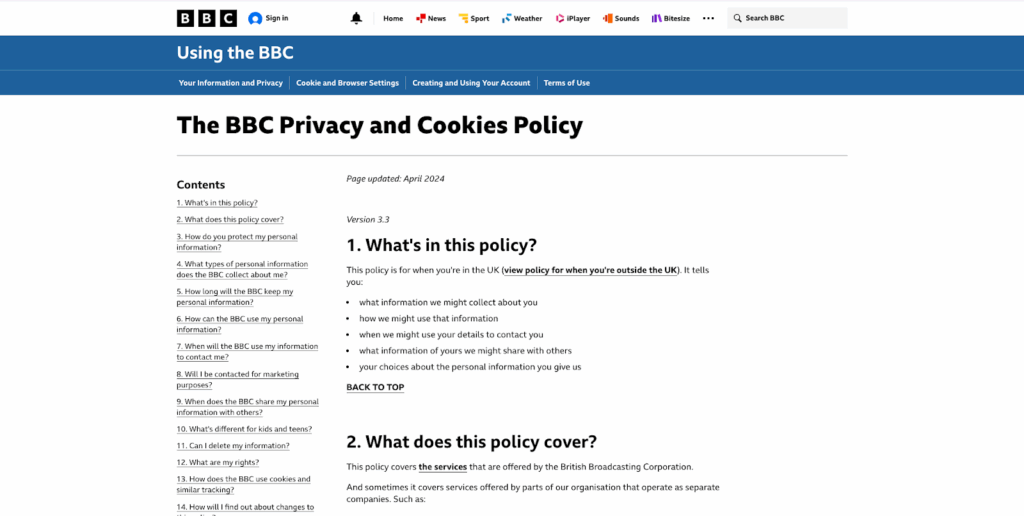
A layered privacy policy presents information in stages, starting with a short, high-level overview of critical information and providing links to more detailed sections. This helps users understand the essentials quickly and gives them choices about accessing more information.
The BBC uses this model effectively. The first layer offers a concise explanation of data collection: what is collected and why. Users can then click through to explore data retention, sharing practices, or rights under the GDPR.
This structure offers great user experience as it reduces cognitive load, improves navigation, and gives people a clearer sense of how their data is handled.
The “plain English” approach (example: Airbnb)
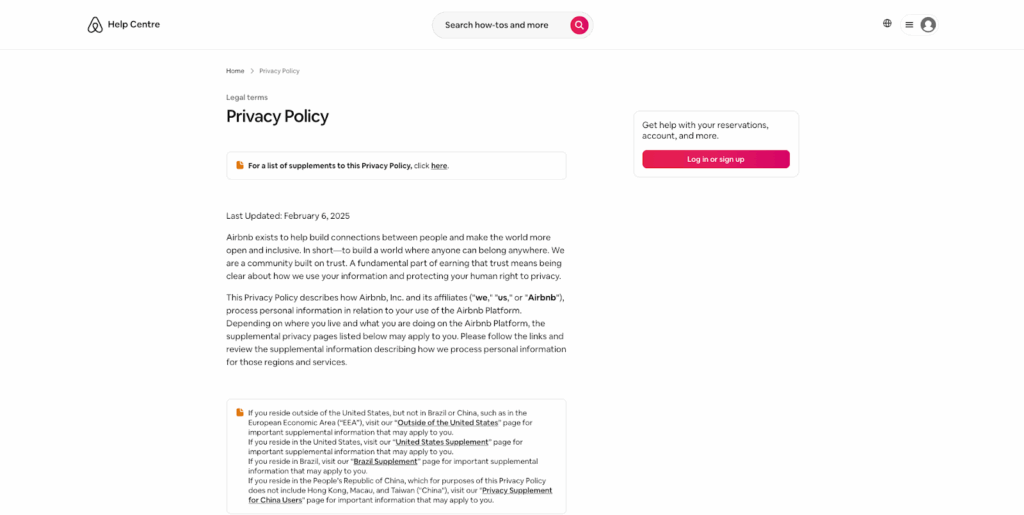
Airbnb’s privacy policy is known for its clear, accessible language. Instead of legal terminology like “categories of processing,” it uses familiar headings such as “What we collect” and “How we use your information.”
This style aligns with the GDPR’s requirement that privacy notices be understandable to the average person, including younger users. Eliminating legalese helps users quickly grasp:
- What data is collected
- Why it’s processed
- Who it’s shared with
- What rights individuals have
Writing in plain language builds trust and helps organizations communicate their data practices more transparently.
The “dashboard” approach (example: Usercentrics)
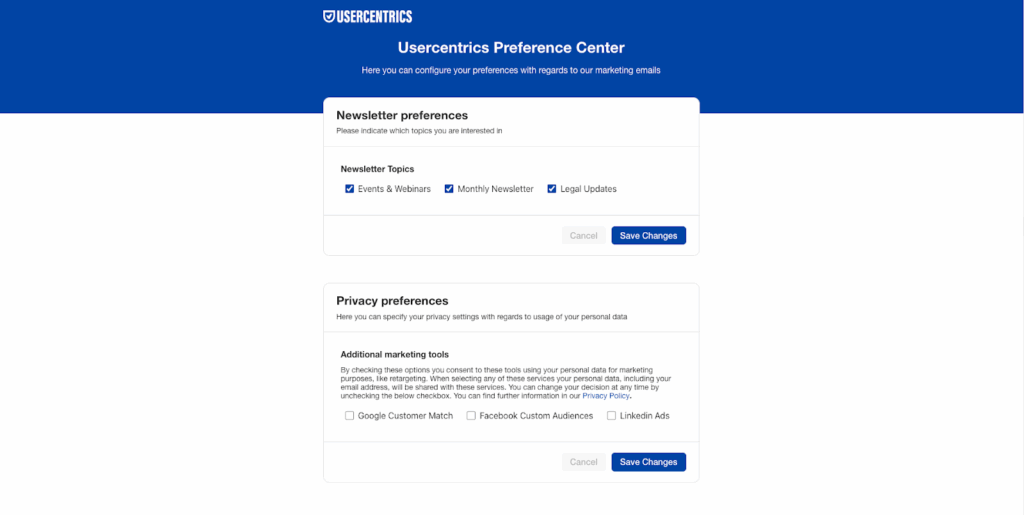
More companies are adopting a privacy dashboard model, which turns the privacy policy into an interactive, user-controlled experience. Instead of a static document, users access a dedicated privacy center where they can:
- View data categories and purposes
- Toggle consents
- Update preferences in real time
- Understand how their choices affect data processing
This approach supports GDPR principles by giving people active control over their data, simplifying consent withdrawal, and improving transparency. With visual components like icons and modular sections, users can quickly understand what data is being collected and why.
Many companies also use their privacy dashboards to educate users, offering explanations, FAQs, or short videos that deepen understanding of data practices. This helps build trust and supports ongoing privacy compliance.
How to create a GDPR-compliant privacy policy
Writing a GDPR privacy policy requires a structured and comprehensive approach. These steps will help you build a document that reflects your actual data practices and supports ongoing privacy compliance.
Step 1: Conduct a data audit
A privacy policy needs to reflect the data you collect and how it moves through your systems. Start by mapping:
- What data enters your website or app (forms, cookies, pixels, third-party scripts)
- Where that data is stored (CRM, analytics tools, marketing platforms, databases)
- Who has access to it, both internally and externally, and for what purposes
- What retention periods are for data and any governing legal requirements
With a clear data inventory, you’ll be better placed to describe your processing activities accurately.
Step 2: Determine your legal basis
For every processing activity, identify the lawful basis under the GDPR. This may include contractual necessity, legitimate interest, legal obligation, or consent.
Document each legal basis so it aligns with your policy and your internal records.
Step 3: Use a generator or seek legal counsel
Attempting to write a privacy policy by yourself, from scratch, can be risky. If you don’t have access to legal guidance, templates can help you get started. Even better, a dynamic generator can keep your policy aligned with your real data ecosystem, including analytics tools, marketing technologies, and third-party platforms.
Using structured tooling also makes it easier to keep your policy updated as your stack evolves. What’s most important to remember is that templates or generators are a starting point, and careful customization for your business operations, technologies in use, and data handling — with regular updates — are critical for ongoing GDPR compliance.
Step 4: Make it accessible
Accessibility is part of GDPR transparency requirements. Your privacy policy must be easy for users to find. Place a link in:
- Your website footer (visible on every page)
- Your mobile app store listing
- Your app’s settings or account section
- At data collection touchpoints, like the checkout flow
Avoiding legalese and writing in plain English where possible will also help people understand exactly what their rights are and how you handle their data.
Step 5: Sync with your CMP
Your privacy policy must match reality. For example, if your policy says “we use cookies” your consent management platform (CMP) must actually block those cookies for EU users until consent is given. Our Usercentrics CMP helps to ensure that your business operations match your documentation and legal requirements.
Common mistakes to avoid while writing your GDPR privacy policy
Even when organizations start with a privacy policy template designed to enable GDPR compliance, important details can be missed. These gaps can undermine transparency and create inconsistencies between what a company says and what it actually does, exposing you to legal risk and reputational damage.
Here are common mistakes to avoid.
Using vague language
Broad statements like “We may use your data for marketing” don’t help users clearly understand what is being done with their data. Be specific and explain the purpose, such as “We use your email address to send monthly product updates.”
Hiding the policy
Your privacy notice shouldn’t be embedded deep inside Terms & Conditions or buried within long legal pages. GDPR transparency requirements mean that it must be easy to find, ideally accessible from the footer of every page.
Leaving out third parties and tools
Your privacy policy needs to reflect all the services that handle personal data. This includes tools like Google Analytics, Hotjar, or HubSpot. Failing to declare a data processor is a major compliance gap.
Using pre-ticked boxes or other invalid consent mechanisms
Your policy might be perfect, but if your forms use pre-ticked consent boxes, you’re non-compliant. Under the GDPR, consent must be freely given, specific, informed, and unambiguous: meaning no automatic opt-ins. Withdrawing consent must also be as easy as giving it.
Copying from competitors
Privacy policies must reflect your actual data practices. Copying text from another website can lead to inaccurate disclosures because your data types, legal bases, vendors, processing activities, and other factors will differ, especially over time. Static or borrowed policies often misrepresent reality and can weaken user trust.
Keeping your GDPR privacy policy up to date
A GDPR privacy policy is a living document. As your data practices evolve, and as regulations shift through new guidance or court decisions, your policy must remain accurate and aligned with current requirements.
You should review and update your policy:
- Annually as a general health check: Routine review helps confirm your disclosures still reflect your actual processing activities.
- When you add or change tools: New technologies, such as chatbots, analytics platforms, or advertising tools, and introducing new processing activities may require additional disclosures.
- When laws or regulatory guidance changes: Developments such as new regulations, legal rulings, or updated transfer mechanisms may require revisions to relevant sections of your policy.
Manual updates to static documents can be time-consuming and increase the risk of inconsistencies. Automated solutions make it easier to maintain an accurate, up-to-date privacy policy that reflects your full data ecosystem.