

Data discovery tools give organizations the visibility they need to understand, protect, and manage their data responsibly. Yet as data spreads across multiple systems, not all tools deliver the transparency required to stay compliant.
The right platform can help teams meet global privacy requirements, reduce risk, and strengthen trust. This guide explores why data discovery has become essential to responsible governance, and which leading tools are helping organizations achieve full data visibility in 2026.
Why data discovery tools are essential
As organizations manage growing volumes of data across cloud and on-premises systems, visibility and control have become central to responsible data governance. Data discovery tools give teams the insight needed to understand, protect, and manage information responsibly. They form the foundation of effective data lifecycle management and turn information into a reliable business asset.
Sensitive data discovery
Organizations need to understand the distinctions between Personally Identifiable Information (PII), personal information (PI), and sensitive data in order to apply the right controls and compliance measures. Data discovery tools automate this process, scanning across systems to locate, classify, and categorize sensitive data in real-time.
This automation strengthens compliance with the General Data Protection Regulation (GDPR), the California Consumer Privacy Act (CCPA), ISO 27001, and other privacy standards (such as those that vary across U.S. states). Automation also reduces the risk of unauthorized access or exposure.
Mapping where sensitive information resides and who can access it helps organizations apply consistent controls and prove accountability across their data inventory.
Supporting GDPR principles
Data discovery tools make it easier to uphold the seven principles of the GDPR by providing clear visibility into what data is being collected and why.
Data discovery is key to GDPR compliance because visibility is the first step towards demonstrating lawful processing and maintaining accountability.
These insights enable smarter retention and deletion decisions, which in turn support compliant data lifecycle management and improve operational efficiency. Improved visibility means that teams keep only what’s necessary for legitimate business needs, which reduces risk, storage costs, and data sprawl.
Strengthening transparency and security across the data lifecycle
Modern data discovery solutions provide a real-time, organization-wide view of data: what exists, where it flows, and how it’s used.
That visibility connects privacy, security, and governance efforts, which helps teams detect anomalies, respond faster, and maintain auditable records of data activity.
By integrating discovery into daily operations, organizations can protect sensitive information while optimizing its business value. By doing so, they’re creating a privacy-led foundation for future growth.
Using data discovery to strengthen privacy compliance
Integrating consent tracking with data discovery takes privacy compliance from policy into practice. It’s a combination that connects user permissions with the actual data to which they apply, bridging the gap between consent and control.
Data discovery supports key operational requirements such as Data Subject Access Requests (DSARs), data mapping, and risk assessments. By automating these processes, organizations can verify lawful data use, maintain auditable records, and confidently demonstrate compliance.
Connect consent tracking and data discovery for full visibility
When consent data and discovery tools work together, organizations gain a unified, transparent view of personal information across systems. This connection helps ensure that every piece of data is processed according to verified user choices and evolving global privacy standards.
Consent Tracking: Consent tracking monitors and manages the permissions individuals grant for the use of their personal data. Without accurate consent records, there’s no guarantee that data is being processed in ways the user has approved. Keeping those records accurate improves transparency and trust across every interaction.
Data Discovery: Data discovery identifies, catalogs, and classifies data across cloud and on-premises environments. When organizations know what data exists, where it resides, and how it moves, they can respond to privacy requests more efficiently and maintain ongoing compliance.
How data discovery tools strengthen privacy operations
Data discovery tools bring automation to privacy operations. They turn manual compliance tasks into continuous, traceable workflows that strengthen accuracy and control across the entire data ecosystem.
Data Subject Access Requests (DSARs)
Privacy laws like the GDPR and CCPA require organizations to give individuals access to their personal data. Discovery tools automatically locate and retrieve that data across systems and connect related datasets to create a complete, reliable record. This automation accelerates DSAR responses and helps organizations handle each request accurately and on time.
Data Mapping: Strong data governance starts with knowing where information lives and how it moves. Discovery tools create real-time maps that visualize data storage, access, and transfer. These maps enable organizations to uphold data sovereignty, meet jurisdictional requirements, and strengthen overall compliance.
Risk Assessments: Assessing data risk requires insight into the data’s sensitivity, potential exposure, and access. Discovery tools analyze metadata, classifications, and usage patterns to identify potential vulnerabilities. This intelligence helps organizations prioritize mitigation strategies and strengthen data protection measures across the entire lifecycle.
The combined benefits of consent tracking and data discovery
Consent tracking and data discovery work together to create a unified framework for responsible data use to deliver measurable gains in compliance, operational efficiency, and user trust.
Enhanced compliance: Connecting consent and data records aligns processing activities with user permissions. This clarity strengthens adherence to global privacy laws and reduces regulatory risk.
Improved data management: Unified data insights remove redundancy and support efficient storage and access. Teams gain the context they need to manage, protect, and use data responsibly across systems.
Increased trust: Transparent data practices demonstrate accountability to customers and stakeholders by providing visible proof of your respect for privacy and information security.
Together, consent tracking and data discovery create a single, trusted view of the personal data your organization collects and processes. This integration simplifies DSAR responses, supports accurate data mapping, and enables proactive risk management. It’s a step that turns compliance from a checklist into an operational advantage.
Essential features of the best data discovery tools
Data discovery tools give organizations the visibility and control they need to manage data responsibly. They identify, classify, and monitor information across systems.
The right tool will incorporate the following features for comprehensive operational and privacy compliance support. Each broad category includes the specific features to look for as you compare data discovery solutions.
Discovery and classification
Automated data classification: Automatically identifies and categorizes data based on sensitivity and context. It supports precise handling of critical information and enforces consistent protection policies.
Metadata cataloging: Creates a centralized inventory of data assets with details on origin, structure, and usage. This transparency makes data easier to find, understand, and manage across teams.
Governance and compliance integration
Integration with governance frameworks: Connects discovery tools with existing data governance and compliance systems to align operational practices with legal and industry requirements. This integration reduces non-compliance risk and strengthens accountability.
Integration with consent systems: Reinforces transparency and trust by synching discovery processes with consent management platforms so that data usage respects user permissions, reinforcing transparency and trust.
Audit logs and reporting: Maintain detailed records of data access and activity to support risk assessments, compliance audits, and internal accountability.
Security and monitoring
Sensitive data detection (PII/PHI): Identifies and protects personally identifiable and health information to help organizations meet regulations such as the GDPR and HIPAA.
Real-time alerts on sensitive data: Provides instant notifications of unauthorized access or potential data breaches so teams can act quickly and prevent data loss.
Integration with server-side tagging: Controls and monitors data movement between systems to help ensure transfers comply with internal policies and privacy standards.
Intelligence and automation
AI-driven discovery and risk scoring: Uses machine learning to uncover hidden patterns, detect anomalies, and assign risk scores. These insights help organizations prioritize data protection based on sensitivity and business impact.
Effective data discovery tools connect automation, compliance, and intelligence into one unified operational framework. Together, these capabilities strengthen privacy management, improve data accuracy, and enable organizations to make informed, compliant decisions.
10 of the best data discovery tools in 2026
The link between data discovery and compliance is clear. Next, let’s look at the tools helping organizations turn visibility into action.
These leading platforms exemplify modern data discovery by combining governance, privacy enforcement, and AI-driven intelligence to give organizations full visibility and control.
1. BigID
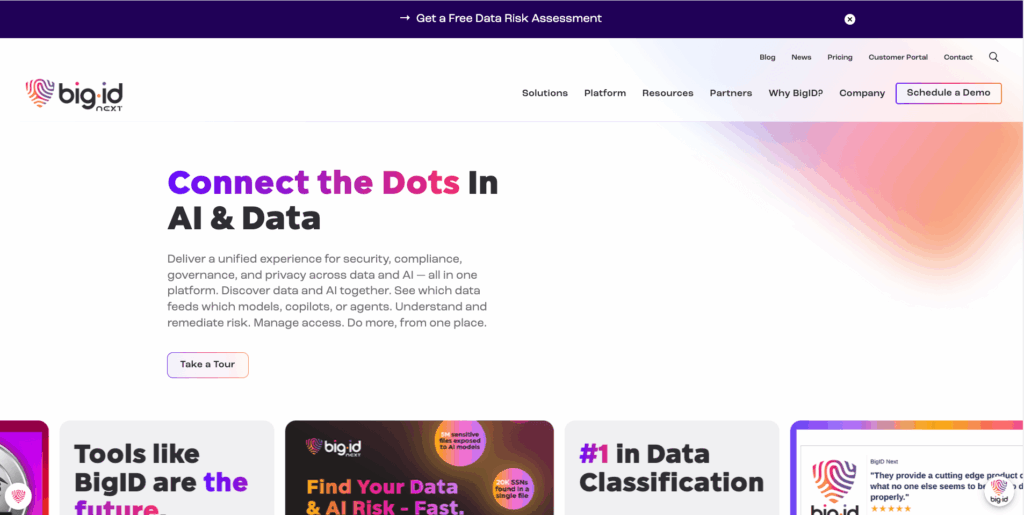
BigID enables enterprises to unify data privacy, security, and governance across cloud, on-premises, and AI environments.
Its discovery and classification engine gives organizations full visibility into where sensitive data resides and how it’s used, supporting compliance, security, and operational efficiency.
Purpose-built for complex, regulated environments, BigID helps enterprises manage risk and maintain trust at scale.
Key features:
- Deep data discovery: Automatically inventories and maps personal and regulated data across all environments to deliver a single, reliable view.
- Patented AI classification: Uses proprietary machine-learning models to categorize data by sensitivity and context in more than 100 languages.
- Data Security Posture Management: Continuously monitors exposure and enforces security controls to reduce breach risk.
- Data Loss Prevention: Agentless capability prevents the unauthorized movement of sensitive data, both while in motion and at rest.
- Data access governance: Provides granular visibility into who can access which data and supports remediation of over-privileged accounts.
- Automated privacy operations: Streamlines DSARs and deletion requests, consent validation, and data-mapping activities.
- AI risk management: Catalogs AI assets and applies governance guardrails to training and deployment data.
Best for: Enterprises focused on data privacy and compliance
Pricing: Custom pricing, with free trial available.
| Pros | Cons |
| Unifies security, privacy, and governance in one platform. | Premium pricing for enterprise users. |
| Automates complex privacy and regulatory workflows. | Initial deployment and fine-tuning require significant effort and expertise. |
| Patented AI delivers highly accurate sensitive-data classification. | Interface performance can lag with large-scale datasets. |
| Integrates with diverse cloud and legacy data sources. | Advanced classification can sometimes generate false positives. |
2. Domo
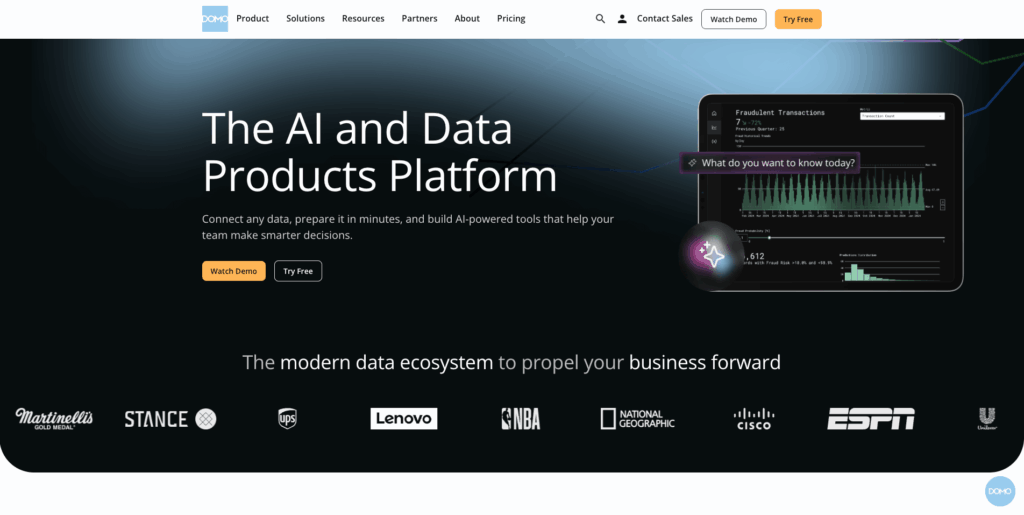
Domo is an AI-driven data platform that unifies integration, analytics, and automation in a single cloud environment. It enables organizations to connect more than a thousand data sources, visualize performance in real time, and apply AI to accelerate decision-making.
Through Domo.AI, users can create custom agents and conversational interfaces that surface actionable insights across teams. This capability turns complex data into clear, business-ready intelligence.
Key features:
- Domo AI: Provides AI-powered agents and conversational interfaces for instant, context-aware insights.
- Data Integration: Connects over 1,000 data sources to centralize analytics and governance.
- Business Intelligence (BI): Offers dynamic, real-time dashboards and visualizations to monitor performance.
- Intelligent Automation: Enables no-code workflows and automated alerts to streamline operations.
- Low-Code App Studio: Users can build interactive applications that extend analytics beyond dashboards
- Embedded Analytics: Share insights with customers and partners by securely embedding dashboards outside Domo.
Best For: Organizations that need real-time data analytics.
Pricing: Custom pricing after free trial, starts with a per-user subscription model.
| Pros | Cons |
| Combines data integration, warehousing, and BI within one platform. | Subscription- and credit-based pricing can be expensive for smaller teams. |
| Offers over 1,000 pre-built connectors for fast data integration. | Performance may slow with extremely large or complex datasets. |
| Real-time dashboards support fast, data-driven decisions. | Advanced extract, transform, and load (ETL) and automation features require technical expertise. |
| User-friendly interface makes analytics accessible to non-technical users. | Front-end customization options are limited compared to other BI solutions. |
3. Data.world
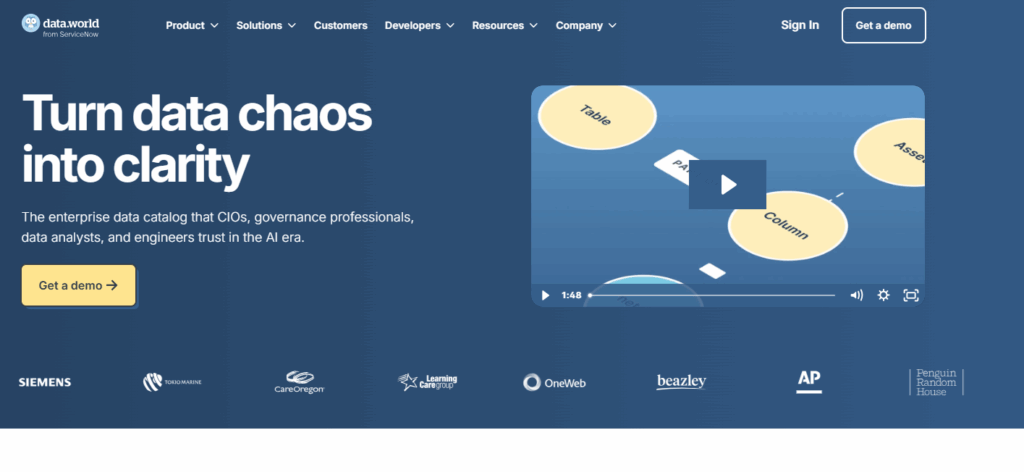
This cloud-based data catalog platform is designed to deliver a unified and reliable view of organizational data. Built on a knowledge-graph architecture, data.world connects metadata, business context, and governance policies to make information easier to find, understand, and use.
Its AI Context Engine enhances Large Language Model (LLM) accuracy by providing structured, explainable context, which supports trustworthy AI applications and informed decision-making.
Key features:
- Catalog: A centralized workspace for enterprise data discovery and controlled access.
- Knowledge graph: Creates a connected data ecosystem that links datasets, users, and metadata for deeper insights.
- AI context engine: Improves LLM output accuracy and transparency by grounding responses in governed enterprise data.
- Governance: Automates compliance and data management through configurable workflows.
- Explorer: Visualizes data lineage from source to consumption to improve traceability and accountability.
- Workbench: Offers an integrated environment for querying, preparing, and enriching data.
Best For: Teams focusing on collaboration and data management.
Pricing: ‘Freemium’ model with premium features available at extra cost. Pricing available upon request.
| Pros | Cons |
| Knowledge-graph foundation supports context-rich, explainable AI. | Acquisition by ServiceNow introduces some uncertainty around roadmap alignment. |
| Smart governance workflows automate compliance and catalog maintenance. | Knowledge graph technology may present a learning curve for new users. |
| Cloud-native design supports scalability and easy deployment. | Primarily aimed at data leaders and technical teams. |
| Delivers precise, connected insights across data assets. | Pricing is only available on request after a product demo. |
4. Alation
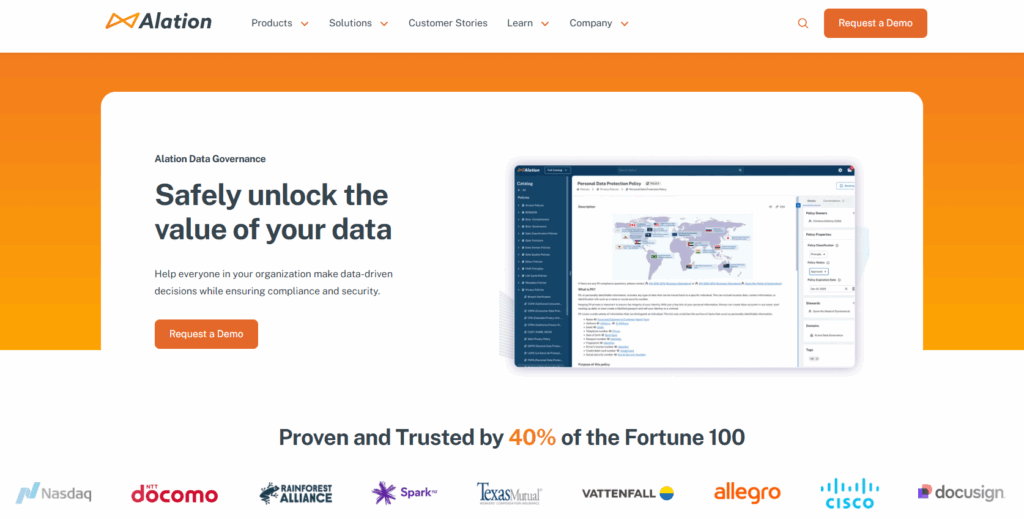
Alation is a data intelligence platform that unifies discovery, governance, and quality management to help organizations build a single, trusted view of their data.
Powered by an Active Metadata Graph, it connects data assets, policies, and users to improve discoverability and control. Its agentic architecture enables AI-powered assistance for cataloging, documentation, and governance.
Key features:
- Agentic platform: Unified environment that combines cataloging, governance, lineage, and quality.
- Data catalog: Centralized search and discovery with natural-language capabilities across all data sources.
- Alation agents: AI-driven assistants that use metadata to automate documentation and data-quality enforcement.
- Data governance: Centralized policy management and automated stewardship supports compliance demonstration.
- Conversational querying: You can “chat with” your data to return verified, governed results.
- Data products marketplace: Teams can share, govern, and reuse trusted data products across the enterprise.
Best For: Enterprises focusing on data governance and cataloging.
Pricing: Contact Alation for custom quotes based on enterprise needs.
| Pros | Cons |
| Streamlines data discovery and access through intelligent search and cataloging. | Enterprise pricing reflects the platform’s advanced AI and governance capabilities. |
| Automates governance and quality control to maintain data integrity and regulatory compliance. | Steep learning curve for new users and administrators. |
| Encourages collaboration between technical and business teams to maximize the value of trusted data. | Integration with existing data ecosystems is sometimes complex, and requires extra configuration. |
5. Informatica
Informatica is an AI-powered cloud data management platform designed to govern the entire data lifecycle across multi-cloud and hybrid environments.
Its flagship Intelligent Data Management Cloud (IDMC), powered by CLAIRE AI, unifies discovery, integration, quality, and governance with the goal of helping organizations maintain trusted, compliant, and AI-ready data at scale.
The platform supports use cases ranging from analytics and modernization to responsible AI enablement.
Key features:
- IDMC (Intelligent Data Management Cloud): A comprehensive, AI-powered cloud data management platform for the full data lifecycle.
- CLAIRE AI: The AI engine that automates tasks and supports AI-readiness and security.
- Data catalog: Enables teams to discover, understand, and govern enterprise data assets.
- Data quality and observability: Monitors and validates data health for reliability and trust.
- Master Data Management (MDM): Delivers a unified, 360-degree view of key business data for consistent insights.
- Data integration: Connects, transforms, and synchronizes data across cloud and on-premises systems.
Best For: Large enterprises that need comprehensive data solutions.
Pricing: Custom pricing based on your business needs.
| Pros | Cons |
| Automates lifecycle management through CLAIRE AI. | High pricing reflects its extensive feature set. |
| Recognized as a Leader in four Gartner Magic Quadrant reports. | Pending Salesforce acquisition introduces potential roadmap uncertainty. |
| Offers over 50,000 metadata-aware cloud and hybrid connections. | Platform breadth can be too complex for smaller teams to implement effectively. |
6. Tableau
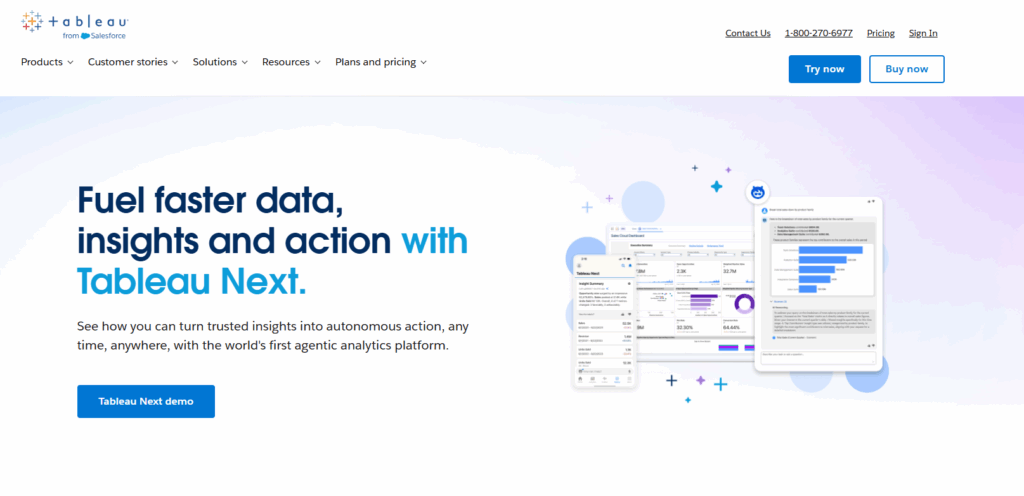
Tableau from Salesforce is a visual analytics and business intelligence platform that transforms data into actionable insights. Its focus is on empowering organizations to explore, analyze, and communicate data visually.
With its latest iteration, Tableau Next, it is evolving into an “Agentic Analytics Platform” that aims to combine trusted analytics with autonomous, AI-assisted action.
Key features:
- Visual analytics: Delivers intuitive, drag-and-drop exploration for interactive data visualization and storytelling.
- Agentic analytics (Tableau Next): Introduces autonomous capabilities to convert insights into real-time, AI-assisted actions.
- Tableau Semantics: Adds business context to data for consistent, governed insights across teams.
- Integrated AI/ML: Embeds AI and machine learning for predictive analytics and pattern recognition.
- Data management: Incorporates governance, cataloging, and metadata management throughout the platform.
- Salesforce integration: Offers seamless connectivity with Salesforce CRM, plus flexible cloud or on-premises deployment.
Best For: Businesses focused on data visualization.
Pricing: Standard tiers range from $15-$115 per user, per month. A custom, premium ‘Tableau +’ plan is available.
| Pros | Cons |
| Industry-leading visualization and dashboard capabilities. | Advanced functionality (like input-output data calculations) requires high user expertise. |
| Strong Salesforce integration supports end-to-end analytics workflows. | Full feature utilization often depends on Salesforce ecosystem integration. |
| Embedded AI transforms trusted insights into actionable intelligence. | Subscription pricing is optimized for enterprise-scale deployments, and may be expensive for smaller businesses. |
| Recognized as a 2025 Gartner Magic Quadrant Leader for analytics. |
7. Qlik Sense
Qlik Sense is a self-service data analytics and business intelligence platform powered by the Qlik Associative Engine. It enables users to freely explore relationships across all data points for deeper, more flexible insight generation.
Combining augmented intelligence with intuitive design, Qlik Sense supports use cases ranging from interactive dashboards to embedded analytics, helping organizations make faster, data-informed decisions.
Key features:
- AI-Powered analytics: Delivers generative and predictive insights through Qlik’s augmented intelligence capabilities.
- Interactive visualizations: Provides dynamic dashboards and data visualizations for exploratory analysis.
- Data preparation: Includes tools for cleansing, transforming, and modeling data before analysis.
- Embedded analytics: Analytics components can be integrated directly into business applications.
Best For: Companies that need advanced data analytics.
Pricing: Subscription-based pricing dependent on business needs. Starter tier begins at USD 200 per month.
| Pros | Cons |
| Intuitive interface supports both business users and developers. | Steep learning curve for users new to data analytics platforms. |
| Highly customizable for advanced, code-driven use cases. | Implementation and licensing costs may be high for smaller organizations. |
| Scales efficiently for high-volume and complex data analysis. | Complex dashboards can require significant computing resources. |
| Integrates seamlessly with diverse data sources across cloud and on-premises systems. |
8. Spotfire
Spotfire is a visual data science and analytics platform designed to help organizations solve complex, industry-specific challenges. It combines interactive data visualization with advanced statistical and predictive modeling to enable users to explore and act on data at scale.
With AI-driven recommendations, Spotfire identifies patterns, trends, and anomalies to accelerate insight generation while maintaining strong governance and collaboration controls.
Key features:
- Visual data science: Merges visual analytics with advanced modeling for sophisticated problem-solving.
- Statistica integration: Incorporates a rich library of advanced analytical algorithms.
- AI-driven insights: Suggests optimal visualizations and models to uncover hidden relationships in data.
- Extensible platform: Supports R and Python scripting for predictive modeling and customization.
- Data virtualization: Connects to diverse data sources for unified analysis without replication.
Best For: Industries with complex data needs like pharmaceuticals and energy.
Pricing: Tiered pricing model. Contact Spotfire for detailed pricing information.
| Pros | Cons |
| Broad visualization and analytic capabilities across industries. | Steep learning curve due to platform depth and breadth. |
| Integrates with several third-party platforms and enterprise applications. | High price makes it difficult for smaller businesses to adopt. |
| Flexible deployment options and strong customization potential. | Limited training resources relative to platform complexity. |
| Supports both low-code workflows and advanced scripting environments. | May feel overly complex for organizations with basic reporting needs. |
9. Collibra
Collibra is a unified governance platform that helps enterprises build confidence in their data and AI ecosystems. It manages the full data lifecycle — from discovery and classification to governance and quality — to provide a transparent, compliant, and trustworthy foundation for decision-making.
Through the Collibra Data Intelligence Platform, organizations can visualize data lineage, automate privacy controls, and operationalize AI governance across complex environments.
Key features:
- Unified governance: Unifies governance for structured data, unstructured data, and AI models within a single framework.
- Data catalog: Accelerates discovery, understanding, and secure access to enterprise data assets.
- Data lineage: Maps end-to-end data flow and transformations from source to consumption.
- Data privacy: Automates privacy enforcement and evaluates compliance risk for sensitive information.
- Data quality and observability: Continuously monitors data health using self-service validation rules.
- AI governance: Catalogs and assesses AI use cases to support transparency, accountability, and ethical AI deployment.
Best For: Large organizations with a focus on data governance.
Pricing: Custom pricing based on organization size and needs.
| Pros | Cons |
| Automates governance workflows and policy enforcement for both data and AI assets. | Requires significant time and training to implement effectively. |
| Connects diverse metadata types to deliver complete context and improve data understanding. | Interface performance can be slow when handling large-scale data environments. |
| Provides detailed data lineage mapping (down to column and transformation level) for full traceability. | Lacks AI-assisted search and advanced analytics capabilities. |
| Employs advanced algorithms for sensitive data classification and operational efficiency. | Some users report challenges maintaining security consistency during data transfers. |
10. Ataccama
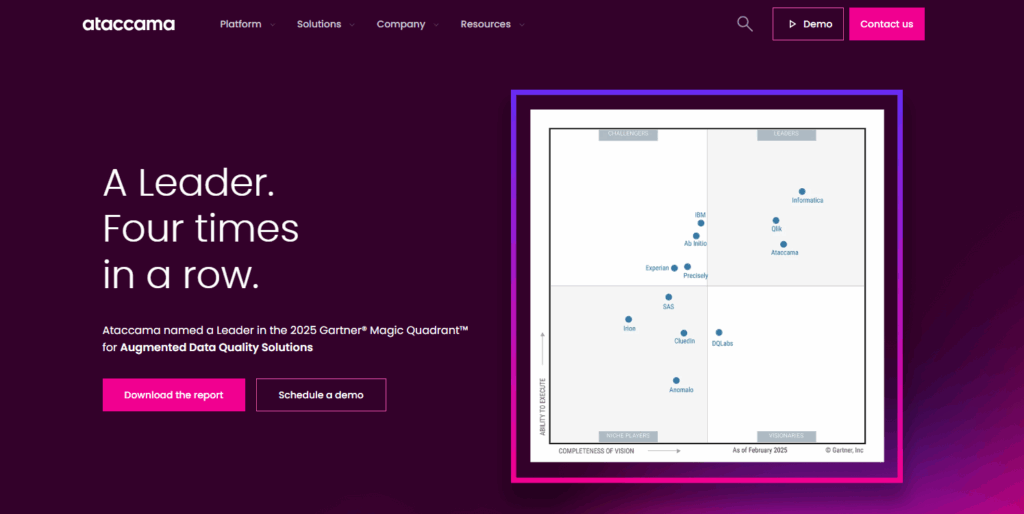
Ataccama is a unified data management platform that automates quality, governance, and discovery to support accurate, compliant, and AI-ready data.
Its Ataccama ONE platform brings together data cataloging, master data management, and observability in a single environment.
Powered by ONE AI, it applies machine learning to monitor, remediate, and enrich data to help enterprises establish and maintain trusted data foundations across complex, hybrid systems.
Key features:
- Ataccama ONE: Integrates cataloging, governance, quality, and master data management into one platform.
- ONE AI: Automates discovery, classification, and remediation for faster, AI-driven insights.
- Data quality: Performs automated checks, monitoring, and correction to maintain trusted data at scale.
- Master Data Management (MDM): Consolidates fragmented data into a single, consistent 360-degree view.
- Data catalog: Enables automated discovery, organization, and enrichment with embedded quality tracking.
- Data observability: Detects anomalies, validates data integrity, and issues proactive alerts for continuous reliability.
Best For: Enterprises requiring integrated data management solutions.
Pricing: Custom pricing available upon request.
| Pros | Cons |
| Strong data profiling and quality-assurance capabilities with accessible reporting. | Limited compatibility with some external data-modifying technologies. |
| Easy deployment supported by intuitive, drag-and-drop workflows. | Generating multiple profiling reports can be time-consuming. |
| Ataccama ONE Platform aligns well with data governance through its workflow structure. | Integration with third-party tools may require additional configuration. |
| Responsive customer support and implementation assistance. | Terminology used in data-quality checks can be complex for less technical users. |
How to choose the best data discovery tool for your organization
The data discovery platform you choose will shape how your organization manages, secures, and uses information. The best solutions balance visibility, compliance, and performance. They enable teams to use data confidently while maintaining governance standards.
Focus on the following criteria to make a choice that aligns with both your operational needs and privacy requirements.
Scalability
Choose a platform that meets current data demands and scales effortlessly as volumes and use cases expand. Consider its ability to scale vertically to handle higher data loads as well as horizontally to add new nodes or environments. Performance should remain consistent as workloads increase so that you have reliable data access and analysis at any scale.
Automation
Prioritize tools that automate data discovery and classification to reduce both manual effort and human error. Built-in scheduling should keep data inventories current, while machine learning capabilities can enhance accuracy and efficiency over time.
Compliance coverage
Look for a solution that supports key regulatory frameworks such as the GDPR, HIPAA, and the CCPA. Comprehensive audit trails and automatic data classification are essential for maintaining transparency and proving compliance during audits.
Integration capabilities
Effective discovery tools integrate seamlessly with your existing data infrastructure, including databases, cloud environments, and analytics platforms. Robust API support enables customization, automation, and interoperability with Cloud Management Platforms for unified governance.
User experience
A clear, intuitive interface empowers teams across technical levels to use the tool effectively, which is particularly important during implementation. Strong reporting and visualization capabilities also help translate complex data insights into actionable decisions.
Cost considerations
Evaluate the total cost of ownership rather than licensing alone. Factor in subscription fees, implementation, maintenance, and training costs to prioritize long-term scalability and value.
Vendor support and reputation
Look for vendors with proven reliability, responsive customer service, and comprehensive onboarding resources. Check independent reviews and case studies to see how effectively the tool performs in real-world enterprise environments.
Security features
Data discovery tools should uphold the highest security standards. Encryption, access controls, and data masking protect sensitive information, while incident-response capabilities enable fast breach detection and containment.
Trial and evaluation
Whenever possible, run a proof of concept to see how the platform performs in your environment. A guided trial or demo helps you to verify ease of use, integration quality, and alignment with your governance objectives before you commit.
Combine data discovery with consent management for full compliance
Data discovery alone isn’t enough to meet ever-evolving privacy expectations. Once your organization knows what data you have and where it lives, the next step is keeping its use lawful and transparent.
The Usercentrics Consent Management Platform (CMP) enables organizations to collect, manage, and document user consent in accordance with regulations such as the GDPR and CCPA. By embedding consent management into every stage of data use, companies maintain lawful processing, uphold transparency, and give individuals clear control over their information.
When combined with data discovery, the Usercentrics CMP forms a unified framework for responsible data management, linking visibility with accountability. Together, these capabilities help organizations protect privacy, strengthen compliance, and use data with confidence in an increasingly regulated digital landscape.

Join our growing community of data privacy enthusiasts now. Subscribe to the Usercentrics newsletter and get the latest updates right in your inbox.
