
Across industries, personal data underpins everyday business operations. This information shapes customer relationships, marketing strategies, and technical decisions. But when that data isn’t handled transparently or securely, it can erode trust and put operations at risk.
A GDPR audit helps you understand how well your organization protects personal data. More than a compliance checkpoint, it’s a diagnostic tool. A good audit uncovers how data enters and moves through your systems, how controls actually work in practice, and where accountability can be strengthened.
Done regularly, a GDPR audit builds confidence. Not just in your ability to meet regulatory requirements, but in how your business handles personal information with integrity.
Key takeaways
- A GDPR audit evaluates whether your data processing activities comply with the regulation’s requirements and identifies areas for improvement.
- Regular audits help you avoid fines, build trust with customers, and maintain operational clarity and rigor around data handling.
- The audit process covers data mapping, consent mechanisms, security measures, data subject rights, vendor compliance, and documentation practices.
- Internal teams can handle routine audits, but external experts can add objectivity and specialized knowledge for more detailed reviews.
- Audit frequency depends on your risk profile, but conducting an annual GDPR review is standard.
What is a GDPR audit?
A General Data Protection Regulation (GDPR) audit is a systematic review of how your company collects, processes, stores, and protects personal data. It measures your practices against the regulation’s requirements to identify gaps, assess risks, and define corrective actions.
The audit examines every stage of the data lifecycle:
- Where does data enter your systems?
- Who has access?
- How long do you keep it?
- What happens when someone revokes consent or requests deletion?
These questions demonstrate whether your operations match your stated policies and legal obligations.
Are audits required by GDPR?
The GDPR doesn’t explicitly mandate audits in the way it requires consent or privacy notices. However, Art. 24 GDPR requires controllers to “implement appropriate technical and organizational measures” to demonstrate compliance. Art. 32 GDPR adds requirements for regular testing and evaluation of security measures.
This means companies need a way to prove their compliance measures work. For most organizations, that proof comes through regular audits. Without them, you’re claiming compliance without evidence.
Some industries face additional requirements. If you process large volumes of sensitive data, conduct regular monitoring of individuals, or operate as a public authority, you may need to appoint a Data Protection Officer (DPO) under Art. 37 GDPR. That role typically includes overseeing audit activities.
However, even when not legally required, a data protection audit benefits companies. It can reduce liability, improve operational efficiency, and demonstrate good faith to regulators if issues arise.
What are the objectives of a GDPR compliance audit?
At its core, a GDPR audit program aims to verify regulatory compliance, but the value it brings extends beyond regulatory boxes.
- Assess data processing activities: A GDPR audit will highlight whether a company is following and enforcing GDPR data subject rights and whether third parties are abiding by them as well.
- Identify and close compliance gaps: A data protection compliance audit shows where your practices fall short of GDPR requirements. Maybe a cookie consent banner doesn’t meet information or UX standards. Or perhaps your data retention periods exceed stated policies. A GDPR internal audit highlights those blind spots.
- Assess and mitigate risk: Not all compliance gaps carry equal weight. An audit helps you prioritize based on data sensitivity, processing volume, and potential harm.
- Document due diligence: If regulators investigate, you need evidence of good-faith compliance efforts. Audit records show you’re actively monitoring and improving your practices, which can influence enforcement decisions.
- Improve data governance: A GDPR audit often uncovers operational inefficiencies. For instance, redundant or excessive data collection, unclear ownership, or outdated processes can be surfaced. Addressing this improves both compliance operations and business performance.
- Build stakeholder confidence: Customers, partners, and investors care about data protection and privacy compliance. A systematic audit approach signals that privacy is a priority, not an afterthought.
Key areas to assess during a GDPR audit
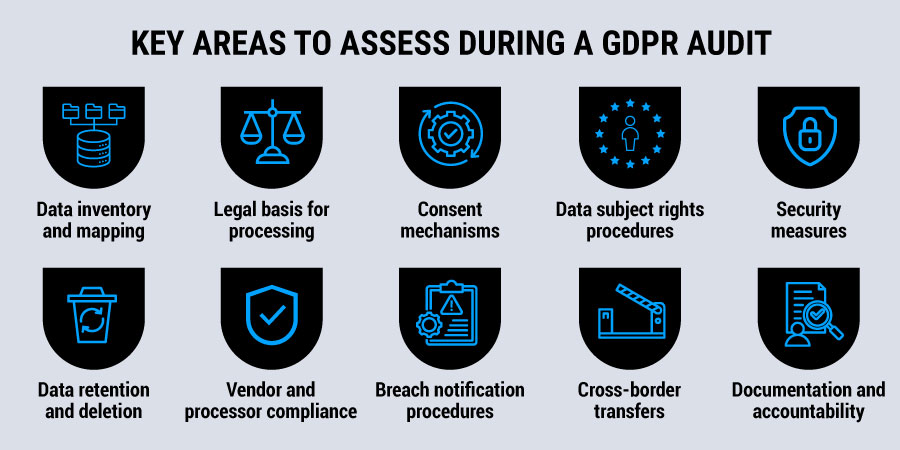
Once you know your goals, the next step is to understand what to review. A good GDPR audit connects all the moving parts of the data lifecycle and management into one overview, and helps you build a complete picture of regulatory compliance.
Data inventory and mapping
You need to know what personal data your company holds, where it’s stored, how it flows through your systems, and who has access. This includes data you collect directly and information received from third parties. Without an accurate data map, other audit areas lack a foundation to proceed from.
Legal basis for processing
Every data processing activity needs a legal basis under Art. 6 GDPR. Are you relying on consent, contractual necessity, legal obligation, vital interests, public task, or legitimate interests? The legal basis must be documented and appropriate for each processing purpose.
Consent mechanisms
When you rely on consent, it must be freely given, specific, informed, and unambiguous. Your audit should verify that consent requests are clear, that withdrawal is as easy as granting consent, that data processing stops upon withdrawal of consent, and that consent records are accessible.
Data subject rights procedures
The GDPR grants individuals rights to access, rectification, erasure, processing restriction, data portability, and objection to processing. A GDPR audit checks whether you can fulfill these rights within the required timeframes and whether procedures are documented and tested.
Security measures
Art. 32 GDPR requires appropriate technical and organizational measures based on risk. The audit assesses encryption, access controls, incident response plans, employee training, and regular security testing.
Data retention and deletion
You can only keep personal data as long as necessary for its stated purpose. A GDPR compliance audit verifies that retention periods are defined, documented, justified, and enforced through automated deletion where possible.
Vendor and processor compliance
Third parties that process data on your behalf must also meet GDPR standards. A data protection compliance audit reviews vendor contracts, data processing agreements, due diligence processes, and ongoing monitoring.
Breach notification procedures
You have 72 hours to report certain breaches to supervisory authorities. A data protection audit tests whether you can detect, assess, document, and report breaches within this window.
Cross-border transfers
Moving data outside the EU requires appropriate safeguards like Standard Contractual Clauses (SCC) or an adequacy decision. A GDPR audit maps international data flows and verifies transfer mechanisms.
Documentation and accountability
Art. 5(2) GDPR requires you to demonstrate compliance. A GDPR compliance audit reviews privacy notices, policies, training records, data processing agreements, and Records of Processing Activities (RoPA) to ensure all documentation is complete and current.
Your GDPR audit checklist: Step-by-step guide
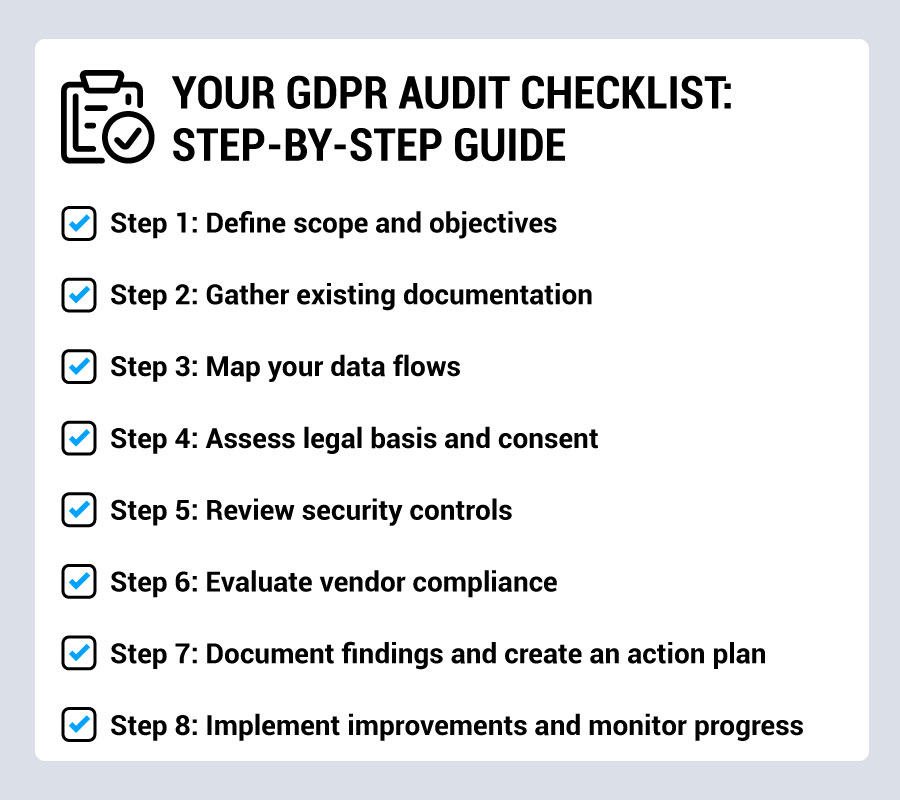
Once you’ve identified the main compliance areas to review, structure becomes critical. A well-planned process turns your audit into a practical assessment. One that helps you understand how data protection functions across the business and where accountability needs to improve.
Step 1: Define scope and objectives
Clarify what the audit is designed to achieve and which operations it will cover. Whether that’s a single product, department, customer base, or the organization as a whole, set parameters that balance focus and relevance. Clear scope creates direction and prevents duplication later.
Document the scope and objectives and share them with stakeholders, so expectations are aligned before work begins.
Step 2: Gather existing documentation
Collect all materials that describe how data protection and privacy compliance activities currently work in practice. This includes privacy policies, consent forms, vendor contracts, data processing agreements, records of processing activities, and security or incident response policies.
Review them for accuracy and consistency — outdated or incomplete documentation often signals broader compliance gaps.
Step 3: Map your data flows
Document how personal data moves through your organization, from collection to deletion.
Identify all entry points, such as websites, apps, customer interactions, and partner integrations. Track where data is stored, who has access, and how it’s shared internally or externally.
Data mapping can uncover shadow systems or legacy processes that may create hidden risks, making it one of the most revealing stages of an audit.
Step 4: Assess legal basis and consent
For each processing activity, verify that you have a valid legal basis. If you’re relying on consent, examine how you obtain it. Are consent requests separate from other terms? Do users actively opt in? Can they withdraw easily?
Also, check consent records. Can you prove when someone consented and to what? If you can’t produce this evidence, your legal basis is weak, regardless of what your consent banner says.
Step 5: Review security controls
Evaluate whether your technical and organizational safeguards are in line with Art. 32 GDPR requirements. To do this, check that encryption standards, access controls, and authentication measures match the sensitivity of your data.
In addition, assess your incident response processes, including how quickly breaches could be detected and reported.
Lastly, interview IT, security, and/or compliance teams to understand how often testing, patching, and employee training occur.
Step 6: Evaluate vendor compliance
List all vendors that process personal data on your behalf. Review each data processing agreement to ensure it meets Art. 28 GDPR requirements. The agreement should specify processing instructions, security obligations, sub-processor provisions, and audit rights.
Also, check that you’ve conducted due diligence on each vendor’s security and compliance posture. For critical vendors, consider requesting evidence like SOC 2 reports or ISO certifications.
Lastly, check whether vendors have sub-processors and if you’ve been notified about them. Review how you’d respond if a vendor suffered a data breach.
Step 7: Document findings and create an action plan
Once you have a clear picture, compile everything into a clear audit report. Organize findings by severity: critical gaps that create immediate compliance risk to be addressed, moderate issues that need attention within a defined timeframe, and minor improvements that enhance your overall compliance standing.
For each finding, document the current state, the required state, the compliance risk, and recommended remediation. Be specific. “Improve consent mechanism” is too vague. “Update consent banner to include separate toggles for each processing purpose and implement a database to store time- and date-stamped consent records” is actionable.
Don’t forget to create a timeline for remediation. Assign owners to each action item and define how you’ll verify completion.
Step 8: Implement improvements and monitor progress
A GDPR audit is only valuable if it drives change. Prioritize critical findings and start remediation immediately. For complex changes, break them into phases with clear milestones.
Establish regular check-ins to track progress and address roadblocks quickly, whether they’re resource constraints, technical challenges, or competing priorities.
Lastly, document your remediation efforts. This creates evidence of continuous improvement, which matters if regulators ever review your regulatory compliance program.
Who should conduct a GDPR compliance audit?
Who performs a GDPR audit depends on your company’s scale, complexity, and independence needs. For instance, internal teams understand systems and culture best, making them suitable for routine reviews. However, they may lack distance or specialized expertise for complex risk areas.
If your organization has a Data Protection Officer, they should oversee, but not directly conduct, the audit. Their role is to ensure consistency and impartiality.
External specialists provide objectivity and technical depth. They’re particularly valuable for detailed assessments or when external validation is needed.
Therefore, many organizations combine both approaches: internal teams for ongoing monitoring and external experts annually to ensure thoroughness and objectivity.
What matters most is credibility. Audits only add value when findings are trusted, transparent, and actionable.
When and how often should you do a GDPR compliance audit?
The GDPR doesn’t prescribe a frequency, but annual audits have become the standard. For organizations handling large or sensitive volumes of personal data, quarterly reviews may be more appropriate.
Beyond set intervals, audits should also follow key business changes, like launching new products, adopting new technologies, expanding into new markets, or following a security incident. Trigger-based reviews keep GDPR compliance aligned with reality.
The first audit often takes the most effort, but it establishes a baseline and the foundation for future efficiency. Once documentation, data flows, and ownership are clear, subsequent reviews become faster and more focused.
Tools to simplify a GDPR audit
Even with strong internal processes, GDPR audits can quickly become complex, and maintaining oversight manually can lead to inconsistencies or gaps. The right tools give privacy teams a single source of truth, making it easier to manage compliance continuously rather than starting from scratch each year.
Data mapping and documentation tools
These tools identify where personal data lives across your organization, how it moves, and who has access. They visualize data flows, highlight potential risk points, and keep your RoPAs up to date.
Having this visibility is essential for any audit. You can’t assess compliance without first knowing what data exists and where it goes.
Learn about the top 6 data mapping software tools for 2025.
Consent management platforms (CMP)
A consent management platform (CMP) manages how you collect, store, and prove user consent, which is a critical part of GDPR compliance. It helps to ensure that tracking technologies and tracking cookies are only activated once valid consent is given, and that users can withdraw consent just as easily.
For instance, Usercentrics CMP centralizes all consent data, providing verifiable records of who consented, to what, and when. This becomes a key piece of evidence during an audit, demonstrating your lawful basis for processing in practice, not just on paper.
Automated compliance and monitoring solutions
Automation tools go beyond documentation. They continuously check for policy changes, vendor updates, or new data transfers that could affect compliance. By flagging risks early, they reduce manual review effort and help you maintain an audit-ready state all year long.
Learn about the top 15 compliance automation software solutions for 2025.
How Usercentrics helps you stay GDPR-compliant
Consent mechanisms and their results are often the most visible — and the most frequently audited — part of GDPR compliance. Many organizations struggle to prove when and how consent was collected or whether it remains valid.
Usercentrics addresses this challenge at its core. The platform enables you to provide consent banners and mechanisms that meet GDPR requirements from implementation, capturing clear records, and providing users with meaningful choices. It automatically logs every interaction, creating a full audit trail that’s easy to retrieve when needed.
So when audit season arrives, the documentation already exists. Your systems generate it automatically as part of normal operations.

Join our growing community of data privacy enthusiasts now. Subscribe to the Usercentrics newsletter and get the latest updates right in your inbox.
