

If your website uses cookies, you need to comply with the requirements of privacy laws. That’s pretty straightforward and common knowledge.
However, cookie compliance isn’t about ticking boxes or displaying a cookie banner because everyone else has one. It’s about understanding what data you’re collecting and for what purposes, being transparent with your website visitors, and giving them control over their information.
To add to this, different regions have different rules, but the foundation stays the same: clarity, consent, and respect for user choices. We’ve broken down what cookie compliance is, why it’s required, how requirements differ across regulations, and how to achieve and maintain it in a user-friendly way.
Key takeaways
- Cookie compliance means following privacy law requirements when collecting, storing, and processing user data through cookies.
- Many privacy regulations require obtaining valid user consent before placing non-essential cookies, and others require enabling easy opt-outs.
- The GDPR and CCPA have different requirements, but both prioritize user control and transparency.
- Cookie compliance banner content ranges from information-only to opt-in or opt-out consent, depending on your jurisdiction.
- Maintaining cookie compliance requires regular cookie audits, proper consent implementation, and accurate documentation.
What is cookie compliance?
Cookie compliance is about managing the tracking technologies in use on your website according to the requirements of relevant privacy laws. At its core, it requires three things:
- Transparency about what cookies you use
- Clear information about why you use them (and the effects if they’re blocked)
- Respect for users’ choices about accepting or declining their use
The specific requirements vary by region, but these underlying principles stay consistent. Users should understand what data you’re collecting, how you use it, and they should have control over these functions.
Why is cookie compliance required?
Privacy regulations have evolved from regional experiments to global standards. The EU’s General Data Protection Regulation (GDPR) set the precedent in 2018, and now California’s Privacy Rights Act (CPRA), Brazil’s Lei Geral de Proteção de Dados (LGPD), and Canada’s Personal Information Protection and Electronic Documents Act (PIPEDA), among other regulations, all enforce requirements around cookie usage and consent. More regions add their own frameworks each year.
The regulatory landscape makes the need to comply unavoidable if you operate across markets. But there’s a more compelling reason to prioritize it: user trust. People engage more with brands that respect their privacy.
They know their data has value, and they want control over access to it. They’re more likely to share information, complete purchases, and become repeat customers when they believe you’re handling their data responsibly.
Therefore, transparency about cookies isn’t just a legal requirement — it’s a competitive advantage for sustainable business.
What are the different types of cookie compliance banners?
Cookie compliance banners come in several forms, each designed for different regulatory requirements and user expectations. Choosing the right approach depends on where your users are located and which laws apply to your operations.
Information only

An information-only banner simply notifies users that your site uses cookies. It doesn’t request consent or provide controls; it only discloses the practice.
This approach works only in jurisdictions with minimal cookie regulations and is generally not compliant with most privacy regulations, including the GDPR.
It’s not common for websites to only use necessary cookies, and even in jurisdictions where prior consent is not required in most cases, easy opt-out must be enabled, so this cookie consent notice is rarely used.
Soft opt-in

Soft opt-in banners assume consent unless users actively object. They typically include a message like “By continuing to browse, you accept our use of cookies” with a link to settings or more information.
This model is declining in viability as privacy laws increasingly require explicit consent rather than implied agreement through continued browsing.
Opt-out consent
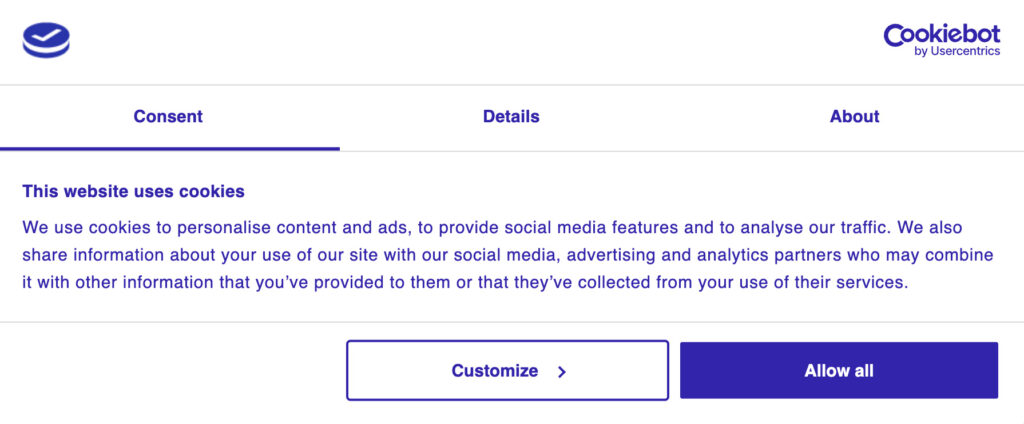
Opt-out banners allow cookies to run by default, but give users the ability to disable them. This approach aligns with California’s CPRA requirements, which focus on the right to opt out of data sales and sharing, as well as profiling and targeted advertising, rather than requiring opt-in consent. Users can click a “Do Not Sell or Share My Personal Information” link — which must be easily accessible — to exercise their rights.
The opt-out model works in jurisdictions where cookie consent compliance centers on disclosure and control rather than prior consent. However, it doesn’t satisfy GDPR requirements, or those of other jurisdictions using an opt-in consent model, for most tracking activities.
Opt-in consent
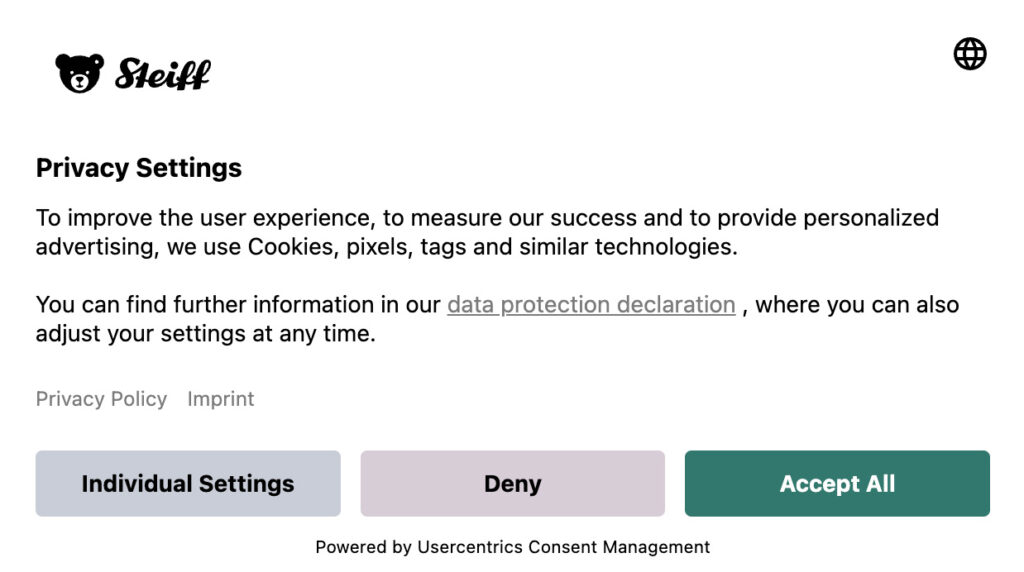
Opt-in banners are the strictest type, requiring users to actively accept cookies before they’re placed. In practice, this model blocks all non-essential cookies until the user clicks “Accept” or selects specific categories they allow. GDPR cookie compliance requires this approach for any cookies that aren’t strictly necessary for site functionality.
Opt-in consent gives users the strongest protection and clearest control. It’s also the most challenging to implement because it requires blocking cookies at the technical level and may reduce initial data collection rates.
It’s also necessary to be able to signal users’ consent choices over time throughout the marketing ecosystem to control third-party services, like for advertising or analytics.
Mixed consent
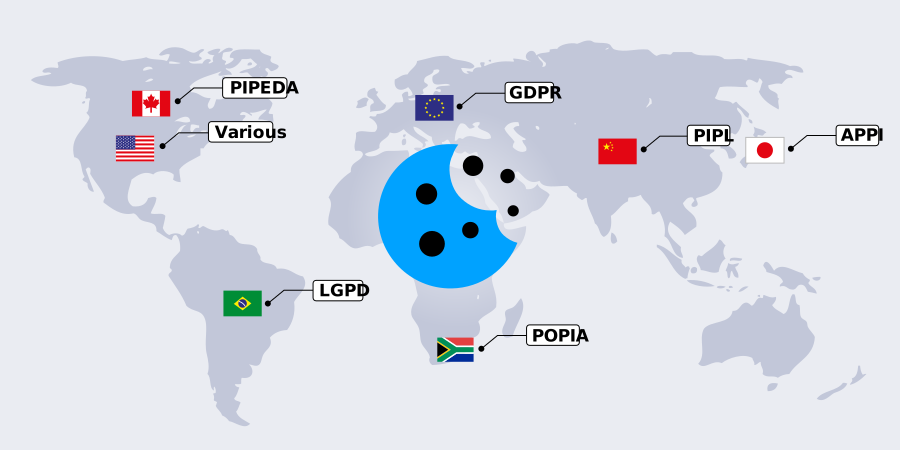
Mixed consent combines different approaches based on a user’s location. For instance, European visitors might see an opt-in banner to satisfy GDPR requirements, while California users see an opt-out banner aligned with CPRA expectations. Visitors from less-regulated markets (of which there are fewer every year) get information-only notices.
This geolocation-based approach lets you tailor cookie compliance to specific legal frameworks without applying the most restrictive requirements globally. However, it requires some technical implementation and a solution with geolocation functionality to detect user location accurately and serve the appropriate banner reliably.
What are GDPR cookie compliance requirements?
The GDPR sets comprehensive standards for GDPR cookie compliance across the European Union. These requirements extend beyond simple disclosure; they mandate specific consent mechanisms and user rights.
Valid consent under the GDPR must be:
- Freely given: Users can refuse without penalty or loss of service for non-essential cookies
- Specific: Consent applies to particular purposes, not blanket approval for all tracking
- Informed: Users must understand what they’re consenting to through clear, accessible information
- Unambiguous: Consent requires an active opt-in action, not implied agreement or pre-ticked boxes
Essential cookies, those required for basic site functionality like shopping cart management or user authentication, don’t require consent. However, everything else does. This includes analytics cookies, advertising trackers, social media integrations, and personalization technologies.
Your website cookie notice must list every cookie, identify its controller (which often includes third-party vendors), explain its purpose, and specify its duration. Generic descriptions like “improves user experience” don’t meet the standard. You need precise explanations of what data each cookie collects and how it’s used.
The GDPR also requires that withdrawing consent must be as easy as giving it. Users should be able to fully revoke consent or change their preferences at any time through an accessible settings interface. When they withdraw consent, you must stop using those cookies immediately, and stop processing and delete data collected under the previous consent where feasible.
Lastly, record-keeping requirements mean you need proof that consent was obtained, including when it happened, what was consented to, and how users provided it.
This documentation protects you in a regulatory audit and demonstrates your commitment to GDPR-compliant cookie policy practices. It also needs to be provided to users who make a data subject request.
What are CPRA/CCPA cookie compliance requirements?
California’s privacy framework takes a different approach from GDPR. The California Consumer Privacy Act (CCPA) and its successor, the CPRA, emphasize transparency and the right to opt out rather than requiring prior opt-in consent.
Under CCPA cookie compliance requirements, you must disclose what personal information you collect, including through cookies, and provide a “Do Not Sell or Share My Personal Information” link if cookies enable data sales or sharing with third parties for advertising purposes.
The CPRA expanded these requirements in several ways. It broadened the definition of sharing to include disclosures for cross-context behavioral advertising, even if no money changes hands.
It also requires businesses to honor universal opt-out mechanisms like Global Privacy Control (GPC), browser signals that communicate a user’s privacy preferences automatically.
Discover the key differences between the CCPA and the CPRA.
Key CCPA/CPRA requirements include:
- Clear disclosure of what categories of personal information are collected by cookies
- Explanation of how that data is used, sold, or shared
- Conspicuous link to the opt-out mechanism on your homepage
- Respect and act on user opt-out requests within 15 business days
- No discrimination against users who exercise opt-out rights
You need to maintain records of consumer requests and your responses, and provide an accessible way for users to verify their opt-out status.
However, unlike the GDPR, the CPRA doesn’t require blocking cookies before user interaction, unless you’re collecting sensitive data or data belonging to children. You can set them by default as long as you provide working opt-out mechanisms and honor those choices promptly.
Other privacy laws related to cookie compliance
Although frequently mentioned, the GDPR and the CPRA are not the only privacy regulations requiring cookie consent. More and more legal requirements that cover cookie use are in effect or will be soon.
EU’s ePrivacy Directive
The ePrivacy Directive predates GDPR but works alongside it. Often called the “Cookie Law,” it requires consent before storing or accessing information on a user’s device, with exceptions for technically necessary cookies.
It is not an EU-wide regulation; EU Member States have implemented its provisions with their own variations, but the core requirement remains consistent: get consent before using non-essential cookies and ensure people can opt out.
Several regulations affect companies doing business in the EU beyond the GDPR. Here’s an overview of country-specific rules and requirements.
Brazil’s General Data Protection Law (LGPD)
Brazil’s LGPD shares similarities with the GDPR, requiring consent for personal data processing unless another legal basis applies. Cookies that identify individuals or enable tracking require either consent or a legitimate interest justification with appropriate safeguards.
The approach mirrors European requirements closely enough that GDPR-compliant practices often satisfy the LGPD as well.
South Africa’s Protection of Personal Information Act (POPIA)
South Africa’s Protection of Personal Information Act follows a similar path, requiring consent for processing personal information unless another lawful basis exists. Cookie compliance under POPIA focuses on transparency about collection purposes and respecting user objections.
Canada’s Personal Information Protection and Electronic Documents Act (PIPEDA)
Canada’s PIPEDA requires meaningful consent for collecting personal information, also mandating clear disclosure, including for tracking technologies that collect identifiable information.
Beyond these regions, other markets are starting to adopt GDPR-style consent rules. Countries like Australia, India, and parts of Asia-Pacific have or are introducing regulations that require transparency and user choice, signaling a global shift toward stricter cookie compliance.
Under the Australia Privacy Act, for example, the seventh of the 13 Australian Privacy Principles (APP) is explicitly about direct marketing, including cookies and their use.
The pattern across these laws is clear: provide transparency about what you’re collecting, why you’re collecting it, and give users control over whether you can proceed. A cookie compliance tool can help handle these requirements and simplify operations across multiple jurisdictions without forcing you to reinvent your approach for each market.
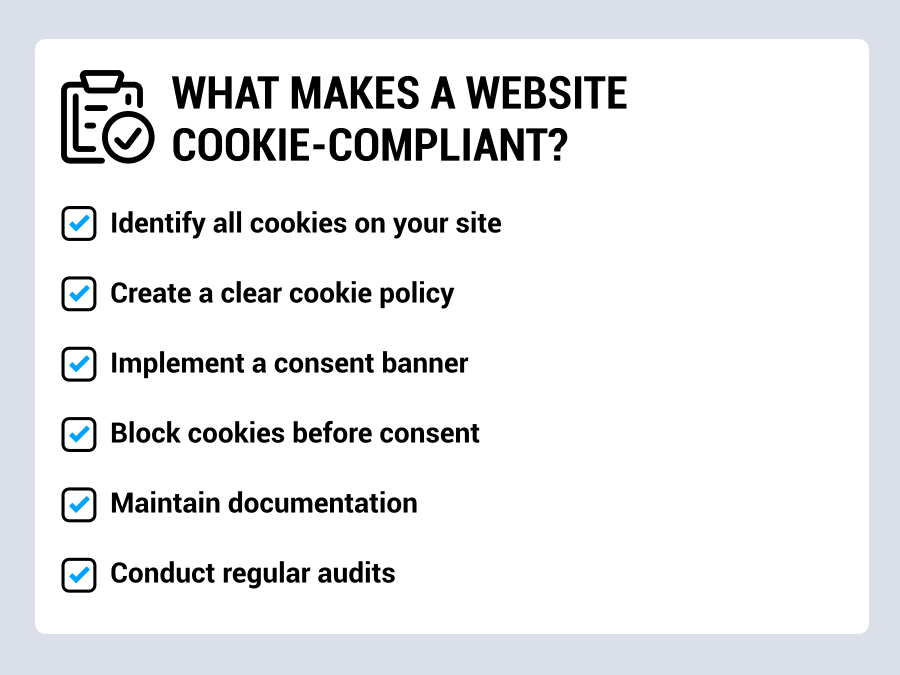
What makes a website cookie-compliant?
Website cookie compliance depends on several interconnected elements working together. Getting each piece right enables you to meet regulatory requirements while maintaining a user-friendly experience.
Identify all cookies on your site
Many websites use more cookies than they realize. Third-party integrations like analytics platforms, advertising networks, or embedded content often place their own tracking cookies without explicit permission from site owners, and if they’re nested, it impedes visibility. You need complete visibility into what’s running on your site before you can manage it properly.
Therefore, start with a scan that identifies every cookie and tracking technology placed on your site. This inventory becomes the foundation for everything else. Because you can’t disclose what you don’t know exists, and you can’t block what you haven’t identified.
The scan should capture technical details: cookie names, domains, purposes, durations, and whether they’re first-party or third-party. This information feeds directly into your cookie policy and consent banner configuration.
Create a clear cookie policy
Your cookie policy translates technical details into language users can understand. It should list each cookie by name, explain what data it collects, specify who controls it, and state how long it persists. Generic descriptions like “enhances functionality” don’t meet regulatory standards — you need precise explanations tied to actual purposes.
Your policy also needs to explain user rights: how to accept or reject cookies, how to change preferences later, and how to contact you with questions. Link this policy prominently from your consent banner and footer, so users can access it easily.
Implement a consent banner
Your cookie banner or cookie pop-up is where cookie compliance becomes visible. It needs to present choices clearly, enable granular control over different cookie categories, and block non-essential cookies until consent is granted. Pre-ticked boxes don’t constitute valid consent under the GDPR, and consent must be as easy to withdraw as it is to give.
The banner should categorize cookies logically, typically into necessary, analytics, marketing, and personalization groups. Users should be able to accept all, reject all, or customize their preferences through an accessible settings interface.
Your cookie banner design matters too: make choices equally prominent rather than highlighting “Accept All” while minimizing or hiding rejection options. In addition, a well-designed banner not only meets legal requirements but also improves user experience.
Clear options and logical categorization encourage trust and increase the likelihood that users will provide consent and return, rather than abandoning the site due to frustration or privacy concerns.
Block cookies before consent
Technical implementation is where many cookie compliance efforts fail. To manage this, it’s best to implement a consent management platform. It gives you a full overview of the cookies on your website, helps you create a customized cookie banner, and prevents non-essential cookies from firing before users give consent.
Server-side tag management takes this a step further. By routing all tracking through your own infrastructure, you decide exactly which scripts fire and when. This setup enforces consent rules consistently and keeps third-party scripts from loading independently.
Maintain documentation
If your company gets audited, you need proof that you consistently obtain and manage valid consent. Therefore, it’s important to have a system to capture timestamps, consent scope, IP addresses, or user identifiers, and the specific version of your privacy policy users agreed to. This audit trail becomes critical if regulators request proof of compliance or if users later dispute what they consented to.
The documentation also helps you track consent rates, identify friction points in your banner design, and demonstrate compliance efforts to stakeholders. This can be automated using a consent management solution.
Conduct regular audits
Cookie compliance isn’t static. Your website evolves whenever you add new features and integrations that often introduce new cookies. Additionally, third-party services can update their tracking technologies without notifying you. Regular scans catch these changes and enable you to adapt before they become violations.
Schedule automated audits monthly or quarterly, depending on how frequently your site changes. Compare new scans against your baseline to identify additions or modifications. Update your cookie policy and consent banner configuration to reflect changes so your disclosures stay accurate as your technology stack evolves.
What are the consequences of cookie noncompliance?
The financial impact of noncompliance can be significant. GDPR penalties have reached tens of millions of Euros for companies that failed to obtain valid consent or mishandled user data.
In the U.S., California’s Attorney General can issue CCPA fines up to USD 7,500 — adjusted to the Consumer Price Index, so currently USD 7,988 — per intentional CCPA violation.
While these penalties are smaller than those under the GDPR, they can still add up quickly when thousands of users are affected. Enforcement activity at the state level has also increased in recent years.
However, the costs extend beyond fines. Investigations, documentation requests, and remediation efforts all consume time and resources, while legal fees can escalate rapidly.
In addition, reputational damage can be even more harmful. Privacy violations are public, and users are increasingly aware of how their data is handled and if it’s accessed by unauthorized parties. When websites make it difficult to give or withdraw consent, it erodes trust and creates friction that pushes potential customers away.
Cookie compliance builds trust
Cookie compliance is more than a checkbox exercise; it’s an ongoing process of transparency, control, and respect for user privacy. From identifying cookies and creating clear consent banners to maintaining documentation and audits, every step plays a role in protecting both your users and your business.
With the right tools, staying cookie-compliant doesn’t have to be complicated. Automating cookie scans, consent management, and up-to-date documentation keeps your site aligned with regulations and builds trust with every visitor.
Join our growing community of data privacy enthusiasts now. Subscribe to the Usercentrics newsletter and get the latest updates right in your inbox.
